Software
Houzz Logo Print
rosesix

japanese maple

11 years ago

I have a japanese maple, it was here when we moved (10 years ago). It is situated between the house and small pond. the last couple of years it starts off great in the spring and as it gets warmer the lower branches leaves turn brown and shrivel up. the upper ones stay somewhat red. We live in St. Louis, Mo area. Do I need to give it some fertilizer? Its lovely but not for long. It is currently starting to burst into little red buds, and looks healthy, but it won't last long. Please advise.

Comments (16)

  • 11 years ago

    A picture would help.
    Is there a lot of shade?
    Mike


  • 11 years ago

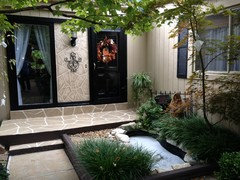
    I hope the pic came thru. Shade and Sun about equal. Thanks for your efforts.

  • 11 years ago


  • 11 years ago

    Looks like it's haunted


  • 11 years ago

    Shade could be a problem affecting the density. Drainage and poor soil might be a contributing factor also.
    Have you done some exploratory digging? That's what I'd do.
    Mike


  • 11 years ago

    I had to look really hard at the photo to understand that last response. Funny!


  • 11 years ago

    Yes, that was a good one, tj!
    Maybe the roots from the maple, whose limb is showing at the top of the picture, is giving the Japanese maple a difficult time. Plus the shade, and you have problems. Maybe a branch or two can be removed from the larger maple to let more light in.
    mike


  • 11 years ago
    Thanks. I will try that. Had torrential rains and hail yesterday. I did get a moisture/ph meter and it showed moisture to be ok but ph low before the rains
    . I have a name of an arborist to do some trimming will ask him.
  • 11 years ago

    If you have a cement foundation, beware of lime leaching into the surrounding soil. Try adding some MirAcid (the blue box) diluted in water. Epsom salts also dissolved in water might perk up your tree.

    Shriveled up leaves typically denote a lack of moisture. Many areas close to the house don't get as much rain as we'd like to think, especially as sheltered as your tree is. So definitely keep an eye on the moisture it's actually receiving. I'd also take a garden weevil and loosen up the soil around the tree, giving it a nice top dressing of compost when done.

  • 11 years ago

    Unless you have a magnesium deficiency in the soil, adding Epsom salts will have no effect on the tree one way or the other. It is a gardening myth that this product has some sort of magical beneficial impact on plants.

    And be careful attempting to loosen up the soil around the tree. In fact, I'd advise against it. Japanese maples have a very delicate and sensitive root system, with the bulk located just below the soil surface. Damage to those fine feeder roots can set the tree back and open up opportunities for root pathogens to invade. Best to leave the soil alone and just apply the compost topdressing.


  • 11 years ago
    Thank you all so much. Right now the leaves look beautiful and red. The moisture meter is great. I've had to water it since all the rain. The arborist is trimming and thinning out the red maple to let in more sun
  • 11 years ago
    This is tree now. Looking good.
  • 11 years ago

    I agree with Gardengal, completely.
    Also, not much lime leaches out of a concrete foundation. At least not enough to affect that maple. Where's the water that would leach it out of the concrete? And if the lime would leach out, the concrete would fall apart. That's usually a mortar problem.
    Mike


  • 11 years ago

    I hate to contradict you Mike (you're such a nice guy!), but concrete leaching calcium carbonate out the lime component of its ingredients is well documented. It can happen just by exposure to air (combining with CO2) or with water - rain water, irrigation water, groundwater, etc. This is a process called carbonation and it actually makes the concrete structurally stronger (if unreinforced).

    Concrete is strongly alkaline - around 12.0 - and while most intense with fresh concrete, leaching occurs over the lifetime of the concrete structure. Does this have an effect on soil pH? You bet, but I've yet to read any definitive studies that measure that specifically. If one's soil is only slightly to moderately acidic to begin with, as it is here in the PNW, planting acid loving plants in close proximity to concrete structures (foundations, walkways, driveways, etc.) is very likely to cause less than optimum growth as the higher pH will limit nutrient access. It's very easy to test - just do a pH test of unamended soil taken from a foundation planting bed and compare it to the same test with soil taken from out in the open, well away from any concrete . The foundation bed will have a pH noticeably higher than the open soil.
    Could this affect the maple? Possibly, but it is something that can be easily overcome with an acidic fertilizer like one would use for rhodies and azaleas.


  • 11 years ago

    You're right, Gardengal, leaching does occur. I just haven't seen any noticeable affect from it. Rhododendrons, Japanese maples, etc, growing just fine planted right next to concrete foundations and sidewalks. Testing the ph, like you say, would be the only way to see how much leaching changes the ph. I'm sure it would vary quite a bit depending on a lot of factors. I've always ignored any effect it might have, like most people when they decide where to plant.
    However, mortar leaching from brickwork and the excess mortar left on the ground at the base of the job has been a concern of mine when doing a landscape. Mortar leaches a lot faster than concrete. I always removed the leftover mortar around chimneys and brick walls. I suppose a sealer would eliminate most of the leaching.
    I've poured a lot of concrete over the years and learned right away to wear rubber gloves to prevent the skin on my hands from cracking because of the alkalinity. Peat bog soil, on the other side of the scale, does the same thing. Both only take a few hours to bloody your hands.
    Mike...enjoying Spring.


Sponsored
High Point Cabinets
Average rating: 5 out of 5 stars21 Reviews
Columbus' Experienced Custom Cabinet Builder | 4x Best of Houzz Winner