Software
Houzz Logo Print
peter_clark30

Removing Groundcover

11 years ago

Recently my wife and I moved into my grandparents' old home. To say it needs some fixing up is an understatement. The garden is large, slightly raised, and overgrown. A huge portion is covered in groundcover of some sort. Now, unlike many people, we are actually wanting to remove the groundcover. Long story short, we are having a fence installed and plan to have a narrow garden around the edge and expand the grass area for our dog. This groundcover is tuff stuff though!


Just today I attacked the ground cover with a mix of hand tools (hoe with 2 prong back), a hedge trimmer, string trimmer, and even a mower. The mower is great at clearing the top of it all, but the remaining stems and roots still completely cover the ground and are very hard work to remove with the hoe and by hand. I'm fighting the urge to just hire someone to do this since honestly we can barely afford the fence itself and are still saving up for it.


Are there any tools or methods to attack this stuff that would make it easier or at least quicker? I'm considering renting a gas powered tiller from HomeDepot or buying an electric one, but I don't know how those would do cutting through this stuff. I'm hoping I could then just rake up the chopped bits. How would a professional crew handle this?


I appreciate any advice that can be given. Thank you so much!

Comments (10)

  • 11 years ago

    Many people don't want to hear this but ..... Roundup is what you need. 1-2 applications should do it (depending on the plant). Follow the package directions to Kill it and then dig it out, replace with compost and till it all up. It is very labor intensive to try to manually remove a groundcover. The root systems are designed to spread and survive. Do yourself a favor. The soil probably needs replenishing anyway.

    Peter Clark thanked gardenshine
  • 11 years ago


    Groundcover · More Info

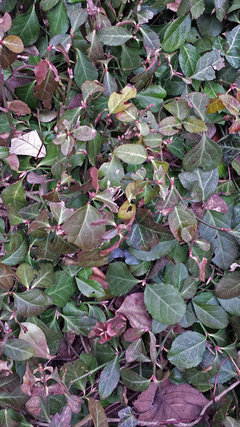
    Here is what the stuff looks like. Maybe a type of jasmine? I'm in Chicago so not sure if that helps narrow it down any. I'm a very very novice gardener so wish I could tell you more. There is also some sort of ivy in a couple of tiny spots (I see 2 leaves in the top right of that photo), but it is in such small amounts I'm not worried about the ivy itself currently.


    Luckily I am finding that the outer perimeter of the yard where the fence will go is strangely a lot easier to clear than the sections closest to the grass. So the area I need cleared right away it looks like I will be able to and then can take my time on the rest which is very very stubborn.


    I have no fear of Roundup and actually have a Costco size bottle of it in my garage currently. I actually got it last year specifically to attack some of this groundcover in another area I needed to raise up by the side of the house. After many applications over a week or two I finally just attacked it by hand. Is there a trick to using Roundup on these types of plants or was I just too impatient for the result?


    As for replenishing the soil, I was planning to mix some compost in before planting anything new surrounded by mulch this time.


    And thank you both for your help!

  • 11 years ago

    The groundcover looks like wintercreeper, Euonymus fortuneii ctvs.

    RoundUp does not work well on this type of plant because the leaves have a waxy cuticle that resists penetration of the herbicide. Ditto with ivy. But it can be effective if you address the cut stems directly with the product.

    From the Missouri Dept. of Conservation: "Vines should be cut by hand and each cut stem sprayed with Roundup (a
    formulation of glyphosate) just after the last killing frost. While the
    Roundup label recommends a 50- to 100-percent concentration of Roundup
    for stump treatment, a 20-percent concentration has proven effective. A
    squirt bottle may be used for spot treatment or individual stumps can be
    painted by hand using a sponge applicator."

    Once the plants are completely dead, I'd still want to remove as much of the root system as possible. To my knowledge, euonymus will not resprout from the root system so you should be able to use the tiller to loosen them for removal.


    Peter Clark thanked gardengal48 (PNW Z8/9)
  • 11 years ago

    Thank you! I had been assuming that Roundup only works on the leaves. This allows me to mow over the trouble areas and then spray them. I can then turn my focus to the most important areas while letting the Roundup take affect. And the part about not resprouting from the root system is some of the best news I've heard! I'll still be ready to attack any of this that tries to come back in the future, but it is a relief to know it won't be as bad as it could be. And the Roundup will hopefully kill those roots anyway.


    Thank you!

  • PRO
    11 years ago

    A hungry goat. All joking aside.....communities in TN have bought a bunch of goats to eat up all the kudzu vines...more than 30 years worth of growth, and they're doing a remarkable, quick job

  • 11 years ago

    Didn't they originally plant kudzu specially to be a cheap food source for goats? Or am I imagining that? I remember growing up in Mississippi and seeing areas of forest completely overgrown by it. Powerful little vine.

  • PRO
    11 years ago

    Hve no idea...before my time, and wasn't in this country until 96....shortly after I moved here I began to see goats on sides of the road in southeastern TN. To me I saw a food source...:) but was told you don't eat goat here....but to keep them alive and they eat everything....they went away for a few years, and now they're back down there eating the kudzu again

  • 11 years ago

    Peter-I removed this same ground cover last summer. It was a nightmare, but I got rid of it entirely and it was WELL established around our patio. I used roundup on the leaves -twice. I waited to see the leaves die, then waited a month and then sprayed all the areas that were still green again. Then came the hard part. The roots of my euonymus were a foot deep and intertwined like you cannot imagine. I went with pruning shears and just tried to cut out as much of the vines above ground that I could. Maybe there was a better tool for this, but this is what I used. Then, I used a shovel and pruning shears to get every last root. I WOULD NOT TILL until you are sure it is dead. I left pieces in the ground and they did start growing new vines. Based on my experience, I would remove it by hand first and wait a while. Then, when you are pretty sure it is dead- then till. It took me one summer, but now I have a great bulb garden. Oh, I cleared an area that was 4' by 10'. Sounds like you may have more-shears might not work for you.


    Peter Clark thanked kfless
  • 11 years ago

    I have most of the important areas mostly cleared now (only can put a couple of hours in here and there). I'm finding using a lawnmower first helps remove a lot of it (and of course compacts it nicely for the yard waste bags) and then I use a hoe with 2 spikes on the back to basically grab the vines and pull them into a pile. In theory I could just mow this pile again, but instead I am mostly just pulling them by hand. I am then going over the remains with roundup. Just got a new bottle with a pump which is a LOT easier on my hand then the old squeeze sprayer I used before. The main area I focused on has just a couple of bits here and there now. Mostly because I haven't done the fine picking up of every strand yet but rather focused on big areas.

    Just for a test run I did try a hand tiller (garden weasel) on a section but wow those roots made it hard. I'm now planning to rent a Mantis XP from Home Depot at the end. There are some roots from bushes I removed in there too so manual I don't think will work without taking forever. My thinking is that if anything survives the tilling, it wouldn't be too hard to target those specific spots by pulling or roundup. Far simpler than trying to remove the roots from a large area. I'm going to pull a number out of you know where, but I would guess in total I will be removing around 500-800 sq feet of the stuff. Hard to tell since it is in several areas and around trees and bushes. My backyard is only around 2500 sq ft total so this will give me a lot of space.

    And go figure now that I am getting this done I am seeing just how much the garden was raised vs the grass. Now I need to level it to extend the grass area some. Since I know it would take me awhile and probably end up lumpy, I'm debating just hiring someone for that. Time to get quotes and save up!

Sponsored
NME Builders LLC
Average rating: 5 out of 5 stars2 Reviews
Remodeling Company in New Albany, Ohio