Software
Houzz Logo Print
strikeraj

range hood dilemma

11 years ago

Hi

I am in ON, canada and I am looking to buy a 36" wall mounted range hood for a 30" RCS range.

I have two of the following options and want to see what you think.

1. Broan E6036SSC

http://www.broan.ca/products/product/267db124-2f29-4375-8259-a95fa22db67a

Pros:

1. Local dealer, easy to get service and part

2. Known brand

Cons:

1. Lower CFM

2. More expensive (about $300 more)

And compare it to this one

2. Kitchenhoods.ca PST-36

http://www.kitchenhoods.ca/range-hoods/professional-series-wall-mounted--p-586.html

Pros:

1. Cheaper (about $300 less)

2. Higher CFM

Cons:

1. Can only order online, store in BC

2. Unsure about quality of hood


What do you think? which one would you choose?

Comments (22)

  • 11 years ago

    I just went through this process of choosing a hood and learned a lot from fellow GWers. There is one member named Kas who is an expert and is extremely helpful. Hopefully he will see this post and help you.


    I would choose the Broan because of the Pros you listed above. What are the total BTUs of the range you are purchasing? Is it a 30 inch range? I would feel more comfortable going with a local company that could provide parts and assistance in the event of an issue. That is worth paying more for in my opinion.


    What type of cooking do you plan on doing? Is the lower cfm enough? I think whether you should go with the lower CFM depends on your answer to this question.

    strikeraj thanked charon70
  • 11 years ago

    @charon70

    Thanks for your reply. It is a 30 inch RCS with 3x 15k btu and 1x simmer buner i am purchasing and my majority cooking is wok cooking. That is the reason why I pick a 24 inch deep and 36 inch wide hood to give me a better capture area. From what I have read and hopefully understood correctly, if I have a larger capture area, I can live with a slightly lower CFM.

    @kas

    Thanks for your advice. I am not sure if BROAN are all made in USA but kitchenhoods.ca is definitely made in China. But since both models are not available locally to see the fit and finish and working (my local BROAN dealers dont have any of the Pro model in store), I am kind of stuck with what is available online. I am hoping someone with actual experience can chime in. But your point about shipping back when there is trouble is definitely valid.

  • 11 years ago

    The larger the aperture area the more total flow rate (CFM) required for the same ability to block effluent from curling out of the hood. (See page 4 of the link for a schlieren image.) This is because capture is local to the impingement area and the velocity at the baffles needs to >roughly< match the rising effluent velocity (up to a meter per second). So, while some other part of the hood isn't doing anything but 'wasting' air flow, we don't have hoods that can self mask to leave open just the areas under impingement.

    Design Guide: Improving Commercial Kitchen Ventilation System Performance

    kas


    strikeraj thanked kaseki
  • 11 years ago

    @kaseki

    Thanks for the info.

    One more thing I should note, the Broan hood is made out of 430 stainless and the kitchenhoods.ca one is made out of 304 stainless. Does it make a difference?

  • 11 years ago

    Features

    • While 430 grade stainless steel is magnetic, 304 grade stainless steel is non-magnetic. Type 430 steel is a less expensive grade of stainless steel that is somewhat difficult to form and weld. Type 304 steel is easier to form and weld than 430 stainless steel.

    Applications

    • Type 430 stainless steel is ideal in the production of automotive trim, the insides of clothes dryers and dishwashers. Manufacturers use 304 stainless steel in the production of kitchen sinks, counter tops, food processing equipment and other equipment regularly exposed to corrosive environments. Type 430 stainless steel is one of the most popular grades of stainless steel.

    Composition

    • Chromium is added to stainless steel, giving the steel corrosion-resistant properties. Type 430 stainless steel is made up of 17 percent chromium and 0.12 percent carbon while 304 stainless steel contains 18 percent chromium and 0.08 percent carbon.


    Read more : http://www.ehow.com/facts_7744463_430-vs-304-stainless-steel.html

  • 11 years ago
    @strikeraj....Are you installing a shelf above your range? I am considering it but I am concerned that it will impact the performance of the hood.
  • 11 years ago

    @eshmh

    Thanks

    @charon70

    Yes I am considering getting the hood with heat lamp and put an ikea wire rack on the back splash. I think a wire rack would not really impact the performance at least for my case since I mostly use the front hob to stir fry in a wok

  • 11 years ago
    last modified: 11 years ago

    Rather surprisingly to me, and I think to the report's authors, a test was performed of a typical wall configuration commercial kitchen cooktop with hood in which a solid shelf was placed to observe the effect. There was little spillage of effluent with this configuration. The schlieren photography showed the flow curling under the shelf to the front edge and then continuing upward. I don't recall if the hood had side skirts.

    This was, however, a commercial configuration where the hood height is typically at seven feet (four feet above the cooktop) and the hood size is typically larger than residential hoods. Flow rate is often higher per square foot of aperture. I'm sorry I do not have a URL for this report, but perhaps it can be found by a sufficiently well tailored search string.

    kas

    strikeraj thanked kaseki
  • 11 years ago

    @kas

    Thanks for the new info.

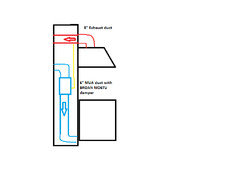
    Actually after reading your info on CKV design, im thinking to do this. Since I will turn on full power of the hood only for the 15 min I am actively stir frying, I think introducing unconditioned make up air should not make the kitchen too cold. What do you guys think?

  • 11 years ago

    bump and see if anyone has comment on the setup above?

    i need to order the parts soon so i really appreciate if someone can comment on it

    thanks

  • 11 years ago

    Strange that I didn't notice this addition to the topic until today.

    I'm not sure the Broan damper can be in that orientation, but I haven't investigated it. A gravity type might have to be in a horizontal duct. At worst there are Honeywell dampers that are pressure or electrically driven that could be used.

    I can't know how much cold youall up in Canada can stand. :) [I'm picturing a long-ago movie theater cartoon with a lumberjack contest on a river I wish I could find somewhere.] If you wear your wool socks you should be OK. I have heard of some Pro style ranges that don't allow MUA to be introduced under them. I don't know why. Just keep in mind that if the hood air flow is enough to capture all of the wok cooking plume, there won't be much stove heat getting to you keeping you warm while cold MUA spills out into the room from under the stove or cabinet.

    But this shouldn't be an impediment. Try it this way and if intolerable, retroactively add some type of coil heater for the duct that you can manually turn on in the depths of winter. It will need a thermal cutout in case you forget to turn it off. In a long ago post, there was a picture of an MUA duct through a basement with an in-line blower and in-line heater. I can't find it at present.

    kas


    strikeraj thanked kaseki
  • 11 years ago
    last modified: 11 years ago

    In theory, 15 min @ 900CFM can replace the air in a 15x15x9 size kitchen 6 times. And I think MUA's duct should be at least as same as the one with the hood. Are you going to put all these in an exterior wall? Then you probably cannot have enough insulation in that area. When you bring cold air directly into the kitchen, condensation may be another issue you need consider, as one member pointed out before.

    strikeraj thanked eshmh
  • 11 years ago

    We are in Toronto - what Brand are you thinking of getting - we've found some great prices along the way (including VAH).

  • 11 years ago

    Shelves and warming lights: I have a fixed shelf on a high riser and when stirfrying on front burner the hood gets all the effluent (600 CFM VH, 42"X27"). But, that changes when we grill or when I'm pan broiling or a fast saute with larger pans (12 or 14") and/or have the rear burners working on med+ heat. Then we get a little leakage over the front of the hood's air curtain. My guess is the increased heat from the back burners and grill disrupts and expands the plume around the shelf, and the pans' lower height allows for more expansion of the plume versus the higher wok before the plume gets to the hood capture area. It's not a deal breaker and the hood clears the excess well, but went with a wire adjustable commercial shelf under warming lights in our second kitchen. That solved the problem, but then the hood is twice as powerful and 30" deep (I know, overkill but toys is toys).

    Strikeraj/Charon70: I stumbled on the Ikea shelf when we were getting started and that looks like it would work.


    strikeraj thanked teachmkt1
  • 11 years ago
    @teachmkt1....What is the model number of the wire over the range shelf? I went to the Ikea website and I couldn't find it.
  • 11 years ago
    I found the shelf but it is too long. I only have 30 inches available and the shelf is a little over 31 inches.
  • 11 years ago

    Thanks everyone sooooo much for your replies

    @kas

    The damper is just a flap controlled by a servo motor that opens and close as the pressure in the exhaust duct changes. So I don't think orientation matters as it depends on the pressure drop in the house to draw in outside air. But what I worry is that there is not enough room in the wall to fit a 6" or 8" duct, and they dont sell a unit with rectangular duct. May have to do some modification myself.

    Yea I do realize that the cooking heat is going out in the hood. Basically what I want is that a big part of the air will go from outside -> damper -> bottom of stove -> rise up and feed the effluent -> hood -> outside, instead of drawing all the air from inside the house. For the air that spills out under the range I will probably need a pair of wool socks lol. But most of the time I wont need the full power of the hood for more than 30 min so I guess I can handle that.

    @eshmh

    Yes I have done the calculation with the depressurization limit of the house. Since my house is an older construction (50 year old), it will have ACH50 rate at about 6. That way house leaking can supply a portion of the make up air.

    Yes I do agree that the insulation in the area of the duct is going to suffer due to the duct taking basically the whole thickness of wall insulation.

    What is the condensation issue you mentioned? I have never heard of that before and would really like to know more about it.

    @3ilovepie

    This is the hood I have decided to get.

    36" wall hood with heat lamp

    @teachmkt1

    Yea I saw your post about the ikea shelf and that is what prompted me to think about warming shelf idea. That is exactly what I plan on getting. In most of my cooking scenario, it will be the front 2 hobs being used at full power. The back will likely be used for simmering a big pot of soup or something.

  • 11 years ago
    last modified: 11 years ago

    Kitchen's air is warm and moist. When you introduce extremely cold air into the kitchen, the warm air may condense on the surface cooled by the cold air. The wall in front of the MUA duct could be cold, and condensation may happen on the wall. I am no expert on this. The member I referred is Fred S (see his post in [https://www.houzz.com/discussions/range-hood-advice-needed-dsvw-vd~2844917[(https://www.houzz.com/discussions/range-hood-advice-needed-dsvw-vd~2844917)). Have you consulted with professionals that you can do this? Simply from the look of it, it just does not look like people would normally do. I would think you may wear a jacket at least to cook if the MUA opening is under the range. :-)

    The duct of the MUA at my place is insulated before preheating, then the treated air is mixed with the air returning to the furnace. The intake of MUA is on the different side of the house from where the hood vent is.

  • 11 years ago

    Air intakes have to be at least 10 feet from air exhausts, including fireplace and furnace exhausts. I suggest locating on the windward side of the nearest exhaust, if possible. Lower is better than higher. A duct through the basement and then up to the stove base would provide room for insulation and any future modifications needed. There has to be a basement, of course, and a wall that can be used to connect to the outside.

    kas


  • 11 years ago

    RE: wire shelf. Mine is a SS 36"X14" This commercial grade (304 SS) and usually not carried at retail, manufacturer is Metro, so restaurant supply houses are best bet to see what size options are available. I think a 24" width is available. On first view it looked a little terrifying if you haven't worked in commercial environs, but the height is adjustable, the shelf lifts off and the arms fold in if the shelf isn't being used. the size is great as it holds a lot of stuff. A bit pricey but the cheaper chrome one is flimsy. With a SS hood and range, imo it looks good (but I like functional). Link is below.

    Grainger--SS post mount shelf


  • 11 years ago

    If I understand the reference, "ACH50 rate at about 6" means six house air changes per hour at 50 pascals, or 0.2 inches w.c. This may be an OK pressure if there are no combustion appliances that use gravity to aid moving warmish combustion gases up ducts. If there are such combustion appliances without their own MUA, then it would be better to limit negative pressure to less than 0.03 inches, and hence the leakage would be under 1 house volume change per hour. Not knowing the house volume, we can't figure the cfm allowed to get that pressure.

    As an example, my kitchen ventilation blowers (hood and ceiling) can pull my house below -0.2 inches even with a 2 x 2 foot opening to the world occupied by a filter and water-to-air heat exchanger. If I allow them to do so, even a blown oil burner furnace (high temperature draft appliance) with its own MUA will leak some exhaust gases past tiny cracks that the normal draft would have leaking in the other direction -- up the chimney. (Zero static pressure sum is 2500 CFM; flow at -0.2 inches house pressure less duct pressure loss and baffle pressure loss, etc., is likely 1200 - 1500.) This type of configuration requires an MUA blower or a lot of open windows.

    kas