Software
Houzz Logo Print
msgreenfinger

Sans japonesa

11 years ago
Hi,

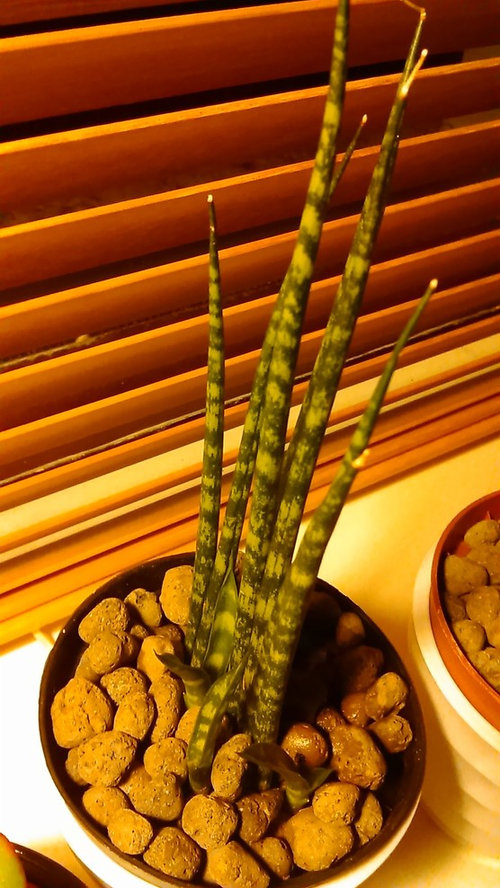
I bought this plant as a bunch of cuttings and many of them has a baby by now.

I would like to know why the new leaves look flattened, while the originals are cylindrical?

Is this because the small leaves are young or a matter of other conditions?


Comments (16)

  • 11 years ago

    On some of the tall desert growing Sansevieria, the new juvenile leaves are different than the older permanent leaves of the parent. These can form rosettes and then the mature leaves come up from root rhizomes up thru the pot.

  • 11 years ago

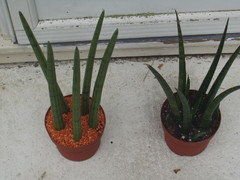
    MsGreenFinger, how do you like your Sansevieria Japonesa? I ask because I have one also and would like to know as much about it as I can. A S. Cylindrical and My S. Japonesa.


  • 11 years ago


    Sans,

    almost all the cuttings produced shoots, they are quite happy on my west facing window sill and they like the semi-hydro system also.

    Still not showing cylindrical leaf form, but I am proud of them anyway :)

    I don't know much about them myself, just treat them as my other sans and succulents.

    Really hope they remain small as I don't have room for 5-6 mature plants in separate pots :)

    Your japonesa doesn't look like a cutting so you may see cylindrical leaves sooner than me.


  • 11 years ago

    Thanks and I must say your plant looks great! I'm am continuing to look in to this plant, so I'll let you know what I find out. I don't think it is going to look any different that it does now. I don't think it is supposed to have a cylindrical leaf shape, but rather this half cylinder V shape with recurving pointed leaves. Happy growing!

    Fred

  • 11 years ago

    Thank you!

  • 10 years ago

    *Update*

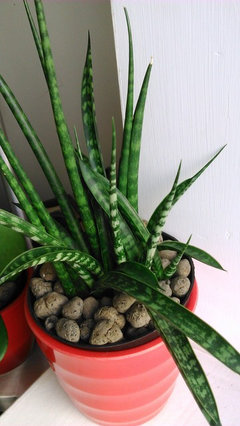
    Here is my plant as today. It has grown a lot during summer! Now the new middle leaves on the offsets are cylindrical. More vivid colors than on the old original leaves. I am very happy for this plant :)

  • 10 years ago

    What a nice plant! Could you tell us a little more about your semi-hydro growing system? I would like to try it.

  • 10 years ago
    last modified: 10 years ago

    Mine I was able to divide and share with a gardenweb friend! That new growth looks wonderful! It will be interesting to see the mature leaves. I wonder if they stay cylindrical. I too would be interested to learn more of your hydro technique. Any trouble in the cold dark months?

    Fred

  • 10 years ago

    Stush, your comment above (from April) said that juvenile leaves form rosettes and from the rhizome come the adult form of the leaf. So the juvenile leaf forms a rhizome which in turn produces the more typical adult form of leaf? In this scenario what happens to the juvenile leaf, coexistence?

    Fred

  • 10 years ago

    Fred,

    Don't know for sure. I have been told that hahnii is the juvenile form of regular trifasciata that stayed a juvenile form. I have never heard of a rhizome from a hahnii growing into a regular plant. So it's just what I read some where. I did see a regular green hahnii that was 4 feet tall! Each leaf was double the normal size and it just 'Stacked' it's way up. Shame I didn't have my camera with me. Place in North Lima, Ohio. Next time I'm thru there, I will have to stop and take a picture of it. It was for sale for $50. That was 5 years ago. So It might be gone.

    Stush

  • 10 years ago

    Semi hydro is nothing special. You get the hydroton (expanded clay), soak it for a day and rinse thoroughly. Bare root the chosen plant, wash off all the soil. Plant it in the hydroton (1/3 of roots can be cut off to encourage new growth, this does not apply for Sans). For tropical plants it is best to put them to a clear plastic bag as in a greenhouse for raised humidity for about 2 weeks until they establish the roots. I didn't do this with succulents. They are in a plastic pot with drainage holes and a cache pot. They are standing in water (very weak solution of Dutch Pro hydro fertilizer) up to 1/3 or 1/5 of pot. Basically plants grow 'water roots' that don't mind standing in water for long periods. They take up all the necessary food from the solution, hydroton is inert.

    In winter little water until days start to lenghten again, and even less fertilizer (actually they do well in plain water). This plant I bough last fall and transplanted in November (I know..) First shoots came in end of January. It sits in the Western window of our bedroom so temps never go under 18-20°C and it is able to catch some occassional sun in the afternoons.

    I looked closer at the rosettes. It seems there is so far one small baby leaf, two flat and one cylindrical leaf in the middle in each.

  • 10 years ago

    MsGreenFinger

    I just looked at mine and it has no cylindrical leaves at all. The new growth isthat recurved crescent shaped leaf. I'm puzzled why yours has cylindrical leaves as well as crescent shaped ( what is the proper term)?

    Thanks for the Hydro lesson! I am going try it sometime. Have you ever tried to root a Sansevieria in water? It is possible.

  • 10 years ago

    I never tried water rooting, I am happy with the shoots coming up from the rhizomes of the japonesa and the S. 'friends'. Don't even have room for more at the moment. Small varieties are very hard to come by in here. My boyfriend doesn't like the large sword-like leaves of Sans trifasciata. This is the only plant he said he doesn't want to see in the house besides cacti with big spikes, so I gave in.

  • 10 years ago

    What's wrong with cacti with huge spines? Gotta teach the cats to leave your plants alone somehow, right?

  • 10 years ago

    OH, not sure if all varieties of Sansevieria will root in water, I know trifasciata and hahnii will, but can't say for sure that others will.

0
Sponsored
Bella Casa LLC
Average rating: 5 out of 5 stars17 Reviews
The Leading Interior Design Studio in Franklin County