Software
Houzz Logo Print
emeuu

Ficus Tree - Code Blue!

11 years ago
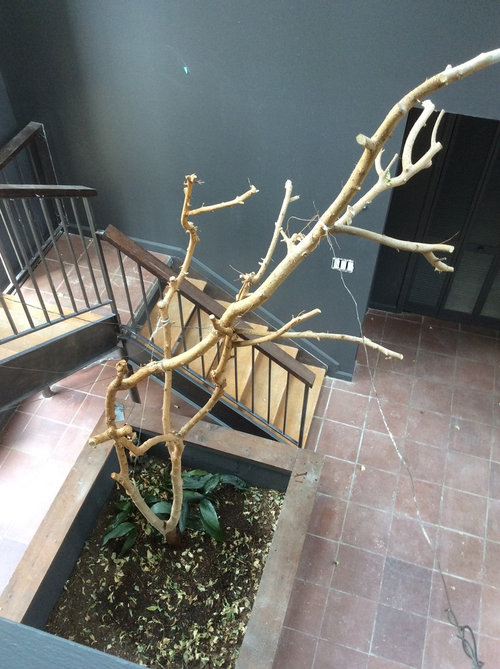
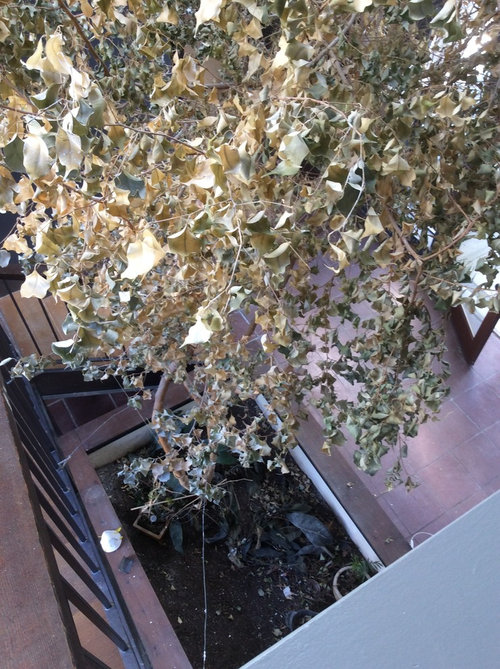
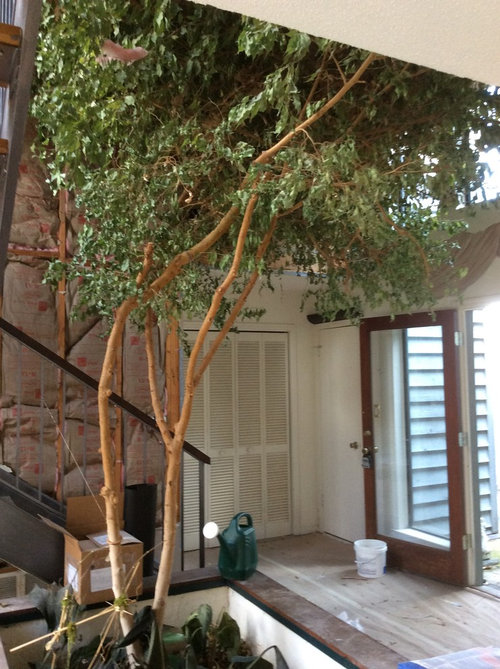
Long story short - large insurance claim forced us to move out of our house in December. My indoor ficus, 30 years old, heart of my home, looks dead after suffering through the past winter without any heat. I pruned all of the dead branches off and now, the only thing left is pretty much the trunk. I'm hoping he will come back and would love any advice on how to help the process by fertilizing, changing soil, etc. I have been watering once a week. Or, worse case scenario, and as much as this hurts to consider, where can I find a large replacement ficus?

Comments (23)

  • 11 years ago
    Well, have you checked to see if there is live tissue?
    Starting at the top of a bare twig, gently scrape the bark with a blunt edge, like a spoon edge or the back of a key. If you see green, the stem is alive. Brown or black would mean that bit is dead; move lower down, and keep checking until you do see green. From there downward the branch is alive. You can cut away the dead top portions of the branch and watch for buds below the cut to swell and emerge within the next two weeks. Hopefully...

    Don't overwater it, leave it be, for the most part, for the next ten days to two weeks.

    I hope it isn't dead. Very sorry to hear of your bad luck.
  • 11 years ago
    Do you live in an area where there is a botanical garden? They might know of a local supplier of specimen sized plants.
  • 11 years ago

    That was a very lovely big tree. If it doesn't come back, try removing all the soil before replanting. A smaller new plant would have a chance to put down stable roots; a large new plant might be wobbly for years to come. Please post again when you decide what to do.

    An alternative you might consider is a water feature.


  • 11 years ago
    I pruned him back 2 weeks ago. I followed your suggestion Mr. Stem, and scraped away on several places and there is green under the bark. I think I will hold off on removal for a bit but there isn't any new growth as yet. Should I fertiliz

    Also, about the soil....

    Should I remove and replace most of the soil now? It looks ok but no telling how much dry wall dust and fiberglass from insulation is in there. All of the walls you see in the background had been taken down to the studs so it was actually pretty uncomfortable breathing in here without a dust mask for the last couple of months. The tree was covered but even so all of the leaves were coated.

    If all else fails I am close to the Atlanta Botanical Gardens and there are some garden places nearby so I will ask about the larger trees they may be able to source for me....should it come to that.

    Thanks everyone for your comments. Much appreciated!
  • 11 years ago
    Have you contacted a Master Gardener?

    The botanic gardens should be able to put you in touch...
  • 11 years ago

    Old post, I realize. The tree has obviously lost its ability to make food (a plant's food is the product of photosynthesis - sugar) so in order to push a new flush of growth it has to rely on its energy reserves, which hopefully were adequate. You shouldn't fertilize until you see evidence of new growth. You shouldn't repot or change the soil because the added stress may produce so much dysfunction in the plant's already unstable systems that they will wobble out of control like an unbalanced top. You should monitor water needs carefully and be sure you don't over-water - water requirements are extremely low absent the canopy. If you decide the plant needs a repotting (repotting and the accompanying root pruning is a rejuvenating process and should be a regular part of every tree you wish to be around for the long haul) it should be done in the early summer or very late spring (Father's Day is easy to remember), after the plant has had a year to recover and rebuild energy reserves that will be virtually depleted from pushing the new flush of foliage. The timing, working with the plant's natural rhythms instead of against them is important.

    There is a huge lack of information out there on how to maintain trees in good health for longer than a few years. The difference between woody houseplants and bonsai that live very happily for centuries lies in what attention is given to roots.

    More on maintaining woody material in pots if you click the link.

    Al

  • 11 years ago
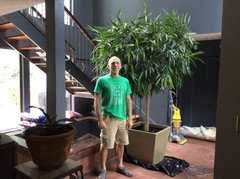
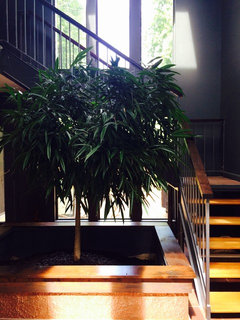
    Thank you for the information. Unfortunately, my tree did not make it. We tried but he just was too far gone by the time we were able to normalize the environment for him. Two weekends ago we cut him down and removed him from the planter box to make way for our new tree. I have acquired a Ficus Alii. This tree is very large, and quite heavy so I have decided to contact our local Pikes Nursery and inquire about their planting service. Here is a picture of our new tree, my husband will help you to get an idea of the size.
  • 11 years ago
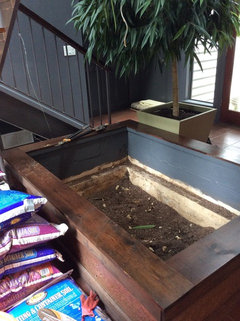
    The tree is going to be relocated into the planter box, built into the house. It's about 6x4 and we removed all the old soil. The depth is at least twice as deep as the pot the tree came in....from a nearby office building.
  • 11 years ago

    Does the planter have a direct link between the soil in the pot and an absorbent substrate below the pot? IOW, is there a direct path for water in the pot to follow into the earth (without having to drip out of a drain hole)? This is a very important consideration because water behaves quite differently in a pot than it does in a raised bed, which is what your planter would be (hydrologically speaking) if it is linked directly to the soil. This is much to be preferred because it makes soil choice much less critical.

    Al

  • 11 years ago
    There is no magic to planting it. Just get yourself a couple bales of pro mix potting soil. Do not use outdoor soil mixes. Add pro mix to your planter and add water to it slowly and mix it throughout the soil until the soil is moist ( not soggy) throughout. Take the tree out of the pot keeping its rootball intact. If it has lots of roots circling around the existing pot shape try to unravel them a bit so that the roots will seek out the new soil in your planter. Plant the tree so that the top of the soil level is the same as it is in the current pot. Do not plant it deeper. When watering your planter try to keep the soil uniformly damp throughout so that the tree keeps growing roots into the new soil. If you kept the old tree alive for so long you should be fine with this one too.
  • 11 years ago

    There may not be any magic, but sound horticultural practices will go a long way toward ensuring a tree that thrives rather than survives. The difference might easily lie in whether or not the container the tree is in would be considered a very large pot, or a raised bed if the soil in the planter is in contact with the earth. Pro-mix is actually NOT a good idea because this will be a very long term planting and more than 90% of the promix blend is organic matter, which will break down into sludge with time, and a large portion of the hydrocarbon chains that make up the soil will quickly be cleaved by soil life and gas off as CO2. Long term plantings perform much better and offer a much greater opportunity for plants to realize their genetic potential if a large fraction of the soil is comprised of stable mineral ingredients that ensure the soil can't collapse structurally.

    Ideally, the root mass would be inspected for potential problems that are corrected at planting time. There is no good reason to keep the root mass intact, as that habit ensures permanent limitations imposed by congestion and/or problem roots in the original root mass that can't be relieved w/o pruning the roots. Problems include circling, girdling, and j-hooked roots, as well as roots growing straight up or down, or back toward the center of the root mass. All of these conditions should be remedied at planting time.

    Al

  • 11 years ago
    We dug about another foot or so down below where shown in the picture and we found packaging peanuts for drainage but I couldn't say with any certainty that this is actually open to the earth. I doubt it.
  • 11 years ago

    Can water at least get out of the planter? Does it drain somewhere? If there is no drainage, all the dissolved solids (salts) from tap water and fertilizer solutions will remain in the soil. This means a steadily increasing level of TDS/EC (total dissolved solids and electrical conductivity - these are ways to measure the level of solutes in the soil solution) and badly skewed nutrient ratios that are bound to result in antagonistic deficiencies over time. Antagonistic deficiencies are a result of one nutrient being present in concentrations so high that it affects uptake of other nutrients.

    Do you have a reverse osmosis water system? Where do you live (large city near you)?

    Al

  • 11 years ago
    No idea since we haven't gotten past the packing peanuts. We are in a NW suburb of Atlanta.
  • 11 years ago
    Nor do we have reverse osmosis. The replacement soil is similar to the soil the other tree thrived in for so long. This weekend I guess we'll attempt to move him.
  • 11 years ago

    Good luck. The cultural wants of alii are essentially the same as benjamina, but alii holds onto it's foliage a little better than benjamina would under the same circumstances. Dyna-Gro's Foliage-Pro 9-3-6 is a VERY good fertilizer for Ficus indoors. It has ALL the nutrients essential to normal growth (precious few soluble fertilizers do) in a ratio at which the plant actually uses the nutrients. It also derives most of it's N from nitrate sources and none from urea. This is a big plus for low-light conditions (indoor growing) because you don't get the coarse, rangy growth associated with ureic forms of N.

    Al

  • 11 years ago
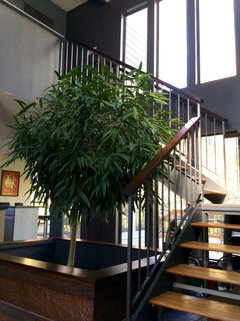
    The final outcome. New free has been planted. He came out of the old planter relatively easy without dislodging much dirt from the rootball. Yay!
  • 11 years ago

    New tree looks good. Please update in a month or three as the plant settles in.

  • 10 years ago
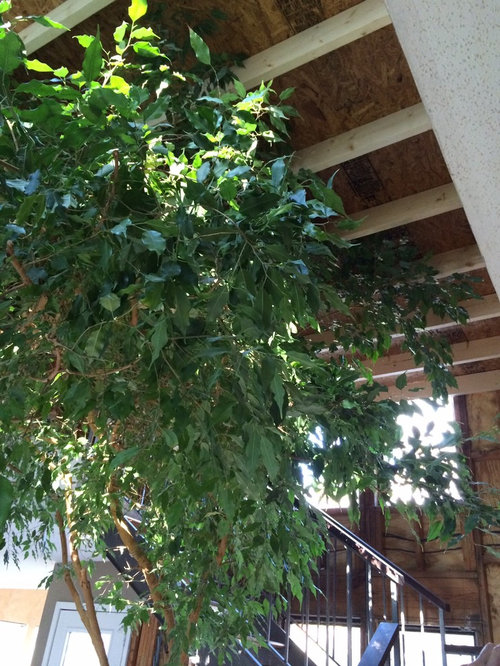
    Mohammad alli. Settling in nicely. I'm watering once a week and purchased the Foliage-Pro 9-3-6. I think so far so good. He is dropping some leaves but from above there is plenty of new growth. Thanks again for all of the advice!
  • 10 years ago
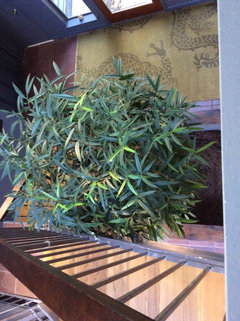
    New growth picture from above.
  • 10 years ago

    Yay! I'm happy for you!

  • 10 years ago
    last modified: 10 years ago

    Good job. Your tree is very apically dominant, which means it will put about 2/3 of it's energy into the top 1/3 of the tree, growing longer and particularly taller branches. I would expect it to lose a number of leaves from 3 places - low on the plant, the side away from the brightest light source, and from the inside of the foliage mass. That will probably stop soon after the vernal equinox (Mar 21) and resume again in at a rate less than this years sometime between Sep - Nov. Happy Holidays!

    Al