Software
Houzz Logo Print
johnnycoleman

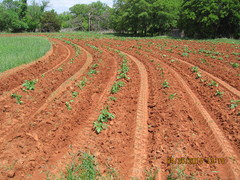
Hilling potatoes

11 years ago
last modified: 11 years ago
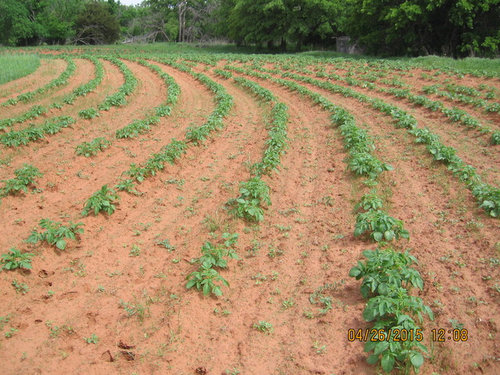
Just finished hilling my other potato patch. Lesson learned; "always plant potatoes in a straight line."

Looks like I killed half of them but the ones I covered with soil will grow back.

Comments (24)

  • 11 years ago

    This is the after shot.


  • 11 years ago

    That's a lot of potatoes.


  • 11 years ago

    mulberryknob
    We give them to the food bank. Our volunteers will get some too. That is 1/2 acre. There is another 1/2 acre on the South side of Guthrie.

    I canned some golf ball size Kennebecs last year. They are great when heated in the oven for a few minutes.


  • 11 years ago

    Johnny, I'm grateful (on your behalf) that you don't have to hill up all those potatoes by hand.

    I hilled up one bed the week before last and the other bed this week. Like yours, mine are growing well and seem ridiculously happy in this prolonged period of moist, mild weather. I did notice yesterday that some of the lower leaves are looking a little bit fungi-infected. I suppose that's happening because it is raining about 4 days a week and on the days it doesn't rain, it looks like San Francisco (minus the Golden Gate bridge) here with daily mist and fog and little sunlight.

    It will be a great potato year if the weather just halfway cooperates, although you're likely more rain challenged there than we are here.

    I haven't seen a single potato beetle yet. Hope that continues.


    Dawn

  • 11 years ago

    Dawn,
    We are unusually wet this year but I wouldn't call it a flood. How deep did you plant your potatoes this year? As you know, we machine planted. Our machine was set at about 6" for all but one row which was at about 8".

    You will notice a few skips in our rows. Some of our volunteers cut the seed potatoes different than I asked. So, we got more blind pieces than I would like. However, I didn't say anything because they were learning to plant and their little kids were there watching. That creates a strong memory in their little minds. It was, on balance, a very successful endeavor.

    I'm expecting about 8,000 lbs of Kennebecs this year. We are scrambling to find enough burlap bags, boxes or tubs to take them to the food bank.


  • 11 years ago
    last modified: 11 years ago

    YES - YES - YES! Thank you very much. I will be happy to pay for postage. However, please send them by ground transport. We have some time before harvest.

    Vision Farms, Inc.
    109 South Division
    Guthrie, OK 73044 USA

    (405)570-2505


    https://www.facebook.com/visionfarms/timeline?ref=page_internal


  • 11 years ago

    Johnny, I planted them about 8" down. I always do and it seems to work well. They are in a raised bed that is 16" above grade level, so even when I plant them deeply, they are above the standard grade level. This prevents them from rotting in cold, wet soil since our soil has a high clay content and water drains down into the garden both above ground and below ground from the property to our south that sits at a higher grade than our place. In wet years I often have a river of water draining underground from next door for weeks and weeks after the heavy rain stops. In a wet year like this, the lower end of our garden can become unusable.

    I wish I could send the drier areas (after yesterday and today there may not be any drier areas) of the state some of our extra rainfall. So far this year, we have received over 15", of rainfall while 10" would be about what a person here would so far expect based on our historical Mesonet record or a little over 11" based on 30-year averages that partially predate the OK Mesonet. In the last month, our rainfall has been about 180% of average for that 30-day time frame. I am concerned about how the onions and potatoes will hold up if the rain keeps falling at this rate. (It is raining right now.) I only have planted one section of the garden that is grade-level. Everything else is in raised beds, and I cannot plant anything else until the soil dries out some because all the raised beds are crammed full of plants. Right now, there's 2-3" of rainwater standing in any part of my garden that is not a raised bed, and the raised beds are only marginally drier. We have mosquitoes the size of hummingbirds. Okay, that is an exaggeration, but they are big and they are hungry.

    We usually are rain-deficient so I don't want to complain about getting so much. Rain is always a blessing and it can stop falling at any time, so we're happy to have it. Every time it falls, though, we are a little less happy to see it than we were the day before. : )

    Dawn

  • 11 years ago
    last modified: 11 years ago

    We called the mosquitoes in Alaska, B52s. When we fired the howitzers, we were using powder made for WWll. There was something in it that made them positively mad. They would attack the muzzle end of the tube (gun barrel) like kamikaze. Never will forget that. (;-)

  • 11 years ago

    That is funny. I wish I had some howitzers to fire at all of this year's skeeters and black flies. When I venture outdoors, they attempt to eat me alive.

  • 11 years ago

    Dawn,
    I used to have livestock. My favorite control was a fly trap. I used a piece of banana peal in each trap.Fly trap


  • 11 years ago

    Johnny, We've made those fly traps before. : )

    We have chickens and all our neighbors have cows, horses, goats, and chickens in some combination. We have gazillions of flies most years, but this year the biting black flies are present in huge numbers. I need a gardening suit made out of mosquito netting. I hope the robber flies show up soon and start eating the black flies.

    Dawn

  • 11 years ago
    last modified: 11 years ago

    Johnny I will get these in the mail soon. I got a shipping box today and not necessary to pay postage, but thank you for the offer.

  • 11 years ago

    luvncannin,

    I will remember you in my prayers this evening.

    Thank you! (:-)

  • 11 years ago

    Thank you. I really appreciate that Johnny.

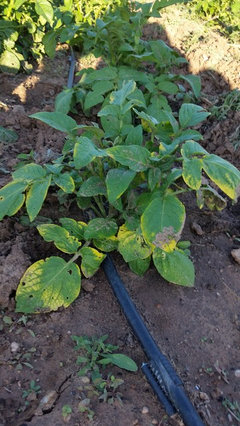
    Do yall know why one of 70+ potatoes is this weird yellowish color? There is just the one in an area where I have 42 plants.


  • 11 years ago

    I would foliar feed one pound of UREA mixed with five gallons of water to test for N deficiency.

    You can mix smaller amounts. Just use the same ratio or a little weaker. Test a few plants and check response before feeding them all.

    I had to side dress 1/2 acre of potatoes this year.


  • 11 years ago

    I'm not expert. Nitrogen cannot hurt. I usually see consistently yellow with nitro deficiency. I'm guessing this is magnesium def. At least they're both easy to fix. Epsom salts for the magnesium.


  • 11 years ago

    Can I use rabbit poo tea ?

  • 11 years ago

    Yes but make it weak. You should have your answer in 48 hours.


  • 11 years ago

    That would be perfect.


  • 11 years ago

    It is odd that a nitrogen deficiency would show up on only 1 plant out of 70, but it does look more like nitrogen deficiency than anything else in terms of a nutrient deficiency. If a gentle feeding of nitrogen doesn't perk it up, we'll have to think about diseases and pests that might give a plant that same appearance. Don't overfeed the nitrogen though. While young potato plants do need some nitrogen early in the season, the later we go in the growing season, the less you want to add nitrogen because it can promote heavy foliar growth at the expense of tuber formation. You walk a fine line when you try to cherry-pick and add one nutrient or another to your soil because an excess of any one nutrient can interfere in the way plants take up and use some of the other nutrients. I've seen people completely mess up their soil by adding first one nutrient or another one, or multiple ones in sequence, without ever having a soil test to show them if the soil was deficient in anything to begin with. The more they tried to fix things by adding random nutrients, the worse things got, so be careful and avoid that approach.

    Since we don't know much about your soil, it is hard to guess if you have some sort of nutrient imbalance or if one plant has a physiological issue. If, by chance, your soil is high pH, that could be the problem because the higher pH can interfere in the uptake of other nutrients. However, if that were the case, I'd expect you'd see a problem on more than one plant. Potatoes are happier in a more mildly acidic soil, but I grow them in highly alkaline soil and still get a good yield. However, I have amended the potato beds with the addition of tons of compost plus peat moss (for its acidity) and sulfur (to lower the pH) and the potato plants have few issues now compared to what they had growing in earlier years in soil to which sulfur and peat moss had not been added.

    If that plant were in my garden, I'd check the undersides of the leaves to see if any insects are feeding on them. That's always a good thing to check with any plant problem and can offer insight into what is going on. Sometimes when I've thought a plant had a nutrient problem, what it really had was an insect problem. And, as much as we hate to admit it, sometimes leaves develop a problem like that and we never really figure out why.

  • 11 years ago

    Dawn,
    When you are visiting with your neighbors, please ask them if there is any interest in cowpea hay.

    Johnny


  • 11 years ago

    Johnny,

    Cowpea hay? You mean the spent plants after the peas are harvested? You bale it? Everyone here just plows it into the ground. We have a cowpea farm here (no kidding!) and I think they even rototill their spent plants into the ground after harvesting because one day the plants are there, and then they are gone, and I've never noticed anyone out there baling it. I'll ask around but since they don't bale their own, I don't know if they'll be interested in buying any. Some folks do bale their corn stalks in a dry year, figuring it is at least some roughage for the animals. I even give my cornstalks to Fred when he wants them for the cows in dry years, but we don't bale them. I just pull them up out of the ground and we toss them into the bed of his truck. It is a low tech operation.

    Or, maybe you've invented a new kind of hay? (grin)

    With all the rain we're having, everyone here is going to be cutting and baling their fields like mad if we can only stay dry enough for the cut hay to even dry out enough to be baled. I think it will be hard to get anyone here to buy anybody's hay of any type this year because they are going to have all they need and more. In a good rainy year, some of the ranchers here can put up three years worth of hay, although they generally won't feed it after it reaches a certain age. When it gets old and isn't useful as feed, they sell it or give it away as mulch hay. The last time one of our friends had too much old hay, he gave me 200+ square bales for mulch.

    The cattle people have had to buy so much hay in recent dry years that I bet they're relieved they'll be able to bale their own and put it up in the hay barns for winter. So many folks thinned their herds down to almost nothing in 2011 and have been slowly rebuilding, and some sold their cattle and gave up ranching after one drought year too many. In a lot of ways, horse ranches are replacing many of the cattle ranches. I don't know which we have more of now, but the horse ranches seem to outnumber the cattle ranches in recent years. It seems to me that the horse folks are a lot pickier about what they feed their animals.

    The last couple of years I've noticed a lot of dodder in the native hay pastures and haven't seen any yet this year. I don't know much about how it spreads, but down here, it seems that dry years favor the spread of dodder more than wet years do. Or, maybe what I am seeing is that it appears in a rainy spring after a drought year. Most of the cattle people here have native prairie pastures, but some of the horse people are a lot pickier and have planted the forages of their choice for their horse pastures. I've never seen the dodder growing in the cultivated pastures that were replanted with something different from the native prairie grasses and forbs, and I've always wondered about that, and we've never had dodder pop up in our fallow pastures. It was everywhere in 2013, but not here. Now see, I know what dodder is, but I've never heard of cowpea hay.

    Dawn

  • 11 years ago
    last modified: 11 years ago

    Dawn,
    I am consulting on a cover crop to replace summer fallow on winter wheat land.
    Cowpea hay is NOT new. I am focused on it because:
    1. It produces even in drought.
    2. It doesn't require good soil.
    4. It loves to grow in high heat.
    5. It is an outstanding cover crop.
    6. It is a legume, so it builds soil. (green manure)
    7. It can be sold in Oklahoma as seed or fresh shelled peas or dry shelled peas. (high quality protein for humans)
    8. It can be sold as a very nutritious hay. (mainly for cattle)
    9. Even if you harvest the peas, the stubble will give a little N gain.

    Whew, I'm tired now.