Software
Houzz Logo Print
gardenho_mi_z5

Furmans Red

11 years ago

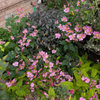
I purchased 2 of these last year and just loved the color. I don't see any signs of life, and wonder if I should by now? Perhaps they are just late bloomers? I'm hoping someone can give me hopes that they will return :)

Comments (18)

  • 11 years ago

    Unless you have a rather unique microclimate going on, I don't think you are going to see these again............sorry :-)

    Despite what you may find from various online sources, this plant is rarely hardy below zone 7 and most of the sources I find the most accurate and reliable list it at a zone 8 (minimum 10-15F). Since it rarely overwinters in my extremely mild (but not hot) climate, I have a very hard time imagining it would do so in your zone 5.


  • 11 years ago

    Thanks gal :(

    Online I've seen hardy 5-9, 6-10 and more. The tag said 6-10 I believe, so I took a chance and mulched heavy. Luckily they were on sale. I sure loved that color.......

    Darn, now I have to find replacements ;0)

  • 11 years ago

    down here in adrian mi... the usual z5 ... we had two zone 4 winters in a row ...

    even if you are suburban ... where small micro pockets can be.. it was still bad ...

    ken


  • 11 years ago

    I just checked on several S. greggii "Wild Thing" that I found on deep discount last year and enjoyed several months of bloom from. No signs of life to this point, but I'll give them at least a couple more weeks.

    By the way, hardiness of perennials is dependent on more than average wintertime lows. There are many instances of plants overwintering in areas that have marked winter cold but also enough summer heat to allow plants to store up energy to tide them over dormancy (the same plants might succumb during much milder winters in places like the Pacific Northwest, because the summers are relatively cool and not to their liking).

  • 11 years ago

    That is perfectly true but Salvia greggii in Z5 is pushing that theory to an extreme :-)

    FWIW, other semi-tender salvias overwinter in the PNW perfectly well - microphylla, guaranitica ('Black and Blue') and jamensis all winter over handily as long as given very good drainage.

  • 11 years ago
    last modified: 11 years ago

    I think it might make a new mexican winter of a dry winter down to Z6b or 7a. I can't say for sure. TR grows them in Oklahoma (7a). She addresses drainage in her soil and gives them a xeric environment. These are xeric plants . Cold and wet is the kiss of death. I did know some one on the salvia forum that got them to winter over in Northern New Jersey(6b) BUT I think he did some extra winter treatments and experienced loss on cold wet years.. There is a difference from one S. gregii to another as to their cold hardiness and their xeric-ness.

  • 11 years ago

    I think s. greggii is hardy to z7. It's grown everywhere in Albuquerque with little care, but this is the desert so there's no issue of winter moisture. There is a Heatwave series (s. microphylla x s. greggii) which is supposed to be rated to z6 See Heatwave Glimmer. I have both, but my greggii are already in flower while Heatwave is just starting to put out foliage. I don't know of a greggii hybrid hardy to z5.

    Cheryl


  • 11 years ago
    last modified: 11 years ago

    Tony Avent of Plant Delights Nursery has this advice on S. greggii:

    "There are many named selections of Salvia greggii that vary in size, hardiness, and flower color. While many selections of Salvia greggii are only hardy in Zone 7, others can tolerate Zone 5b (-15 degrees F) temperatures. Salvia greggii prefers sunny, well drained sites and are intolerant of poorly drained soils."

    http://www.plantdelights.com/Article/Salvia/Perennial-Salvia/Salvia-greggii/Salvia-nemorosa/#sthash.Hj0mW8XV.dpuf

    Reinforcing the drainage issue, S. guaranitica is fully hardy here in zone 6a in an open, exposed site that is mulched in winter (but otherwise unprotected) and has excellent drainage.

    David Francko ("Palms Won't Grow Here (and other myths)":

    "Warm temperatures and abundant water, nutrients, and sunshine during the growing season optimize photosynthesis and the production and storage of carbohydrates. These energy reserves nourish the plant during the colder, darker months of winter and are necessary for the production of antifreeze compounds...This fact also explains why many warm-climate plants - southern magnolias and crape myrtles, to name two well-known examples - do well in the lower Midwest with its long, hot summers and winters with temperatures below 0F, yet languish in zone 8 England, where summers are relatively short, cool and often cloudy and winters rarely drop below 10F."

    *happy note - just spotted the first emerging shoot of Musa basjoo (hardy banana), surviving its second winter in a row of sub-minus 10F temps.

  • 11 years ago

    S. guaranitica is the only salvia I grow which died over last winter. I have s. greggii, s. pachophylla, chamaedryoides, darcyi, microphylla, and hybrids Ultra Violet and Heatwave Sparkle. All are growing well in my garden which is nominally z7. I have dry soil, hence excellent drainage and the winter was mild. You really can't go by what the experts say.


  • 11 years ago
    last modified: 11 years ago

    I've grown several color shades, named & unnamed of S. greggii & S. microphylla since the early 1990's. Some of those winters have been extremely cold & wet here in zone 7 while other winters are mild, they are semievergreen during those. Its so non-picky about conditions I grow them in clay, sand, good soil, full sun, inferno conditions, partial and even dry shade under trees in cruddy soil. Salvia greggii is a plant that will take just about any condition so I root lots of cuttings and have them everywhere, they root quite easily. My sister has several in zone 6 Kansas growing in rich soil and not so rich soil--- same thing, sun or various degrees of shade --- they reliably winter over for her too in wet years or dry.

    Just because you lost one plant doesn't mean you cannot grow it, I've lost a couple every now and then but that also happens with other plants from time to time. Maybe zone 6 is the limit?

    They are not late bloomers by the way, its one of the earlier blooming plants for me, mine have been blooming for about a month now.

  • 11 years ago

    Yep, I also have them all over the place (being as they are the easiest plant to root - any old twig stuck in a bit of soil will root and grow away) Quite a few of the sages are slow to get going and in the UK, the likes of guarantica, patens, uliginosa, involucrata barely awake before frosts whack them back...but the greggii (and even more so microphylla) are bulletproof in dry sandy soil...although the pale La Luna and the jamensis hybrids are temperamental and quite a few of them are bare twigs all winter. I have given numerous ones to everyone I know and encouraged much swapping...so we can manage a display of palest creams, through all the pinks, lilacs, reds, corals to deepest purple (Nachtvlinder, one of my darkest and best) for months on end. Cerro Potosi is blooming already, as is the pineapple sage (elegans)


  • 11 years ago

    Would these do okay in pots where excellent drainage could be provided (since my beds are obviously not well drained)? ( planted Black and Blue 2 different times and it never came back).


  • 11 years ago

    You can also root branches on the plant by burying a portion of the top part and putting a rock or something over it. I have several from seedlings, a seedling plant will be blooming within months the first season, right now there must be 60 seedlings out there. I got a white one that way. In rich soil with adequate moisture they get huge.

  • 11 years ago

    All of my shrubby salvias are in pots and do very well indeed - but I do not grow many of the herbacious types.


  • 11 years ago

    Campanula, Why do you keep them in pots when you have land screaming to be landscaped by them?

  • 11 years ago

    Probably because I have dozens of them, Mara...and they just look wrong in (english) woodland, even on the edges. I have many grateful pals though.


  • 11 years ago
    last modified: 11 years ago

    I got a good laugh on this one. It makes a lot more sense growing S. greggii in pots than a certain someone I know of who's been growing prickly pear cactus in pots for quite some time now, in Texas (!) of all places.

    The G. salvia have a fairly compact root ball but think of those poor suffering cactus who like to send out 6 or 7 ft long, shallow, anchoring roots being confined and stunted in pot prisons. If anyone asks me, a pot amounts to cruelty to Opuntia cactus. Up north where its wet I could understand but in Texas?

    Personally, I would imagine the salvia is probably an excellent candidate to be grown as a pot plant, thats probably why the ones I planted in what I call crap-hardpan out there are going great guns in full bloom. They don't seem to mind root confinement. Its one of those plants that will grow where nothing much else will I found. I overuse them shamelessly.

    I guess when it comes to "why are you doing that" some people would wonder why this Okie just forked out $50 for 5 plants of a strain of Los Lunas Little Bluestem when the whole country side is covered in the stuff. Answer is "I have my reasons".

  • 11 years ago

    I had my reasons too. I was just beginning with cactus and those coreid bugs moved in in force and reduced the ones in the ground to weeping bleeding 200 lb monstrosities. They had me spooked. The pads in pots on my elevated bridge seemed to be escaping them. I had not improved the soil for the cactus beds to receive them. Time got away from me. Even Cactus does not like this limestone marl/caliche. I have been bringing in soil finally. Broke ground on another bed. This might actually be a good thread. "The crazy things we do in the garden for a good darn reason , or for that fact for no reason at all."