Software
Houzz Logo Print
lilies08

New growth from base only

11 years ago

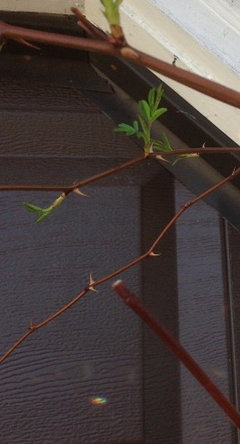
Hello, I have a few rose bushes that were here when I moved in to the house a year and a half ago. I am pretty sure they are Darlow's Enigma. I'm getting concerned because the new growth that has started this spring is only happening from the base of the bush but not from any of the existing canes.

Does this mean that ALL of the existing canes on ALL four bushes are dead? Should I cut them all to the ground to make room for the new growth? Or is it possible that the existing canes will start to produce new growth, eventually?A couple of weeks ago I pruned just a bit off the ends (maybe 1/4 off the ends). I did not prune any dead canes because I don't know how to tell which ones are dead. In contrast, I also have a few John Cabot roses that started growing last month, and for those it was easy to tell which canes were dead because they had no growth, and some were black.

If the Darlow's Enigmas are in fact dead, what might have gone wrong?

Any advice would be appreciated! Thank you!


Comments (16)

  • 11 years ago

    If the canes are brown , they are dead. Prune back below the brown stuff--which might be down to the base if it is brown all the way down.

    On canes that are still greenish but not producing, prune back about 6 inches. Is the entire center of the cane glistening white? If not, prune back another 6 inches. Still not glistening white in the center? Keep pruning back until you get to the white centers. Again, if the entire cane has died, that may mean you have to prune back all the way down to the base.

    If the rose is grafted and the new growth is coming from the graft or above it, then everything is all right and you are just getting a new bush. If the growth comes from below the graft--bad news. It is probably undesireable rootstock like Dr. Huey which is taking over the plant.

    If the rose is not grafted, any new growth from the base just means that you are getting a new plant. no problem, in other words.

    Let us know in about a month or so how it is going.

    Kate

  • 11 years ago

    First off, where do you live or at least what zone are you in? It sounds like your roses suffered from winter kill but without know your zone I can't say for sure.

    To tell if a cane is a live or dead start at the tip and snip off a piece about an inch long. Look at the center of the cane. Is it a moist looking greenish white or a dried tan of brown color? If it is moist and whitish it is alive. If it is tan of brown in the center it is dead. Keep snipping off small sections and checking the center all the way down the cane until you find that good white center. Once you reach that clear white center anything from there down will be alive. Do this on each cane until you are only left with live wood. Even if that means taking the cane right down to the bottom. Removing dead wood will stimulate new growth if the rose is still alive.

    The reason John Cabot had live cane higher up is because it is a very hardy climber. It needs to retain live cane up higher on the bush in order to bloom and climb. We call this a cane hardy rose. Darlow's Enigma is a shrub rose and does not need to have hardy cane above ground to survive. As long as the graft, if it is a grafted rose, and the root ball survive the winter the rose will produce new canes each spring if it needs to. If you could post a picture of your DE roses it would help us determine if they are grafted or own root. That makes a difference. If your roses are grafted and those new canes are coming up from below the grafted area it may be that your rose has died and the root stock is coming up instead. If your roses are own root then it would be DE coming back from the roots. A good picture of the base of the rose will help us determine what you have.

  • 11 years ago

    Thank you so much! These are presumably grown on their own roots because the previous owner said they were purchased from High Country Gardens, which only sells roses grown on their own roots.

    I'm in zone 5b in Colorado. We did have a long spell of sub-zero temperatures at the beginning of the winter, (not as low as -20, but the windchill was that low), so maybe that was the problem. All of the canes are indeed brown except for two green canes on one bush :(

    So, I guess I will cut them all down! Thanks so much for this information - it's very helpful!

  • 11 years ago

    This is a great example of why roses grown on their own roots solve the problem of dying to the ground in cold winters, and then losing the rose entirely because the roots are somebody else. Congratulations! Your new canes should be the same rose, so just take care of them.

    Jackie

  • 11 years ago

    Hmm, all the live canes on my Darlow's Enigma are brown. The dead ones are gray, and there are a fair number of them because I didn't take a week last year and prune them out. When you are dealing with roses that aren't HTs, you have to throw the HT manual out the window.

  • 11 years ago
    last modified: 11 years ago

    Maybe Darlow's Enigma is different than other roses, but on my roses--HTs AND non-HTs--brown canes are dead canes. All you have to do is cut them to hear the dead wood go snap! I agree, however, that dead canes can also be gray--even black occasionally.

    Don't know why your live branches are not green like everybody else's--: )

    And we are NOT talking about HTs. We grow lots of old and new shrubs--as well as a few HTs. We know that a shrub is different in key ways from an HT, but thank you for reminding us in case any of us forgot that.

    The important point for this original poster is that the green canes might also be dead--which is why Seil and I gave the directions we did for the green canes that are not putting out buds.

    Kate

  • 11 years ago

    Not all brown canes are dead wood. Black, yes, brown/gray, maybe, maybe not. As canes age they can get a brown or gray bark like color and still be alive. That's why I always do the snip test to get to a clear center to see before I just assume the entire cane is dead and cut it off. I learned that lesson early on when I cut off a huge cane and found out it had a perfectly clear, moist and white center. I was so ticked with myself! It may take a bit longer to prune doing it a piece at a time but it will save you from cutting off perfectly good canes for no reason.

  • 11 years ago


    Depending on the parentage, a healthy rose cane can be green, brown, red or any combination. Currently I am trying to tame an overgrown setigera that quite possibly has healthy black canes. I'll see in a week or two. The cutting back to solid white pith is also an HTism. Roses that don't necessarily winterkill, and can have older canes that are 3, 5, 15 or whatever years old can develop a heartwood that is brown and solid.

    The bottom line is to know your roses.


  • 11 years ago
    last modified: 11 years ago

    I've never seen DE, but quite a number of those species and close-to-species roses have various shades of brown wood. Rosa primula, R. cinnamomea plena and Nevada come to mind. The colour adds greatly to their charm, IMO

    :¬)

    (Cross-posted with you, Mad Gallica)

  • 11 years ago

    OK--if I ever run across brown canes that are alive, I will remember that you told me so. Just hasn't happened so far in my garden with a number of old and new shrubs, and the Austin shrub I pruned just today had several brown canes that were so brittle, they snapped off with almost no effort. But if you people are seeing brown canes on your shrubs and the canes are still alive and producing, I'll take your word for it. : )

    Kate

  • 11 years ago
    last modified: 11 years ago

    No need to take anyone's word for it, Kate - have a look at those beauties I mentioned on Google. As far as I can remember, even the younger stems and canes are brown, so I think it would be pretty clear to anyone thinking of pruning them that they're perfectly healthy and normal. Mind you, I'm not talking a dry dull brown here, more like nice, gleaming cinnamon/tan/reddish-browns... I expect Camps could tell us which particular sub-genuses (geni??) have this trait. (The Cinnamomeae family would be one - named after the cinnamon-coloured canes)

    Comtesse :¬)

  • 11 years ago
    last modified: 11 years ago

    Don't cut the brown canes yet, they may not be dead. I will take some pictures of my DE for you tomorrow.

  • 11 years ago

    Older very alive canes of my banksia are always brown, and in fact get weird bark that curls up and is decorative, like some trees do - this is normal. The more I learn about roses, the more I realize that there are not any rules about what different ones may do. The "rules" were invented by people who just have limited experience.

    Jackie


  • 11 years ago

    Thanks again for the helpful input! I snipped a dozen or so of the canes, and most were brittle and dry, presumably dead. There were a couple of canes that had a hint of green inside, but those still aren't producing new growth.

    The largest bush has 3 fully-green canes, among dozens of brown, dry, brittle ones. The green ones have just started producing leaves. But, I think I will cut the 3 green ones off along with the brown, or I will just have a few straggly canes sticking up above the rest of the new bush. :/

    Now I have to figure out how to cut down this monstrous rose bush without getting mauled by thorns! I have elbow-length gloves but I feel like I'll need body armor!

  • 11 years ago

    A lot of my DE canes are brown, but they're alive.


Sponsored
AIS Renovations
Average rating: 4.5 out of 5 stars15 Reviews
Custom Craftsmanship & Construction Solutions in Franklin County, Ohio