Software
Houzz Logo Print
hzdeleted_24306274

Ficus lyrata pruning help

11 years ago
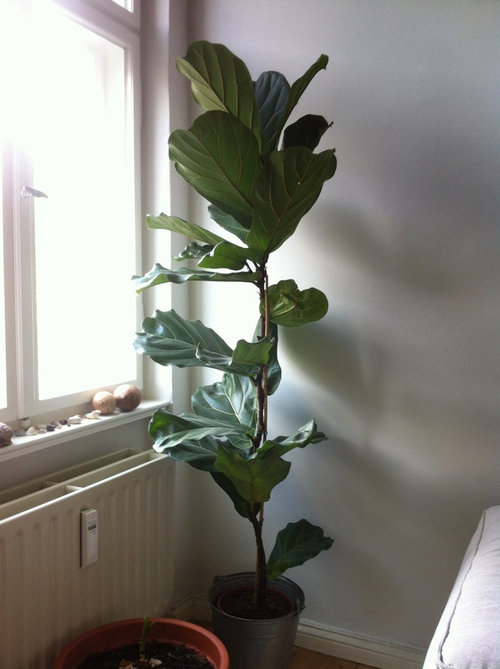

Hello

I'd love some pruning advice for my Fiddle leaf fig.

My tree has a single trunk which I think will soon be too skinny to handle weight of new leaves. It's already top heavy and beginning to lean over. I want to create something with a strong vertical self supporting trunk that can handle some branching at the top. Ideally I'd like mine to look something like these other 2 pictures below - 3ish branches and a tall solid trunk. It's spring here in Europe so I think a good time to act?

I have just noticed a new single branch has occurred (you can see this in the photo of my tree at top - the 2 little leaves pointing at the window 3/4 of the way up trunk are part of this new branch).

Should I lop the top off the tree just above this new branch? or to ensure a stronger trunk do I need to be a little more ruthless and lop the top off further down like halfway up ?

And should I make the cut below a leaf (leaving long piece of trunk at top, or just above a leaf so there is less bare trunk sticking up, or roughly halfway between leaves?

Also can I repot and prune the roots at the same time as lopping the top off? Or should re pot and root prune be done next spring to avoid shocking the plant? Also when pruning roots is a good approach to cut away the big thicker roots and preserve the small thinner ones, or remove a combination of both?

Many thanks for your help


Comments (3)

  • 11 years ago

    Sorry! I got your email a day or 2 ago, but my time here has been limited - been digging post holes and setting posts for more bonsai grow benches - not used to such hard work after the long winter. Finally a summery day today with temps above 70*! Rockin'!

    You're caught in a catch 22 situation. It's the amount of food the tree makes that determines how thick/strong the trunk is, and the leaves are the food factories, so eliminating them actually slows down trunk thickening. Light is actually the key to upright ficus retaining the ability to support the canopy. For now, concentrate on getting the tree in the best light you have (outdoors is best), and don't remove the leaves on the lower trunk (they're strengthening/thickening it).

    Other than support the trunk mechanically, your only option is to cut the tree back. This works because 1 degree of deflection in a 3 foot tree is a bend of only 3/5 the deflection in a 5 ft tree, AND, a 3 foot stick is harder to bend than a 5 ft stick because of the difference in leverage.

    Don't lop off the tree just above the branch. Ideally, you would remove a leaf or two just above the new branch, and tie the new branch to the current main trunk so it starts to grow upright. Essentially you're using the current trunk as a stake. Once the new branch is 'set' and growing vertically on its own, you can sever the current trunk just above your new leader. Alternately, you could simply remove the leaves above the new branch on the current leader and leave a stub tall enough to tie the new leader to. You can move the new leader gradually by tightening the cloth ties that secure it to the old leader every week or two.


    That's exactly what I'm doing here on this Korean hornbeam I grew in an area dedicated to large bonsai starts - only I'm doing it on a large scale. Bonsai trees need to have a LOT of taper. Part of the branch on the left will be purposely thickened and used in the composition. Originally, that branch was almost horizontal. It needs to be moved about another inch toward vertical, which I'll do by continuing to tighten the wire. You could also use wire if you cushion the new leader with soft cloth. No need to cushion the main trunk, because that's going away in a month or 2. The new leader (my tree) hasn't erupted from the small branch yet. ALL of the trunk above the branch I'm bending will come off once the branch is fixed in place - at least a year.

    You can do the pruning work you decide on now, then repot in mid-Jun if you like. This thread, about maintaining trees in pots, will help you with the root work. If you still have questions, ask here or there. DO stop back before you do the repot, and use the time between now and then to figure out what soil you'll use - a very important consideration.

    I realize the problem with following my advice lies in the fact you need to do things to the tree that temporarily make it less attractive in order to develop something you can build on. I understand that it's normal for you to look at the tree now and me to look at it with an eye that sees it several years from now, so if you feel like you can't bear to start whacking away at your tree - I get it, I really do. The main consideration is that you feel comfortable and optimistic about anything you do.


    I hope that helped.


    Al


  • 11 years ago

    Hello Al and thanks for such a terrific detailed response.

    I'm certainly prepared to sacrifice short term looks for a better shaped tree in the long term. Can you clarify why I should train the new branch to be the main leader?

    Is this because when I eventually sever the current trunk just above the new leader, it will stimulate new branches at the location of that cut?

    If not, how would I generate multiple branches given my desire to develop a tree like the references above?

    Is it possible to train the new branch as you suggest and also stimulate different new branches below this new branch? The reason I ask is that, after having a good look at the tree (and its lean) again, I think creating new branches above the new leader will still result in a top heavy tree that is in danger of not supporting it's weight. Or should I have more faith in the fiddle leaf's ability to branch out in a way that will be able to carry the load?

    Attached is a pic showing the state of the lean.

    Enjoy that sunshine and thanks again!


  • 11 years ago

    I suggested you train the new branch as the new leader because it's convenient - it's already 'there' and in a position that seems it would allow you to shorten the tree enough to prevent the deflection in the trunk. There is nothing to stop you from cutting the tree back further if you like ...... or not as much. Your options in that regard are pretty much un limited. If it was my tree, I'd cut it back to just above the first healthy branch, but that's because I appreciate a lot of taper in a tree - itsa bonsai thing.

    Branches aren't likely to occur at the site of the truncation when you top the tree. Instead, new branching will occur from axils (crotches) of existing leaves for several branches proximal (closer to the roots) to the truncation.

    After the new branches form and have grown out so they have 3-4 leaves, you cut them back to 2 leaves - you don't allow them to grow long. Then, new branches occur in THOSE axils. You allow them to grow to 3-4 leaves and then cut them back to 2 leaves. This is how you build ramification (lots of leaves and branches) into the tree. Soon, you'll be REMOVING branches that don't compliment the tree's appearance.

    "Is it possible to train the new branch as you suggest and also stimulate different new branches below this new branch?" If you wait until summer, that SHOULD occur when you cut the top back, but there is no guarantee. If the new branch cum leader has at least 3 leaves on it, cutting that back to 2 leaves will help (a lot). If you do that, you'll have removed the primary source of a growth regulator (auxin) that suppresses lateral growth (new branches). To some degree, the tree will branch on its own. If the tree is growing robustly and has lots of energy reserves, it's almost like it doesn't know what to do with all the energy/food it's making, so it has to grow new branches so it has a place to store it. That's not technically true, but it's close enough and easy to remember.

    You can easily correct the lean in your tree by changing the planting angle when you repot it, or by utilizing directional pruning. If you look at the picture above, the new branch forming will grow to the right. If the cut was lower so the new branch grows from the leaf axil on the left, it will grow to the left. You could forget the new leader and cut the tree back to a leaf that is pointing toward a vertical line from where the tree comes out of the soil. This will balance the tree and put it's visual weight back over the tree's base. I think trees with movement (curves or angle changes) in their trunks are much more interesting in standards (straight trunks).

    Al