Software
Houzz Logo Print
mksmth_zone_6b

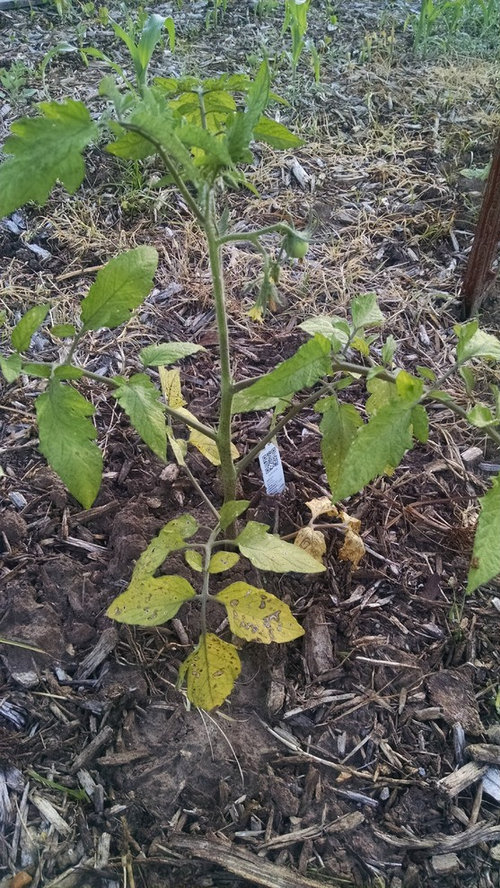
tomato issues already??

These have been in the ground for about 3 weeks. No temps close to freezing but has been 40's at night and of course good rainfall.

Some of the others look a bit worse. I hope with the heat and dry we are having they might start looking better. Im cant remember which one this is. Might be the Rutgers


Comments (5)

  • 11 years ago

    Already? Absolutely. Sadly, whenever there's a lot of moisture like we've had in April, tomato plants are prone to many issues. Various diseases can be bacterial, fungal or viral in nature and diagnosis by photo is not necessarily easy unless another person has dealt with an identical issue in the past and has experience with it. Identification by photo can be further complicated by the fact that you often have more than 1 thing going on at the same time.

    I am assuming your plants were once a healthier green and then all the rain fell and a few cold nights worked their way back into the forecast and everything sort of went downhill from there?

    It is likely the yellowing on the lower leaves is related somewhat to excessive moisture (I am not sure if you have had excessive moisture, or just average moisture, but I've had excessive rainfall and have been watching my plants closely because of it). Often, when we have really wet soil, the water itself clogs up the roots of the plants and interferes with their ability to take up nutrients from the soil. This can result in plants that are growing in a sluggish manner and have poor color. Cold nights can combine with the excessive rainfall to exacerbate the problem. If this is what is going on with your plants, it will largely self-correct and their color will improve and their growth rate will improve as the soil dries out (if it gets a chance to dry out).

    Regarding the spotting on the foliage, I'm not going to attempt to diagnose it because of the reasons I mentioned above, but I'll tell you what I would suspect if I saw something like that in my garden. I'd first look at the bacterial diseases common here in spring----bacterial speck and bacterial spot. I'd read the descriptions of each and compare their symptoms to what I was seeing on my plants. I'd try to find photos at a University/Extension website to compare them to what I was seeing to see if I could find a match. Then, if neither of those seemed to fit, I'd look at Grey Leaf Spot as a possibility. There are lots of other options, but those are the three that seem most common here at this time of the year.There are many websites that have photos of tomato disease symptoms, and I usually start with the one linked below. Another good one is Cornell Vegetable MD Online. In the OSU Fact Sheets, there are three different ones that deal with diseases, pests and physiological problems. I am sure you can find them by googling. While it is hard to narrow it down to a specific type of disease since often their symptoms are overlapping or similar, it is important because there are different types of treatments for different types of diseases. If your plant has a fungal problem, you need a fungicide. If it has a bacterial disease, a fungicide wouldn't help, etc.

    Even without a specific diagnosis, I'll tell you what I'd do. I'd remove those lower leaves with the yellowing and the spotting and would dispose of them in the trash, not in the compost pile. Then I'd spray the plants with the fungicide of my choice (I'll explain that in a second) whether I thought I was dealing with a fungal issue at this exact moment or not. I'd put down 2 to 3" or even 4" of mulch as soon as possible. Now, this is tricky if your soil is very wet. It is better to leave it unmulched so it can hurry up and dry out before it rains again. However, many diseases reside in soil and when it rains, the raindrops hit the ground and splash the disease up onto the leaves. So, you'll have to decide for yourself whether it is more important to you at this point to get the soil to dry out or to mulch to avoid soil splash.

    Regarding the use of a fungicide: nothing you do will help your plants more, but 9 years out of 10 I don't spray mine with a fungicide because I prefer to eat food that has not had anything sprayed on it. I'm just stubborn and pig-headed that way and often my plants pay the price for that by contracting Early Blight, which is not what I see on your plants. So far, we've been a bit too cool for EB to develop so far, but now that it is warm and sunny, EB may start hitting our plants soon. Some years I don't see it much at all (usually in the hotter, drier ones), some years it arrives in June, and some years in arrives in May. If you prefer to go the chemical route, the fungicide of choice for tomatoes is Chlorothalonil, which is found in Daconil and Ortho Disease Control, to name two. If you prefer to go the organic route, Serenade likely would be your best bet. Neem oil also has fungicidal properties.

    Because it is easier to prevent fungal diseases than it is to cure them once you have them, in a very rainy year, or at least in a very rainy spell in spring and summer, it probably is always a good idea to spray your plants with a fungicide. For that reason, I bought a product with chlorothalonil and sprayed my plants with it yesterday, hoping to prevent the fungal diseases from developing for as long as possible. I'll probably spray about once every 10 days from now through the end of June, which tends to be when my rainy weather ends. Most years I absolutely avoid the use of a chemical fungicide, but as I sat inside on so many days in April and watched it rain day after day, and watched it stay foggy, misty, drizzly, etc. on so many other days when it wasn't actually raining hard, I knew in my heart that I could choose (a) to start preventive treatment with Daconil or something similar or (b) to do nothing and to sit and watch Early Blight develop and quickly take over my potatoes and tomatoes in the next week or two. This year I chose (a). I have used Serenade in the past and found it fairly effective in drought years when disease pressure was low, and not nearly as effective in wet years when disease pressure was high, so I made the choice I felt was best for my garden.

    Spraying anything on my plants is not something I take lightly. It makes me anxious because I hate using chemicals. I look at my beautiful plants and hate the very pale whitish-grayish residue that the cholorothalonil leaves on the plants, but I'd hate Early Blight a lot more. The fungicide needs to be sprayed on the tops and bottoms of all foliage and on the stems in order to deny the fungi a place to attach to the plant.

    If you think you have found a diagnosis for the spotting on the leaves, you'll see that each type of disease has a different sort of treatment (if a treatment is available at all). Regardless of what it is, though, removing the diseased leaves will slow down how quickly it spreads, but just removing the leaves isn't enough as the disease is clearly present somewhere (or your plants wouldn't have it) in the air, soil, water, etc. so can continue to infect the plants. I usually keep Green Cure, Neem, Serenade and Copper on my potting shed shelves at all times because they are good products that help fight various diseases.

    As thrilling as it is to have rainfall, I find it a whole lot easier to grow tomatoes in drought years than in rainy years. In the drought years, it is easy to solve the big problem (lack of rainfall) with drip irrigation. In the rainy years, water on the foliage causes tons more problems, and each type of problem needs its own solution. Still, the rainfall is here this year, and my drought is over and gone, and I'm not going to give back the rainfall and fall back into drought voluntarily. I'll just do what I can to keep the plants healthy.

    I haven't seen any real disease issue on my tomato plant foliage, other than a tiny bit of bacterial spot about 3 weeks ago, but I found Early Blight on two leaves of one potato plant yesterday (which is why I sprayed the Ortho Disease Control on the potato and tomato plants).

    I hope you can figure out what is causing the leaf spotting on your plants, And, for what it is worth, I don't think it is Septoria Leaf Spot, so maybe that helps you rule out one possibility. In my garden, Septoria doesn't usually appear until June in the years it appears at all. I think the last time I had a serious case of Septoria was way back in 2008.

    I don't know if anything I said helps, but I hope it does. I absolutely hate to try to diagnose tomato diseases by photograph (including my own) and have found it helps if I break off a diseased leaf and bring it into the house, sticking it in a glass of water so it won't wilt, and then sit here at the computer with it beside me or while I'm looking it up in my tomato disease book. It is astonishing to me how many diseases can look similar to one another, and by the way, sometimes something we think surely must be a disease is not----it is instead a physiological issue, environmental damage or pest damage. Examine all the possibilities and rule out each possibility one by one.

    Dawn

    TAMU Tomato Problem Solver

  • 11 years ago

    My plants that were in the wettest part of my garden started looking the same way on the bottom leaves. I removed those branches and the plants are putting on new growth that looks healthy. The plants on the 'high' side of my garden which were put in first are looking just fine, and the later ones put on the wet side look healthy as well. What looked like spots on mine were actually little holes. I hope I don't have a disease this early.

  • 11 years ago

    Dawn. what would we do without you. Seriously the knowledge you share is nothing short of amazing. Im going to start with some pruning and see how it goes. I too dont really care to spray a lot of stuff on any off my edibles.

    soonner, that encouraging to hear. thanks!

  • 11 years ago

    I just thought that was normal with all the rain we've had.

    I do a foliar spray at planting, fruiting stages, and on occasion when the plants start looking a little stressed.

    Epsom Salts and Fish Emulsion are normally what I mix for a foliar spray. If I ever get around to ordering the rest of the stuff to mix up Garret's Juice I'd like to see how well it works.

    Over the last 20+ years on this garden area, I've been fortunate enough I haven't had to deal with much in the way of fungal or viral issues.

  • 11 years ago

    Carol, Might they be flea beetle holes? If you aren't seeing flea beetles, it could be bacterial speck or bacterial speck. The center of each little speck or spot rots away leaving a little hole. Both bacterial speck and spot develop a very specific cool temperatures, and I rarely see them here because most years we don't stay in that temperature range very often. This year we probably have, but I haven't seen them here (knock on wood). I did have a couple of tomatoes with some sort of spotting on lower foliage and I didn't know what it was and was too busy to take time to try to figure it out. I cut those lower diseased leaves off the plants and disposed of them, telling myself that if it popped up again, I'd take the time to try to figure it out. It didn't pop up again (yay!) so I just chalked it up to cool, wet weather.

    Mike, I just hope you can figure it out. My problem with disease diagnosis is that I rarely see the same thing twice (except for Early Blight), or I see it once every 10 years, so I don't have a lot of experience with diagnosing.

    Bruce, I was perplexed at first when we moved here and Early Blight just seemed to pop up out of nowhere. I never had much trouble with it in Fort Worth, although in my dad's garden less than a block away, Septoria Leaf Spot was an issue every year so I do tend to recognize that (sometimes) when I see it. Then, I looked around our pastures one day, and in the roadside bar ditches, and realized all the native solanums had EB too---and not just in our pastures and bar ditches, but in everyone's. So, since the fungal spores go airborne and spread easily, I figured out where it came from. I just don't worry or fret about it too much because usually we get dry in June even if spring was wet and it spreads less and kind of just peters out and goes away. Because our April rainfall was almost 200% of our normal April rainfall, I decided to not take any chances and to go with the chlorothalonil. I'm going to try hard to stick with it and appreciate having less disease.

    What usually happens in any given year is that I say to myself, to Tim and to anyone who will listen: "This year I am not going to mess around and wait for Early Blight to show up. I am going to spray Daconil and prevent it from becoming established." Then, even after saying that, I don't do it. Then, when the EB is running rampant in June or July, I am kicking myself for not doing what I said I'd do. So, this week I decided I'd just do it. I did leave one row of cherry tomato plants unsprayed for a very specific reason: they are my garden Gatorade in the summer as I pick handfuls of cherry tomatoes in the garden and eat them while I work. Had I sprayed those plants, I couldn't eat from them without thoroughly washing the fruit. I guess it is good to have those plants as a control anyway, so I can see if the plants sprayed with Daconil actually do stay healthier. Since I rarely use it, I am not sure how well it will work. I have spent my whole life avoiding the use of Daconil, and I guess I am at the point where I think that using it might be worthwhile if it means I don't have to spend a lot of time in June removing diseased EB leaves from the plants.

    I like Garrett Juice. I used to mix it up all on my own, for maybe 5 or 6 years. Then, one year I just bought the concentrated pre-mixed Garrett Juice and used it, diluting it per the label instructions. It was such a time saver! I do use liquid seaweed a lot, as well as compost tea, and I usually have molasses on hand and orange oil too. It was Howard Garrett's radio show, books and newspaper columns that turned me into a mostly organic gardener. I'll never be 100% organic, but I am pretty darn close to it most years. I also like to use fish emulsion, but the smell attracts cats like nobody's business so I don't use it as much as I used to.

    Early Blight is really my only recurring tomato problem. Since it is endemic on native plants, I suspect it always will be an issue. I almost never have viral issues, and don't see bacterial issues a lot. I get spider mites every summer, but then they are on every plant on our property, including bermuda grass, so I don't take it personally. I don't even treat the plants for the mites. Once the mites are really bad, it is so danged hot and I am so tired of canning tomatoes, that I just don't care if the plants die. (They look like crap from spider mite damage, but remain productive and don't die, so why worry and fret over the mites?)

    Every disease that hits my tomatoes seems to happen about once in a decade, and often it is just an issue on one plant. I have seen Southern Blight, exactly once and it was on a Southern Nights tomato plant in either 1999 or 2000 and I've never seen it since. I had Septoria Leaf Spot on a bunch of plants in 2008. I had bacterial wilt in 2007. I had tomato spotted wilt virus on one plant in one year, but at that time it was not a well-known disease and I couldn't figure out what it was (in those pre-internet days). Years later I saw photos of plants and tomatoes with TSWV and had an "Aha!" moment and realized it was the disease I had seen about 10 years before. It just seems so random, but I'm not complaining. There's tons and tons of tomato diseases I've never seen first-hand, and hope to never see. The same thing happens with pests. I've had tomato pinworms on my tomato plants exactly one time in my life. I've never had whiteflies or russet mites. You'd think the same things would hit every year, but they do.

    Even though heat and drought make me crazy some summers, I bet they get the credit for the fact that diseases tend not to run rampant and spread all over even when I do nothing to treat the plants except to remove diseased foliage. I know people who have one wilt disease or another every year like clockwork and I don't know if it is endemic in their soil or why they constantly have to deal with it, but I'll take EB any day.

    I am grateful that Late Blight is so rare here. I've never had it on my plants and my dad never had it on his plants. so I've never seen it first-hand. We are so fortunate here that our temperatures usually are not in the right range for Late Blight to develop during our tomato growing season. It just devastates tomato plants in some climates. I've had friends mournfully tell me that their plants have been hit by Late Blight, and then I look at their plants and what they actually have is grey mold or black mold, not LB.

    Even with Early Blight showing up at some point on tomato plants every year, I never see it on my pepper plants, even though they are susceptible to it....and even when the tomato plants and pepper plants are growing side by side.

    I do work harder nowadays to space my tomato plants properly, or more properly than I used to. Growing too many plants too close together does allow EB to spread rapidly, so I am trying harder to grew fewer plants with better spacing. In our early years here when the soil was not in as good of a condition as it is now, the EB was very hard on the plants. Nowadays, with better soil health, it is more of a visual annoyance than anything else, but I doubt I ever will get the soil in such good shape that the EB never shows up.

    Dawn

Sponsored
Peabody Landscape Group
Average rating: 3.5 out of 5 stars8 Reviews
Columbus' Reliable Landscape Design & Contracting