Software
Houzz Logo Print
sans2014

variegated question

11 years ago

Are variegated African Violets more difficult to keep healthy than solid green leaved

plants?

Comments (32)

  • 11 years ago

    The well being of any AV depends upon its growing conditions & expertise of the grower. I don't believe variegated ones are less healthy but they sometimes are subject to browning of leaf margins when conditions are off. I grow a number of variegated ones. . . some varieties are more challenging than others. However, some green leafed varieties can be equally so. Heavily variegated types may grow more slowly than their green counterparts but that is because of reduced areas of chlorophyll not lack of health.

    Terri

    Sans2014 thanked terrilou
  • 11 years ago

    What Terri said.

    I've had completely green leafed plants collapse on me, where variegated ones didn't flinch. and the opposite as well. so for me it depends on each variety, not leaf type.

    for show plants, i think it is harder to maintain uniformity of variegation throughout the year (temperatures and fertilizers both affect the amount of variegation) and it's easier to spot a culture break or anything iffy on variegated foliage.

    so keeping them alive and healthy is no more of a problem than with green leafed varieties, i think, but keeping them flawless is an art.... but then again, same for solid leaves...


    Karin

    Sans2014 thanked Karin
  • 11 years ago

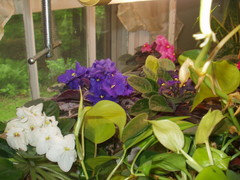
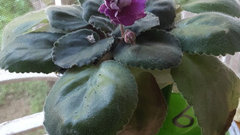
    The variegated African Violet in the picture does not look like this at the moment, the photo is from last summer.


  • 11 years ago

    You can't judge them all from one plant. In that fashion I could say all solid leafed plants are duds because rhapsodie Natalie keeps rotting on me...

    I am also sure I had duds of certain varieties. Plants that just weren't as vigorous as they should have been. Live, learn, decide what is worth the trouble and what isn't...

    Sans2014 thanked Karin
  • 10 years ago

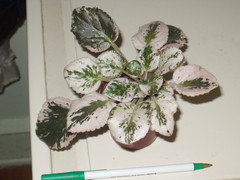
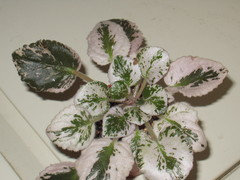
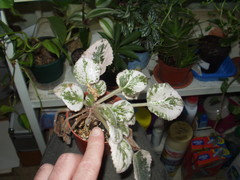
    I can't find my old post on this little guy, so I'm posting here instead.


  • 10 years ago

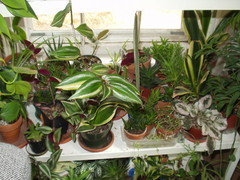
    same plant, but where he lives!

  • 10 years ago

    That is some beautiful variegation! Now I am no expert on this, but I would think if you plan to propagate from that violet, I think you should pick the leaves with the most green in it. Some white is ok, but I would use those greener outer leaves. Just what I have picked up from reading posts.

    Oh where is Irina & the gang when you need them????? Rosie

    Sans2014 thanked Rosie1949
  • 10 years ago

    In my very limited experience, I took 2 outer leaves from my variegated plant and it took 6 months before I started seeing baby leaves. My variegation is different from yours, however, so that might make a difference. None of my plain leaves took anywhere near that long. On the other hand, my variegated mini did not take any longer than my plain ones. Your plant is lovely, by the way.

    Sans2014 thanked Royals fan-MO6a
  • 10 years ago

    Oh hey Royals fan,,,,,I have had leaves that have taken longer than that! Not that it makes me happy,,,,but they eventually delivered!

    And they were plain green! But my issue is my leaves need more light and they would root faster I am sure. I am working on an artificial light. Have to get a timer. Keep forgetting that!!!!! Rosie

  • 10 years ago

    Wow! I just figured they were slow because they were variegated. I only have natural light which has been ok but it's pretty weak during the winter. This winter was a mild one though. I have found that patience is key.

  • 10 years ago

    No it can happen to either. And I have the same problem. Window space goes to plants. Back a little farther goes to leaves. I do rotate them so everyone gets a little something. As soon as I remember to get that darn timer I will be better off! lol Rosie

  • 10 years ago
    last modified: 10 years ago

    Sans 2014,

    Is your variegated plant the same one that is in full bloom with medium tome bright purple flowers in the photos from last year? If yes, then it looks like Optimara Modesty, in both the color of the blooms and the pattern of the variegation of the leaves. I have that plant. So does Aegis who might give you his opinion.

    It tends to be far more fragile than an Optimara with all green leaves, but less fragile than non-Optimara AVs that have a lot of variegation. That and the big cloud of bright purple blooms makes it one of the most popular AVs of all time. You are fortunate to have it. Your instincts are correct, an AV with that much variegation needs monitoring. The inner leaves start out with more white, then slowly turn green. If you have concerns about the ability of the AV to thrive, you can add Epsom Salts to the water you use. This is good to do when the plant has stopped blooming and is resting a bit and working on growing its leaves. I forget the exact portion, however, it is very small. Maybe 1/4 tsp to a gallon of water. But I would have to look it up. I am planning to do that to my AVs showing the amount of variegation your plant has. I don't want to take a chance on losing them. Personally, I would not remove any leaves at this time for propagation, because it is the green leaves that are supporting and feeding the rest of the AV. An expert member of my AV club would say that the more white the more fragile the plant and the slower to grow. So, variegation is a fluctuating trait that can be changed. It appears and disappears. Those who succeed with heavily variegated AVs are also excellent growers. For "average growers, " like myself, I tend to green up the AV until it has achieved substantial growth, only then do I allow the variegation to develop in the newer crown growth. Now, you did not ask if bloom color affects fragility with variegated plants. In my opinion, yes, I think Optimara Modesty does so well and blooms so profusely because it has somewhat traditional purple blooms. The blooms have not been tampered with genetically as much as the pink blooming variegated plants. In general, the most stable and strong performing AVs are the purples and blues compared with the pinks. Joanne

    Sans2014 thanked fortyseven_gw
  • 10 years ago
    last modified: 10 years ago

    Thank you Joanne

    I did post pictures of this plant last year.

    This plant has history, I have brought it back from the brink of the abyss at least 3 times. That is why it is on the shelf it is on so I can see it every day and stick my finger in the dirt when ever I think it needs water. This poor little guy needs me to pay attention to him, when he doesn't get it he gets in trouble really fast.

    Water is the issue, too wet then over compensation too dry and the down ward spiral begins! That is the usual thing that happens. I tried rooting a broken off leaf last summer. Had a nice yogurt cup with a lid (both opaque from a granola kit type yogurt), but I left the lid off too long one day and the humidity dropped and that was all she wrote.

    Fred

  • 10 years ago

    Yup, I forgot to mention that watering seems to be the most critical factor with variegates. I wondered why your AV got small compared with the photo of it iin full bloom last summer.

    Bringing it back from the brink, I know that one well. If it is Modesty, I ordered one from Optimara directly. Usually, they have extraordinary packing, but that ONE TIME, the AV arrived all tossed around and bruised. I tried rooting the broken leaves, no luck. The papa plant did not do well, not matter where I placed it but I did not think to dome it.

    Then last year, I got one locally grown at an AV club sale. It has done very well. However, once I found the right spot, I don't move it. It is alone with only two others in indirect light. It seems to want to be the center of attention. You are right, I must stop by every morning and tell him how handsome he is or he pouts. My other Optimaras thrive on a little neglect, but not this champ.

    It is worth the trouble, as unusual and yet familiar with the purple blooms. I would like another, but not from propagation, maybe from a plant sale. I think if it is locally grown in a greenhouse, then it is acclimated to my environment and has a better chance of thriving. Joanne

    Sans2014 thanked fortyseven_gw
  • 10 years ago

    I think the issues are covered. Keep leaves in humid environment - means covered, bagged etc, give them warmth and a moderate amount of light, variegated leaves take longer, old leaves take longer. So the necessary component is a truckload of patience for the grower. I do not where they sell it - but we all need it.

    Sans2014 thanked irina_co
  • 10 years ago

    Sans2014, I have just re-read these posts and something jumped out at me. I wish to make a suggestion about (not shouting,,,enunciating) "STICK MY FINGER IN THE DIRT,,,,,,".

    In my opinion I will never stick my finger in any plants soil to see if it is damp below the surface. It seems to me that when you do that, you risk breaking the very fine feeder roots that are continually trying to form to sustain growth! Imagine breaking roots every 3-4 days or so. That is a lot of invasive testing for water. Now maybe you don't go down very far, but to me 1/2" is 1/2" too far.

    Here is an alternative. First, when you water a plant of any kind, you should water until it is free draining and then let it sit in the water for no longer than 1/2 hour. Then drain the container. Then hold the plant and feel how heavy it feels at that moment. As time goes by, water will be used, the plant will feel lighter and lighter. You don't want it totally dry (you will get the "feel" for that point). Then you water and soak again.

    There are other ways, but never, IMHO, should a finger be pushed into a pot of anything.

    Another method is wick watering. And yes it does well with variegated and green leaved plants. Almost all of my violets are now on wicks and there are a lot of past posts on the subject. The only thing you will have to do is change up the soil a bit.

    You may find you won't have such a struggle with watering if it is on a wick system.

    This is just my opinion, but more and more people have posted that it does work better! If you need any help or more information about it feel free to ask me. Or anyone on this forum. We are here to help out!!!! Rosie

  • 10 years ago

    And just to endorse what Rosie had said I have tried growing them for over three years with hardly any success.

    And since the beginning of this year I just decided that I was gonna try wicking and it made all the difference I now have very healthy plants which are now starting to bloom or in bud.

    And the only thing I need to do is refill the reservoirs. It don't get more simple than that.

    Yes you would need to ensure your soil mix is very light so lots of perlite. But trust me for me, I can't keep them alive otherwise.

    And I have the years of failure to prove it. :) Velleta

    Sans2014 thanked Velleta Tardiel
  • 10 years ago

    Hey Velleta! Glad to hear you are still doing well!!!!! Rosie

  • 10 years ago

    Just waiting on some blooms to post a few pics. Don't want to board you guys with just nice shiney leaves:) Velleta.

  • 10 years ago

    Velleta,

    By wicking, I am guessing that your recommending the use of the glazed pot that sits inside a glazed pot with a water reservoir at the bottom, yes?

  • 10 years ago

    Hi, well some people do that but I live in Jamaica and don't get those pots here.

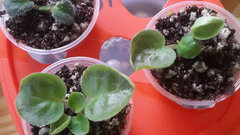
    So I use a plastic pot depending on the size plant and string a wick through ( I use the knitting yarn) then just place on my resorvior. Ta-da. All done. You can use anything that has a cover and just cut two holed in the top, one for the wick to go down in the water and the other for refilling the container. VELLETA


    those are two pics of mine so you see what I mean.

    Sans2014 thanked Velleta Tardiel
  • 10 years ago

    Just an after though. It was already mention but cannot be over stated. In order for wicking to work properly the soil must be VERY light and fluffy.

    So I use twice the amount of perlite to soil. Also don't pack it in just put it in around the plant give a good watering so the water run down on the wick and then place it on the resorvior.

    This will also help the wick to start pulling up the water to the plant. Hope this helps. feel free to ask anything your not clear on. We are happy to help. VELLETA


    Sans2014 thanked Velleta Tardiel
  • 10 years ago

    very good tip: LIGHT and FLUFFY! Is that a cotton yarn or do synthetics work too?

  • 10 years ago

    No cotton, it rots easily and will get clogged so the wicking stops working.

    Synthetics works much better and also last longer. Also depending on the size of the plant you can unravel the yarn and use one strand for suckers, and two or three strands for bigger mature plants.

    I learned from the pros here. This also helps to control the amount of water taken up to the plant.

    So the plant can never get over water because it pulls the water as it needs it. VELLETA

    Sans2014 thanked Velleta Tardiel
  • 10 years ago

    very nice looking plant! Do I see a Variegated leaf sneaking into the picture there?

  • 10 years ago

    Looks like a very pretty blue! And yes!!! I see it too!!! A variegated leave at 2 o'clock!!!!! Yay!!!! Rosie

  • 10 years ago

    Yikes!

  • 10 years ago

    Variegated plants are generally weaker than their green leaved sisters, They should be babied. Your natural light shelf is occupied by multiple plants which took most of the light - you stuck this one in a 4th row from the light behind a tall Sanseveria which left this little variegated plant deprived of light - and it is already has 2/3 of leaves variegated - means it is already 2/3 less strong.

    Yeah - you can save it it - if you repot it, and give it a better place and space. If you do not have the privileged place for this princess...too bad.


    Sans2014 thanked irina_co
  • 10 years ago

    Well, I am all for trying to save a plant if possible. Here is what I would do.

    Very gently take all the dead and dying leaves off. Leave as much of the crown as you can. Plant may look a little lopsided during recovery but who cares!

    Now, unpot plant, gently shake off excess soil, and repot. At this point I would put it on a wick system with 1/2 favorite potting soil and 1/2 perlite in the smallest pot available that will hold the roots till it can recover and start growing again.

    If wicking is not your thing, I would repot in your favorite soil mix, but just make the soil BARELY damp. And I cannot stress barely enough. Put it in a baggie and keep a good eye on it. Make sure it is not too damp. When it starts to actively grow, wean it off the baggie system.


    Those are the two methods I can think of at the moment that I would do. But I would try. Good Luck Fred!!!!! Rosie

    Sans2014 thanked Rosie1949
  • 10 years ago

    I put the little guy there so i could keep a closer eye on it. The light in winter is fairly good in that spot, you have a good point about poor light and variegated plants. The sun no longer comes so far into the room as it id in say January. I'll be shifting things around anyway as it is soon time to put some of my collection outside for the summer. I'll find a place with good light for this guy as it is unique and must be saved. This is an irreplaceable plant, I've never seen the like before and certainly not in the big box stores.

    Rosie, I'll repot it soon and let you know how the roots are. Still mulling over the whole wicking technique. I would hate to lose this guy.

  • 10 years ago

    I love wicking,,,takes the guesswork out of watering for me! Just remember the mix has to be really light. 1/2 and 1/2. Look up the wick discussions and you will understand better. Still your choice, but it did work for a person named Velleta in a really hot climate!!!!! Rosie