Software
Houzz Logo Print
lindsay_ke

South-facing foundation plants

11 years ago
last modified: 11 years ago

Ok, so I've spent the last year building up the north side of our house, and now I need to plant on the south side but am not as familiar with full-sun plants. All I can come up with to plant there are Indian hawthorne or knock-out roses. Any other ideas? Would one of those work well?

I'm in the DFW area.

Comments (13)

  • 11 years ago
    last modified: 11 years ago

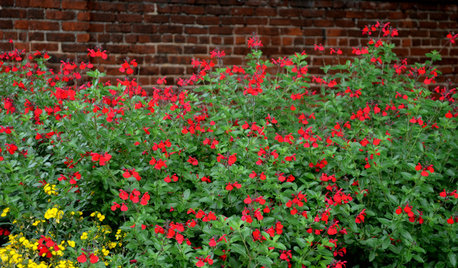
    I have been thinking Rosemary. It's so easy, and Salvia Greggii. I'll look up the other ones. I think part of the problem is that I don't know how to arrange the plants to make it look nice and organized.

  • 11 years ago

    Salvia X trident has silver leaves like Cenizo but blooms dark blue in the spring whereas Cenizo blooms in summer Evergreen sumac is an under used native that takes trimming very nicely and needs no water in Central Texas once established. I also like mountain laurel. Agarita and Texas barberry, Salvia repens west Texas form.

    Lindsay K thanked wantonamara Z8 CenTex
  • 11 years ago

    Oh yes, I love the salvia trident!

  • 11 years ago
    last modified: 11 years ago

    Nice suggestions. Probably should look for 'Arp' or 'Hill's Hardy/Madeline Hill' rosemary cultivars for their cold hardiness in north Texas. Also, noticed winter leaf retention varies a lot among our S. Greggii varieties, so might have to try a few different ones on your site if that's important. 'Furmans Red' hangs on pretty well for us, while our unnamed natives drop the most.

    Abelia usually remains evergreen in DFW, does well in the clay, and now has cultivars in a number of sizes and leaf color variations. Tough once established, though can't handle a 2011 like dry heat wave as well as the previously mentioned without some irrigation, but better than Indian hawthorne.

    Gaura is another long blooming option. The native varieties seem best in meadow/natural plantings, but there are a number of newer cultivars that could also fit nicely in a more traditional foundation bed. 'Snow fountian' is one with nice upright shape, long blooming white flowers, and stems that can turn an attractive red in the fall.

    Dwarf yaupon is another tough evergreen that can handle full sun, though no flowers/berries on these.

    Lindsay K thanked bostedo: 8a tx-bp-dfw
  • 11 years ago

    I'm having great luck with cenzio too, and fall aster though it's not an evergreen.

    Lindsay K thanked User
  • 11 years ago

    A lot of the cenzio I see in my neighborhood looks leggy and sparse. Any tips for keeping it full?

  • 11 years ago

    Grim it back a couple of times a year. Trim it hard in early spring and late winter. plant it in FULL sun.

    Lindsay K thanked wantonamara Z8 CenTex
  • 11 years ago

    Ok, that's good to know!

  • 11 years ago

    In an irrigated landscape or just under the roof line, cenzio receives too much water after it is established to maintain a full compact appearance. Just my experience. I loved my cenzio particularly after a summer thunderstorm but with just that bit of extra water from the drip line and the foundation watering the appearance wasn't what I wanted.

    Hardy Hibiscus with a little supplemental watering will do well along with Dwarf Yaupon and Bufford hollies, dwarf nandina but not the compacta, MINI Crepe Myrtle, Coreposis, Prairie Verbena, Coneflower, Needle Palm or Saw Palmetto if you can find it.

    Lindsay K thanked Cosmo
  • 11 years ago

    Ok, we do water our foundation during the summer. I may put a cenzio somewhere else in the yard where it won't get the extra water.

    I would *love* to put some of the dwarf crape myrtles along the foundation, but someone told me they should be 6 feet away? I was surprised by that since they're more of a small shrub.

  • 11 years ago
    last modified: 11 years ago

    "... dwarf crape myrtles along the foundation... should be 6 feet away"

    General comments are often made about CMs without clarifying their stature. Miniature or dwarf CMs have leaf areas similar to other like-sized foundation shrubs, so can be treated the same. Though another potential issue with planting dwarf CMs too close to a building is too much shade to flower reliably, especially if there is substantial roof overhang.

    We've had two dwarfs and three miniatures as foundation plants for a couple decades without problems and they were planted only 24 to 30 inches from the slab along the east face. However, we do have a drip irrigation circuit in those beds to maintain moisture around the foundation.

    One other observation is that the dwarfs (and larger sized miniatures) we've had always seem to mature to heights 1 to 3 feet taller than the range given on the label. Just something to check into if your vertical fit is tight.

    Edit: Mature cenzios in our Dallas neighborhood seem to get leggy at the bottom when they stop getting full sun as the surrounding trees grow. Bush germander (Teucrium fruticans) is a well adapted non-invasive silver-leaf alternative that seems to hang onto its lower leaves a bit better and can be left natural or sheared like boxwood. Though flowers do not stand out as nicely as on TX sage. 'Azure' is a better flowering dwarf bush germander cultivar that is supposed to top out around 4 ft instead of the 6 to 8 ft given for the standard variety.

    Lindsay K thanked bostedo: 8a tx-bp-dfw
  • 11 years ago

    That's great that you had good luck with your dwarf CMs, Bostedo. I think I'll try them! It gets hit hard with sun all day in that spot, the eve doesn't cover except in early morning and early/late evening. That's good to know about the azures too, I actually prefer that size anyways.

Sponsored