

Plantophobia?
This is a bit contentious, maybe. I'm just interested in your opinions.
There are some words which come up over and over again on the GW forums which I always find hard to relate to. They barely feature in garden literature over here and I'm wondering if there is something in the folk memory which makes people ambivalent about plants? Maybe a throw back to when nature was the enemy to a hard working, pioneering people battling to get established? And not such an issue here where the landscape was pretty much tamed centuries ago?
The words are 'invasive' (misused to mean vigorous or spreading)', 'out of control' (to mean getting a bit big for the space), 'ugly' (to mean quirky and not blob shaped) and 'messy' (applied to trees behaving naturally e.g dropping leaves). It's almost like a fear that the plants will get us if we don't keep them firmly in their places. Anyone care to comment? Or am I imagining this?
Comments (28)
 11 years ago
I don't read any British gardening websites or literature, so I don't have a lot of basis for comparison, but I think HGTV (and perhaps US culture in general) has a lot to answer for in this regard. There are many shows with make-overs of gardens using inappropriate plants for the space and never any follow-up a few years down the road. There is never any discussion of soil or maintenance or pruning or what happens with leaves and berries and rarely mention of why a plant was chosen for a particular spot beyond "curb appeal", a term I have come to loathe with regard to gardens. Instant gratification is everything with no regard for plants being living things that grow and change or any recognition of the need to research plants' growing style or cultural needs before plopping them in the ground. So then when someone plants in a similar manner at their own house, issues develop and the initial planting doesn't stay looking the same. I think that this is less true with folks who love plants and gardens, particularly when we have gotten over the first few years which often has a steep learning curve.
And even further back pre-TV, starting after WW II when houses began being commonly built in large developments, builders often put in the initial landscaping, so now there are many homes with badly trimmed or overgrown shrubs planted too close to buildings, etc. that may be many folks' main exposure to yards and gardening.
I also think you have a good point when you said, "Maybe a throw back to when nature was the enemy to a hard working, pioneering people battling to get established?" I do think a certain part of this is engrained in many of us in the US, that conquering nature to carve out farms and cities is a part of our culture. I've twice had folks ask if I was afraid to live in my rural area (an old farm that's mostly wooded.) I think some of the use of words like invasive as a replacement for garden thuggishness reflects a lack of understanding of basic ecological processes due to a combination of cultural and educational factors in the US.
Do I sound curmudgeonly enough? ;>)
I do think that many of the folks who come here genuinely want to learn about plants and gardening and are looking for healthy ways to maintain their yards for their families and whatever wildlife is around, however, which is part of what keeps me visiting GW. And I think that gardening literature rather than the informal writing and questions that happen here doesn't have the same expectations and uses of terminology outlined in your questions.
 11 years ago
I look forward to other responses, because I think the answer to your question could easily fill a graduate academic program. I wanted to comment specifically on the term "invasive." The wilderness that existed on the North American continent, before any European boats arrived on the eastern coast, had been in a state of uninterrupted natural development for millions of years. The Native Americans made no attempt to change or control nature, beyond hunting for food as it naturally occurred. When Europeans arrived, they had a predetermined idea of life that had been ingrained over thousands of generations since the time of the Mesoptamians (sp?). So, they set out to convert the new world into a world that they understood. In the process, they brought plants that were both useful from an agricultural sense, and ornamental. Since those plants had not evolved in the climates present on this continent, nor had they developed alongside the native flora and fauna, there was not the balance that had existed before. Some of those plants had the ability to grow much more successfully than the native plants. As a result, those newly introduced plants have, over the past few hundred years, spread over the areas where they are successful, and pushed out the native plants. As a result, the wildlife that had evolved over millions of years to depend on the native plants, are now threatened. Bees that survived on shallow flowers that blossomed in early May, can't feed their nursery of baby bees if the only thing blooming in May is a deep flower whose nectar and pollen are out of reach of their short proboscis. So, those plants that were introduced and have now "invaded" the native areas to the point they are negatively impacting the survival of native species of insect and bird, are labeled as invasive. While that is the scientific label, others use invasive to describe any plant that grows more vigorously than is convenient. For example, Trumpet Vine is a native plant that is prized by hummingbirds. But, it is so vigorous that it can literally pull down houses. But, technically, it cannot be considered invasive.
Of, course there is a lot of other development that has had a terrible effect on the survival of native species of plant and animal. But, those plants are even moving into the areas we have tried hard to set aside in an effort to preserve some of the wonderful diversity that existed and made this continent so valuable from a natural resources standpoint. But, I wanted to at least help out with the invasive terminology.
Martha
Related Professionals
Sebring Landscape Architects & Landscape Designers · Cumberland Landscape Architects & Landscape Designers · Knoxville Landscape Architects & Landscape Designers · Boston Landscape Architects & Landscape Designers · Cedar Rapids Landscape Contractors · Pittsfield Landscape Contractors · Missoula Landscape Contractors · Little Rock Home Builders · Effingham Home Builders · Jacksonville Home Builders · Vineland Home Builders · Danbury Home Builders · Scranton Home Builders · Los Angeles Home Builders · Merced Home Builders- 11 years ago
"Ugly" and "messy" are subjective; "out of control" less so, but still subjective.
- 11 years ago
Docmom said,"The Native Americans made no attempt to change or control nature, beyond hunting for food as it naturally occurred. "
This comment is off her main point, but I've read that fire was used by many of the precolonial indigenous people in N. America for land management.
 11 years ago
I live in South Dakota, US and I think that the situations and backgrounds are different between us, as you mention, and I also believe that we are shaped by our surroundings. I have never been to Britain, so what pictures I have of it in my mind are from literature and the media, which means nice little hedgerows with lovely gardens and and lawns between, or green fields with sheepdogs etc. Well, and Palace Guards and London, of course. I don't think that we have more pests, exactly, but what we do have that you lack is a continental climate. I think that to me it is climate that shapes us, perhaps with a big dose of youth as a nation with its hubris and high expectations as you say. There is a tornado somewhere in the US just about every day this time of year it seems, with a persistent background of drought in the one place in the US that isn't so predisposed to storms. I worried about certain Gardenwebbers during some previous hurricanes, and was happy to hear they were okay, but they were having to start over in their yards.
I also think that using the internet makes us all a bit more forthright and maybe "combative" than we might be if we just met in person. I don't think we would bore people with our problems so much face to face. I don't know what brought people to Gardenweb in the first place, but I have a suspicion that it was a certain problem they had that they just couldn't solve themselves. So that might skew this place towards complaining in general.
I also want to point a finger towards the Big Box stores where the majority of garden plants are purchased here. Do the majority of people in Britain buy their plants at stores that also sell tires, particle board, food, and clothing? And their a plant inventory is in such shape that they should include a two page article on how to get the plant to actually survive, with not a clerk in sight to answer questions? And a warning that the plant probably will kill all the pollinators that come to it, and by the way, in your zone it's an annual? So there's not just the climate to fight, but the agricultural-industrial complex as well. Is that also entrenched in Britain?
About invasives- As a nation of immigrants we have introduced a lot of the plants and animals that we found useful or pretty and made us think of "home", but it's recent enough that there are writings documenting the changes and their deleterious effects. I think Britain is actually also a nation of immigrants, but I think this probably began much longer ago with prehistoric peoples, Romans, Friesians, Normans and Vikings and then later peoples from colonies all over the world. Or that's the image I have in my mind. So you've been living with your "invasives" for a lot longer and just like the decendents of Romans and Vikings are British the plants are maybe as British as any other plant, and any effect they had on local flora and fauna is lost to antiquity and they're not something to fight.- 11 years ago
Oh, and by the way, there are a lot of native Americans who were farmers, clearing land and planting crops. I like to think that all native Americans were as crafty as anyone about managing and using to their benefit what they found around them.
- 11 years ago
This is an interesting question. I don’t think Americans are unduly afraid of
what nature can do, but rather, appropriately wary. After all, this is a land of astounding
natural wonders, but also a land subject to hurricanes and tornadoes, dust
storms and earthquakes. The sheer size
of the landscape has allowed invasive species to encroach, things like lythrum
in swampy areas, or kudzu vine and Japanese honeysuckle in the woods and fields
of the eastern seaboard. Because such
plants were not part of the native vegetation, they run amok and, if left
uncontrolled, would blanket the countryside.Compared to this, the UK is a sheltered spot with much less
to fear from nature. The wildness was tamed long ago, I think. Both Americans and the British are realistic
about their gardening situation. But
their situations are quite different. floral_uk z.8/9 SW UK
Original Author11 years agoThanks for all your thoughts and for taking time to write such great contributions. We have our share of invasive plants - Google Rhododendron ponticum or Japanese Knotweed. Interestingly many plants which are problematic in various parts of the US are no trouble here, presumably for climatic reasons. Japanese honeysuckle, for example, is widely grown in gardens but hasn't spread into the wild, nor have the various other shrubby Loniceras. Ailanthus is a well behaved tree apart from in central London (microclimate?) where seedlings appear along the rail system. The great plant hunters of the past brought thousands of plants to Britain and only a handful have ever caused any problems. We grow a huge number of aliens but very few are invasive. If we were restricted to natives our gardens would be a poor show. We don't tend to use the term invasive in a garden context. We might say rampant, spreading, thuggish, or whatever, but not invasive. That tends to be reserved for truly invasive species of plants and animals in a wildlife context.
Of course many people buy plants on impulse at supermarkets and DIY stores but I think most get them at garden centres. We also have garden makeover shows with impractical and impossible results. Sales of decking are booming - despite it not really suiting our cool damp weather. The curse of landscape fabric covered in gravel is also spreading in a misguided assumption it will reduce maintenance. In our climate, of course, it just provides a great substrate for lush weed growth. But I don't think there is so much use of the vocabulary of fear regarding plants.
And of course, we have much smaller plots. Most of us can see our entire lot from the house windows and not much can romp away without our noticing. Maintenance takes less time and we can keep on top of things more easily. A plant getting 'out of control' implies that the gardener hasn't paid it much attention for quite a while which is less likely if it's under your nose.
And yes, Britain is certainly populated by immigrants who arrived in waves over many, many centuries. Many of our plants were brought over in these various waves. The Romans brought our stinging nettles and Bishop Weed. Thanks Romans ;-) And I wish the Victorians had left Calystegia sepia where they found it.
- 11 years ago
Interesting discussion. I find the prized gardens here in NM are recreations of what we've been told is the English style - manicured lawns, tidy perennial borders, hybrid roses. I went on a garden tour last June when temperatures were already in the 90's and saw a lot of this. This style is nearly impossible to maintain in our harsh desert climate. To my eye it just looks silly. As one garden website says "this is the wild west, not the mild west".
Right outside a couple of these gardens I saw tough natives probably regarded as weeds by the gardeners on the tour. I think there's been a re-thinking of gardening style given the general state of drought, but it's slow coming. In the meantime people go on trying to grow the wrong plants in the wrong places.
Cheryl - 11 years ago
I think the smaller plot situation that you have is a part of it. I am curious- what is the largest piece of not-trammeled-much-by-humans land that you have there? One of the US states that has a large percentage of federal lands is Utah, which is 70 percent federal lands-national parks, national forests, and bureau of land management lands. It is 84,899 sq mi in area. This is not too different than the area of GB. 70 percent of Utah's area is 59,429 sq miles. Now imagine if you had no more than a handful of federal workers taking care of 70 percent of GB, how Bishop's Weed and Big Bindweed could run rampant and maybe even become invasive. Now granted Lonicera isn't going to be a problem in Utah, since it is too dry, but Utah has a list of 32 "noxious weeds" on their Dept of Ag website, of which 32 are introduced species.
 11 years ago
The simple answer is that a lot of people are not planting a garden as a group of plants interacting with each other, but a collection of individual specimen plants. Some of it comes from dry conditions, where spacing plants out gives them a larger area to draw water from, but I think most of it comes from a desire for order. Since many American gardeners seem to consider a formal garden layout a form of devil-worship, the easiest way to organize a group of plants into a perceived whole isn't a tool they are willing to use. The typical kidney-shaped bed, with no edging, looks like a weed patch unless the plants can stand as tidy individuals.
- 11 years agolast modified: 11 years ago
I've often said that my garden is full of 'invasive' plants instead of using terms like thugs, aggressive spreaders etc. and maybe keeping 'invasive' for things like wild blackberry, purple loosestrife and english ivy might be more appropriate.
To my using 'invasive' is just saying 'be aware' are you sure you really want to plant this and have to deal with it forever :). We often use different terms which mean the same thing like 'take out' or 'take away' and then there are those that do not mean the same thing LOL.
Annette - 11 years ago
..I might offer an alternative opinion on a couple of views put forward by floral above there.. one is the use of the term 'invasive'... I do use that a lot and as far as I can tell, it's quite commonplace in gardening terms.... some plants I can mention like Houttounia chameleon... Japanese Anemone...Euphorbia Griffithii...Phygelius..... all spread by underground runners that I term invasive...not least running Bamboo which is overplanted here... they invade other plants...neighbouring gardens... much planted Phormiums also have invasive roots that can dominate plants nearby and choke them out of it... so yes, I use that term a lot... spreading or thuggish wouldn't necessarily be adequate....
...as to the use of landscape fabric....although I loathe the stuff, I do feel it has its uses....I have some here and it can be essential when you are dealing with weeds such as Field Horsetail which is all over my garden, and if I didn't use double thickness landscape fabric covered by gravel, I would never have time to garden.... as it is it comes up in my borders but the fabric covers other areas which just gives me some breathing space.... the alternative would be to try clear the area with Glyphosate -
...caught between a rock and a hard place on that one...
...to get far away from civilisation here, one would have to be walking in our Lake District, in the North West... where there are remote areas that can be quite dangerous - boggy...and only for the experienced rambler... but you could be just about as far away from habitation as it's possible to be here.... some places in Scotland likewise I imagine...  11 years ago
When I talk about invasive, I am talking about plants that have the ability to take over my grassland that is the front of my property or take over my woodland and reduce the the viable diversity in it. Right now that is canadian thistle, star thistle, bastard cabbage, KR bluestem. I here there are several new nasties on the way, A Saharan mustard that is gobbling up desert ecosystems. It arrived as a Tasty new herb seed package in the 1990's. I just saw a stand of narrow leafed thistle on the road side by my from entrance. That appeared originally in the 1990 also, and is just now being seen in Texas and I am jumping the fence of my absentee neighbor land owner to bag the blossom heads.. I am very clear about what is a garden thug , a plant used inappropriately in a small garden that is a head ache to structures and a mixed border. A plant that wants its own area with lots of foot room. An invasive a plant that will spread ad infinitum like Japanese knot weed, Kudzu, and rosa-multiflora that displaces and removes diversity. The question is, (Now this is where it gets complicated) do they remove diversity and will they always be a plague or will they find an equilibrium after their initial take over is slowed. There is some evidence that the bird life in a Salt tamarisk grove(a plant that is taking over desert waterways) is higher in birdlife, lizard populations and bugs than the native groves... Purple loosestrife has more fish species. Go figure. So my little head is being scratched hard. Am I thinking or is it bugs.. My biologist that wrote up my wildlife plan, wants me to irradiate burr clover ( a cover crop that escaped). This plant improves soil by adding nitrogen. My soil is in need of nitrogen. Will it improve the soil till it is out of a job? How far do I take this?
There is a rancher out in Texas who think that we have gone a little kookoo the other way. He thinks many of these plants will abate on their own after they have leached a a certain nutriant that they find essential and then their waste products that feed other plants will contribute to their own control. He has some proof about it watching and cataloging star thistle.Here is his link to his ideas about "Invasion Biology" more about animal eradication. I find his ideas interesting. I can't find the article he has on the star thistle solving itself. I am not won over but I am open to ideas to push around.
http://circleranchtx.com/aoudad-the-bogus-boogeyman/
I think Europeans do not understand about the wide open spaces in this country and what that means to the uncontrolled spread of plants. I have a 8,000 acre ranch next to my land. NO one is out weeding it. It is hard enough for me to control 17. Texas is impossible to weed in the way that the lands are controlled and managed in Europe. We have made colossal agricultural mistakes in the name of agricultural manipulation in our countries past.. The introduction of Kudzu for erosion control for one comes to mind in the south East.. My grandmother planted Bittersweet and wisteria and those plants are now a huge problem in Pennsylvania. 5leafed akebekia is becoming a problem killing trees in the woods around her. That has come from escaped suburban plants from the neighborhoods that have grown up around her. When I drive out of Austin I see all the escaped plants that are over competing and pushing natives out.. Is it all bad or is it change. I have not answered this question in my mind. I vacillate a lot. .
I live in an area that is a fire based ecology. Historically it's systems are based on having fire once every 10 years.I beg to differ with the poster above, Indians DID alter their environment. They used fire to draw in the prey because it would sweeten the tired land and make for better young forage and less woody plants. They were huge pyromaniacs. This helped to maintain the grasslands and the Mountain ash Junipers. Mountain ash junipers are Native but their natural place is in the steep canyons. Fire suppresses their spread. Fire is not happening these days, and the juniper has spread out of the canyons here in Central Texas. The land I live on has been severely altered in the last hundred years. Buffalo altered this land through their intense pervading trodding. Holistic land management practices theories think that much of the semi arid and arid lands were dependent on large herds trampling and pissing to fertilize and turn up the seed bank below and then moving on. They think that much of our desertification is due to the loss of the large intense herds that stayed close together in a pack and moved freely. This land was overgrazed sinfully by ignorant Europeans that did not understand the climate here. They over raised herds as they would in Europe and that removed the grasses and when we got the torrential rainfalls that we do (last night 10" fell in the neighborhood) the topsoil went away. WWI set in motion a huge push in overgrazing to supply the troops that didn't stop. All these land practices have left us vulnerable to being taken over by plagues of newcomers.Globalization has made the acquisition of new pretty things very easy. People get up in arms when they are told their sweet pretties are monsters in the wild. They don't see the damage. The damage can change from place to place. It is controversial and raises the hackles of many.
 11 years ago
To address floral's original proposition, I think many of these terms are tossed around by folks who are somewhat new to the world of gardening. IOW - and I don't mean this in a critical way at all - they really don't know any better and are using descriptors that they feel best explains the situation, whether they are used with horticultural accuracy or not.
Since I deal professionally with a lot of "new" gardeners, I encounter this often. It is just unfamiliarity with the plants themselves and how they grow naturally. And often, keep growing!! There is also a mindset, that may be cultural in its origins, for a need to "groom" plants to fit into a specific location or situation whether it is entirely appropriate or not. This is usually illustrated by pruning things into tidy little balls or mounds or precise hedges and heaven forbid!! - never allowing them to touch their neighbors. On the other side of the discussion, I think there is also a bit of a "plant it and forget about it" mentality that overlooks the fact that basic ongoing maintenance is required to achieve both an attractive and well-groomed garden as well as assuring proper plant health. A garden is not a static environment and if you treat it as one, it will eventually come back to bite you.- 11 years ago
Perhaps another reason for the use of pejorative terms like "invasive" and "noxious weed" comes from the experience of the people inhabiting the vast farms and ranches of the American midwest and west. There, a plant species can bring disease or greatly effect the farmer's yield and there are a number of plants that, if eaten by cattle or other animals can cause sickness and death.
- 11 years ago
Whichever way you cut it, gardening is intimately connected to culture and like all things shaped by humnan hands, both reflects and refracts the prevailing cultural attitudes of the present day...and it is surely no coincidence, in a period when America is losing some of that imperial vigour, more insular and even, facing rising economic dominance from China, for example, that the concept of planting natives takes on much greater resonance. Sure, we can agree that there are ecological factors at play (and I would say it was part of the same continuum) but it is naive to imagine gardening is any more ahistorical or apolitical as any art. And, of course, we all situate ourselves along a broad spectrum of ideas, expectations and aspirations - I absolutely deplore the idea of an 'American' style, any more than the so-called 'english' garden has any validity whatsoever apart from a sort of idealised fantasy (a horrible mash-up of cottage garden and mansion house roses and delphiniums)..when in reality, a trip around any small town soon dispels the notion of 'national styles'..
 11 years ago
"There is also a mindset, that may be cultural in its origins, for a need
to "groom" plants to fit into a specific location or situation whether
it is entirely appropriate or not. This is usually illustrated by
pruning things into tidy little balls or mounds or precise hedges and
heaven forbid!! - never allowing them to touch their neighbors." gardengal, I am seeing this desecration around here more all the time. When you say "may be cultural in its origins" are you thinking, like i am, that it may be that the hired yard workers who come so often from points south over the border, have discovered its just faster and easier to sheer the all shrubs that way? neighbors down our street have a row of eight shrubs in front of a concrete wall that are the exact size and shape of oil barrels. it amazes me that they are thought to be attractive by the homeowners. and i know of a row of REDWOOD TREES that are trimmed very precisely into 'toadstools' no more than 8 feet tall and kept that way! min- 11 years ago
I agree completely with Wantonamara's post regarding how the American Indians used fire to attract the big game to their areas.....
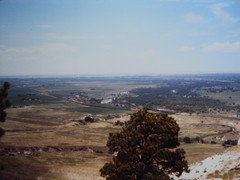
...here is a photo I took from western Nebraska, some years ago... before 1900 this far reaching Plain would have been bare of trees, even along the riverbank likely trampled by bison... but as you can see - they're gradually taking over.... spreading away from the river.... that's the old Oregon Trail down below...
....Bison with Campanula rotundifolia....at Yellowstone Park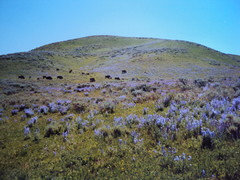
..I'm sorry if I've gone a bit off topic... - 11 years ago
"When you say "may be cultural in its origins" are you thinking, like i
am, that it may be that the hired yard workers who come so often from
points south over the border, have discovered its just faster and easier
to sheer the all shrubs that way?"
Not at all :-) This seems to be the clear intent of the homeowners regardless of the ethnicity of their yard care workers. I can think of several specific neighborhoods in my area where this type of plant manipulation is de rigueur to the point where it could be something written into the HOA covenants!! Except that these neighborhoods have existed for much longer than HOA's have been around and popular. (And btw, most of the yard workers in these areas are Asian in ethnicity and were in place and in much demand long before our southern neighbors moved north - I'm talking 30+ years of precisely trimmed boxes, balls and squares :-))  11 years ago
It is like a row of stacked dominoes. Proper pruning techniques take time, effort and the knowledge to teach. The work force often turns over too quickly for that. They can instruct a new worker how to whack a shrub into some unnatural shape with powered hedgers within a few minutes instruction. Just lopping off all of the tree branches takes no skill and little time. Done. Bonus income for them having to rehire you to repeat the work every year or two to remove the tree's huge sucker regrowth.
Add: Proper pruning so that the plants retain a more natural form takes as much work, or more than what can quickly be done with hedgers, but the ignorant owners cannot tell that the workers have done anything beyond grass mowing. When commercial interests hire a maintenance firm, they tend to want to "see" where their money is being spent. HOAs want the owners to "see" where the dues money is going. Educating the owners and board members is at least as difficult as training the workers.
Add: Homeowners see what is being done at commercial centers, and think that is how their plants are supposed to be maintained. That is how the "pros" are having it done, after all. Or the firms they hire for a minimal amount of money per week goes the quick/no training needed route, too. The maintenance firms that know proper gardening cannot compete financially.
And even with success and a beautiful landscape result, all it would take was an unlocked hedger shed, new worker that was unsupervised or a team that was running behind schedule and tempted to take the quicker method to unravel years of progress.
It is/was an incredibly frustrating, frequently futile effort.
- 11 years ago
A lot of speculation above and also some information.
A question for floral_uk.
To your knowledge, if British gardeners (or at least those who write about gardening) are not inclined to use the term "invasive" about plants like goutweed and crown vetch (say Spanish bluebells in the UK), what word do they use?
On a continuum, "vigorous" doesn't say to much.
Simply "spreading" from a neighbour's garden, from a horticultural introduction from another continent, , etc., etc., doesn't make the point (at least to those on the receiving end).
Trivial point: perhaps it should be phytophobia, since phobia originated as a loanword from ancient Greek (though it was admittedly then taken up in Latin and New Latin).
floral_uk z.8/9 SW UK
Original Author11 years agoSunnyBorders - spreading, romping, vigorous, thuggish, rampant and even, as malorena said above, invasive. So it seems I was wrong - some people do say 'invasive'. I am quite involved in wildlife and countryside matters as well as gardening, so I personally only use invasive in its strict sense.
- 11 years ago
Floral_uk, I think your original thesis around "invasive" is an extremely interesting one, but I feel it deserves more than speculation.
From my involvement in gardening, I tend to see gardening in terms of the Little Dutch Boy with his finger in the dyke. But is the sea invading the land or is the dyke invading the sea?
To the latter, I do agree that what I take to be gardens are temporary. As they say "Gardens die with their gardener" or, without knowledgeable and diligent intervention, very soon thereafter.
 11 years ago
Entities that sell garden implements and packages of stuff have an interest in "educating" the public about aaaaaaall of the little tasks they're "supposed" to do to "control" plants and the wildlife in their yard. A guy with a Scottish accent is constantly on TV commercials reminding everyone to "feed" their lawn (almost certainly a monoculture of non-native grass, if in the US.) And the Roundup commercial constantly reminds that you're delinquent in your duties if you have a dandelion on your property, or anything growing in a crack in pavement.
Foundation shrubs are the biggest mystery to me. Most people hate to do anything in their yard, but most houses have them, usually meatball or hedge-shaped. When they don't get mangled often enough, then it becomes a "creepy house" where shrubs block most of it, especially the windows.
By cultural in origin, I took that to mean learned behavior, following the cultural norm. I've read a couple books about this, how government and garden associations, the golf/turf industry, has gone to great lengths to influence the attitudes of homeowners and appearance of neighborhoods, at least in the US. Most municipalities have laws about "weeds" growing above a certain height. A front yard full of native wildflowers would likely get attention from an enforcement officer in most incorporated areas. There is a definite attitude and assumption that, through the miracle of products and implements, one *can* (and should) control nature.
In the US, this seems to have started with the first boatload of pilgrims, who cleared native vegetation to have a spot to grow the edibles they knew from the mother land. Then they started chopping down the biggest trees to build things.
I also reserve the term invasive for non-native plants that have gone feral and displace natives.

christinmk z5b eastern WA