Software
Houzz Logo Print
s8us89ds

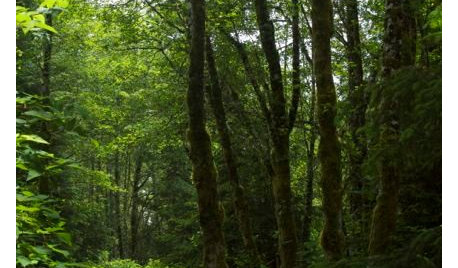
Do you consider this a woodland?

11 years ago
last modified: 11 years ago
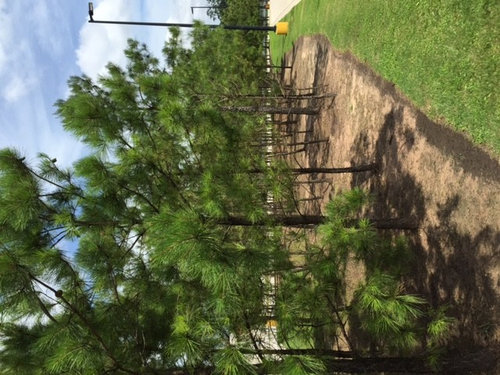
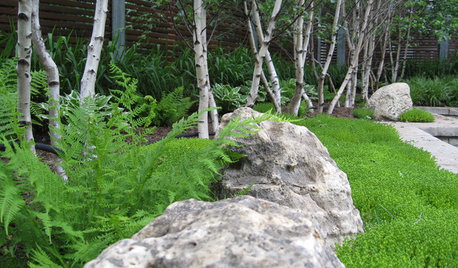
This is a planting strip in a Walmart parking lot. I consider it a monoculture. I think a "woodland" should have more than one species in it. Imagine if a beetle or a fungus took over there. There would be nothing left but bare ground.

Comments (16)

  • 11 years ago

    Nope, it's a plant strip, not a woodland :)


  • 11 years ago

    Regardless what tag gets applied, the notion of diversity is one that often gets misconstrued, IMO. To me, it is a community-wide issue, not an issue within one tiny little planting. Yes, this Walmart may lose these trees, t'is true, but that's not exactly a catastrophe, more of an annoyance. Also, if one looks into N. temperate zone forests, it is a myth that always and everywhere, the various species are homogeneously mixed, nature preferring to do drips and drabs of monoculture itself, within a more diverse contest. Conifers in particular are wont to arise after some type of disturbance has "cleared the field" and as such, temporary monocultures are extremely common, the word temporary here indicating timespans up to and including hundreds of years! Don't believe me? Look up the terms long-term seral stage in any good work on silviculture and see what it says.

    +oM

  • 11 years ago

    True. And you can see that effect when wandering in the woods. A "stand" of Oak trees here. A "colony" of Holly trees there. And so on.

  • 11 years ago

    Exactly. I'm all about diversity of plantings but people are getting carried away, as I said, far beyond what Ma Nature herself does. Some of the most impressive stands of trees, BTW, are naturally-occurring monocultures, or nearly so. People forget about the element of time. Sooner or later, everything you see around you will be replaced by something else. But because this often happens on a time scale greater than the typical human lifespan, we see permanence where there really is none.

    +om

  • 11 years ago

    But in terms of "Walmart Woods" planted by some local landscape firm and maintained by crews that probably spray herbicide on any seedlings that sprout up in that pine needle litter...it will take neglect before that strip starts to undergo any ecological transition. Without neglect, those trees will eventually reach a greater height, with no understory beneath them or age diversity among them, only to wait for lightning, wind, chainsaws, beetles, or fungi to undo what took years to grow. And what will probably happen, if local events are any indication, is that the felled trees will be replaced with turf grass.

  • 11 years ago

    Oh by the time the trees get 'tree-like', someone will cut them down and expand the parking lot, or a bank will be built there.


  • 11 years ago

    Quite right, "d"! Or Wallymart will expand its offerings to the public, taking up the last little bit of "greenspace".

    +oM

  • 11 years ago

    Although we can't rule out the possibility of Walmart putting up plastic trees in their place.

  • 11 years ago

    Yes, as part of their "green" initiative.

    +oM

  • 11 years ago

    Do you?

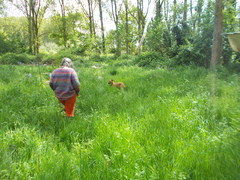
    This was grazing marsh until 1947 when it was planted up with hybrid poplars as a timber plantation. When the bottom fell out of the matchstick market, it was abandoned in 1975 until bought by us in 2012. The monoculture has been diluted by seedling oak, elder, hawthorn with a thick understorey of bramble, nettle and numerous umbellifers and red campion. Essentially, this is a landscape in continual change, which will be exacerbated with our intervention.

  • 11 years ago

    Yeah, nature doesn't prefer monocultures. It will accept them for a time, maybe even a long time, but nature prefers biodiversity if at all possible. Different species can then fill different niches and compete and work together and so on. Nature likes to use every drop of water, every last ray of sunlight, and every last ounce of soil...if at all possible.

  • 11 years ago

    I think the dynamic elements of a given area's plant community needs to be embraced more. I've heard if a million times-"That red pine plantation is a biological desert". No, it is not nor will it be in the future. Foresters use the phrase "to capture for forest" when talking about the practice of taking a cleared piece of property and planting pines or any other tree on it. Sure, initially, you've got whatever weeds are present, and then those pine trees. But give it time....all sorts of other plants and their accompanying fungi and animals move in. We're just stuck in a too-short timeframe when thinking about these things. By "capturing" the site, all kinds of more shade-tolerant plants can and will move in. Not something that is or would be possible under corn and beans!

    +oM

  • 11 years ago
    last modified: 11 years ago

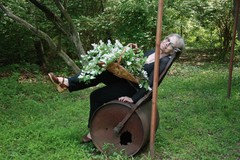
    I love the word "successional". I have been thinking about it a lot.. I just got back from wandering around my childhood haunts. Here is my sister sitting on the Tennis court roller barely inside the used to be tennis court. It was the really wooded part behind her. our job was to roll the court after a rain. God I hated tennis. I much prefer picking flowers in the court. This is my sister picking flowers for a memorial service.

    I went to New Hampshire to the mountain house of my grandmother, now my cousins, and I remember the trees in the woods being mostly all maple and paperbark white birch. All the large paper bark birches are dead and the maples have aged and almost dead . I saw the woods as modest. Originally, this land was clearcut by the large lumber companies that have since moved on to the Pacific Northwest during the end of the 19th century. So what I was remembering was the first mature stands of transition trees.We had a million dollar view of the Sandwich range, back then that stretched across the northern horizon. I think cousin peter struggles to keep a view of Mount Chocarua now. The small hemlocks and pines have become towering affairs and blocked it all out. The woods have changed. Oaks have moved in. White and red pines are becoming immense and Peter says they live about 75 years, the life of a man and he now lives in fear of the monster by his house. I woke up in the morning to a flock of turkeys roosting in it. It was modest when I saw it as a child, so that makes me feel older than the woods..

    Successional even addresses the Blueberry field that is now birches and ferns. No more pie.

  • 11 years ago

    Interesting report, wanto. One minor point of departure-not between you and I but between myself and your cousin (and maybe I'm just misinterpreting his words): Relating to the lifespan of red pine and white pine, one really needs multiple centuries to capture their potential lifespan. For one example, and this is for the western Great Lakes forest area, a recommendation went up recently to allow for longer rotation on red pine, the idea being that this is a species which can easily last for 400 years. Now, the suggested rotation of timber purposes was not for the full 400 mind you, but it was in the range of a 200-yr. rotation interval. Of course, now that we have short-sighted fools running our state, all bets are off. In fact, if somebody can make a dollar today on a tree that would yield ten later, the single dollar mindset is going to win. Again, that's another story!

    +oM

  • 11 years ago
    last modified: 11 years ago

    Um, yes well lifespan seems to be measured in multiple ways - the commercial' lifespan of a hybrid poplar is short, very short - they are harvested after only 2 decades, even less. Then there is the lifespan of continual growth...and we are in the end range of that at the moment, with most of ours topping out at around 60-70 years...but obviously, these trees are going nowhere soon unless it is at the end of a chainsaw bar. Even the huge (for us) storms over the last 2 winters resulted in not a single felling and I am chancing not just my arm but probably my life, parking right underneath one of the larger (older) poplars in our fragile horsebox (although I am not so stupid as to fail to pay attention to prevailing winds and fall direction of trees in the wetter and more unstable locations nearby)). Interestingly, I have been watching the effects of 'nurse' trees - in that every oak which has grown to reasonable size (over 30-40 years, acorn producing, has grown in the direct shadow (within 2 metres) of a poplar while the clearings have stayed clear. We are happily using the bramble stands as handy nursing stages for our own seedlings, noting the reluctance of deer to battle through a blackberry thicket.
    As an arborial novice, I have had few preconceptions regarding forestry management and although it feels as though we are wandering blindly about, I feel at least I am not being deceived by prior assumptions and dodgy dogma.

Sponsored