Software
Houzz Logo Print
mbohio

Spacing for Bloodgood Japanese Maples?

11 years ago
last modified: 11 years ago

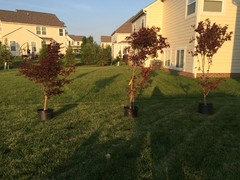
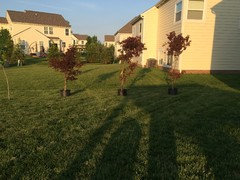
I just bought 3 Bloodgood Japanese Maples that we'll be planting tomorrow. Now I'm trying to figure out how far apart I should space them. Ideally, I would like to put them pretty close together so as they grow, they sort of grow together and create a sort of wall of beautiful privacy on the side of our yard, but I also want to make sure that I give them enough space to be healthy. What is the minimum recommendation on these - I looked online and only found guidance from one source which said 36"-60" which would be great because then we would go closer to the 36" but I was hoping someone here might have actual experience with this. In the attached photos they are about 60" apart. Any advice?? Thanks!

Comments (15)

  • 11 years ago


  • 11 years ago


  • 11 years ago

    I have no idea where you are located or how well these trees may grow for you, but Bloodgoods get to be pretty good sized for a Japanese maple - around 25' tall and as wide, if not slightly wider. Planting them 36" apart is NOT advised! Generally you want to space trees like this the full crown spread to avoid congestion and overcrowding/shading. That would mean 25' apart, allowing for the crown of each adjacent tree to fill in. You can plant them closer to create more of a screen, although it can detract from both their appearance and health, but I would not recommend planting them any closer than 10' apart........and even that is pushing things!!

    These are intended to be specimen plants, meaning each individual tree having pride of place without competition. My advice is to space them out properly and fill in between with something else of a more shrubby nature.

  • 11 years ago
    last modified: 11 years ago

    I really appreciate your advice, but I am also a little confused by it. Everything I am reading (I really tried to do some research) suggests that the spread of these trees is 15' (maybe 20') wide. Also, multiple gardening and horticulture websites suggest that because they remain relatively small, they are good in groupings and can be planted together, within reason of course. Also, I understand that Bloodgoods do okay with shade, so some "merging" of their canopy would not do them any real harm, right? I certainly want the trees to be healthy, but I also want to find a compromise with the functionality I'm going for. Have you ever seen problems with Bloodgoods planted more closely together?

  • 11 years ago
    last modified: 11 years ago

    Also, I live in Ohio, zone 6a.

  • 11 years ago

    gardengal48 really knows her stuff- I'd take her advice over random websites. The Bloodgoods in my neighborhood are quite large trees.

  • 11 years ago
    Thanks! What area of the country do you live?
  • 11 years ago

    As I stated, these are not normally planted as a grouping but rather as individual trees. I've attached a link that shows two Bloodgoods planted in close proximity.........but 'close' is relative :-)) These are certainly planted no closer than 10'.
    twin Bloodgoods


  • 11 years ago
    last modified: 11 years ago

    If you take the one out of the center in your picture so that the two on the ends are the final spacing that will probably be about right. 'Bloodgood' has a tall and narrowish habit, is known over 33' tall - a spread of half that height would be over 15'. Many other kinds of Japanese maples grow broad crowns so even a comparatively narrow one like 'Bloodgood' will probably be more than half as wide as tall in an uncrowded position.

    But you are planting several together to form a grouping (hedge or screen, really) so the spread of an isolated specimen in the open doesn't really come into it - except that it shows your original spacing was way too tight. And it also shows how much space your grouping (3 in the space for one) is likely to eat up over time, in this case it will be decades before the full size is approached.

  • 11 years ago

    "tall and narrowish habit"?? Not so much. In most cases, the canopy spread will equal the height as any image search will confirm. Generally the canopy is described as "rounded and spreading", often in graceful layers. Vertrees describes it as a "broad topped tree". Look at the full tree shot on the Monrovia website - that is classic Bloodgood form.

    All of this is in aid of an explanation to carefully consider the spacing before planting. It's a little difficult to envision what these little guys will look like in 10-15 years but crowding them too close is not going to produce the best look. Maybe review a bunch of Google image searches to get a feel what an individual tree looks like with a few years on it (and some with even more mature trees with well developed heights and canopies) and extrapolate from that how your spacing may impact appearance.


  • 11 years ago

    I have never seen them wider than about 15 ft in my area. I would give them at least that much space to spread. Planting them 36 inches apart is not a good ideal.

  • 11 years ago
    last modified: 11 years ago

    Thanks all, I did some research on how big they get in my climate and it looks like typically have about a 15-20 feet spread. So we ended up planting them about 10 feet apart to give them space, but also set it up so that as they grow, their canopies will grow together just a little, but without crowding each other. I am so excited because even though they are still quite small, they are so beautiful!

    gardengal48 - The spacing in that example photo is exactly what I'm hoping for when they are fully grown and I think that's about the spacing we went with.

  • 11 years ago

    miketann - Agreed. We already have 6 arbovitaes right next to our patio, and then we planted 14 additional trees in our backyard on Saturday, 9 of which were evergreens (combo of pine and spruces). However, we didn't want a pine forest in our backyard, so we broke it up with a few deciduous trees, which included these 3 Japanese maples (and 2 ivory lilac trees). So while we certainly are not expecting full privacy on this side of the yard (it's on the side furthest from our patio so we don't need a wall), we wanted something that would provide some cover from our neighbors yard... and just some visual interest as well.

  • 11 years ago

    Notice also that the Vertrees description uses the word "strong" twice. That is because there is a tendency for the true cultivar to be tall growing with upward oriented main branches that grow close together to produce an elevated crown, comparatively narrow at the sides until the specimen matures and then spreads out more later. That is the point: it would tend to work better in a grove style planting than so many other forms that want to form a broad mushroom or dome shape from early in the game.


Sponsored
Buckeye Basements, Inc.
Average rating: 5 out of 5 stars40 Reviews
Central Ohio's Basement Finishing ExpertsBest Of Houzz '13-'21