

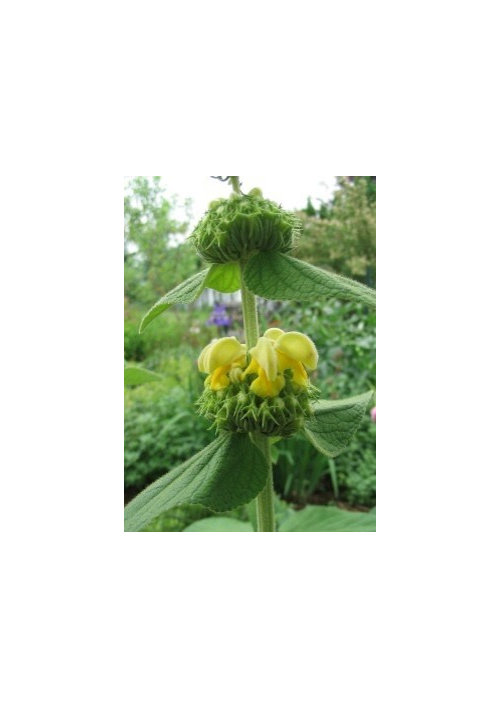
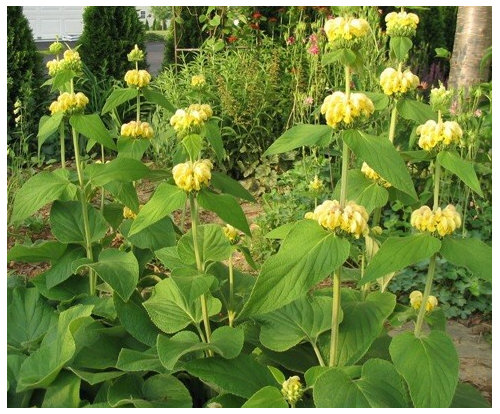
Phlomis Russeliana
Ohmygoodness! I need this. Can't find it. Anyone?
Comments (26)
 11 years ago
I was at the website of Swallowtail Garden Seeds looking for something else and noticed that they have Phlomis there, and they ship quickly, but the seeds need cold in order to germinate, so you probably wouldn't have much luck with it now. It reminds me a great deal of lion's tail, which looks fairly similar, but with orange flowers, and which gets a lot taller---8' or more. I have to stake lion's tail when I grow it or it eventually falls over sideways because it just gets too heavy for its own good.
Related Professionals
Lake City Landscape Architects & Landscape Designers · Anniston Landscape Architects & Landscape Designers · Orange County Landscape Architects & Landscape Designers · Jackson Landscape Architects & Landscape Designers · Beaumont Landscape Contractors · Petersburg Landscape Contractors · Champaign Landscape Contractors · Lewiston Landscape Contractors · Portland Landscape Contractors · Rochester Landscape Contractors · Oshkosh Landscape Contractors · Bridgeport Landscape Contractors · Billings Accessory Dwelling Units · Everett Accessory Dwelling Units · Cheyenne Accessory Dwelling Unitsnowyousedum
Original Author11 years agoThanks Dawn. High Country was out of stock on this item. I'll have to try to remember Swallowtail for next year.
nowyousedum
Original Author11 years agoWent to Dallas this weekend and took the back roads home. Stopped at a nursery (naturally, lol!) and they had Phlomis Russeliana! Whoa, baby! Well. It wasn't quite as awesome in person. I passed on it. Now I'm regretting it.
- 11 years ago
You're welcome. I'm curious about what Dallas nursery had it. Do you remember which one you visited? Some of my favorite nurseries are in Dallas although I don't make it down there to visit them very often any more. I might need a vacation-from-the-garden-day to go nursery shopping in Dallas. After this horrible cloudy, cool, flooding-wet spring, I wouldn't be surprised if nursery stock did look less dazzling than usual too.
nowyousedum
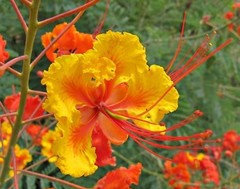
Original Author11 years agoIt was actually on my way home. Since 35 N was closed, I took back roads through Weatherford to Mineral Wells, then Wichita Falls, Lawton and home. I believe the nursery was in Weatherford. Wish I could remember the name of it. The gal working there was super nice and helpful! They also had a different Bird of Paradise variety that I wish I had picked up as soon as I saw it. Went back and it was gone. Have you ever seen this?
- 11 years agolast modified: 11 years ago
That is Red Mexican Bird of Paradise. Caesalpinia pulcherrima. Seeds are commonly available online but its not as hardy as the yellow type. I've got two of the yellow variety which are small airy trees and both have bloomed quite heavily & non stop since spring here in zone 7b, they just keep putting out new buds. I've gotten more comments on them this year than any other plant and they are really pretty. It would be an experiment with the red type as to its hardiness but I've grown several plants successfully that are listed as zone 8. I sometimes see the red listed at zone 9 and that is always stretching the limits too far. They come up quite easily from seed, I've got some volunteers in my yard this year.
I have a Phlomis russelina plant also from a trade on GW. A couple years ago I had tried seeds but out of at least 100 none sprouted and those were fresh seeds from my sister's plant. Frankly as a garden plant now that I have it I'm underwhelmed especially considering how anxious I was to have one after seeing pictures online.
- 11 years ago
I love the bird of paradise plants, both red and yellow. They're just so pretty.
Is the Phlomis russelina just not as pretty in real life as it is in photos? I'm wondering if maybe we are just too hot for it here.
- 11 years ago
Maybe so, my sister grows it in partial shade to mostly shade and my mother used to do the same. The pictures I saw online were in full sun and the plants looked more dramatic in every respect so I planted mine in full sun. Its been wilting in the afternoon and looks rather pinched and scrawny now like plants do when its so hot and they don't like it. I think its a Mediterranean plant? If so we just might be too hot or humid or both for it in full sun to get that look like you see in photos. Still, its my first full summer growing it and this has not been a typical summer, maybe the rain did a number on it. I'm leaving it alone, time will tell.
- 11 years ago
I think it is native to the mountainous region of Syria, so maybe this year's rain and humidity are just too much for it. If it won't grow and be happy in your perfectly drained soil, then there's not too much hope for the rest of us. I think you're right in thinking this isn't the best year to judge its performance. Maybe next year we will have more normal rainfall and you'll get to see what it does in a more normal year. Well, not that Oklahoma's weather is ever really normal, but sometimes it isn't too bad.
- 11 years ago
As a lover of the open prairies and lots of sky, I'm personally not a fan of trees and shade gardens so I'm always on the lookout for plants that are not the typical choices for the unwelcome shade I have to deal with from the neighbors sun robbing trees. For example, Salvia greggii does great and so does echinacea just to name 2. You name it, I've tried it. I originally wanted it as that type of plant so most likely it will end up in a shadier spot in the end since I am choosy about what I plant in my really sunny spots which is never big enough for what I want to grow. After seeing photos online, I did want to try it out in full sun with good drainage to see if it would be more dramatic, I like the flower formation on the stiff stems.
I often post on the Perennials Forum and I found it interesting that growing in shade down here is not even remotely the same as growing in shade further north. We can extend our choices to include many plants they could never consider growing in shadier areas. They may not be jealous of our heat but they do marvel at our amount of light, wide selection of plants needing higher zones, many of which we take for granted and length of growing season. Its so drastic I came to the conclusion they do not know what 'real summer' is any more than we know what 'real winter' is.
- 11 years ago
That's anew one on me, or the photo is misleading. That Red Mexican is outstanding the yellows and reds mix just right. i,have never seen a bird of paradise with that type of flower. Will they return in a 6b zone?
- 11 years agolast modified: 11 years ago
I seriously doubt it, its a tropical plant native to Mexico zone 8b to 10. It can take some frost but dies down to the root, otherwise its evergreen. I wouldn't expect it to be root hardy here.
nowyousedum
Original Author11 years agotexasranger2, are you saying you grow salvia gregii in the shade??? I thought it was only full sun. This is one of my very favorite plants!
- 11 years ago
I grow salvia greggii in part shade too, and coneflowers as well. In my garden, they're both in sun until about noon. Over the years I have learned that so many of the plants that demand full sun in milder climates are much happier in only partial shade here. I even grow some tomato and pepper plants at the west end of my garden where the shade from the adjacent pecan tree shades them beginning around noon. Those plants that get the shade will continue to thrive much more deeply into the summer than the tomatoes and peppers growing in full sun.
I also grow hollyhocks, daturas, Maltese cross, bachelor buttons, Laura Bush petunias, tansy, silver tansy and balsam in the shade at the west end of the garden, along with some comfrey, cannas and colocasias. I almost never have to water the ones in the shade and they still bloom just fine.
In Fort Worth, we had heavy shade from neighbors' trees all around us and it drove me nuts because it was hard to have enough sun to grow anything that flowered. Here, we built our home on the highest point of the land so we'd be safe from flooding, which happened to be a clearing in the woods with a lot of sunshine. We only kept the big pecan tree near my garden and one post oak. We did plant more trees around the house for shade, but left plenty of open, sunny space for gardening. It is not a decision I've ever regretted. There are lots of prairie type flowers that grow well on our property in full sun, and I can put the pickier ones in shade if they need it.
My favorite prickly pear cacti is one that grows on the edge of the woodland about 3' north of my garden fence. It is the only one that survived the drought of 2011, so I think it is growing in a spot that is perfect for it even though most people are surprised to see it there and tell me it cannot be happy there. Well, it is happy and it blooms just fine. I'm about to get to the point where I think most everything I grow is happiest with a little shade, though some things still don't like too much of it.
Dawn
- 11 years agolast modified: 11 years ago
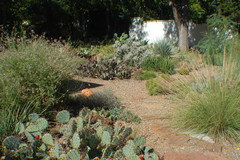
The big englemanni cactus, the ones you see so often in peoples yards all over OKC grow in full shade all summer. The photos below are of the south end of my backyard and its full sun in winter but stays in shade in summer. Those cactus will grow ANYWHERE.
I grow Phlox pilosa, Mexican Feather Grass, Autumn Sesleria, Salvia Greggi, Mealycup Sage, Silver King Artemisia, Blue Fescue, Salvia microphylla 'Lips', an Oklahoma native type of sedge (Pennsylvania?), Chicks and Hens, Sedum, Ninebark, Wild Asters, Malvaviscus arboreus AKA Turks Cap, Lantana, Zexmenia, Black Eyed Susan, Autumn Sesleria Grass, Pine Muhly Grass, Lindheimer's Big Muhly Grass, Calyophus berlandieri (Berlandieri's Sundrops) and Achillea in full to mostly to part shade.
The most surprising one was the Silver King and I am amazed how much shade it can tolerate, it brightens up that dark area and will grow in that terrible soil, its a classic dry shade situation. I've got a long row of those and I've started dozens of Salvia greggii and just keep plugging in plants to cover the awful dirt.
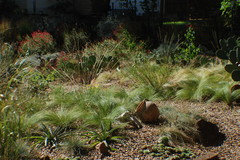
Its a difficult area along the west where the neighbor has volunteer Hackberry trees coming up right along the border, I mean right smack on the property line, it looks like hell over there so I deal with the dark creepy backdrop, cruddy fence for his dogs, his shade, seedlings, roots etc and these plants have proved successful. The only problem I had this year was with all the rain the Mexican Feather grass got so tall and completely out of hand and unattractive I had to rip them out. I'm replacing them with Blue Fescue. This was shot before the flooding rains hit.
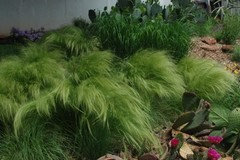
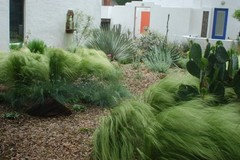
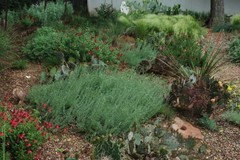
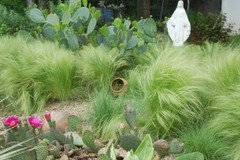
You can see the Gregg Salvia and Artemisia below. I plugged these in on his side reaching my hand through that hogwire fence and planting rooted cuttings. The only reason you can see them in the photo is because it was shot on a cloudy day, otherwise its like the bottom two pictures and the plants are plunged into blackness.
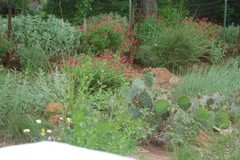
Below, the wall of darkness. One problem is my whole back yard wants to lean toward the east just to get away from it, I find grasses don't lean but nearly everything else does.
- 11 years agolast modified: 11 years ago
Nah, I just grow 90% native 'weeds' and wild shrubs that will take hardcore or drought conditions. If you see it happily blooming out in the wild, it'll bloom in your yard, its just a matter of gathering wild rather than paying retail. You can find many garden worthy plants and gather all kinds of cool seeds along the roadsides. If you stick with stuff that will take abuse (like our average weather for instance) you can't go wrong, I learned this about 8 years ago when I finally threw in the towel on the foo foo. My prairie sideoats grass, annual gaillardia, little bluestem, skinny tall prairie coreopsis, snakeweed, bitterweed and fetid marigolds, is a sea of easy self sustaining color & I've gone plumb native grass crazy here.
- 11 years ago
Tex, love your yard. I have a soft spot for cacti, but my bare feet need a little grass to wiggle in. I cannot work up the nerve to remove all of the grass and do a landscape like yours, but I can look at yours and dream!!!!! All of mine are in pots and not for our zone. So the prickly pear and all of the other cacti grow in unimproved clay? Does the prickly pear get invasive? Every time I start to grow it I get visions of ranchers having to burn it to control it.
I had a large tree type cactus before the tornado and it would flower these beautiful magenta flowers for weeks in late spring. I couldn't even find a piece of it to start another one at the new house. When I find me a spot I will have another one!!!
I have Mexican feather grass everywhere, when it get straggly I just trim it back to about 6" and it does good. In the bottom photo are those agave or aloe in front of the photo?
Again, a beautiful example of doing what you love and yes you are truly gifted.
- 11 years agolast modified: 11 years ago
stockergal, I've got lots of unplanted areas that are gravel so its very easy to walk around here except not barefooted.
The opuntia aren't invasive but they do put out some seedlings so I learned to take off the pears in late fall or pick them up off the ground, otherwise I have several baby cactus and its real easy to put your knee or hand down on an infant. The big green almost spineless Englemanni opuntia aren't picky about soil or drainage (as long as its not standing water) and neither are the big chollas with the magenta flowers. I have several cactus not quite as forgiving from other places though and I added a lot of coarse sand to the soil for the more special cactus but the O. macrocentra native to Texas is very tolerant of conditions. In the back are three separate large raised areas which are mounded islands with wide gravel paths surrounding them, then there are two areas along each side, the photos make everything look closer together than it is. I have no problem getting to any area to weed or trim. Opuntia grow very fast in the ground, they put out long lateral roots to anchor the plant and in a pot they can't do that so they just sit there suffering and stay small. Cactus are like any other garden, not invasive but in need of regular maintenance & pruning at times.
Those are Manfreda in the front of that bottom photo, they like shade.
- 11 years ago
texasranger, You are truly a gifted gardener and I know that you have worked very hard to create your gorgeous landscape.
That is a seriously shaded wall of shade area that you have there. In our summer heat, I like shade as much as the next person does, but as a gardener, I'd rather not have shade that deep and dense in any place where I'm growing plants. Anything I have growing in serious shade tends to lean out to get more sun too and I suppose that is one of the issues you cannot avoid when you have flowering plants in or near heavy shade.
We have too much clay for the cacti to get too invasive, so when they pop up here or there, I leave them where they are and then have to work hard to "train" Tim to mow around them. Otherwise he just mows them down. Down south of us in the Thackerville area where there's deep sand (several hundred feet deep in some areas nearer the Red River), the prickly pear thrive and can form huge plants. When in bloom, they are just spectacular.
I always thought that nothing would kill our prickly pears growing in dense clay as they seem able to tolerate extreme drought and fairly heavy rainfall, but then the heat and drought of 2011 proved me wrong.
We had the same issue with hackberries growing in our fenceline when we lived in Fort Worth. We killed every seedling that sprouted in our yard, but neighbors on both sides of us just let the hackberries grow right up through the chain link fence which drove me nuts.
I do not grow many ornamental grasses, although I love them. We live in a grassland area where wildfires spread rampantly many years, so landscape grasses just add to the fire risk for us. Our fire risk is so high in dry years that I dare not do anything to add to it, and Tim is obsessed with mowing down every bit of grass he finds, so growing ornamental grasses near the house would become a bone of contention. If I lived in an area that wasn't so high risk for wildfires and that wasn't so overrun with venomous snakes, though, I'd grow ornamental grasses in a heartbeat.
Dawn
- 11 years agolast modified: 11 years ago
Dawn, I read about your fires during the drought and its understandable about your husband not wanting them close to the house out in the country but don't you love looking out over a large view of native grass growing wild especially in fall? There is a stand of native grass with a lot of Big Bluestem up by Edmond I discovered recently, you don't see much Big Bluestem growing in large stands around here anymore. I do see a lot of Little Bluestem and Indian Grass however, the Indian Grass really stands out as very light glaucous blue and is very pretty growing along the side of the highway.
One of the nice things they are doing here in OKC is to grow ornamental grasses in the street medians. A lot of them are now planted in stands of native grasses and they have several buffalo statues placed in various places all over the city, especially close to downtown and along the streets downtown. The new highway underpasses have relief sculptures of Oklahoma Scissor Tail Flycatchers on them as decoration. I keep meaning to go around and shoot some photos of these areas but am waiting until fall when they are at their peak. Up by the capital and the surrounding buildings is all done in native plants with big swaths of grasses and large rocks. I was asking the gardener at the History Museum about them and he says "You mean them weeds?" Well, I for one don't see them as weeds and I often go there at different times to look at the plants. There is a row of Three Leaf Sumac that is very nice, I collected some seeds and now have a couple starter plants among some other perennials and grasses I've collected seeds from.
There is a really nice one I'm planning to photograph later in the season by the railroad underpass on 23rd Street close to Byrons Liquor Store, its a huge mound planted in Switchgrass with shorter grasses massed in front with rocks and a few buffalo statues. It used to be a drab empty lot.
Here's a few shots from past years....
WILL ROGERS PARK:
Sideoats grama, Lantana & Love Grass (crepe myrtles in background)
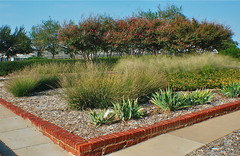
Love Grass
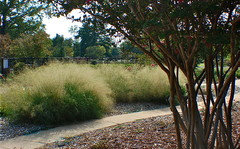
THE HISTORY MUSEUM:
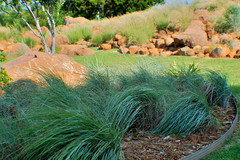
Sideoats Grama, Purple Threeawn
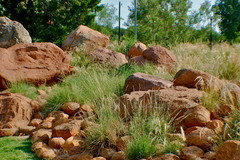
Mix of Sideoats Grama, Blue Grama, Purple Threeawn, Muhlenbergia riverchonii (specifically native to Oklahoma only, the blooms are dusky purple)
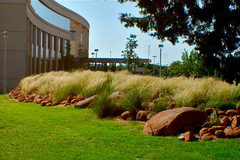
Coming in to the beds planted in native forbs
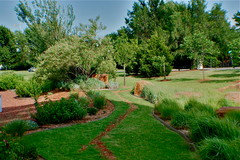
Desert Willows, Bluestem and other native plants & trees
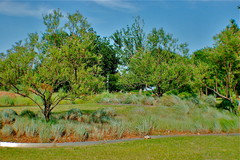
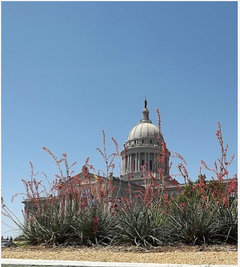
THE CAPITOL:
Hesperaloe
- 11 years ago
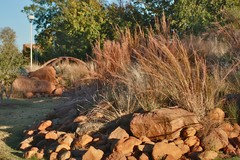
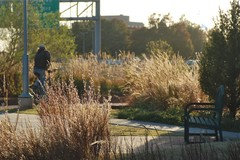
The History Museum native grasses in fall, bottom photo includes the guy working around "them weeds". I wish my landscape was bigger and looked this weedy.
- 11 years ago
I do love native grasses. I just find it impossible to be able to justify growing ornamental grasses near our house when wildfires can run rampant here. If wildfires weren't an issue, I'd grow them for sure. I'd just been to too many fires over the last decade where the grasses catch the houses (or barns, vehicles, whatever.....) on fire before firefighters can even arrive at the scene, and often the firefighters are racing from house to house for hours trying to stay ahead of an uncontrollable wildfire so they can at least save the homes. The homes that fare the best have no tall grasses, whether native by happenstance or ornamental ones (native or not) planted on purpose as a part of landscaping, within 40 or 50' of their homes, and have the lawns mowed down very low, and shrubs and trees planted around the homes limbed up to 8' in height to prevent a fire ladder occurring. Fire ladders are where fire progressively climbs from shorter plants up into taller ones and then reach out and catch structures on fire. The more cedar trees on a property, the greater the fire risk so we cut down cedar trees on our property every chance we get. Since they are invasive and easily spread by seed, we speed a part of every year cutting down new cedar trees.
I have grown Mexican feather grass in containers sitting on a concrete patio adjacent to the detached garage, and even that can be problematic because grassfires and wildfires often spread via sparks flying through the air, so even containerized grasses could get hit by a spark and could ignite.
In the worst wildfire years, our community members have been advised to protect their property by mowing all the grass down short and then going out and cutting the grass stubble down as low to the ground as possible, preferably to where it is 1/4" tall or shorter, to make the fire risk as low as possible. We did that once--probably in either 2005 or 2006. I hated it---a whole winter with no lovely grasses dancing on the wind was just dull. It was like we had carpeted our property with beige carpeting. But, we also had 4 wildfires within one-quarter mile of our house that year, and I liked the peace of mind I had from knowing we had done everything we possibly could to make our fire risk around our home as low as it possibly could be under the circumstances.
There also is the snake issue. It is not uncommon for us to encounter snakes weekly, and about 75% of the time, we are seeing copperheads, timber rattlers (often referred to as velvet-tails because their rattlers have a black, velvety coating) and western diamondback rattlers. We do our best to keep the civilized acre around the house mowed short during snake season, which runs roughly from April to late October, though I've seen snakes out as early as February and as late as very late November. Chris and I have both stepped on copperheads and not been bitten, and I've had quite a few close calls (meaning I didn't see a snake until it was within striking distance) with timber rattlers. At a time like that, I'm all in favor of removing all grasses and paving everything with concrete. Of course, we'd never actually do that.
So, even though I love ornamental grasses (especially Pink Mulhly grass) and used to grow them, I just don't and can't have them any longer. It is frustrating, but I do understand the risks involved, having known people who've lost their homes when grassfires turned wild and got to the building before firefighters could arrive, and I've had friends bitten by venomous snakes they didn't see in the yard (I'm not blaming tall grass, just saying it ups the risk factor). I prefer to avoid both issues.
If I'd known then (when we built the house and did the initial landscaping in 1999) what I know now, after 11 years of working with the VFD, I'd have landscaped entirely differently. I would have put trees and shrubs much farther from the house and likely would have chosen some different shrubs. I probably would have used rock mulch instead of organic matter like shredded bark. Instead, I just try to maintain everything pruned as high up as possible in bad drought years (and I backslide and let them branch out down lower in wet years) and try to keep the lawn well-watered. I used to overseed the lawn with rye grass in the winter, thinking the green grass would slow down fire as it approached our house, should we have a wildfire approach our property. (We have had them moving our way, but they've been stopped on the adjacent property well before they got close to our fence line in each case.) When a retired professional firefighter told me it might or might not work because green grasses will burn under certain conditions, and they burn hotter than dormant grasses because of their oxygen level, I quit worrying about overseeding. Firescaping is well understood now, but we'd never heard of it when we first moved here, nor did we realize how high the wildfire risk would be. We moved here in 1999 and didn't have a truly bad wildfire year until 2005, although there was some fire trouble in 2003.
I love, love, love Purple Sand Lovegrass. We have it here, but since we have dense clay, it stays small and puny compared to the way it performs in well-drained sandy and sandy loam soils. I didn't even know what it was, but it was scattered in our pastures (and occasionally pops up in our gravel driveway) and I loved it when it bloomed and formed the seedheads, and then I read Sara Stein's books "Noah's Garden" and "Planting Noah's Garden" and realized we had love grass here when I was reading about our struggles to get it to germinate and grow for her. (Kinda appropriate for Love County, I guess, to have love grass.) The first time I saw love grass that was huge and dense, it was in the winter so it was its winter color and the firefighters were fighting a horrific battle to stop it from burning. Apparently, when the love grass is burning in the winter, it burns like crazy and is very hard to extinguish. You hear the frustration in their voices when they arrive at a fire scene and warn the other fire units en route to help them that "it's sand lovegrass". I made the mistake of telling a firefighter that I loved the love grass and he acted like I had lost my mind. I've since seen huge fields of it during the growing season when it is green and lush in western Love County and it is equally beautiful then. I think Tim has mowed our love grass almost into extinction, though sometimes it springs up in the front pasture where I fight him tooth and nail on mowing. We have reached a compromise where he doesn't mow that pasture at all most of the time, but once grass fires are becoming an issue, he gets to mow it (eventually, after I negotiate and stall for as long as possible). That pasture hasn't been mowed this year and it is a lovely blend of many kinds of native grasses and forbs plus the cosmos I mixed in with the native wildflower seeds, and I love it. So far, it is still mostly green. At some point the summer it will turn brown and the "mow it versus don't mow it" battle will begin. I try to point out that the wild creatures need the native plants in order to survive and they need them year-round, not just when it is convenient for us humans. One point in my favor is that we have an established population of wild turkeys on our property and the young ones have been eating in that front pasture a lot, which I guess makes my husband more tolerant of how "unsightly" it looks in its natural state.
Because we're closer to the D-FW metroplex than to OKC (about 30 miles closer, I guess), we shop a lot down there, and both the Tx highway department and many commercial properties use tons of native grasses and other native plants in their landscaping now. I love it. Even just 10 or 15 years ago it was pretty rare to see desert willow, chaste tree, red yucca and many native grasses in use in landscaping, now it is much more common. Long before the native plants became popular in landscaping, I used to go to the Heard Museum's annual native plant sale and to a similar sale at the Fort Worth Botanic Gardens. Those years seem so long ago and far away now, and you can find native plants in any places---not just at those annual sales.
I grown sumac right outside my kitchen window in what used to be a butterfly bed before it got too shady for many of the bloom flowers. I love being able to enjoy the sumac's flower heads in season and the red foliage in the fall. Most people here spray sumac (and the roughleaf dogwood I adore) with herbicide, but I leave them alone and let them grow and spread whenever possible. We now have sumac growing in about a 10' strip between our driveway and the property line to its south. It used to be just bermuda grass there, but now that I've got the sumac growing there, it looks nicer than just mowed bermuda. And, we didn't even plant the bermuda. Our grass was 6-8' high when we bought the property and it was mixed native grasses of many kinds, plus some horrible stuff like Johnson grass. For two years, we left the grass alone and let it be while we spent weekends clearing the woods so we could fence in 14 acres (to keep out the cows from neighboring property). It wasn't until we got ready to build the house that we cut the grass at the home site right before the builder began work. On one of our weekend visits up here to check on the progress of our house, a neighbor gleefully pointed out to me that bermuda grass was popping up all over the place where we'd cut down the tall grass. He was thrilled for us, saying "you won't even have to plant a lawn" and I was depressed. I hate bermuda grass. Our native grasses predominate in the pastures when we don't mow, but if you mow more than once or twice a year, the bermuda starts trying to take over. As far as I'm concerned, that's another reason to avoid mowing.
We have many native grasses here, including bluestem, but my favorite is the curly mesquite grass, and we only have a couple of patches of it scattered here and there, mostly in places I don't go because they are too far from the house and too snakey. I'm just happy knowing it is growing back there, even if it is growing in places where we rarely get to see it.
I also love seeing the native grasses in winter when they are coated in heavy frost or light ice and sparkle like diamonds.
- 11 years agolast modified: 11 years ago
Dawn, I understand your situation, truly I do. I read numerous detailed posts you made during the drought, the fires and know you are married to a firefighter.
My main reason for posting the pictures was to point out that for the first time in my life Oklahoma is paying homage and showing pride in its own native plants and grasses. I've lived here all my life and am amazed to see this new direction. Previously it seemed as if we all thought of our state as plain, boring & filled with empty nothingness so we frantically imported plants & trees from elsewhere to spruce it up and do anything we could to make it different and not look like Oklahoma. No one would have seriously considered using local native shrubs, forbs or especially prairie grasses as ornamentals. Imagine the looks you would have gotten a few years ago to even suggest it.
We destroyed 90% of the largest natural grassland on the planet with old attitudes and that is a tragic thing. It took eons to form and we wiped it out in a single moment geologically speaking. Thankfully attitudes are changing, I was stunned to read nursery's cannot keep little bluestem in stock now and plants sell for upwards to $10 each and fly off the shelves. Europe in particular is enthralled with our native grasses and many improved cultivars are being created all the time and they sell like crazy.
If someone wants to know what will grow well in Oklahoma, and this question does seem to come up all the time on this forum, this direction is a viable option offering a pest free, non chemical & water saving one at that. In an urban area which is apples and oranges different than where you are down there in southern Oklahoma on a large piece of land it offers a good ornamental option.
As a matter of fact, I view the trees, especially the Eastern Red Cedars as a bigger culprit in the fire problem than the grasses. You can see the process happening right before your eyes. An open grass field gets small cedar seedlings volunteering all over it, those go unchecked and in a short time they are mature, then the deciduous trees come in and before you know it a grassland has become forested and is a major fire threat as it goes up like a torch blowing sparks for long distances. You can drive through and see fields in the various stages of takeover and view the progression and how fast it happens largely due to unnatural fire suppression. A grass fire moves low at a brisk clip but the trees create a deadly, uncontrollable inferno, which I am sure you are well aware of. Trees scare me much more than grasses if we want to talk fire but I don't think people get scared off or fear planting trees, not like they do with grasses.
To put it into context, I am probably just as much anti-tree as your husband is anti-grass but perhaps the neighbor has made me jaded over the years or maybe its because I see the problem happening with such appalling speed all around me. I do know I am sick of fighting trees and spending money due to peoples insistence on having them and/or neglect. A well placed tree is nice but they are not sacred cows like some people seem to think, the ones who cry that cutting a tree down is tantamount to murder and how good they are for the environment, meaning any environment.
- 11 years ago
Believe it or not, I understand why you'd be anti-tree. In Fort Worth we had such heavy shade that it was hard to grow anything, and for someone like me who loves growing all kinds of veggies, herbs, fruits and flowers, that was just torture. I couldn't very well ask my neighbors to cut down 50-70 year-old-trees just so I could grow things. Honestly, I didn't find much fulfillment in growing shade-loving ground covers, or in tucking desirable plants into tiny nooks and crannies that got an hour or two of sunlight here or there. I love trees, but in their place, which more times than not is not too close to the house (ice storms bring down trees here in OK all too often, and right on top of power lines and houses) in my opinion and not too close to the gardens either.
Don't even get me started on cedar trees. Our property is not too wide---maybe 400' from south to north but deep---about 1300-1400' deep from east (near the road) to west (the back property line towards the Red River) and back there at the back part of the property, it is almost wall-to-wall cedar trees, with many fairly old ones that are maybe 50 to 60' tall and have huge trunks. I hate them. Nothing desirable grows underneath them or near them as they suck up all the water and seem to poison the soil. In areas closer to the house where we cut down large cedars, nothing---not even weeds and really not even the bermuda grass---filled in the bare soil for about 3 years. I don't like any invasive trees that seem to ruin the soil for other plants. I just kept piling compost on top of that bare soil where the cedars once grew until that area finally healed. Unless a wildfire takes out those cedars, we'll never be rid of them. They are too tall to safely cut down.
You need a beaver. When beavers move into our creek once every few years, they wipe out trees right and left, and not just the younger, smaller saplings they can drag to their dam. We've had them gnaw all the way around very old black walnut trees that were so big around that Tim and I together couldn't get all arms all the way around the trunks. Why a beaver thought it would chew through the bark and girdle a tree it couldn't use is beyond me, and since we try to stay out of the snakey woods in snake season, we didn't realize how many big trees they had killed until the damage already was done. I saved the few remaining walnut trees then by caging them with woven wire fencing, but they'd damaged most of the trees on the north side of the creek by then, and now cedars relentlessly invade that space in spring, summer and fall, and I cut them down in the winter just to keep the cedar trees from taking over that area. It is a battle I'll likely never win. One beaver motivated to build a dam could wipe out the trees that surround you in no time.
When we are at fires, we see cedar trees literally explode and send their burning resinous sap flying through the air. It will ignite anything it lands on----other cedars, grass, mulch, even houses. For that reason, we have cleared all the cedars we can from within 100 yards of our house, but the neighbor's property to our south is overrun with them, so the risk remains high. Have you ever read about how Mr. Bamberger has restored the Selah Bamberger ranch preserve in Texas? He did many things to remove the invasive plants and restore the native ones, particularly in terms of removing the junipers, and when he did that, wetlands reappeared and he completely changed his land. Back when he started, you couldn't just go online and order seeds of the native grasses and forbs he needed to restore the land, so he collected his own seeds and scattered them for years. I think of him and his efforts every time I cut down a cedar tree. In the areas where we removed cedars, prairie grasses and sumac and many native fruit trees (often plums, but sometimes persimmons as well) returned. I'd rather look at them than cedars any day of the week.
I'm glad that Oklahomans are gaining an appreciation for our native grasses. We never should forget that it was not, for ages and ages, the woodlands that built most of this state's soil---it was the grasslands.
A few years back, and I think this was in the drought of 2008, our firefighters were fighting a fire in a field on the east side of I-35. It was extremely windy--gusting to maybe 35-40 mph, and I watched a wall of flame spring up suddenly in a cedar grove and roll right over a big brush truck that was fighting to stop the fire from reaching I-35 and jumping the highway. My husband and his best friend were in that firetruck, and we wives stared in horror as the flames rolled over the truck. Luckily, the wind-driven fire was moving so fast it literally rolled over the truck and kept going, and the truck didn't ignite, the tires didn't melt, and the firefighters, both of whom were wisely inside that truck with the windows rolled up, weren't harmed, but I've never gotten over seeing that happen. If I ever thought that cedar trees had even one single reason to exist, after that night I never ever have had one good thing to say about cedars. The firefighters stopped that fire that night and it didn't jump I-35 (which would have sent it burning through our neighbor's ranch and headed right for our place) but we have fought many cedar-fueled fires since then.
As a gardener, I silently rejoice as the cedars burn because I know the grasslands have a chance to recover, and I know the future fire risk will be lower without the cedar trees. Oddly, though, something else I hate almost as much often survives the wildfires and grass fires and that something is grasshoppers. I cannot tell you how many times we have stood in a burned-out field after the fire has been extinguished and found non-burned grasshoppers clinging to the ashy remains of tall grasses, smoking trunks of trees and even metal or wood fence posts. Why don't the grasshoppers just fly away from the fire? Why do they stay there, or fly right back in after the fire rolls through? I've seen it many times and it baffles me. We finally decided they are crazy or perhaps their brains have been addled by smoke inhalation.
I also rejoice in wet and rainy years, no matter how much temporary damage the excess rainfall causes. I can't help it. Even if I am standing knee-deep in mud and the garden plants are struggling mightily, I love the rain. Do you think my fire chief husband lets me wallow in the joy of it being wet and green with lush pasture grasses that are knee high to chest high instead of our usual tan, parched fields? Nope. He surveys the lush green growth everywhere and reminds me that everything I'm loving so much now will just be fuel for the fires when it dries out and the inevitable drought conditions return, bringing us massive grassfires and wildfires fueled by the wet years' growth. Sometimes he doesn't say it for a few months, but inevitably he sucks all the joy out of a wet year by worrying about the coming fire season when all the green turns brown, and if he doesn't, another firefighter who lives up the road starts saying it. When the two of them get together and start talking about all the excess growth and how it will fuel fires, I have to leave the room. I suppose that is the cycle of feast-and-famine, flooding followed by fires, that has occurred here for decades, if not for hundreds of years. I figure I'll just enjoy the green years and help our firefighters fight the fires in the brown years.
It would be nice to live in a place where the climate is more moderate and we don't swing from extreme flooding to extreme drought, but for those of us who live in Oklahoma, moderate is not really a word we can associate with our climate or weather.
Now, for anyone who is interested, here's a link about the restoration of the Selah Bamberger Ranch Preserve.
Bamberger Ranch Habitat Restoration


Okiedawn OK Zone 7