

Tomato problem
I have searched and cant seem to find an answer. A friend who is a champion gardener came to "me"? to ask my opinion. Don't tell him I know nothing about tomatoes!
the top of one tomato all of a sudden has tiny leaves. All other 30+ plants normal, and there no discoloration no curling at all just tiny.
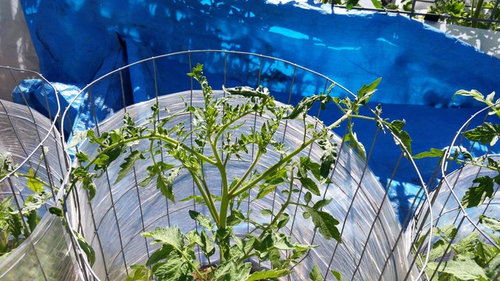
I wondered if the new growth was stunted because of all the water somehow?
I did not get the variety but I am pretty sure its hybrid. He likes those bigger better faster...
Comments (36)
 11 years ago
My first thought was herbicide damage also.
My second thought was a virus .
I thought I could see some curling of the leaves also, which made me think of leaf hoppers and maybe curly top.
But I think Dawn has some good advice on what to try. With the crazy weather we just went through it is possible it might just be stress. Just because the rest are not showing signs of stress may just be they have a better root structure to help overcome it.
Related Professionals
Wilmington Landscape Architects & Landscape Designers · Corpus Christi Landscape Architects & Landscape Designers · Spokane Landscape Architects & Landscape Designers · Bronx Landscape Architects & Landscape Designers · Cowansville Landscape Architects & Landscape Designers · New Orleans Landscape Contractors · Hagerstown Landscape Contractors · Parkersburg Landscape Contractors · Davenport Landscape Contractors · Oshkosh Landscape Contractors · Port Saint Lucie Accessory Dwelling Units · Jackson Accessory Dwelling Units · Galveston Accessory Dwelling Units · South Bend Accessory Dwelling Units · Kahului Accessory Dwelling Units 11 years ago
I've had a few that looked like that for a while, but since it's started to dry out and I've been able to aerate the soil a little, they are bouncing back just fine.
I did side dress with some fertilizer during the monsoon and used a mild foliar spray every 5-10 days, just to try and keep them going.
The three plants I pulled out and replaced had very little root growth, so I suspect that may have been a big part of the problem.
- 11 years agoSeveral of my tomato plants have developed small leaves at the top and look spindly as well. Upon close inspection, I observed what I think is aphids. They are little oblong white specks on the leaves and stems. If that's what they are, I've never had aphids on my tomato plants before! I mixed up some Eight spray and doused them last night. I don't know if the white varmints are the cause of the small leaves or just opportunists on weakened plants from all the rain. Any thoughts? So, Luvncannin, do a really close inspection for white varmints.
- 11 years ago
I have the same problem, only on all of my plants. I am using a raised garden for the second year. It have been very wet, and cool. Very little sun too. I am going to fertilize and aerate today and pray for sun and warmer weather. All my plants came from a couple of different nurseries.
luvncannin
Original Author11 years agoI will go back by there and see if I can see anything different. I told him I would just wait it out unless there were some definitive signs of disease or fungus. he did fertilize and he does use lots of sprays, chemicals. Bloom boost, set, fertilizers , pesticides all on a schedule :) he was going to leave it alone except the fertilize and see what happens
I did tell him I know nothing about gardening I just know who to ask for help.thanks y'all
- 11 years ago
Kim, As much as i love tomato plants, I don't really give mine a lot of attention. I tend to plant them, stake them, mulch them and then leave them alone until it is time to harvest them. I suppose I am more of an hands-off gardener with them than most tomato-maniacs are. This year I did spray them once with Daconil early in the season in between rainstorms in order to try to prevent fungal diseases, and intended to spray them regularly this year, something I've never really done, in order to keep the fungal diseases under control. Of course, having rain fall about 2 out of every 3 days throughout May made regular spraying impossible so I didn't do it.
After reading about your friend's tomato plants, I made a note to look at mine when I went out there, paying particular attention to their newest foliage. On most of my plants, the new foliage is regular sized despite heavy water-logging caused by 2' of rain in May and another foot or so prior to May. There's a couple of plants with smaller new growth, but it is on plants at the far west end of the garden that were the next-to-the-last ones put in the ground---far later than all the others (except the backups I finally stuck into the ground last week). Those west end plants are only 2-3' tall compared to the older plants that have been in the ground the longest, which are 6-8' tall (except for the dwarfs, of course). While their foliage is smaller than the older leaves (which is normal until those newer leaves grow a bit more and enlarge), they are healthy and not at all curled or rolled. That made me wonder if the new leaves are just a function of his plants being fairly young and maybe having immature root systems that have been a bit slower to recover from the waterlogging. My first tomato plants went into the ground in latest March or early April and my last ones went in last week to replace onions pulled because they were waterlogged and some were rotting. I have plants in all stages of development but only the ones at the west end (morning frull sun, afternoon dappled shade) have those smaller leaves. I'll be watching to see if the smallish leaves enlarge normally, and I bet they will.
okoutdoorsman, I haven't removed the one plant I have that is permanently stalled at a small size, but I bet when I do, I'll find little to no root growth has occurred since it was planted. It was in the lowest spot in a raised bed in the garden where the catmint plants beside it also waterlogged, and I'm still not sure if they'll recover. That is a problem spot area where water drains underground from the neighbor's property next door and a literal underwater stream runs underneath the east end of that raised bed. It always is a problem spot in the 20 or 30% of the years that we have a really wet spring. After I pull it, I won't replace it. I grow too many tomato plants as it is and won't even miss that one.
materlady, It could be either. This is an issue like "what came first, the chicken or the egg?". Aphids feeding on plants can weaken them, of course, but aphids also are opportunistic and will attack weakened plants. I just ignore aphids when I see them because our little population of lady bugs and other beneficial insects will come along and gobble them right up. I have a huge garden and we usually only see aphids for 2 or 3 weeks at a certain point in spring, and then the ladybugs take care of them and that is it for the year. I prefer not to spray poisonous chemicals in my garden if I can avoid it, and I can avoid it about 99.9% of the time. One word of caution about spraying carbaryl on tomato plants----doing so normally will increase your spider mite problems because the carbaryl does not kill the spider mites, but it does kill the beneficial insects (including predatory mites that feed on the spider mites) that feed on the spider mites. In the absence of those beneficial insects that do help keep the spider mite population lower, the spider mite population can just explode in hot weather.
lovett1941, Be careful what you wish for. Once our rain stopped here, we instantly went to miserably hot and humid, making me wish for one of those cooler rainy days again. (Clearly I always want the weather I don't have, because when it was raining, I was praying for sunshine.) I bet that your plants will improve tremendously as soon as they get some warmer temperatures and sunshine.
Despite incredibly heavy rainfall (at our house, we've already had the same amount of rainfall in the first 5 months of the year as we normally get in a whole year), my tomato plants are growing and producing great. They did not look all that great during the rainfall and it was obvious they needed sunshine and nutrition. I knew they were in highly-enriched, nutritious soil so I didn't worry about their pale color, and they still were growing both taller and wider, but they weren't setting much fruit in all that rain. I knew the nutrition issue would correct itself when we started getting less rain and more sun and it is---the plants' color has darkened a lot this week between the absence of excessive rainfall and the improving drying of the soil, and the presence of sunshine all day long every day. It is almost too sunny and too hot for plants that just spent a long wet, cool May in cool, moist conditions, but the plants are quickly adapting to having more normal conditions now. Of course, any day now, as they realize the heat is here to stay, they may start looking a little less happy.
Y'all, I hope your wet soils are drying up as well as ours appears to be drying out. It is almost amazing how quickly we're drying up now. Most of the big puddles have soaked into the ground, and the water standing in the pathways between the garden's raised beds is all gone. It still is muddy in the garden, but at least there's no standing water. And, finally, finally, finally, our Flood Warning for the Red River here has gone away because the river is back below flood stage. It still is up high and running fast, but it is within its own banks, so that is progress. I noticed today that a lot of the bottom lands still remain under water, but the water has fallen 5-8' (you can tell by the mud line on the trees) this week, so things are looking up here.
Dawn
- 11 years ago
I, too, have aphids on my tomato plants for the first time ever (25+ years.) I am using insecticidal soap, and while it may be just wishful thinking, I think they are looking better. It would really suck if they made it through all the wet to die a lingering death by aphids (pun intended.)
- 11 years agolast modified: 11 years ago
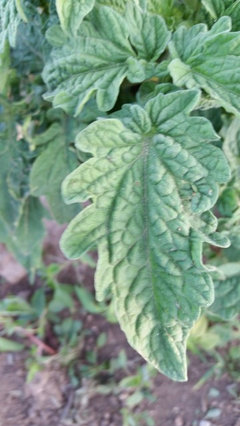
Interesting! I came to the forum tonight specifically to ask for help. I, too, have one out of twelve tomato plants that's doing the "tiny leaves and rolled weirdly" thing. Only one, a Homestead that I picked up at the plant swap (anyone else having any kind of issue with a Homestead?). It started out as a big beautiful plant, and the bottom 2 ft. of it still exhibit normal, flat and large leaves. The top two ft. are lighter in color, sparser in leaf production and curled under and around like little fists. This started around the first week of the continuous rain (3-4 weeks ago) and I wondered if it was too much rain, too cool, extra-sensitive hybrid, etc. None of my plants were stressed during all of that - they've been quite happy as they're in raised beds, I've fertilized with Tomato Tone a couple of times, etc., etc., and there has been no spraying by anyone around me that I know of (and the tomatoes next to it show no symptoms).
I'm attaching pictures - thanks! (oh, also....I've not noticed any aphids, but I'm going to wear my glasses and look at them more closely tomorrow, hahaha).Sharon
luvncannin
Original Author11 years agolast modified: 11 years agoSharon I have and probably brought the Homestead but mine are not showing any signs of problems.
I have 2 ,not sure what they are yet cause I didn't want to mess with them last night too much, that are turning yellow. The whole plant. We gave them a dose of poo water and if that doesn't help and they get worse I will pull them out.Also Dawn I too am way more relaxed gardener than he is. He gets high yields which is great as he gives it all away but it is too intense for me.
- 11 years agolast modified: 11 years ago
Sharon, Your plants, unfortunately, exhibit the classic symptoms of herbicide drift injury, specifically a product that contains 2-4-D. I'll link a page with a photo of 2-4-D damage for comparison. Herbicide drift can hit 1 plant out of 100, or it can hit them all, or anything in between. It just depends on how much herbicide was drifted and on how concentrated it was when it hit any given plant. I've had herbicide drift damage hit only 1 plant in a bed with 2 rows of 15 plants, and I've had it hit 15 plants in a row. You just never know. Because herbicides can easily drift a half-mile, and perhaps further in special circumstances, you often have no idea that anyone within that distance of you sprayed a herbicide a few days before you saw the damage. Sometimes plants recover on their own, and sometimes they don't. My plants got hit at least 4 times last year, and some died following each incident. This year they've been hit only once, and none of them has died yet.
Kim, Yellowing leaves are a symptom of stress, so can indicate anything from being too wet to too dry, too hot, insect-infested, various diseases, a nutritional deficit, etc. If you want, post a photo of those two plants and we'll try to guess. To a certain extent, especially with very wet weather and also especially when we go from being cool and cloudy to being hot and sunny overnight, yellow leaves just happen. I never pull a plant just because it has yellow leaves. I remove the yellow leaves, spray the plant with a fungicide if I think that a fungal infection is the reason the leaves are yellowing (with brown spots and some sporulation) and give the plant a chance to bounce back. I'd only pull a plant with yellowing leaves if I saw evidence it had a serious disease issue that I wanted to stop from spreading. Even plants that have a lot of yellowing and look like crap still can produce perfectly good tomatoes, and that is their purpose----to produce a harvest.
If a plant is yellowing because it has a nitrogen deficiency, it probably would take something stronger than a dose of poo water which is relatively low in nitrogen to bring it back to green-ness. Have you had a soil test on your garden soil so that you know it is balanced and does not have any nutritional deficiencies?
My tomato plants are improving in color. They are losing the pale green they get when they're waterlogged and cannot absorb nutrients, but there is some early blight, and I'll get them sprayed one of these days. It is major harvest time around here now, and just getting the harvesting done and the food prepped for fresh eating and/or long-term storage is eating up huge chunks out of my schedule. I need to try to get outside right at daybreak tomorrow to beat the heat because I stayed out there too long today and got too hot. I feel like the sudden change from cool/cloudy/rainy/misty/foggy to hot/sunny/dry/windy has been pretty hard on a lot of the garden plants, and they'll look a little better after they have a little more time to adjust. I probably could say they weather change has affect Tim and I the same way. We keep wondering how it suddenly got so hot and miserable. The yellow leaves on your tomato plants are basically their way of saying the same thing.
Dawn
- 11 years ago
Dawn...thanks! You are absolutely right; I Googled images of 2-4-D damage to tomatoes and it does match what I have. Should I trim these odd, gangly stems back to healthy growth, or just leave them alone? As I said, the bottom of the plant looks great!
Sharon luvncannin
Original Author11 years agoNo Dawn I have been meaning to do that but I cant find out where. My ag ext office charges too much and I know I had found one place that was only 10$. I will look into that. I have some good fertilizer but I will get pix posted before I try anything else.
- 11 years ago
Sharon, Oops. I forgot the link. Sorry, But, since you already Googled and found the photos you needed, I won't add it now.
I always leave them alone and only cut them off if they wither and die. Generally the limbs put out new healthy growth after a while. However, it isn't a sin or anything to cut them off. If you don't like looking at them, cut them off. The deciding factor for me would be whether or not the plants already have fruit on them that might sunscald if I cut off the damaged foliage. I will ignore damaged foiliage and not cut it off in order to protect developing fruit if I have to.
Normally, you can help the plants by watering them heavily to flush out any herbicide that remains in their system, but I don't think I'd do that if the soil is still heavily saturated. My soil is dry on the surface and maybe an inch down, but very wet below that and yours may be more or less the same way since we had fairly similar rainfall in May.
It is odd. For our first few years heer, we got lots of damage from glyphosate drift. Now we never see that. And, we didn't see much, if any, 2-4-D damage during our first few years here, but now we see it all the time. It appears folks within a half-mile to a mile of us have stopped using glyphosate and are using 2-4-D instead. I am immensely pleased at how little damage we have had so far this year, but am worried our good luck won't hold. I hope your plant recovers just fine. Homestead is so good at setting fruit in hot summer temperatures that it would be a shame if your plant doesn't make a full recovery.
Oh, and I should add, with my tomato plants that had herbicide drift damage a few weeks ago, I never cut anything off, and now when you look at the plant, you don't see any damaged leaves. I'm not sure if they grew larger and took on a normal appearance after a while, or if the plant put out new suckers and then the damaged leaves maybe fell off. The one thing I am sure of is that I did not remove them. The catnip plants that were damaged at the same time were a lot slower to recover, but they look pretty good now. I did cut their damaged portions off because the plants looked all but dead.
Dawn - 11 years ago
Good to know - I'll probably just leave them alone. No fruit has set anywhere (yet), so...we'll see how things progress - thanks again!
luvncannin
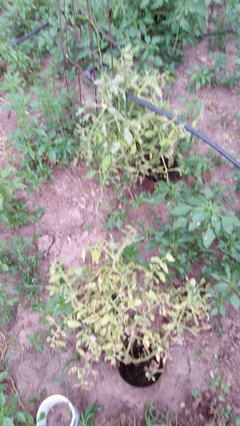
Original Author11 years agoIt seems to be declining. I will try some fertilizer and give it a few more days to see. The picture at the bottom is how all of my tomatoes look except those 2 problem ones. they are in the middle of an area surrounded by other plants so I don't suspect any kind of drift.
- 11 years ago
Yellowing leaves from the top are harder to diagnose than yellowing from the bottom.
I assume you checked the undersides of the leaves for pests or pest damage and didn't find any?
Normally, when it is nitrogen deficiency, that starts at the bottom and works its way up, which is not what your photos show.
Fungal diseases start at the bottom and work their way up, which is not what your photos show.
Yellowing from the top down sometimes is iron deficiency, and this takes us back to the importance of a soil test. When we talk about any sort of nutrient deficiency, we are referring to a deficiency of that nutrient within the plant itself, and not necessarily within the soil. Often, particularly with high-pH soils, the nutrients are there but the plant cannot take them up because some other nutrient or the soil pH itself is interfering in the tomato plant's ability to take up the nutrient.
If your upper leaves are beginning to curl in combination with being yellow, the most obvious explanation might be Tomato Yellow Leaf Curl Virus.
If I had any tomato plants that looked like that, I'd first try to approach it from the nutritional angle and I'd feed the plants with a complete and balance fertilizer. This is better than attempting to add only N or P or K or any other single nutrient because then you get in the position of taking a scatter-shot of approach of trying first one thing, then another, and each thing you try may cause a new nutritional imbalance that damages the plant in another way and causes another problem. Use an actual plant fertilizer, whether organic or synthetic in origin, and not just compost tea or manure tea. The plants need a real fertilizer with reasonable and known analysis numbers to pull them out of their off color. When you use a homemade poo tea you have no idea how strong or weak it is unless you've done it for years and know how strong (dark) the tea needs to be to pull a plant out of a nutritional tailspin. To me, your plants just look really hungry. Again, the soil may be chock full of nutrients, but if it is high pH, that can lock out the nutrients by preventing the plant from taking them up. I have high pH soil and it has taken years of amending to get the soil to where they have a beautiful healthy leaf color during the growing season, and I still use Tomato Tone and other organic fertilizers and soil amendments every year to keep the soil in that condition.
You also can have poor foliar color if the soil is staying excessively wet. My plants had poor color (in my opinion) during the month of May when we had 25.5" of rain fall on top of about 12-14" that had fallen in Jan-April. I knew the soil had plenty of nutrition within it, but the roots of the plants were so clogged with water that there was no room left for nutrient uptake. Once the rain stopped falling and we had some drying out of the soil, the color of the plants rapidly improved within just a few days. I had resisted fertilizing them with anything because I felt like their color would improve as soon as we dried up, and it did. If your soil in the upper few inches is not waterlogged, the plant color ought to improve on its own, unless......
If you have very sandy soil or a fast-draining sandy loam (some sandy soils are very compacted and do not drain as fast as you'd expect), then the nutrients can wash out of the soil as heavy rain pours down and runs through the soil. Again, without a soil test to know what you had to begin with, we can only speculate that the soil had adequate nutrition to begin with. However, if cool-season plants produced well and had good color, we can sort of assume there was adequate nutrition in the soil at least during the team the cool-season plants were growing.
Sometimes when the nights are staying too cold (and I cannot imagine that is a problem at this point in time....my nights are staying in the 70s lately), nutrient uptake is poor and that resolves on its own with warmer nights. Remember that if you see poor plant color in late winter or earliest spring or in mid- to late-autumn because you don't want to be trying to resolve an issue that is merely a temperature issue that has to resolve itself.
Because of your location, you might see some things that are more common in western OK, KS, western TX, etc., that those of us further east and south don't see.....like, perhaps, psyllid yellows. I've only had that once (in 2008).
If it isn't a nutritional issue, then the yellowing from the top down doesn't fit many diseases commonly seen here (but maybe it is something more common there). Normally, the big question here in our area is why the leaves are yellowing from the bottom up, and for that, there's lots of possible answers.
I'm sorry. I don't think I helped much, but I tried. Before you yank out the plant, I'd suggest trying to fix it nutritionally and giving it time to improve----a week or two. Often, plants come out of a tailspin with adequate feeding and go on to do great and to produce well. I only yank a plant if it has something that I know is contagious because any other issue that shows up is a learning opportunity. Also, what happens if you yank one or two, and then each and every plant starts showing the same symptoms? If you experiment with the early problem children as you search for an answer/solution that turns the plant around, then you already have the "cure" figured out if it becomes a widespread problem.
We are at the tail-end of the time when we even will get tomato fruit set now as the temperatures are starting to get high enough to cause blossom drop, so getting the plants back on track is important if you want tomatoes this summer. It would be easy to yank the plants and say "I'll plant more for fall." However, you could have the same thing happen in the fall......so try and find a solution if you can. I consider my garden just a big old science experiment and learn something new constantly from whatever problem is showing up at the moment. I always want to try to understand what is causing something I'm seeing so that I know what to do about it the next time it shows up. That way, the poor plant or plants that are under-performing are serving a useful purpose by teaching you something so at least you get something out of the experience of having grown them.
Having said all the above, I've never had plants yellow from the top down like that and I kinda thought I'd seen it all over the years, if not in my own garden, then in the gardens of friends and family. That's one reason I lean towards thinking it is nutritional....because it isn't really a common disease, other than if it were to be Tomato Yellow Leaf Curl....and if you don't see curling, that's not it either!
luvncannin
Original Author11 years agoThank you so much. I am going to fertilize with the one I just bought 10-13-12. its called trifecta. it worked great on my puny peppers.
you gave me a lot to think about. They look worse today and I will take some more pictures in the morning. I want to try to get these babies turned around and I believe it is nutrient def. There are no bugs no curling no funky discoloration. The part of the garden where they are is not as much compost tilled in. Its more sandy , that is something we will be working on in the fall. The main garden area is 80 x 100 ish and there are 3 definite different soil types. I guess it depended on how mush manure was dumped where, way back when.
I never thought about the strength of the poo water. I have a 55 gal drum and constantly add stuff to it to make tea. it has a sludge that I stir every day when I add water too.
This is great I have hope and will post updates.luvncannin
Original Author11 years agoSome sad pictures. I fertilized the day before
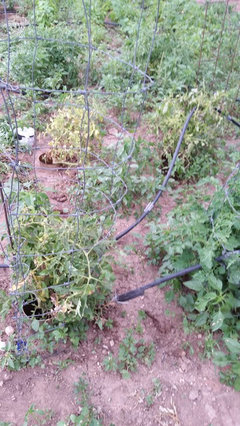
There are 3 in this area now that are yellowing. I fertilized all 9 in this block of tomato plants.- 11 years ago
Sandy soil? That's a whole different can of worms then.
I have to start out by saying that I've never, ever, not even once in my life seen tomato plants that look like yours. I've never even seen photos of tomato plants that look that bad, with the yellowing starting from the top first. With most tomato issues, yellowing starts on lower leaves and moved up. I look at the plants in your photo and feel baffled because they look so very different from anything I've ever seen in my own plants or in anyone else's plants.
Since they are in sandy soil, it might be root knot nematodes, with which I don't have a lot of experience since I don't have RKNs in my soil. You could rule it in or out by pulling one plant and checking for galls (swellings) on the roots.
It most likely is some sort of nutritional issue, but it is hard to guess. If your leaves were more mottled, I'd think it might be one of the mottle or mosaic diseases.
Since you've never had a soil test and have no idea what your soil pH is or might be, it is impossible to just guess what might be wrong.
To me, those plants look like they are either severely over-watered, under-watered and/or starving to death. Does anyone that you know who grows tomatoes there in your area have anything similar going on with their plants? It might be a disease y'all have there in the Texas panhandle that we just don't see here.
Also, when did you plant them? A healthy plant that was transplanted into the ground at the proper time should be very large by now. My oldest plants are 6-8' tall and even the very last back-up plants that I stuck in the ground in mid-May are 3' tall and a healthy green, are blooming and setting fruit.....so, when I look at your plants, I see a general failure to thrive that seems more likely to be nutrition-related but I'm only guessing. In another section of the garden do you have healthy green tomato plants that are making good growth and producing fruit?
If it was rainfall-related, it seems like it would be more widespread. The way it is spreading, though, makes me worry it is a disease. Have you checked the foliage for insects? It could be that something is feeding on the leaves and damaging them. In your part of TX y'all probably have thrips and whiteflies and other pests that I normally don't see here (because you're in the normally hot and dry panhandle where pests seem to proliferate quickly and spread diseases).
My gut feeling is it relates to the soil, but I'm not sure in what way. I think those plants may be too far gone to save. If you fed them with a water-soluble fertilizer, you should see vast improvement in under a week and maybe in only 3-4 days.
If you see shoestringing, mottling, mosaic-type coloration or curling, it is likely to be a disease. With photos taken from a distance, it is hard to see any leaf well-enough to tell if any of the above are showing up on your foliage.
Honestly, to me, those plants look like they are dying, and I am not sure if anything you can do would save them.
Are those little cans I see around the root zone? If so, it is possible that they held too much water and caused root rot or something during the heavy rainfall.
- 11 years ago
I came back to add that there is a nagging thought in my sub-conscious mind that says maybe something is wrong with your poo tea. Not knowing how you brew it, I cannot imagine what my subconscious mind is worried about. Be sure you are using only well-composted, aged manure. New manure could burn the heck out of your plants and kill them. New manure also could contain bacteria and other pathogens. And, unless you are 100% certain that the animal manure you use comes from animals NEVER fed anything that was sprayed with a persistent herbicide, then there is a chance there's just enough herbicide residue in it to hurt your plants a little bit every time you use it. Tomato plants can be damaged at herbicide residue levels as low as 1 part per million.
luvncannin
Original Author11 years agoThat's so helpful and sad too that I have some mystery going on. I believe it started as too much water and not enough fertilizer/nutrients. and then not enough water.
-the cans I have to use around all the tomatoes and peppers or the wind beats them to death or severely stunts their growth. like a few of my plants that never got cans and they are half the size.
-Size well they are smaller since fighting these issues but most of mine are between 2 and 4 feet. these are struggling at 12 to 18 inches
-compost tea is a large barrel with about 5 gallons of poo to start full of water about 30 gallons. stirred several times a day. This is the same manure and tea that I have used on my whole garden. I have added this manure in several beds directly like onions and beans and they did not have any issues. I add in scraps from the veggies when I clean them in the sink in the garden. I top off this barrel every day but don't use it every day.I got behind fertilizing and I thought I had this perfect soil and didn't really get in a hurry but I am almost sure that is the problem. The tomato area on the far west side is doing great, slightly different soil. the tomato area to the south of these doing great different soil structure. This area is more compacted and sandy them the fluffy loam that is the rest of the garden.
I guess I will give them through this rainy spell and see how they fare. By Monday I should have an answer keep or pull. Thanks so much for trying to figure this out for me.
if indeed it is poor soil how often should I try to fertilize to keep everything healthy in this area? I have some espoma 3-4-4. And i have the 10-13-12
 11 years ago
I skimmed through most of this thread for a second time, but I might have missed something. The curly top leaves and strange twisting has been a topic on several groups I am in. Someone suggested hydrogen peroxide to get oxygen to the roots. I soaked seeds in a hydrogen peroxide solution this year. We also added ground aspirin when we planted (because DH found a recipe) but it didn't help in the pots that didn't drain. I have no idea if this would help, just passing it on. http://davesgarden.com/community/blogs/t/BriarRose74/1860/#b
luvncannin
Original Author11 years agoThank you I will check into that. We are getting a little rain here and there so maybe the fertilizer will kick in too
- 11 years agolast modified: 11 years ago
Kim, I understand the use of the cans to protect plants from wind early in the season, but the folks around me who use them, remove them before the plants get so big that they can't lift the cans ups and pull them up and over the plant without damaging the plant. My dad used them long ago, but eventually switched to wrapping his tomato cages in clear plastic or with old sheets to block the wind. He only wrapped about the bottom foot of the cage and also removed it as soon as the worst of the April wind had passed. The down side to using the cans is they can hold water, and if there isn't mulch that blocks the cans from receiving direct sun, they can heat up and radiate the heat down to the roots or up to the plants above. Would you like to sit out there in the garden in today's sun with sheet metal wrapped all the way around you to reflect heat onto you? Heck, no!
The fact that some plants never have made it above 12-18" indicates a long-term problem. They may have been too wet early in their lives, but should have caught up after the soil dried up some. It might be a soil issue if all the smaller ones are in one area, but if the smaller ones are surrounded by larger, healthier plants, then it seems less likely to be a soil issue since it then would seem to be hit or miss.
If there is a problem with herbicide residue, it almost always affects tomato plants even when nothing else is affected, so you cannot automatically rule it out if other types of plants seem fine. Different kinds of veggies react differently to herbicide contamination and I don't know of anything that is more sensitive to it than tomato plants so they can show damage when nothing else does. Tomatoes can show damage at even 1 ppm whereas other plants may not show damage until they have 3-6 or 10 ppm. When herbicide drift via the air hits my garden, I probably have 40 kinds of flowers, 15 kinds of herbs and 20 kinds of veggies in the garden. What shows damage? Tomatoes, tomatoes, tomatoes, and occasionally catnip or a random flower here or there. This year I have had drift damage on three tomato varieties, catnip and calendula, and nothing else. The calendula is practically buried under taller plants of different types and yet the herbicide drifted and damaged it anyhow.
It it likely that your poo tea is growing bacteria, and you are dumping that bacteria on the garden every time you use it. In our climate with our heat and sunshine there is no way that bacteria is not growing in that barrel especially if you are adding plant waste to it. For healthy compost tea or manure tea you should only add compost or manure that has been fully/completely composted so that it no longer resembles its original self---whether it originally was cow patties or vegetable waste or whatever. It needs to look like fully-decomposed compost with no chunks of un-decomposed anything in it. It not only needs to be fully composted, but must have been composted on a hot compost pile that got hot enough long enough to destroy all the dangerous pathogens. If you cold compost and your pile never gets hot enough to steam, then your compost can be full of disease microorganisms. Compost, manure and the tea made from them both are great, but not when they are being done in a way that could be hurting the plants in your garden. Again, different types of plants are susceptible to different micro-organisms, so whatever is in the poo tea might include something that harms the tomatoes and nothing else.
When you have a widespread problem like what is happening, and happening very quickly, with your tomato plants, something major is going on and you have to evaluate and question every single thing you do to try to get to the root cause of what is wrong.
If your soil is very sandy, there may not be anything you can do at this point to save those specific tomato plants. Very sandy soil has trouble hanging on to water and to nutrients. The only way to fix it over the long term is to add tons and tons of organic matter. You could do it most easily via the huglekultur method which involves digging a shallow trench and filling it will decaying wood. Picture the beautiful brown, humusy topsoil found beneath trees in a woodland, and that is what a hugelkultur can give your plants in fairly short order. Or, you can just repeatedly add tons and tons of compost and other organic matter to the soil. Understand though that this is a never-ending project because in our climate "heat eats compost" and it eats it up quickly. To improve the sandy end of my front garden I worked tons and tons of wood chips into the soil for the first 4 or 5 years along with other forms of organic matter. In some climates, this method is frowned up because the wood ties up nitrogen as it decomposes, but in our climate, I just add extra nitrogen to compensate when I add wood chips. Even if I put big pieces of bark mulch chips in the soil, in a year or two it is totally decomposed and gone without a trace. Another way would be to grow cover crops and green manure crops that go back into the soil.
You also have got to find out what your soil pH is. If your soil is fairly alkaline (mine is very alkaline), just the pH alone can tie up some nutrients. It won't matter if those nutrients are there in the soil, in your organic matter or even in a pelleted fertilizer you added to the soil....the pH or some nutrient imbalances can tie up the other nutrients so that the plant roots cannot absorb them.
If this is your first time to garden in this specific location, understand that while organic gardening is wonderful, it is not wonderful the first year or two or three if you are starting out with poor soil lacking in life. You need to have an active soil food web existing in the soil that will help break down and digest the organic fertilizers and make them available to the plant roots, or the organic fertilizers go unused. This is also the reason that some people struggle to garden organically in containers---the lack of the soil food web in their sterile soil-less potting mix. When I garden in containers, the first thing that goes into the bottom of each container is a big old chunk of a half rotted tree limb or stump, surrounded by lots of leaf mold and compost scooped up from our forest floor. I also use lots and lots of compost in my soil-less mixes instead of peat moss because compost is alive and peat moss is dead. To garden organically successfully it all starts with the soil, and normally in first-year gardens, the soil lacks all the vital microorganisms needed to make organic gardening work. I happily admit I used pelleted slow-release synthetic fertilizers and Miracle Grow water soluble fertilizer our first few years here so I could keep my plants fed while I built better soil. Every year, as the soil got better, the need for synthetic fertilizers decreased. That was the tradeoff I made in order to be able to garden successfully while continuing to build the soil. Nowadays, I don't have to add much to the soil because just the mulch that I use (4-8" per year, though not necessarily 8" piled onto top of a bed all at once) decomposes and enriches the soil, but we're well into our second decade here so the soil we have now bears little relation (thank God!) to the soil we started out with.
There are no shortcuts. Fixing the soil is the most important thing. To me the two thoughts that instantly pop into my head when I look at your latest photos are "those plants are starving" and "those plants are dying". That is the instant gut reaction, not a thought-out reponse, but I've gardened long enough that I trust my gut reactions. It is highly likely there's pest or disease issues too, but I think they most likely are secondary to the soil or nutritional issues.
Is this garden where the slaughterhouse used to be? If so, you have absolutely no idea what sorts of chemical, pesticide, herbicide or hormone residues may reside in the soil. There could be something there that we'd never dream was there. Starting out with a good soil test from a reliable soil lab would be the first step to turning things around. Sometimes a soil test is a luxury, but in your case, because of your soil's past history as part of a slaughterhouse facility, it is a simple necessity. You could have heavy metal contamination or something that we'd never even guess was there. That's always the sort of issue when you are growing on a piece of property that had a previous life as a business of any sort.
Tim looked at the photos on my computer when he came in from work this morning and he felt like the plants looked as though they had been poisoned by something. (I always say he is not a gardener but he was a gardener when he was a teenager and he does know a lot about growing.)
In your part of the country, twisty curly leaves would have me on the lookout for Yellow Tomato Leaf Curl or Curly Top Virus, neither of which I ever see here, so I cannot tell you what they look like in the earliest stages. You can google and find photos that how what they look like later on.
Herbicide contamination via the air as drift or via contaminated mulch, manure, compost, straw and hay as herbicide carryover is becoming epidemic. You have to work really, really hard nowadays to keep the herbicide carryover out of your garden, and if it is windborne, there's no way you can stop that part of it.
luvncannin
Original Author11 years agoThank you so much for putting so much time into this for me.
yes this is an old slaughterhouse property. However this area was only ever a garden. its approximately 100 by 150 which we only planted 75x 100. It sits downhill from the actual buildings but their runoff goes to the neighbors field. Since these are the only plants I am having a problem with and they are all together I think maybe a soil test for that area would be good.I wanted to do soil tests at the beginning but I never found out where and kinda forgot about it. I will look it up after I get done with my jam.
- 11 years ago
I jellied today and I'll be jamming tomorrow. We are birds of a feather, aren't we?
The most budget-friendly soil test that I know of in the state of Texas is the basic test done through TAMU, which used to be $10.00. I don't know if it still is that amount. Then, depending on what you want to know, they can do all kinds of other tests. Back when we still lived in Texas, you could pick up the soil testing forms and mailer (I believe it was a bag and a cardboard box back then) at your county's ag extension agent's office, take your sample following their directions, mail it in and wait for your results. They usually got results and recommendations back to you pretty quickly.
I'll link the website for the TAMU soil lab below after I google and find it.
For anyone here in Oklahoma reading this, the OSU Soil Lab offers the same type of testing.
There's also a great private soil testing lab in Edinbug, TX, and all I remember about its name is that it has the words Texas + Soil + Lab in it. After I link the TAMU lab, I'll search for it.
It is hard to know what to look for when you're starting from scratch, but more and more your plants are almost looking like that have salt damage or some obscure disease like bushy stunt. At least with a soil test you can establish where the soil stands and what it needs. That gives you a starting point. From that starting point, at least you will know what you need to do to get the soil into better shape. Usually when a plant is having trouble, it all starts with the soil.....plants in problem soil tend to be more vulnerable to pests, diseases and odd quirks of weather (you know, like no rain for 5 years and then a year's worth of rain in a month....not that such things ever happen in Oklahoma or Texas).
I know it is discouraging to have plants that look sickly or are underperforming, but you learn from experiences like this and over time all this experiences and challenges turn a beginning gardener into a very well-experienced one. The only way to truly learn gardening is by doing it, so every experience, good or bad, is just a part of the learning curve.
Dawn
- 11 years ago
The private soil lab in Texas is linked below. It has been around a long, long time, is very highly recommended and is what I'd consider a premium type soil lab----probably utilized most often by folks in the ag business who want some very fancy and highly technical testing done. The map on their home page that has little dots which I assume represent their customers just blows my mind. I knew they were well-known and highly-respected but had no idea they were used by so many people outside the state of Texas.
Their reputation is superb, and if you ever should need testing that is above and beyond what TAMU offers, this is where I would go. They can test just about anything and everything.....for a price.
luvncannin
Original Author11 years agolast modified: 11 years agowow you are fast!
I got a few pints of apricots done for mom and some jam for non diabetics, lol.
I was thinking and pondering all the possibilities and thought what if the guy that plowed my field had a hunk of junk/herbicide on the plow. I had thought that in the beginning when I had the weird yellow potato leaves. Well who knows without a test. I will talk to my son and figure out which ones we want to get done. Thank you a thousand times. I really don't like having a problem the experts cant figure out.- 11 years ago
You're welcome, but I am not an expert.
To get a diagnosis of a tomato problem that a person never has seen before and that doesn't match the commonly-found photos of "tomato issues" online usually requires a trained plant pathologist or a county extension agent or someone similar. A layperson generally can only diagnose tomato problems they've experienced before. There are so many tomato problems with similar symptoms that it can be hard to narrow down the problem to one specific cause. For all we know, what is wrong with your tomatoes might be something as simple as them getting too dry, which can cause symptoms that mimic those of some diseases, but it seems to me that if the entire area was too dry, every single plant would have symptoms. Or, since it is happening in heat, it could be something as simple as spider mites, russet mites or broad mites. All of the mites are so small they are hard to see with naked eye, but you usually can find them by holding a white sheet of paper under an infected plant and thumping it. If little tiny things fall to the paper that are roughly the same size as the dot over the letter 'i' in this sentence and they begin to move around on the paper, those are spider mites. I've already got spider mites on my plants (had them show up early this year---in April) but so far the lady bugs are doing a half-decent job of keeping their population from getting out of control.
If it were me, I'd start with the simple, basic soil test. It might show nothing is really wrong with your soil in terms of the basic nutrients and CEC. You always can get more extensive and pricier testing done at a later date if your basic soil test shows something is really wrong. The good thing is that TAMU will give you recommendations about how to fix any nutritional issue their tests find. So, what I'd do in that situation is follow their recommendations to fix the soil, then see what happens with the next crop planted there. It could be an easy fix. However, if your soil test finds major problems, you then might want to have more extensive testing so that you can find and fix everything that is wrong.
Based on my experience here, there's nothing wrong with my soil that cannot be fixed primarily through the addition over the years of tons of organic matter, humus and compost. I have used sulfur to help bring down the pH a little bit and that made a ton of difference because my pH tested in the 8.2-8.3 range initially. Nowadays, as long as I am regularly adding a lot of organic matter, it stays just a little bit above 7.0.
And, I just want to add, that if you get poor nitrogen results on your soil test, take them with a grain of salt. Nitrogen is highly mobile in soil and often tests low on soil tests even though it is readily available in the soil. I don't worry much about low nitrogen on a soil test if my plants are staying a nice, healthy green as they are a more reliable indicator most times of the year than a soil test's nitrogen reading.
Finally, are you familiar with Pomona's Pectin? You can use it to make diabetic-friendly jams and jellies. It is both sugar-free and preservative-free, and also no-GMO and vegan. I've never seen it in stores. I just order it online. I like it better than the standard low-sugar pectins available at the grocery store.
Dawn
 11 years ago
Thanks for the heads up on Pomona's Pectin. We have been working on cutting back sugar and this will be helpful for making sugar-free jelly!
luvncannin
Original Author11 years agoI have some Pomona's pectin that I haven't tried yet. and hope to get some fruit to use it too. I can not believe how much sugar goes in the regular jams and jellies. I may start making all mine with Pomona's and a little honey.
Well Dawn if you are not an expert then you are the closest I have ever known.
I am thinking the routine and micronutrient test and then go from there. Its only 17. so that's not as bad as I thought. I am only going to sample that 75 x 30ish area because the other two areas are completely different soil structure.- 11 years ago
Kim, I agree about the amount of sugar needed to safely preserve fruit. It makes most jams and jellies too sweet for me, so while I make a lot of jams and jellies for my family, it is mostly Tim and Chris eating them as I find the normal ones too sweet for me.
I agree about sampling the soil separately for testing. Since you already know you have a different soil structure in the three different areas, I think that mixing soil from all three areas together would skew the results.
In her book that was published 10 or 15 years ago, Maria Rodale (of the Rodale family that published Organic Gardening magazine, now replaced by Organic Life magazine) talked about deciding at some point to test her soil in her yard for heavy metal contaminants. I don't remember why, because they already had lived and gardened there on that property for some time. And, of course, she was totally organic and still is. To her horror, the soil was very badly contaminated with heavy metals and she eventually figured out it had either been the site of a gas station or paint shop or something (sorry, my memory is fuzzy as it has been a long time since I read her book which is wonderful) decades earlier. As I recall, the solution for them was to replace the soil (several feet of it, I think, and there's that fuzzy memory again). I can only imagine how horrified she was to learn she had been gardening on such badly contaminated soil. Luckily, most of us are unlikely to ever learn something terrible like that about our soil, but I learned a lesson from that---we never really know what was done to our soil before we came along, do we? Well, I know cotton was grown on our land at one point, according to locals who remember that, and we do have cotton root rot in our soil, but you can have CRR without ever having grown cotton as it is a disease that actually affects thousands of plants that are not cotton. I love cotton and want to grow ornamental cotton, but if I ever get around to doing it, it will b grown in containers.
luvncannin
Original Author11 years agoThat would be horrible. Kind of like the growing a greener world they bought and used contaminated hay for mulch on their show gardens. What a disappointment.
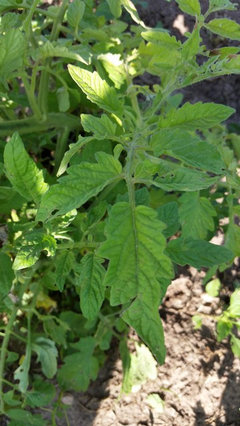
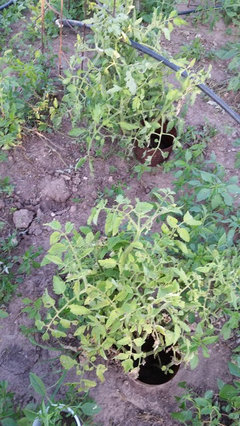
I went ahead and pulled the one plant there was not one green leaf left on the whole thing but roots looked great, healthy. There are two more but they are about half green so I will wait.


Okiedawn OK Zone 7