

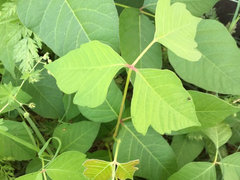
Poison ivy
Covered the poison ivy patch with cardboard and plastic and put a pallet on top. It is next to the shed and was growing up through the pallet before. Anyone have a way to kill it (besides goats)? It is wraped around the neighbor's tree and comes through the fence. I have visions of this giant poison ivy root reaching out to cover the whole block. We have put roundup on it before and it only laughs at us. Vinegar and salt gave it acne, but never slowed it down. I am hoping I can smother this one patch, but it comes up other places.
Comments (35)
 11 years ago
I'm so sorry Amy. Only way I've ever read (or experienced) to get rid of it is to use glyphosate. In areas where drift might occur I paint it on with a small brush. I encourage people to not mess around with pi in inhabited areas because so many have severe adverse reactions even from the dust particles of the dead pi plants. :( BUT love yas no matter whatcha do.
On the flip side, pi has its purpose. If a pi plant is on a weak tree a dog isn't likely pee on it repetitively and cause it to die faster. I've seen this process before. pi doesn't compete well with weeds. I wonder if its presence isn't often indicated in areas where plants need protection. Just thinking out loud on that one. 11 years agolast modified: 11 years ago
I'd use a selective herbicide like triclopyr as opposed to a non-selective herbicide like Round-up because Round-Up can kill other plants you'd rather not kill.
You can find triclopyr in herbicides specifically labeled something like "Poison Ivy Killer" or "Poison Ivy & Brush Killer" or "Brush Killer". The last time we bought one, which was years ago, it was in either a black or blue bottle but I don't remember what brand we used.
If there is any wind at all, or if the poison ivy is very close to desirable plants, I'd brush it onto the poison ivy while wearing long sleeves and gloves intead of spraying it, and I'd use a cheap foam paintbrush to brush it on thoroughly and completely. The older and more well-established the poison ivy is, the harder it will be to kill and multiple treatments may be required if you see regrowth after it appears that the poison ivy has died.
When we first moved here, I spent at least 4 winters removing poison ivy from our woodland. It was old, climbed up as high as 60' into the trees and had a main stem as big around as my wrist. I would saw through the big plants (practically like cutting a tree, only it was a vine clinging to a tree) and pull down all I could and then when regrowth appeared in spring at the stump/base of the poison ivy plant near the ground, we'd brush on the brush/poison ivy killer. Sometimes, with stubborn ones that kept coming back, during the growing season we'd drill holes into the stump of the plant and pour the brush killer in the holes. We still have a lot of poison ivy in there, as the birds spread it via the berries, but at least we got rid of the really huge plants on the edge of the woods near where we mow and also near the pathways where we walk (though we don't walk there in snake season).
I do not seem to be particularly allergic to poison ivy, but I still am very careful to wear long sleeves and gloves, and we keep a bottle of poison ivy hand cleaner in the house. I use it to thoroughly wash my hands and arms after I have finished with the poison ivy killer even though I don't think I made any direct contact with my skin touching the poison ivy. The poison ivy cleanser we have sitting in the kitchen right now is PROTEK X Poison Ivy, Oak and Sumac Cleanser. I use about a bottle a year, usually in early spring when I am cleaning out the garden fenceline next to the woodland and hand-pull a clump of grass or something that's trying to grow through the fence and come up with a handful of young, newly-sprouted poison ivy. When that happens, I drop everything and go to the house and wash thoroughly with the poison ivy cleanser. I always think there is no poison ivy in the garden until the day I find myself holding some in my hand.
Despite all the time I've spent removing poison ivy from the woodland and from the garden fenceline, I've only broken out with the rash once since we moved here in 1999, and it was a small spot and it went away quickly. I give the poison ivy cleanser all the credit in the world for that.
When I have poison ivy plants to dispose of, I don't compost them and I don't burn them. I bag them up in a thick black plastic lawn-and-leaf bag and they go out with the household garbage. If you burn the poison ivy plants, the burning can release the urushiol oils that cause the rash and discomfort and those oils in the air can be inhaled and can cause an internal poison ivy reaction. I worked with a young woman in the late 1980s or early 1990s who became very ill in exactly that way---she had the poison ivy rash inside her body (lungs) and outside of it too. They had burned a big brush pile with poison ivy on it while clearing the land where they were building their home.
The University of Missouri has a great document on poison ivy control that explains the different herbicides you can use. I've linked it here before. Let me go find it and link it for you.
Dawn
Related Professionals
Brooklyn Landscape Architects & Landscape Designers · Carson City Landscape Architects & Landscape Designers · Wenatchee Landscape Architects & Landscape Designers · Palm Bay Landscape Contractors · Springfield Landscape Contractors · Oklahoma City Landscape Contractors · Champaign Landscape Contractors · Albert Lea Landscape Contractors · Albany Landscape Contractors · Rochester Landscape Contractors · Cheyenne Landscape Contractors · Owensboro Accessory Dwelling Units · Salisbury Accessory Dwelling Units · Sheboygan Accessory Dwelling Units · Medford Accessory Dwelling Units- 11 years ago
I don't react much to poison ivy, but one time my exposure was just perfect while clearing the fence line of very tall weeds. I was pulling by hand. The ivy was as tall as I am. I was standing downwind on a breezy day and it was pollinating. My eyes, my face, my throat inside and out, the exterior of my chest were exposed.
Interestingly, my hands and my arms were barely affected, but the rest of me was miserable. Still, I was only suffering a mild reaction given the impeccable exposure. I experience in slight how horrible allergic reactions can be. I'm glad it happened. AmyinOwasso/zone 6b
Original Author11 years ago::vigorously knocking on wood:: I have never had it. This is why I am trying to do it, because my husband gets it a couple of times a year. My daughter breaks out if she even thinks about poison ivy. Daughter has used most everything availabe and has settled on Fels Naptha soap to wash with after mowing, etc. This year I am growing "gum plant" (it has a long Latin name I can't pronounce) the flowers have a resin in them that is supposed to help with the rash. I would grow jewel weed, but I don't think I have a location for it.
Bon, you are so lucky you didn't have a worse reaction, and I am making a mental note not to mess with it when pollinating! I NEVER would have thought of that. What time of year WAS that?
Dawn, thanks for the link, I will read up on it. We haven't sprayed roundup since the garden got big. Well, maybe DH srayed the fenceline for bindweed and PI once last year. My plan is to use the foam brush method at some point.
A couple of years ago an ice storm broke a cedar tree in the back yard. Spring came and and I'm standing on the patio looking out in the yard and ask DH "Is that poison ivy hanging out of that tree?" You couldn't see it before. But it had one of those monster vines growing up the back side, wrapped around in the tree and finally beginning to cascade down again. I cut some new sprouts there earlier in the season this year, and pushed a tin can down over the stump.
I would borrow some goats, but I suspect they would want to eat more rhan PI. Wonder if they like bindweed.- 11 years ago
I don't know what month, but recall it being very late spring with summer right around the corner. The weedy fenceline had gotten away all that spring because our machines were inoperable.
- 11 years ago
Al and I went to an auction the other day and it was being held outdoors and moved around the property as the auction progressed. We were not interested in many things so I had brought a lawn chair from the car and we were just kind of taking turns sitting down. I was near a tree and a woman came over and said, you better be careful sitting that close to poison ivy. I had noticed a vine on the tree but had identified it as Virginia Creeper. I said, "I think that is Virginia Creeper". She said that she wasn't allergic to poison ivy and she reached out and starting rubbing a leaf between her fingers. I am thinking to myself that I really hope I am right. LOL Then she said, "Oh, I think you are right because my fingers are not tingling like they do with poison ivy". Had never heard of anyone identifying PI using that method. LOL
- 11 years ago
I always run into folks that think VC is PI. At least once every couple of weeks. They think all vines are PI, all snakes are cottonmouth, and all spiders are fiddleback. I get it if I just say poison ivy. I can see the stuff a mile away. Shoot! I am starting to itch now!
- 11 years ago
Scott, where I live it is easier to kill poison ivy than it is Virginia Creeper. It 'creeps' into everything.
- 11 years ago
Carol, That is a hoot! I've never understood why people cannot tell 3-leaved PI from 5-leaves VC!
Scott, I agree that many people over-react and assume the worst in every case.
I got into a heated conversation once over 20 years ago with a Boy Scout leader who was incorrectly telling the kids at Cub Scout Day Camp that the VC was PI. I was right and he was wrong and he would not back down until another male scout leader told him he was wrong. I guess because I was a woman he thought I couldn't possibly be correct in identifying VC as VC. (He also didn't believe women should be scout leaders either, so he was sort of a lost cause.)
I tend to assume the opposite---that something isn't a poisonous plant, venomous spider or snake until I learn that it is. That's worked well for me so far.....
Dawn
- 11 years ago
That time I was infected, something funny happened. I had just been to the doctor for treatment. I had just been all over the internet looking for proper identification. Earlier that morning I had taken banana peels and rubbed them over my face and chest, it was that fresh. Later that day a client and myself with my kids in tow hauled some of her authored books to a local retailer. For the kids, we decided to stop by Braums for a treat and a trip out to playground so the kids could bounce.
The edgings of this play area were nicely trimmed, but among them was a PI vine nicely wound up from the bottom and peeking through bush branches. I couldn't believe it, but I should have because 'tis the season' it was. Its presence looked intentional, because it was pretty. Considering my recent experience I decided to let the manager know I had identified poison ivy in the bushes of their play area. I sauntered up to the counter, spoke to the first lady and asked for the manager briefly mentioning pi.
That day there was a woman covered in poison ivy rash from the top of her face downward explaining to a Braum's manager that PI existed in the play area. I was not upset, you see, but you would have thought a gun shot went off. The communication went downhill from there in a very funny way as they all assumed my rash was from their playground. - 11 years ago
Bon, did you look like the type that would have been playing in the bushes? LOL
 11 years agolast modified: 11 years ago
I grew up in Monmouth County, NJ. I was told that we had the highest concentration of poison ivy in the country. It might just have been so, as I recall walking down woodland trails surrounded by "underbrush" which was 90% poison ivy. From the time I was in first grade until I left home for college, I had some poison ivy on me, year round. I never developed full resistance. But it hasn't been a terrible problem since, second grade.
When me and my brothers would hit a "critical mass" of poison ivy infection, if it was summer time, my mom would load us all up in the station wagon and take us for a day of the beach. Salt water really helped dry the stuff up.
The worst case I ever saw was a class mate, in third or fourth grade, who moved to our town from somewhere in France. Apparently they don't have poison ivy in France. He and his dad set about making a garden and pulled out a lot of "underbrush" with their bare hands. Then, they burned it, roots and all. He had ampules the size of a quarter and had to spend time in the hospital. He looked like he had early onset leprosy. The next worst case I've seen was on my wife, Jerreth, who, after years of being fairly resistant to it, got a real good dose of exposure (while in Monmouth County). She had a fine rash all over her. But the real problem was that it went systemic, attacking her internal organs. She had to go to the hospital. We have since found a product called Tecnu Poison Ivy Scrub, which actually removes the oils from one's skin, even when it has started to break out. Walmart had a combo package of the scrub, along with a fantastic lotion (also Tecnu) which helped with itching. I even use this when I start into poison ivy.
Our son, who is a veterinarian, has told us repeatedly, based on the immunology he's studied, that one never breaks out from poison ivy sooner than three days after exposure. He swears that it's impossible to have a reaction any sooner. Well, I trust him... But, I have to admit that many times I have had exposure, known it, and started itching within hours.
Perhaps it's because I grew up around so much of it. But I spot the stuff, even mixed in "underbrush" as if it were florescent orange. I suppose it's because it is not so common here, that people struggle to identify it. Beside confusing Virginia creeper with poison ivy, I regularly encounter people who are afraid to touch green ash tree seedlings and any other plant with a set of three leaves.
By the way. Back in the 70s I read Euell Gibbons' book, "Stalking the Wild Asparagus." In it, he gave an old logger's solution to building immunity. This lore said, that in February, before the plant leafed out, one should eat three leaf buds. Then, as the leaves grew, one should eat three tiny leaves a day. This was supposed to build ones resistance for the entire year to come. I cannot remember for how long he said to do this. I made it to about day three, when I broke out with poison ivy in my mouth!
- 11 years ago
LOL Carol!
Those poor people from France! There's no better way to appreciate geographical immunity than to travel abroad and experience exotic plants and bugs. My daughter and I had zero immunity to the mosquito population in the middle east.
You are a brave soul for having tried Euell's method. - 11 years ago
Jerreth and I lived near here, for the first 1 1/2 years of marriage. But we lived elsewhere for decades, before returning. When we did, we had almost no resistance to the local chiggers. I would pick up chiggers while standing in a person's driveway! I think my resistance has largely returned. Though, come to think of it, I look kind of like a polka dotted person during most of the warm season!
- 11 years ago
George, You're not the only polka dotted person in the warm season. I've been working hard this year to be less polka dotted. I've only had chiggers once so far, and had only a few on my feet after I had spend two days weeding the flower border and taking it back from all the weeds that spray off during the heavy rainfall in May. I scrubbed my skin so hard to get all the chiggers off of me before they could climb higher that my feet, ankles and legs were bright red.....but I did not have another single chigger bite appear after that scrubbing, so it worked.
Oddly, even though there's a gazillion mosquitoes everywhere, I've only been bitten a few times and usually they devour me. Chiggers usually only get me once because after I've had them once, I am much more careful about avoiding them, and it isn't easy when you're in a rural area where they run wild.
I think that the Protek X we use is about the same type product as the Technu that you use. We used Technu poison ivy products for a long time before the store where we shop started carrying ProtekX instead. In the summer here, you buy what you can find because often it all is sold out, sold out, sold out......all summer long. After all the rainfall this year, I imagine poison ivy will be even more plentiful than it is in a normal year. There is a little right along my garden fence line, and I am trying to ignore it.
This past week has been a really snakey week here, and I am not sticking my hand into any weedy area along a garden fenceline and the accompanying fenceline because there's just a ton of snakes out and about since the weather got so hot.
Dawn
- 11 years ago
I did pull a lot of weeds yesterday, but not in the possibly snakey area where a little PI is trying to come under the garden fence in the NW corner of the garden. I think I'd rather risk touching PI while harvesting in that area later this summer (I'm growing some sort of volunteer gourd there but it hasn't flowered or set fruit yet so I don't know which one it will be) than risk a snake bite.
I think it is cool you found jewel weed. When jewel weed blooms, the flowers are kinda pretty.
- 11 years ago
Sorry to dredge up an old thread, but thought I'd mention that I've found that GoJo and similar mechanics' grease dissolvers work great for removing poison ivy oils from the skin. For me they're every bit as good as Tecnu, at a fraction of the cost per use.
If you think you've been exposed, rub a liberal amount over the affected area, rinse with lots of free-running cold water from the faucet (to prevent opening the pores), pat dry. Repeat with a fresh towel. Wash with soap. Dry with yet another towel. Launder the towels. I'm not sure you really need all the towels, but I'm just being careful.
We live in the sub-suburbs (a little more rural than suburbia, but not really out in the country) and have an acre or so of unmanaged (neglected) trees. The woods are full of poison ivy and it's always encroaching on the areas we frequent.
I'm not much one to use herbicides, but I'm allergic enough that I spray it with Ortho Poison Ivy and Tough Brush Killer (nee "Brush-B-Gon"). I buy it in concentrated form at the hardware store. Mix 1/2 cup of the concentrate with a gallon of water, pour it in the Hudson sprayer tank, and have at it. It contains triclopyr triethylamine salt.
The well established vines as big as my wrist I have to saw in two at the base of the tree. I've read that urushiol is in every part of the plant, so I take no chances. I sweat in heavy clothes that cover every square inch of skin, including a ski mask for my face, just in case the sawdust gets blown toward me.
I agree that Jewelweed is the stuff to use if you contact PI without realizing it until (oops) later. Around here, conveniently, you usually find Jewelweed growing near most of the poison ivy. Thanks, Mama Nature! My better half makes homemade soap with Jewelweed in it, and swears by it.
We keep a few sheep, and have found that some of them will eat poison ivy with no ill effects. They're not as uncritical about their greens as goats, I guess, and not all of ours have been interested. The bad news is that sheep cause even more collateral damage to the greenery you want than Brush-B-Gon. This is no doubt also true of goats.
You say France doesn't have poison ivy? Thanks. I'm making an note on my "investigate for retirement" list. - 11 years ago
I had some type of rash for about a week and never did identify it. I found some small PI but I don't think I touched it, but I was cutting down some stuff in that area. Yesterday I got a wasp sting and I have a swollen, hot, red, itcy arm. It got me on the inside of my wrist and I have swelling from just above my fingers, to just below my elbow. I had one bad reaction a few years ago, but the swelling was not nearly this bad. My neighbor told me that after you have one reaction they will get worse each time. That is not good news.
- 11 years ago
Well, I know that some people can come
up with an allergic reaction to another kind of plant, which
resembles that of poison ivy. My mentor back in the 70s, Mr. Mauser,
would develop poison ivy symptoms whenever he came in contact with
Lambs Quarters. He would be a mess! He planted over an acre of
tomatoes and a 50' X 50' patch of melons. Just when things were
getting ready to be picked, he'd come up with this terrible reaction.
He was fortunate that he had a teenage friend who could go out there
and pick for him!
Carol, the reaction you describe, by my
understanding, is not truly an allergic reaction. But your neighbor
is quite accurate about how these reactions can worsen. My personal
experience with bee stings might help illustrate how it can go. When
I was 13 I started keeping bees. I'm sure I'd been stung by a honey
bee before, while running through the lawn barefoot. It hurt, but I
experienced almost no reaction to that sting. When I started into
beekeeping it took a couple of weeks before I got stung. The first
time I got stung, it was by two bees. One got me on the tip of a
finger and another stung me in the armpit. Within the hour I had a
rash on my torso and was experiencing hot flashes. My mother took me
to the ER and they treated me with an adrenaline shot. When the
reaction subsided my mother commented to the doctor, “Well, I guess
George is finished with beekeeping.” The doctor replied, “We'll
see. You'll know the next time he gets stung. The reaction will
either get worse, or it will get better.” I never had such a bad
reaction again. Though, for years the reaction was about like the one
you just described. I could get stung on the hand or wrist and I'd
swell and turn red to my elbow or even to my armpit. The swelling
would take a couple of days to disappear. I was determined to keep
bees. And I kept at it. By the time I was in my 20s I just had
localized swelling when stung. Then, one day, in the mid 90s, I had
to deal with an emergency situation, involving Africanized bees. I
was stung perhaps 80 times. I had no reaction. In fact, for several
years afterward I not only didn't swell from bee stings, but they
hurt much less than before. I went some years without keeping bees
(and without getting stung) and now the stings hurt, but redness and
swelling last only for a few minutes. All that is to illustrate how
an immune system my respond.
Here's a link to a great Youtube video
on how to avoid getting poison ivy. This summer I have followed this
fellow's advice with good success.
George - 11 years ago
Carol, My body reacts in a similar way to scorpion stings. The more recent stings have been worse than the ones a decade ago or more, but not drastically so. I only get stung once or twice a year now, but so far this year have eluded the scorpions. A wasp stung me back in the spring. Flew past me, turned around, came back and stung me right in the middle of my back while I was working in the garden. Tim saw the whole thing. I've never had one fly by, do a U-turn and come back after me on purpose before. My body didn't react to that nearly as much as I thought it would....pain, of course, but only a little swelling.
What is it about hands and arms? When I get stung on a hand or an arm, there's always that swollen, hot, red reaction, though I don't see a similar reaction if I get stung on my leg. When I get stung by anything like that, I come right inside and take Benadryl right away and it really reduces the swelling quickly.
A couple of days ago, our 1-year-old kitten, Pumpkin, playfully ran through a clump of tall grass near the edge of the woods and unknowingly disturbed a bumble bee nest, hive or family reunion. Those angry bees came pouring out of there and one of them stung Chris. I grabbed the cat and took him indoors, Chris was running from and swatting at the bees, and Tim went to the garage and found a can of wasp spray and sprayed it into that clump of grass. That was the first time in 6 or 8 years we have disturbed a ground nest of bees, wasps or hornets, and it brought back unpleasant memories. Since then, we keep the door to Chris' house closed while we are inside working on it, but that sure does cut down the airflow and it gets hot fast in there. We only work on it in the cool early morning hours on days he's not at work.
We haven't has as much trouble with paper wasps building nests up on the porch and other buildings this year, but there's tons of yellow jackets and bumblebees around this year.
I saw poison ivy along the northwest corner of my garden, right along the fence line where it tends to pop up annually. I got a couple of handfuls of it when weeding in the spring, but have just left it alone ever since. When I think I have made contact with poison ivy, I wash with a poison ivy hand cleaner, Medina orange oil or one of those mechanic's soaps that have pumice or something else granular in them that helps you scrub your hands clean....or lava soap....and all of those seem to help get the poison ivy oil off my hands. I've only had the tiniest of poison ivy outbreaks twice in my life, both times since moving here, so it is one of the few things I'm apparently not terribly allergic to.
This fall when I do garden clean up, I'll remove all the poison ivy I find. Mulching heavily usually keeps it from advancing very far into the garden, but since the woodland is filled with it and sits only about 8' away from the northern garden fence, I'll never be able to get rid of it all.
Dawn
 11 years agolast modified: 11 years ago
I need to break out the Brush-B-Gone after finding a couple of pi shoots under the big pines. Thanks for the reminder to use that product. There is a huge crop of it across the road on an abandoned lot I may hit at the same time. (Sssshhhh-I know it's not my land, but I mow their hell strip and I don't want to get that stuff. There's already enough in the woods behind our yard!)
Carol, I'm sorry to hear that about the wasp sting. I always thought your immunity would build after being stung by one. The last one I got was from a wasp that chased me when I walked by my dad's well house (where there was apparently a huge nest) and one chased me halfway to the house before it got me between the shoulder blades. Normally I see yellowjackets around here, thank goodness. I blow really hard when they fly near my head/face area and that seems to repel them. I read that somewhere and it sounds silly, but they do fly away.
Carol
- 11 years ago
I luckily have never had a reaction from poison ivy. I can pull it by hand and nothing. My husband however can be half a mile away just walk by and he has it. His reactions are pretty bad, so after doctoring him I'm very glad I am not allergic.
I have just started seeing wasps this year. We have a large pile of pipe left over from rebuilding our fence and they love that hot pipe. It must be 200 degrees inside those pipes, don't know why but that's where they are.
Saw my first bumble bee a few days ago. I have not see a honey bee in several years, I keep hoping they will build a nest somewhere along the creek. Also, saw my first cicada wasp this week. The frog are still everywhere and getting fat. Waiting for my hummingbird to fly back by everything is in bloom for him. They have not started to migrate yet have they?
- 11 years ago
The hummers might be migrating. We are seeing tons and tons of them and have been for a couple of weeks now. In general, they are not visiting the feeders because we have tons of flowers in bloom for them, but they fly in circles around my head when I'm out in the garden early in the day. They don't want me too close to any of "their" flowers (which actually are my flowers that I planted for them, lol). Right now, the 6 trumpet creeper vines scattered over about 2 acres are the big hummingbird attraction.
- 11 years ago
I forgot to say that we have honey bees everywhere. They are always abundant here even in winter and come out to eat on all but the coldest winter days. Want to know my honey bee secret? Other than cultivating lots of flowers that attract pollinators, I always put out a little cracked corn and hen scratch every day in an area about 50 yards from the house for the mourning doves and wild turkeys. Guess who is out there at the feeding area every morning? Honey bees. I am not sure how they do it, but they feed on the cracked corn. They are out there very early in summer (usually by 6:30 a.m., and earlier than that in June when the sun is up really early), waiting for me, anxiously scouring the ground for any little bit of cracked corn that the doves or wild turkeys missed. This has been going on since at least 2008. The bees are out there all day long until early evening. I suppose they feed on the cracked corn somehow in addition to whatever they get from flowers when they're in bloom, and they must use it to supplement their own supply of honey in winter.
When my friends in our neighborhood are complaining that there's no bees pollinating their fruit tree blossoms in spring because "all" the bees are at my house, it always puzzles me. I don't understand why the bees aren't visiting their trees, but then some of my friends use chemical pesticides, so maybe that makes the bees avoid their property. I always suggest they scatter some cracked corn beneath their fruit trees in latest winter/earliest spring to attract bees to the trees before they bloom in the hope that the bees will visit daily and then pollinate the fruit tree blossoms once they appear. Some people here say they haven't had a decent number of bees since the hot, dry summer of 2011, but I fed the bees well that summer (not just corn, but sugar water and other things) and our population might have dropped some but it never went away.
AmyinOwasso/zone 6b
Original Author11 years agoI live in town, but I still see a surprising number of honey bees. We have the short white clover in the yard, and dandylions they seem to like.
- 11 years ago
I'm glad to hear you are seeing honey bees there Amy. I had read a news article a few weeks back about how a lot of Oklahoma bee colonies had died off over the past year, but the population here seems fine to me. We also have a lot of bumble bees----definitely more than usual, and I'm not overly fond of them as they can be very aggressive. I'd rather have the honey bees present in large numbers than the bumble bees. I haven't seen many cicada killers either or red wasps, but we have lots of yellow jackets.
- 11 years ago
Dawn, the bees are probably picking tiny particles of the corn to take home and feed it, as they would pollen, to their brood. I've seen bees collect corn pollen and I've seen them hovering around salt blocks, etc. They know what they need!
- 11 years ago
George, I wondered if that was what they were doing. Thanks for the explanation. The bees are so thick that the doves are ignoring the cracked corn in their usual feeding area and going into the chicken run to get the chicken's food. Then the chickens get upset and start hollering and the rooster comes running and chases off the doves.....it is a three-ring circus around here some days.
Dawn
- 11 years ago
Dawn, I here you. The other night I had the dogs chasing the cat, the cat chasing the bunnies and the bunnies running circles around the pipe pile. If anyone would have stopped it would have been a wreck. And i was in the middle trying to save everyone. I finally just gave up and set down and laughed at the craziness of it all. I love this job!!!!!
- 10 years ago
Thoughts on organic methods of poison ivy removal? Pulling the plants with gloved hands, careful disposal... No goats but I do have chickens, think they might take care of it without harm if I move a chicken tractor to that area?
- 10 years ago
To stay organic, you might get goats or chickens to eat it. Otherwise, hand-digging or pulling it while wearing gloves is about as organic as it gets. It may come back from being dug or pulled though. Mine always does, eventually.
Some chickens will eat poison ivy and some won't. Just remember that in order to eat it, the chickens have to walk through it and stand in it, and they can pick up the oils from the plant on their feathers. So, if you let the chickens work in the poison ivy, avoid touching or handling the chickens for a few days in order to avoid making contact with the poison ivy oil that might be on them.
AmyinOwasso/zone 6b
Original Author10 years agoI haven't tried this, but there is a vinegar that is 20% acetic acid. Worleys in Owasso carries it for around $20. I don't know if vinegar that strong qualifies as organic, and you have to be careful using it lest it burn you. It might leave the ground permanently unusable for all I know. I've been wondering what would happen in the neghborhood if I got one of those little bitty goats. Think I could pass it off as a dog?
- 10 years ago
That 20% horticultural vinegar can be really dangerous if it gets in someone's eyes while they are spraying it, so goggles and full skin protection should be worn while using it. While it qualifies as organic (I don't know if it is OMRI approved for certified organic production), it is a potentially dangerous product. Drift of the horticultural vinear can kill nearby plants the same way that drift of synthetic herbicides like 2,4-D and glyphosate can kill nearby plants, so it is not something I'd ever use near desirable plants. Some people have had luck with horticultural vinegar killing poison ivy and others haven't. I suspect it is easier to kill new poison ivy growth with it than older, more well-establised poison ivy plants that are tougher. Some folks mix together horticulural 20% vinegar and a tablespoon or two of a commercial orange oil (like Medina Orange Oil) and a tablespoon or two of a strong soap (not detergent) and spray that on poison ivy and have success killing the PI. It may take repeated applications over several weeks time.





scottcalv