Software
Houzz Logo Print
gotchalksr

Wondering what you consider your top 5 essential tools?

11 years ago

Specifically, I am just getting into woodworking and as far as measurement tools, I am not sure which ones I will be using. Obviously, I have a tape measure but what else should I focus on getting? I seen combo squares, compasses, calipers, small squares, larger framing squares, and various levels. What would anyone recommend? I will be working primarily off a small table saw once I make a crosscut sled. Any recommendations outside of measurement tools are also welcome. I would like to know what is key to woodworking or diy projects and possibly what brands are best. Some are obviously better than others but I want stuff that will last without breaking the bank. Any help appreciated!

Comments (18)

  • PRO
    11 years ago

    It would help to know what kind of projects you will be working on?Some of the tools you mentioned are basically carpenter tools and some are woodworking. Levels are used primarily for carpenter work as are framing squares .Compasses are used for laying out circles or arks which may come in handy for some woodworking.

    I owned a custom cabinet and furniture shop for many years and rarely used any type of square but a machinists 4" and 6" square for setting up my equipment.Once the equipment is set up correctly it will cut square.If your building case work a framing square will come in handy for making sure the cases are square when you assemble them.

    A bevel square is good for setting angles and a adjustable T square is nice for getting angles on larger pieces of sheet goods.

    It all depends on the type of projects you are building.I would suggest buying the tool you need for the job at hand while getting started .

    Apache RP thanked Precision Carpentry
  • 11 years ago

    Thanks for the reply. My projects will likely vary from solving simple storage problems(hanging various objects/tools for better organization) to making small repairs at first to more involved stuff like building practical pieces---been aching for a workbench so I am not sitting in a lawn chair or on the ground when messing with lawn equipment. There is also an A/C unit that we would like to put in the wall and a room that has drywall waiting. It would be awesome to get to a point where I can plan and build new cabinets for my mom. The ones in her home are the originals---a 70's era pre-fab house so they have seen much better days. Of course it makes sense to buy what I need and grow from there but it is overwhelming to a greenhorn. Especially with measurement tools because, at least from what I have gathered, there are tips and tricks that pros know that I can only gather from experience so even the simple explanations you shared will help me decide what to purchase and what I can forget. Like should I invest in a machinist square? If so, what size? A lot of lists across the web mention great DIY lists for tools but none go into detail more than a torpedo level or measuring tape when it comes to that stuff.


    I only hope the portable table saw will suit my needs. It is a newer Dewalt model with the built in stand. I won't necessarily need to rip full sheet goods on it(certainly won't attempt it unless I am certain I can safely) but it would be nice to make a sled to utilize it for safe and accurate cross cuts. I have other basic tools like a cordless drill and sander already. I've been planning this for a while now so I've probably over thought it way too much. It seems ironic too. A year ago, I built a raised garden box with nothing more than a drill. I had fun but I had no idea woodworking even existed. About two months ago, I stumbled on some videos and I caught the bug. I see various ideas and would build and build and build if someone asked me to complete a project. Sorry...that is probably useless information but it may help explain why I asked a question with a seemingly obvious answer to most people. Buy as I go and I will always have what I need.


    Given your business and professional experience with cabinets/furniture, what types of joints would you suggest a newbie like me look into/learn/study(not certain I know a suitable term)? I don't expect to get into that immediately but it is another fascinating topic with many options. Thanks again for your response above!

  • PRO
    11 years ago
    last modified: 11 years ago

    I would suggest a stacked dado blade for your table saw and a set of chisels.The basic traditional joints you should learn are dados and rabbets plus mortise and tenons.These can be done successfully on your table saw with a stacked dado set.A small drill press and the chisels will be needed to get you started with the mortises to accept the tenons..A 4" machinists square will help to lay them out.Marples makes some decent chisels at a good price.After you start to buy edge tools like chisels you will need some good stones to sharpen them on.

    A router and a straight bit can also be used to make mortises,dadoes and rabbets .It is a very versatile tool and can do many edge profiles.If money was a concern I would probably buy it before the drill press.

    This stuff can get out of hand very quickly but is also very enjoyable.

    Apache RP thanked Precision Carpentry
  • 11 years ago

    The same thing happened with the garden last year. Gardenweb was actually how I found these help forums because I don't like to do anything half ass. I just can't help it. lol.

    I was considering purchasing a router as my next major tool specifically for joint work and other finish stuff. Thanks for the awesome insight and information. It helps significantly for someone new to this. I will stay on the look out at yard sales and store sales given Father's Day. Thanks again!

  • PRO
    11 years ago

    Hi,
    If you get a dado blade, you will soon want zero-clearance insert(s) for the tablesaw.
    A 6" combination square is one of my favorites.
    A marking knife is 10x more accurate than a pencil.
    I can't do anything without sharp planes and chisels, so there is sharpening gear to buy.
    Dado w/glue (and brads to make Norm happy) is a good joint for plywood, so a brad gun & lots of clamps comes to mind.
    Good workbench w/light and a practical height for the job at hand. Sawhorses and a flush door slab make a good table, but it's not steady enough for a workbench, and a planing bench has to be long and quite stable.
    Could go on and on.
    One measuring tip; if you drop your tape measure, test it, the tip will bend and give you a friendly 1/16 error. Test it every day.
    If you can "hold the work in place and mark it" (w/knife) you have eliminated two points of adding errors. For furniture/cabinets it's a must.
    Casey


    Apache RP thanked Sombreuil
  • PRO
    11 years ago
    last modified: 11 years ago

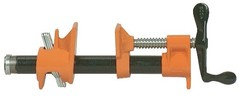
    I can't believe I forgot clamps.I have a few hundred in different kinds.You can never have to many.I would suggest as a start to buy some 1/2" Pony pipe clamps.This way you can buy pipe in different lengths with threaded ends and use the same clamps for whatever project you have going at the time.

    Apache RP thanked Precision Carpentry
  • 11 years ago

    haha, This is awesome.


    That tape advice is great for anyone. I worked as a frame saw operator and our tapes had to be verified every so often. That little bit of product lost if it was off would result in bad welds and frames would fail just after welding.


    Yes, clamps. I was curious of which type to buy to start---one video I watched about clamps(The Wood Whisperer) he admitted he bought a bunch of C-clamps because they were cheap but he never needed them. All of this is great information.


    Why bring a hammer? There would be many natural options on the island. :)

  • 11 years ago

    Pipe clamps (using 3/4" pipe) are completely adequate for most purposes, but I have to admit to lovingthese for gluing panels or carcases, I also find many uses for the one hand operable clamps like these. I make a surprising amount of use of old-fashioned wooden adjustable handscrews-- non-parallel jaws are often just the thing-- more often for holding things than clamping glue-ups. I do have 50-60 6" C-clamps I bought at an auction, and on big glue-ups most of them can get used.

    Apache RP thanked rwiegand
  • PRO
    11 years ago

    The pony clamps for 1/2" or 3/4" pipe will be a good choice for a lot of people. An advantage is if you have 2', 4', 6' pipes, you can switch the heads around as needed, and have that flexibility until you can afford to buy more heads.
    The problem I ran into many times is that wood glue + black iron pipe can make black iron stains on the workpiece. You always need to double check that they are not in contact. Buy galvanized pipe? nope, it slips because I guess the thickness of the plating.
    Casey


    Apache RP thanked Sombreuil
  • 11 years ago

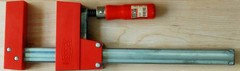
    Pipe clamps do offer a lot of bang for the buck and most home centers will cut and thread the cheaper (per linear foot) longer pieces of pipe for free. Of course, Bessey K-body clamps are the gold standard (and slightly more expensive than actual gold).

    As for the black marks, I found a little pieces or strips of wax paper between the wood and the clamp eliminate the problem.


    Apache RP thanked mike_kaiser_gw
  • 11 years ago

    If you're gonna buy many battery powered tools, you ought to stick with one brand and voltage as much as possible. Once you've bought one set of something like a drill with charger and a pair of batteries, then you can buy bare tools (without another charger and batteries). I'm partial to Dewalt - medium price, reliable, available everywhere.

    Apache RP thanked turnage (8a TX)
  • 11 years ago
    last modified: 11 years ago

    So this pipe for clamps, can anyone tell me what I would be looking for if I went to the blue guys? Like a specific description or brand? I looked briefly online but there are so many options. I did read about the staining/wax paper as a solution. Oh and will pipe clamps be able to clamp a work piece to a bench? I think so but I'm learning.

    Yes, I went with Dewalt after having a B&D drill/driver that couldn't complete a project on one charge. Granted, I was driving 4" screws so I was not surprised. I went right out and got the Dewalt(ironic, I know). Sadly, it didn't occur to me until after needing one that an impact driver would have been useful to purchase at the same time.

    I appreciate all the help! I am curious...are there any lefties here or anyone that has worked with a lefty? This is a field where I imagine we would stand out.

  • 11 years ago

    You're looking for what's called "black pipe" (because of it's color).
    It is traditionally used for gas supply lines. You'll find it in the
    aisle next to the copper, plastic, and galvanized (silver color) pipe.
    The most popular brand of pipe clamp hardware is made Pony although other companies make essentially the same thing. The hardware is available for both 3/4" and 1/2" pipe but most people use 3/4". Plastic pads for the jaws are also available to help protect the surface being clamped although scraps of wood can be used and some people fabricate their own pads.


    As mentioned before pipe clamps are popular because they're relatively inexpensive and can be made to almost any length, limited only to the pipe you have on hand. Woodworkers, in general, tend to be a frugal group.

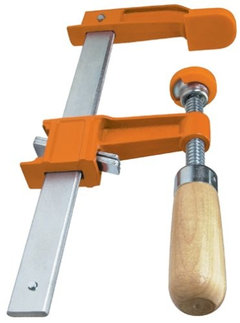
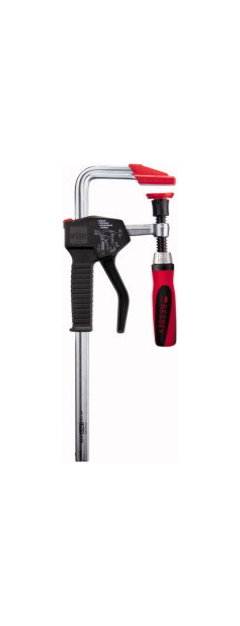
    A variation on the theme are "bar" clamps, which use a steel bar in place the pipe. Like a pipe clamp, one end is fixed and the other moveable. The smaller bar clamps are often called "F" clamps because of their shape. They're available in a variety of lengths from about 4" to 36" for light to heavy duty applications and with a variety of jaw depths.


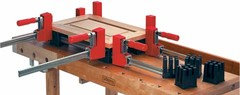
    The drawback to pipe clamps is that the jaws of the clamp doesn't say perpendicular to the pipe which can create problems when gluing up panels - a series of board glued together to make something larger (think of a table top). As pressure is applied, the boards want to bow slightly. The traditional way to deal with this problem was to use "cauls" which are pieces of wood clamped across the surface to keep the panel flat. Bessey developed K-body clamps which were designed to keep the jaws parallel. K-body clamps are fantastic clamps and unfortunately rather expensive (and generally worth the money). Other companies have introduced their version of the K-body clamp but I haven't used any of them.


    Another drawback to pipe clamps is that they have a relatively small jaw depth and for some applications, like a frame and panel door, that can create a challenge. Most of the K style clamps have a much deeper jaw.


    I might suggest buying clamps as needed (and depending on what you're doing, you may need a lot of clamps).


    Apache RP thanked mike_kaiser_gw
  • 11 years ago
    last modified: 11 years ago

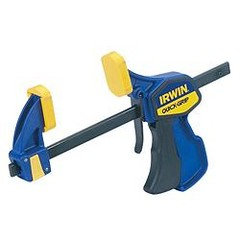
    Another type of bar clamp is the "quick" clamp which can be used one handed by squeezing the handle to move the jaw along the bar. While easy to use, they typically don't have the power of a traditional bar clamp, although Bessey does have a specialty clamp that combines the speed of a quick clamp with the power of a bar clamp, but as with all things Bessey, aren't cheap. They're available in sizes from 6" to 36".


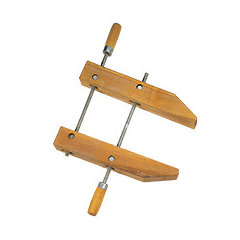
    Another traditional clamp is the wooden clamp. Although I have a pair I haven't used them very often.


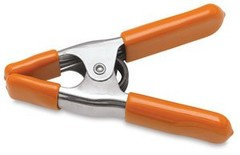
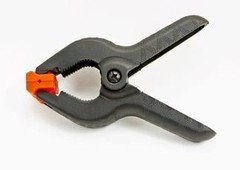
    Spring clamps come is a variety of sizes and styles with both metal and plastic bodies. They're easy to use but apply light clamping force.

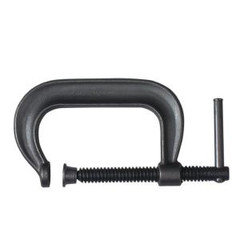
    C-clamps are traditionally a metal working tool but can have their place in the wood shop as well. They also come in a variety of sizes. Their biggest drawback is the small face of the jaw which can mar the workpiece.

    These are the clamps most commonly found in wood shop but there are no hard and fast rules and plenty of variations depending on the project. As I said, it might be useful to buy clamps as you need them rather than buying a bunch you may or may not use. I might also suggest checking Craigslist for used clamps. Unlike power tools, there generally isn't a lot to go wrong with a clamp nor do they typically wear out (unless, maybe, you getting something from a commercial shop). Pretty much they work or they don't and a few splatters of glue or paint usually doesn't effect the operation.

    Apache RP thanked mike_kaiser_gw
  • PRO
    11 years ago

    I have a bunch of wood clamps in three sizes, and they are the best for what they can do. I have 6 bessey K-clamps, and they are also great. The smaller versions of bar clamps have a lot of flex, but are still useful for lighter work. I haven't used a c-clamp in years, but I do have a 3-way facing clamp that is a specialized c-clamp, used for putting the ivory fronts on piano keys.
    Quick-grips are sometimes handy, I mostly use them with the router as hold-downs for workpieces.
    Spring clamps are terrific, and I have a dozen-odd, but for gluing you have to be really careful because they can shift around the mating pieces; a brad or two is needed for safety, of use a woodworking clamp.
    If you figure out how to do a "rubbed joint" properly with hot hide glue, you don't need huge numbers of clampage.
    Casey


    Apache RP thanked Sombreuil
  • 11 years ago

    Thanks for all that information Mike. And Casey too! I will likely start with quick clamps and also check into pipe for clamps. To start, I mostly want to complete a few projects where work pieces will need to be secure.


    Being that most of my work will be in a basement, I am wondering about humidity and wood right now. Is there a standard for wood shops? From the checking I have done, provided the little gadget is accurate enough, the area is consistently at 40-41 RH with temp around 70-75. That appears perfect to me so why ask? Well, there is evidence of past water damage and I was told it is often moist there. But it isn't(the living area upstairs sits at a higher RH with the A/C on) and we've had lots of rain. So unless I am missing something, the only thing I can think is the previous owners had no clue how to control moisture?

  • 11 years ago

    A very unusual question! As for me, my 5 essential tools are: my brain; saw; screwdriver; hammer and chisel. So simple instruments you may think but I'm a beginner in this matter (try to make some simple stuff so far but hope to get more experience and support here).