Software
Houzz Logo Print
joshuagbarber

Please Help Us Save Our Maple!

11 years ago
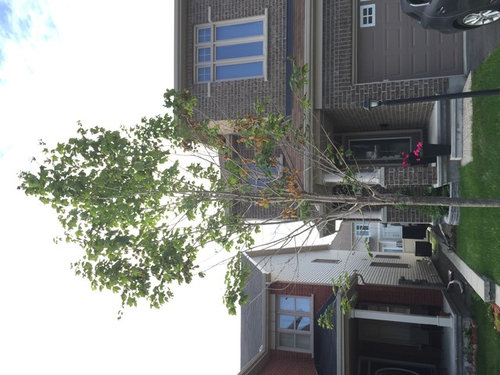
My wife and I have a maple in our front yard that was planted about 10 years ago. It was always the first tree on the street to get its leaves in the spring, and the last to lose them in the fall. It's a beautiful tree.

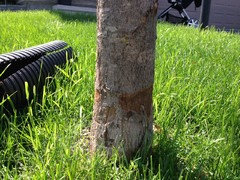
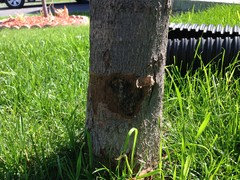
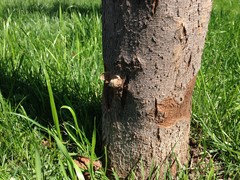
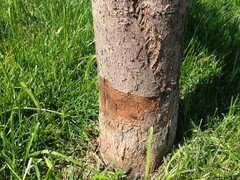
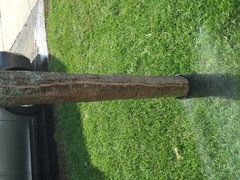
This Spring, when the snow melted (we live in Ottawa, ON), we noticed that moles or some other pest had chewed almost around the entire trunk. As a result, there are now dead branches on the tree, and it looks like it's dying!

See the photo attached and please let me know if and how I should trim it, if there's any product I can use to feed the tree, or any other helpful tips you may have. I heard from one person that I should cut off the top to encourage growth outward, not upward. Regardless, we want to restore this maple back to her originally flourishing self! Any help you can offer is much appreciated


Comments (16)

  • 11 years ago

    I think a lot of us would like to see a photo of the damage and a photo of where damage did not occur. About what percentage is left undamaged or what percentage is a straight shot of chewing w/o gaps between the chewing?

    Dax


  • 11 years ago

    and try to figure out how to make the pix upright ... maybe turn your gizmo the other way ...

    pic of the trunk at ground level also ...

    one thing for sure.. ignore the nimrod you were talking to ... in regard to trees anyway ...

    ken


  • 11 years ago

    Hope these pics help. The damage isn't all the way around the tree.

  • 11 years ago

    can we dig out the grass carefully and find out where the root flare is??? ... we are supposed to see it ...

    roots are made for soil and dampness.. trunks are all air ... putting trunk in soil.. not good ...

    see link

    and while you are at it.. go 2 or three feet out.. and add mulch ...

    to keep that nut with the weedwhip away from it ... and the mower guy ...

    ken

    https://www.google.com/search?q=root+flare&source=lnms&tbm=isch&sa=X&ei=oCmDVYzlG4rCsAW7q4OoBA&ved=0CAcQ_AUoAQ&biw=864&bih=745&dpr=0.9


  • 11 years ago

    kind of looks like a weedwacker did it

  • 11 years ago

    Is it decided it is animal damage and not mechanical? Do voles eat the bark (above the ground) or under the soil? When rabbits almost girdled shrubs last winter I could see the tooth marks. I ask because in case the damage is mechanical it would involve another step: fire the yardman.

  • 11 years ago

    Yes, get rid of grass the way ken says. No mulch volcanos against trunk. So in case you ever invite any weedwackers into your yard they won't be as inclined to get near the trunk and flay it alive

  • 11 years ago

    Thanks everyone for all your help. Just to clarify, it isn't a weedwacker. I mow the lawn and do the trimming, and I'm very ginger around the trees. Plus, the tree was fine in the fall last year. The damage appeared only when the snow melted this spring, along with a bunch of dead grass around the trunk, which I neglected to mention originally. As for doing what Ken said, I appreciate the idea, but the tree flourished for years with grass at the base. Something definitely got to it over the winter.

    Is there any trimming I should do to dead branches? I was told today by someone at a nursery that I could do a "skin graft." Is that a thing? It seems like the concensus is to just leave it alone and let the air at it.

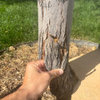
    One last question in addition to the ones above: there seems to be a large split up the trunk (see attached photo). Is this normal, or part of the tree healing? Sorry for the photo being sideways. I'm not really sure why it's doing that.


  • 11 years ago

    Sunscald is the reason for that large split.

    Dax


  • 11 years ago

    One point of minor disagreement with my friend Dax regarding planting depth: While this tree-a species adapted to high water tables-is doing well despite our inability to view root flare-that area of swollen tissue where trunk meets roots-it is undeniably planted too deeply. There is no flare at all apparent, and that's a mistake. The down side of a too-deep planting manifests only very slowly over years. And wetland species like this maple (red? Freeman? silver?-can't tell from pics) is of a type that can actually handle being buried too deeply better than an upland species like say, its cousin, the sugar maple. So it's adapted to occasional flooding and siltation caused by flooding and as such, may be less susceptible to the range of problems caused by this burial, but it is still planted too deeply.

    +oM

  • 11 years ago

    i must have missed the 10 years ...

    but i would still want to know where the flare is.. and i would still want the mulch ring ...

    ken


  • 11 years ago

    +oM I think it's tough to gauge. All your points are valid about "slowness"/"time" for a tree that was buried too deep, but I look around my own landscape and there are tree after tree that show no root flare. And further into city plantings along streets, mature trees with 1' + caliper have no roots to be seen.

    I think we both can be right or wrong.

    Dax


  • 11 years ago

    The damage looks mechanical to me and not enough to cause the lack of leaves.
    I notice your lawn has no broadleaved weeds. Have you used a weed killer on the lawn? Another reason not to stick a tree out in the middle of the grass.
    Mike


  • 11 years ago

    I would say-differing tree species exhibit differing levels of sensitivity to improper planting depth. Floodplain species are the most tolerant, again because they've had to adapt to two conditions which mimic being planted too deeply-flooding and deposition of sediment following flooding.

    +oM

  • 11 years ago

    Yup, it's called advantageous rooting.
    Floodplain trees generally have thinner bark too. Less fires on a floodplain.
    Sub-alpine trees have thinner bark for the same reason.
    Mike