

Soil Test Analysis Help
Hello,
I recently had a soil analysis completed for my lawn, and would appreciate some recommendations to help improve the lawn and soil. I do have some unknowns, but I'll do my best to provide as much information I can. Please, ask for more input if needed.
I bought my home a year ago, and it is 10 years old with 5k square feet of lawn. I'm in 6A hardiness zone in the metro West of St. Louis, MO. By talking with neighbors on both sides, I know the builder brought in some top soil to start the lawn, but it is mostly clay in these parts of Missouri. I'm pretty sure it was started with K31, but has been over-seeded with different varieties of fescue. I believe the prior owner used synthetics for maintenance.
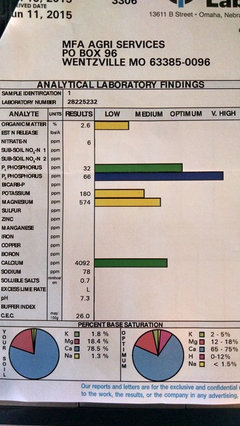
I've attached a couple pictures along with the results of the soil test. I have a decent stand of grass, but it is obviously looking a bit stressed.
My goals:
- Improve soil composition by a program of non-synthetics and recommendations according to the analysis.
- Over-seed with a fine blade fescue. My father has been over-seeding with Jaguar Fescue. I like the look, but I'd like additional recommendations.
- Get it green!
I do have access to a couple feed stores around town, a farmer's co-op, and a distributor of other organic turf products. I've already put down 10lb/1000k square foot of alfalfa pellets about three weeks ago. I also put down Healthy Grow 8-3-5 in April.
More on their products can be found here:
http://agro-logics.com/products/category/granular-organic-fertilizer/healthy-grow/
Any help anyone could provide would be greatly appreciated! Have a great day.
Brad
Comments (22)
 11 years ago
Why was the soil test not sent to the University of Missouri Cooperative Extension Service? The fee for that same test there would be $10.00 per sample and you could consult with your county horticulturist about what needs to be done.
http://soilplantlab.missouri.edu/soil/testfees.aspx
The soil pH is about where it should be at 7.3, maybe a bit high ut in the ball park.
Organic matter is quite low at 2.6 percent. 5 percent is what most look for and 6 to 8 percent is better, in my experience.
CEC (Cation Exchange Capacity), a measure of how the soil will hold onto both moisture and nutrients or release them for plants to use, is high at 26. The CEC would preferably be in the upper teens to low twenties. More soil organic matter would help lower that.
The nutrients P, K, Ca. and Mg. are not in balance, but getting the soil organic matter level up probably would help with that as well.
Perhaps, in addition to that soil test, these simple soil test may be of some help.
1) Soil test for organic
material. From that soil sample put enough of the rest to make a 4 inch level in
a clear 1 quart jar, with a tight fitting lid. Fill that jar with water and
replace the lid, tightly. Shake the jar vigorously and then let it stand for 24
hours. Your soil will settle out according to soil particle size and weight.
For example, a good loam will have about 1-3/4 inch (about 45%) of sand on the
bottom. about 1 inch (about 25%) of silt next, about 1 inch (25%) of clay above
that, and about 1/4 inch (about 5%) of organic matter on the top.2) Drainage. Dig a hole
1 foot square and 1 foot deep and fill that with water. After that water drains
away refill the hole with more water and time how long it takes that to drain
away. Anything less than 2 hours and your soil drains’ too quickly and needs
more organic matter to slow that drainage down. Anything over 6 hours and the
soil drains too slowly and needs lots of organic matter to speed it up.3) Tilth. Take a handful
of your slightly damp soil and squeeze it tightly. When the pressure is
released the soil should hold together in that clump, but when poked with a
finger that clump should fall apart.4) Smell. What does your
soil smell like? A pleasant, rich earthy odor? Putrid, offensive, repugnant
odor? The more organic matter in your soil the more active the soil bacteria
will be and the nicer your soil will smell, to a point. Too much organic matter
can be bad as well.5) Life. How many
earthworms per shovel full were there? 5 or more indicates a pretty healthy soil. Fewer than 5,
according to the Natural Resources Conservation Service, indicates a soil that
is not healthy.kimmq is kimmsr
Related Professionals
Palm Bay Landscape Architects & Landscape Designers · California Landscape Architects & Landscape Designers · Athens Landscape Architects & Landscape Designers · Lewiston Landscape Architects & Landscape Designers · Poughkeepsie Landscape Architects & Landscape Designers · Bennington Landscape Architects & Landscape Designers · York Landscape Architects & Landscape Designers · Hattiesburg Landscape Contractors · Leominster Landscape Contractors · Plattsburgh Landscape Contractors · Orange County Landscape Contractors · Kahului Landscape Contractors · Cherry Hill Flooring Contractors · Dayton Flooring Contractors · Oneonta Flooring Contractorsbmj202
Original Author11 years agoThank you for the feedback, kimmq. I didn't use the University of MO, because the farmer's co-op I took the sample to was a much more convenient location.
It sounds like my biggest opportunity is the increase the organic matter in the soil. I realize a great way to do this quickly is to top dress the lawn. Any thoughts on how many applications of alternative materials(alfalfa, corn meal gluten, the Healthy Grow fertilizer mentioned above) would achieve similar results?
- 11 years ago
When top dressing a lawn you would be somewhat limited in how much organic matter you could apply without smothering the grass that is growing, about 1/4 inch of material. That, however, could be done several times during the growing season depending on how fast the Soil Food Web moved the material into the soil.
I'm leery of Healthy Grow products because it looks like they come from an egg factory not a farm. It sounds that the layers are confined to cages with conveyor belts that collect the eggs and manure and the chickens never see the sun or get out on pasture, a factory and not a farm.
kimmq is kimmsr
- 11 years ago
I'm going to try to say this nicely, but be warned.
So let's start at the beginning.
You know a little about the history of your yard, and that history goes a long way toward explaining some of the results your soil test revealed. New (er) yard, low organic matter. Nutrient values all over the board. CEC in the mid 20s.
You've established what you want: A green lawn, and a certain product mix to achieve it. Now let's start by asking the right questions.
What do you know about the nature of turf grasses? How do you mow? height? mulch mow? how often do you water and how much?
Turf grasses are hungry, lazy pigs. They want want want nutrients and water, and they don't want to work (grow a root system) to get them. the easiest way to get a lawn to grow a deeper root system is to manipulate water.
Now let's get to where I may have problems controlling myself.
The only thing kimmq is kimmsr had to say I can agree with is that pH is of little importance in this situation.
If you increase organic matter, you will not decrease CEC. We have no way of knowing if your CEC is high, low, or right where it should be: We don't know what kind of soil you have. Yes, it's clay, so higher values are expected, but specific types of clay will have higher or lower values by the nature of the physical properties of those types of clay.
Now having a higher CEC value is generally a good thing. It means what fertilizer you put down is more likely to bind to the soil, and transfer to the plants growing in it, and less likely to leach out.
How many applications will it take to get where you want? That's not a question I can answer. The alfalfa and some water might do what you want, but really, you weren't asking the right question. Some nutrient values are low, some are lacking. As you fertilize going forward, look for products that will supply what you are short on. In a couple of years, get another soil test and compare. have nutrient levels balanced out? If yes, you can reduce to more a routine maintenance schedule. In they have improved, but still a little low, continue. A soil test is more of a guide to help you. You can spend endless hours exhausting yourself trying to understand every nuance of the results, but in the end, it's just a guide. If you were managing to maximize production, you'd use the results in a different manner, but then, you also wouldn't be asking for advice on an internet forum.
bmj202, I apologize to you right now, because I'm going to kick the idiot:
Any discussion of adding organic matter that does not include aeration is incomplete. Any discussion of lawn maintenance in general that does not include aeration is incomplete. If you don't know the last time your lawn was aerated, schedule it now. I'd recommend doing it once a year, but what the blue blazes do I know? I don't base my answers on what google has to say.
Best things you can do: Manipulate water to encourage root growth, mow high, mulch mow, and aerate. In this specific case, because you know you are low in certain nutrients, look to add those, but be careful about adding too much too fast. bmj202
Original Author11 years agoThanks for the feedback, waynedanielson. Last aeration was last fall. I mow on the highest setting and mulch it. I admit I probably do not water enough when the lawn needs it. STL summers can be blazing hot and dry or dump rain for a week straight. I have a decent handle on a lot of the basics. I suppose the biggest piece of feedback I seek is what types of products I can use to improve nutrient values which are lacking while also improving the organic content of the soil. From some of the research I've done I understand synthetics reduce the amount of beneficial microorganisms. Which synthetics will or won't, I don't know.
- 11 years ago
Soil micro organisms, the Soil Food Web, need organic matter to feed on. Synthetic fertilizers do not supply any organic matter to the soil so the Soil Food Web will eventually (when the organic matter is depleted) do dormant. The soil in Missouri is mostly clay and clay tightly holds both nutrients and moisture so plants growing in that cannot get what it needs. Organic matter helps release the nutrients and moisture the clay holds onto, and changes the CEC to something in the upper teens to low twenties which is a good range for the CEC to be in.
A soil with adequate amounts of organic matter will need less water to have good plant growth.
kimmq is kimmsr
- 11 years ago
bmj, it sounds like you're off to a good start. Learn what you can from as many different sources as you can. If sources from different backgrounds tell you the same thing, it's at least worth considering
I'm not convinced that synthetics do what some claim they do as far as soil life is concerned. The nature of life is too vibrant, too persistent. If you need some help and need it quick, that's what the synthetics do. Organics work slowly, over the long term. There's a balance in there, if people let you find it. I tend to do things with a light hand...for the most part, plants want to grow, and do very well without our help. A little nudge works, often better than if you do a lot. I'm advocating for a slow approach. You're dealing with a living thing here, and there are so many potential interactions it's impossible to list them, let alone explain them. Go slow. Be observant. Adjust based your observations, and try again.
You're doing the right things. Mow high, mulch, aerate. Water as you need, but manipulate it to grow that root system (not too often, and when you do water, water deep). Take a few notes on what you do and what happens after. Eventually, you'll find more of a routine from year to year. As for when that will happen or how many applications that will take, it's almost impossible to predict: There are simply too many factors to account for. Almost more important than what you use is how you do it. Mowing height, mulch mowing, water...these are almost more important than using this product or that, and given time, will give you want you want. If you want it sooner, nudge. But be careful about going to fast. - 11 years ago
@Wayne - a little synthetic here in there will not implode a lawns life, but over time it will destroy it. While there are certainly some sources that are bias toward organic, I think you have 10x more careful with what you read about Synthetics. It's a multi-billion dollar industry, and the giants that profit from the sales of it, run most of the studies, and control what is reported on it.
What I have observed in my own lawn is a dramatic increase in worms per shovel, continues improvement in OM levels now around 8-11% or more, better drought tolerance, minimal thatch (almost none), organic fertilizers are broken down much quicker, including grass clippings, compost ect.
Here is a pretty good outline of the process a lawn goes through when it is on synesthetic regularly for an extended period of time:
http://www.naturesafe.com/index.php/2000/08/01/vicious-circle/ bmj202
Original Author11 years agoI have some application guidelines obtained from my soil test. They are as follows presented in lbs/Acre:
- Nitrogen 140
- Carryover N 11....not sure about this one
- Phosphate 20
- Potash 45
I'd like someone to check my figures. I have 5000 square feet worth of turf.
43560 square feet in an acre5000/43560= .11 acre worth of turf
140lbs X .11 acre= 15.4lbs of Nitrogen20lbs X .11 acre= 2.2lbs of Phosphate
45lbs X .11 acre= 5lbs of Potash
Does this add up? If so, I have no idea over what period of time I should add this material. Does anyone have any thoughts? Wayne? Kimmq?- 11 years ago
I could have linked you to some 100 page scholarly articles, but figured I'd save you the reading. That site did a fine job of explaining the high level process.
I don't even know why I have to argue this on an organic lawn care forum. If you don't believe synthetic damage the soil food web structure, I'm not going to be able to convince you. Have you not noticed %OM levels in organic soil vs. Synthetic?
bmj202
Original Author11 years agoI think we all understand synthetics are inferior to organic matter when aiming to maintain a healthy balance of beneficial microorganisms in soil.
Please, do not highjack my thread to create a petty dispute. It's not welcome. My goal is to seek help for finding solutions with the facts I have. Take your articles elsewhere unless the support what I am asking for.
Thank you.- 11 years ago
Let's take a moment to talk about fertilizer. To a plant, nitrogen is a molecule with a small charge. It often exists attached to something else, such as oxygen (nitrate, NO3). That charge, and the strength of that charge, is what is important. A weak charge is easily broken, a strong charge is not.
Phosphorous exists in the soil in multiple forms. Some of these forms have strong charges that render the molecules insoluble. Other minerals also exist in multiple forms, Fe, Mn, Mg, Cu among them. Funny that I either have to list the entire periodic table or clearly state a disclaimer that such a list is not complete.
Go back to your soil test. See where there are two types of phosphorous? One of these types is easily soluble, one of these is currently not. However, over time, the less soluble form breaks down and becomes more soluble.
CEC is a measure of how many of these charges a given sample of soil is capable of holding. Clay soil and organic matter have a higher CEC. Think of some of the richest, most productive farmland around. Are you thinking of beach sand? Or some kind of clay?
Nitrogen has a weak charge. It easily forms bonds with other elements and compounds...for the purpose of this discussion, water vapor would be another compound. Hence, the transitory nature of nitrogen.
Phosphorous and potassium, and several of the primary micronutrients, form stronger bonds, less easily broken. As such, they exist in different forms at any given time, and often you need less of these to maintain a certain level of production.
Soil is not a solid mass. It's a colossal jumble of particles of various sizes, air spaces, water, living things, and decaying organic matter. more air, less water. more water, less air. in any given sample of soil actual soil particles, be it sand, silt, or clay, is going to comprise only about half of the sample.
The important thing in managing soil? It's not to manage the soil, it's managing the air space (pore space) that exists between the soil particles. Too much air, and the soil dries out, and anything trying to live in it dries out. Too much water, everything drowns. All of life happens in the pore space.
All the chemical interactions, all the water a plant absorbs through it's roots, these all happen in the pore space. Everything we're talking about exists in and happens in the pore space.
Which gets us back to what exactly do you put on?
So your soil test is a snapshot in time. At the time your soil test was taken, according to recommendations from the lab, you needed 140 lb of nitrogen per acre. Do the math, if you apply a fertilizer with 10% nitrogen, you are looking at 140 lb. If you find a fertilizer with an analysis of 10-3-4, and apply 150 pounds, you will have applied 150 lb N, 4.5 lb P, and 6 lb K. Again, this was a snapshot in time. When the lawn is growing more vigorously, it needs more (cool weather, spring and fall). Going into summer, the lawn wants to go dormant in the heat and doesn't need as much. Again, don't think you need to supply an entire year's worth of fertilizer at one application.
I've seen some pretty intense calculations as to volume of grass clippings equaling nitrogen potential. But all of these are dependent on specific soil types...in sand, with a much larger pore space, organic matter intermingles at a larger size. As you get into clay soils, it has to break down into much smaller pieces to work it's way into the soil profile (here's where aerating helps you). Generally, I start by treating a part of the yard at a certain rate and waiting. If the result is what is desired, treat the rest. Or adjust and treat another small part.
Don't worry...as soon as you think you have this figured out, something will change.
Through this all, the other things you do are perhaps more important that what you are using for fertilizer, most of which have been touched on. Here's where I touch nerves...I don't go to the church of the believer. I don't believe in synthetics, but I use them. Why? They work. I don't believe in organics, but I use products and techniques that come straight out the organic handbook. Why? They work. There's a balance...if people will let you find it, but we seem to be losing that ability. - 11 years ago
@Wayne, good advice. Just a quick math check though. If he needs to apply 140lbs of nitrogen p/acre and the source has 10% nitrogen, he would actually need 1400 pounds of the product (1400 x .10 = 140lbs nitrogen). 140lbs / (43560/1000) = 3.21 lbs of nitrogen p/1000sq, based on his labs recommendations. To get 3.21lbs of nitrogen you would need to buy 200lbs of Soybean Meal (8% nitrogen) and apply at 40lbs/1000sq.
My math could be off, so feel free to correct if I made a mistake. I believe grass clippings are said to provide about 25% of your lawn's nitrogen needs, often written as a 4-2-1 fertilizer source, but as mentioned that can vary from lawn to lawn.
Obviously, that is too heavy, so do it in 2 feedings of 20lbs p/1000. - 11 years ago
Cool season turf grasses (blue grass, Perennial Rye, Fescues) need about 2 pounds of Nitrogen per 1,000 square feet per year. A 40 pound bag of Milorganite ( 6 percent N) spread over 1,000 square feet will supply about 2.4 pounds of N, enough to feed that turf grass for a whole year. If the grass clippings are recycled in place, mulch mowing, those clippings can supply up to 1/2 the needed N for the year so even less commercial "fertilizer" is needed.
Excess Nitrogen is not stored but is washed out of the soil with excess water where it is a source of pollution of the drinking water. It is better to err on the side of too little N than too much.
kimmq is kimmsr
- 11 years ago
If I do math at the end of the day, I always double check it in the morning. You heard about the Norwegian who could count to 21? He had to take his shoes and pants off.
I was both right and wrong. 1/10 acre. 150 lbs of 10-3-3 will wield 15 lb N. 140 lb/A x 0.1 A = 14 lb N.
Here's where Scott's got it right: If you apply regular applications of fertilizer and water, anyone can have a picture perfect lawn. They made it easy for people. It's this time of year, you do this step of the program.
Where I don't like that approach is that it was a one size fits all solution, and not only does the U.S. have different regions of the country with different climates and different weather, there are over 50,000 different soil types.
And that's the heart of your question. You don't want the short course in turf management, but that's what you are going to get, if not this year, then eventually. You want to know what to put down, in what amount, and when, but you don't want to use Scott's.
That's why you need the short course in turf. You're basically going to create a four step program, or version thereof, for your lawn. So you need to know a little something about basic turf management.
The basics of turf management are simple. Water and fertilize. We make it complicated, because we're human and that's what humans do.
And the basics start with mowing and water. You have a couple of specifics, such as a certain texture you want to see, and what that grass type will do in your soil, with your weather, that's something you're going to have to learn. There's a cycle to things, a natural rhythm. Learn that rhythm, a how you can manipulate it, and for the most part, it's common sense. More water in the heat of summer, less fertilizer. More fertilizer when the lawn is actively growing, but it's surprising how little you really need.
At some point, you have to talk about traffic. A heavily trafficked lawn is going to need more. More stress, more performance, higher inputs. A large part of that is water, but some of it is fertility. - 11 years ago
Organic growing involves a little more than just watering, mowing , and fertilizing. A basic principle of organics is that a good healthy soil will grow strong and healthy plants, so to an organic grower a good healthy soil is necessary and a good healthy soil involves getting adequate amounts of organic material into the soil.
Many of us long time organic growers that have applied the basic principles to our soil have found that over time as the amount of organic matter in the soil increases so do the needed nutrients meaning we need to use less "fertilizer".
kimmq is kimmsr
- 11 years ago
bmj,
Wayne has given you the best, most accurate explanation of CEC.
As a rule of thumb, you never want to apply more than 1 lb. of any nutrient per a month's period of time. In the case of fescue, 3 lbs of N annually is in the ballpark. So 1 lb late May early June, 1 lb early September, and a 1 lb Winterizer applied after topgrowth stops, but before any Winter dormancy occurs is a common schedule. The P and K can be applied on the same schedule in their respective proportions. bmj202
Original Author11 years agoThank you all for your feedback. I have a good plan to move forward.







waynedanielson