

For Straw: Help please...
Hi Everyone. I'm a long time lurker. I need some help from Straw, please, regarding the use of Sulfate of Potash and Soluble Gypsum. I have both and would like to know exactly how you use it. You mention them a lot in your posts. How much of each do you typically use per gallon? Do you make a concentrate first with the Sulfate of Potash and then use the concentrate at 1 teaspoon per gallon or do you add 1 teaspoon of the powder per gallon of water? Can you give me detailed instructions for both please? Also, are you using this as a root drench or a foliar spray? Any help would be appreciated. Thanks
Heather
Comments (73)
 11 years ago
Advice needed from Strawberry Hill
Hello I am a 'newby' but have been studying everything Strawberry Hill said for months now, and...it works! many thanks for all you great advice!, and I just have to say - you have such lovely roses.... :)
I want to use Gypsum for my roses, the Austins have weak necks and the blooms fall down are few I only have one bloom on my Graham Thomas. Plus they aren't shooting up with strong canes either. I have clay soil.
we just had great rains...sadly I have discovered this part of the forum too late.
Will it be advisable to add the powdered Gypsum I purchased at the local nursery directly on top of the soil and water it in, or should I wait for more rains which might not come soon...or should I mix that with water - how much per rose?
or...should I dig the gypsum in around the rose when the soil dries out a bit?
or....should I mix the gypsum with water and some Apple cider Vinegar not to spoil the rain water in the soil already? Should I wait for the soil to dry out a bit?
I don't have access to Sulphate of Potash..(the local nursery doesn't stock that yet).can I use wood ash? will that do the same good?
I only use organic fertilizers, I don't spray and thanks to all your advice I don't have Black spot and many Ladybirds...
I added Molasses and milk, Epsom Salts and horse manure around my roses, over a thin layer of Corn flour, Brewers Yeast, milk powder and a bit of cinnamon, and around some I sprinkled cracked corn (Trichoderma) as well. Even the Andrea Stelzer (BS-prone) is clean.
(I found that Cinnamon is a great ant deterrent.)
I replanted an Evelyn rose but did the huge mistake to put her into a hole (new compost and some Rock Dust added, plus banana, gave lots of water) - where I took out another rose, (also transplanted but to a new hole) and she (Evelyn) nearly died - until I added wood ash - only bit. the rains did the rest. I have her in the new space for almost a month now and nothing else seemed to help. I will add Mychorrizal fungi as well...using a dipper to get it to her roots. She is looking much better , still yellowish leaves and little growth, - but I am wondering if I should add some gypsum as well - in water...and how much, and if so, with Apple cider vinegar? (I already gave her sugar, molasses, liquid seaweed, nothing seemed to help as much as the wood ashes did during the rains).
 11 years agolast modified: 11 years ago
Hi jessjennings: Welcome to this forum, and you are welcome in Jim's thread "Roses & Stuff" where we have a "sunshine pledge" to get 20 min. of exercise outdoor, plus chat daily about our goals, be it losing weight & living healthy, or exchanging cooking & living tips. Our health is just as important as roses.
Although many sites state that gypsum is neutral, the pH of gypsum is slightly acidic (6.8), and gypsum lowers pH faster than sulfur. U. of CA at Davis stated that 1 lb. of gypsum is equivalent to 5 lbs. of sulfur. Gypsum is useful to bring down the pH of VERY ALKALINE tap like mine, near 9 for the town next to me. Since rain is acidic at pH 5.6 you don't want to use gypsum, in case your soil is acidic, or your rose is grafted on Dr. Huey.
Questions to see if your soil is acidic or alkaline: What zone and state you are in? Are hydrangeas around you pink or blue? Are the leaves on your plants very dark green, or lighter green? There's the thread "Cheapest soil pH test using red cabbage" in this forum.
Own-root doesn't secret as much acid as roses grafted on Dr. Huey. Grafted on Dr. Huey are bought at local stores, own-roots are ordered from a particular nurseries like Roses Unlimited and Chamblee's. But if the hole was previously occupied by a GRAFTED roses, then that hole would be more acidic.
Evelyn likes it alkaline even as own-root-rose. Rock dust? If your rock dust is rock-phosphate, it would be 30% phosphorus and 48% calcium (data taken from EarthCo. booklet). When the soil is acidic, phosphorus is released quickly, and phosphorus burns. Putting banana in the hole ferments and sours, making soil more acidic. When the pH drops or too much phosphorus is given, it will zap out potassium.
Why adding woodash helped? Woodash has pH over 11, very alkaline, plus high in calcium & potassium. No need to add mycorrhyzal fungi .. acidic soil has plenty of that, and there's plenty of that in rotting banana. NO to apple cider vinegar ... too acidic. You want a slightly alkaline hole, plus a balance of nutrients. The ideal ratios in rose-tissue-analysis (also by U. of CA) is: For high-ratios of nutrients in rose tissue in %: 5 nitrogen, 3 potassium, 0.3 phosphorus, 1.5 calcium, and 0.35 magnesium. For ppm it would be 250 manganese, 150 iron, 15 copper, 50 zinc, and 60 boron.
Since rock dust has plenty of calcium, you don't want to add more calcium via gypsum. What's lacking is potassium, since it's needed at twice the amount as calcium. Potassium is known to strengthen weak stems, and is leached out during rain, along with nitrogen. Wood ash has way-more calcium than potassium, and wood ash is salty.
Austin roses have a big demand for potassium. Potassium is what makes strong stems, more blooms, and bigger booms. Since you already used woodash, pH over 11, plus salty ... I would order sulfate of potash (potassium sulfate) from Kelp4Less, free shipping, 1 lb. for $16 https://www.kelp4less.com/shop/potassium-sulfate/
Sulfate of potash has salt-index of 34, compared to muriate of potash (potassium chloride) with salt index 112.6. Muriate of potash is what local-stores sell, it's cheaper but saltier. Amazon sells cheaper sulfate of potash, but I never order from that company before. But I did order from Kelp4Less and got excellent results, with stingy Frederic Mistral giving me 40+ blooms in spring flush, plus strong stems.
This is my 2nd year testing sulfate of potash & blood meal & gypsum for pots, to repeat U. of Kentucky's success with Omega 6-6-6 (blood meal, bone meal, sulfate of potash). Picture below is taken few days ago, Sept. 30, of Cloude Soupert rose, which came as a tiny 3 inch. rooting a few months ago. It didn't bloom much until I sprinkled 2 teas. of sulfate of potash, 8 teas. of blood meal, and 2 teas. of gypsum. NPK of sulfate of potash is 0-0-50, and NPK of blood meal is 12-0-0 (1/4 the %), so you want 4 times more blood-meal than sulfate of potash.
If your rose is really wimpy or if it rains heavily, I would add a bit more blood-meal to achieve the ideal ratio of 5 nitrogen and 3 potassium in rose-tissue analysis. Since I use exclusively rain-water (pH 5.6) from my rain barrels, I topped with 1/8 cup pea gravel (pH 9) for trace-elements and to balance out acidic rain water. Below is Cloude Soupert rose, taken Sept. 30 & healthy with buds, pic. taken during gusting wind up to 40 mph, but no broken branches in my roses. My Chicagoland is very windy, and sulfate of potash helps with stronger stems.
Related Professionals
Aurora Landscape Architects & Landscape Designers · Clearlake Landscape Architects & Landscape Designers · San Antonio Landscape Contractors · Taunton Landscape Contractors · Scranton Landscape Contractors · Farmington Landscape Contractors · Helena Landscape Contractors · Toronto Landscape Contractors · Ocala Architects & Building Designers · Belleville Architects & Building Designers · Asheville Architects & Building Designers · Hilton Head Island Architects & Building Designers · Lafayette Architects & Building Designers · Buffalo Architects & Building Designers · Honolulu Architects & Building Designers- 11 years ago
thank you so much for the great advice Strawberry Hill...
Unfortunately I stay about 16 000 km's from you and where Sulphur of Potash is readily available...I already called the local nursery (about and hour's drive away) and they don't have any.
but I'm going to search for this and hope I will find it soon...also blood meal...sigh...
I live in a very remote, tiny, beautiful village in South Africa.
Are there any organic alternatives I can use? Can I 'plant' a piece of lamb meat next to her? (I don't have any dogs)
Just so desperate Evelyn is my favorite rose...
Her leaves are light green and not looking strong....although, thankfully, she is still alive after quite a few weeks...
I also still have to have the soil tested, but by this time I'm sure it's really acid.
will have to purchase a hydrangea seeing that no one here have any.
The rose growing there previously was a Purple Glow.
I did add some horse manure around Evelyn, is that a good thing? (and corn flour and a tiny bit of Brewer's yeast and a small amount of liquid seaweed and molasses...yes desperate, desperate...)
Could I still add some bone meal, is that rich in potassium?
It's just that there aren't a lot of the right goodies available in the area...
I did however, get hold of Mychorrizal fungi...and in (another) desperate attempt to help her...already put 20 grams in around her ...really really desperate...I should have waited, but alas...
- 11 years agolast modified: 11 years ago
Hi JessJennings: Bone meal is No-No. I burnt countless geraniums, tomatoes, plus killed a $30 rose with that stuff. Bone meal is high in sulphates (that burns), plus phosphorus (zap out zinc and potassium). Use bone meal only if you have phosphorus-deficiency, such as reduced branching of your roses (just one skinny stem), or purplish spots on the margins of leaves. Bone meal is high in phosphorus, and roses need very little of phosphorus, only 1/10 of potassium.
For rose-tissue analysis, you need 10 times more potassium than phosphorus, and 12 to 15 times more nitrogen than phosphorus, and twice more calcium than phosphorus.
Pea-gravel gives plenty of calcium, so does horse manure. It's the potassium and nitrogen which are lacking. Nitrogen mobility is a 10, it leaches out with rain. Potassium mobility is a 3, it leaches out with rain. But phosphorus mobility is a 1, it stays put, and very little is needed. If you put bone meal on top, it stays put to burn surface roots, plus attract flies and breed maggots. I don't recommend any animal products, since greens are best for nitrogen, and minerals as in pea-gravel or red-lava-rocks are best for potassium for acidic soil.
Red-lava-rock is very high in potassium, plus iron, calcium, boron, and many trace elements. The pH is alkaline at 8.2, perfect to neutralize acidic rain (pH 5.6), or your acidic clay. Large chunks of red-lava-rock can be crushed if you soak that in rain-water overnight, and hit with a hammer. My most healthy roses? I put acidic alfalfa hay (Lucerne) with NPK 2-1-2, then I top that with red-lava-rock.
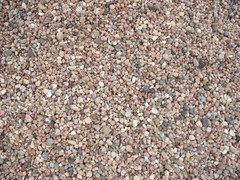
Pea-gravel, see picture below, has a variety of colors, thus many minerals, including potassium and calcium. My Evelyn loves pea-gravel, and leaves become shiny & glossy, plus many petals-blooms.
Green leaves, Hay and grass is even better than blood meal for nitrogen, since leaves have zero salt. One rose grower mulched her roses with mint-leaves for nitrogen. Mint leaves is high in magnesium, iron, and vitamins. One fall I pruned my tomatoes' branches and mulched roses with that. When I scraped that off, there were tons of earthworms beneath. Greens on top feed the earthworms and beneficial bacteria that fix nitrogen from the atmosphere. Air is composed of 78% nitrogen and 21% oxygen.
Cocoa shells mulch with NPK 2.5-1-3 is high in nitrogen and potassium, with pH 5.6. That would be too acidic for Evelyn, but you need to neutralize the acidity with horse manure on top, or pea-gravel (pH 9). My best blooms were with cocoa mulch and pea gravel.
Horse manure is great for roses, the pH is usually above 8 (very alkaline), due to lime added to deodorize the stall.
Corn flour and brewer's yeast are very acidic. Brewer's yeast has some potassium, thus promotes blooming, but it's very acidic plus high in phosphorus, so that burns. I don't recommend that unless you are in dry & alkaline place like California. I already posted pic. of how I burnt my roses, with leaves turning yellow with black spots, by just 1 tablespoon of Brewer's yeast per bucket of water.
Evelyn likes it alkaline, so anything alkaline like horse manure (pH 8), red lava rock (high potassium, pH 8.2), or pea gravel (pH 9) .. would be best as the top-most layer. You still need nitrogen, so I would put greens like fresh leaves, hay or grass down 1st, then put the alkaline minerals on top. My best health & most blooms were when I put green alfalfa meal (pH 5.8) down 1st, then horse manure (pH 8) on top.
Below picture is the pea gravel that I used on Evelyn with great results. I use 1 cup red-lava and 1/2 cup pea-gravel. Pea-gravel doesn't need to be crush, since it releases minerals instantly when rain-water hit. But you need to crush red-lava-rock .. it softens if soaked overnight in rain water.
- 11 years ago
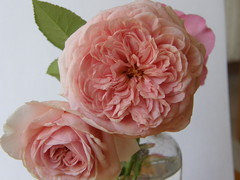
Below my 1st blooms of Evelyn when I bought it as a small pot. I mulched with green alfalfa meal 1st, then horse manure on top. Picture was taken at 90 degree hot and dry summer, using alkaline tap water at pH 8.6:
Below is Evelyn made deeper pink by lowering the pH of my alkaline tap with molasses. Molasses is acidic and feeds mycorrhyzal fungi, so I don't recommend that with acidic rain-water (pH 5.6). Molasses is best used with alkaline tap water (pH above 8):

- 11 years ago
Hello Strawberry Hill
I am so glad I didn't add bone meal :)many many thanks for the stunning reply and explanations it is much appreciated :)
I added a thick layer of Comfrey leaves, mint, Coriander, Fennel, and a few Beetroot-leaves around the rose.
In the meantime I will try and find lava rock/pea gravel and Sulfate of Potash. I will also brew a Comfrey tea to use a bit later on, until I get hold of everything I need.
I have already asked the local nursery and they never even heard of lava rocks, but I won't give up searching. Sulfate of Potash is a mystery to them as well....
Your roses are beautiful beyond words....thank you so much for sharing the photo's.
It is spring here and I just received another order of roses to be planted in the New Moon (next week). I will keep all your advice in mind when doing that. As soon as they start blooming I will try and send some photo's as well.I have read that by adding a bit of mychorrizal fungi below the rose when planting it helps them survive droughts and too much rain (we have those extremes here, plus immense heat and icy frost in winter) - can I do that?
plus I've read in one of your previous posts that you add up to 8 cups of gypsum per hole - especially for the Austin roses? Do you advice me doing that as well?
I have added some gypsum around the Austins I have - one of them was struggling to open it's blooms - the Prince, and today it is opened and beautiful....and not hanging down... - 11 years agolast modified: 11 years ago
Hi JessJennings: I add lots of gypsum to the planting hole since my clay is rock-hard, and I have to dig very deep & big hole for drainage and winter-survival.
Gypsum's acidic sulfur release is fast, and it softens my hard-clay better than vinegar. My soil pH is near 8 where it's rock-hard-clay. If you clay is easy to dig when it's dry, and if your soil is fluffy & loamy, then only 1 cup of gypsum per planting hole. Roses Unlimited also recommend 1 cup of Garden lime (pH 9) along with 1 cup of gypsum (pH 6.8), to balance out its acidity.
Both calcium and potassium are needed for stronger plant tissue. But Austin roses has a higher demand for calcium, due to many petals. Normal rose tissue analysis is twice more potassium than calcium, but for Austin roses, I use equal potassium to calcium.
How to tell if something is alkaline or acidic: Anything hard, like my rock-hard clay is VERY alkaline, pH near 8. But the spot that was previously occupied by a tree, it's loamy & fluffy due to tree roots' secreting acid. Hard rocks like pea-gravel has pH over 9, while softer-rock like red-lava has pH 8.2, much lower.
My last house had acidic clay (pH below 7), with blue hydrangea. It was easy to dig, the clay was soft, and leaves were dark-green on my azaleas and rhododendrons. My current house has alkaline clay (pH near 8), plants have pale leaves, and my acid-loving plants have yellowish leaves.
From Wikipedia on Mycorrhyzal fungi: "These structures have been shown to host nitrogen fixing bacteria which contribute a significant amount of nitrogen and allow the pines to colonize nutrient-poor sites.[12]"
Mycorrhyzal fungi grow from decayed organic matters. That's why Roses Unlimited nursery also recommend putting 2 cups of alfalfa meal in the planting hole. Any plant-matter when buried & decay will grow mycorrhyzal fungi. Since your soil is acidic, neutral pH green matter like alfalfa hay, grass clippings layered with soil will grow mycorrhyzal fungi to benefit roses. My bumper crop of tomatoes? That's when I raked FRESH grass clippings into my clay, a few weeks before planting. But when I dumped wet grass clippings 6 months ahead, that didn't work. The lifespan of beneficial fungi is about one month, that's the logic of frequent adding green-stuff on top, to supply nitrogen & feed earthworms, and to grow more mycorrhyzal fungi.
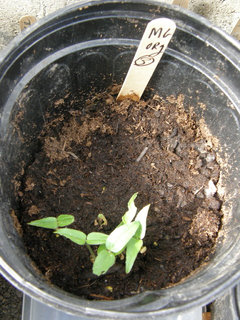
My kid is doing a plant-experiment in school. She soaked the mung-bean-seeds in distilled water (slightly acidic), put the cover on, and leave in the dark pantry. But she left it there too long, and molds were growing on the seeds, pretty gross. She planted it anyway in the pot with MG-potting soil. We also made a new batch of mung-bean sprouts, with no molds. The temp. went from hot & dry above 80 degree to tons of rain, then very cold today, 50 degree F. Surprise !! The moldy mung-bean-seeds grew into vigorous plants, while the normal seeds didn't even grow. So you are right about Mycorrhyzal fungi helps plant to cope with extremes in weather. Below are the mung-bean plants (previous moldy) growing very vigorous in MG-potting soil:
 11 years ago
Great looking blooms Straw! Very clean & healthy looking! :-)
- 11 years agolast modified: 11 years ago
Thank you Jim. I appreciate your support.
Jessjennings: An idea occur to me, how about tiny beans like lentils and split-peas, in the planting hole for potassium? Dry beans are high in potassium, and cheap. Few years ago I question myself when I put cracked-corn in the planting hole, but I got amazing plant-growth with that approach !! Like 10 blooms on 1-month newly bought roses (Lavender Rose and Tchaikovsky).
Cracked corn is acidic at pH 4, great to break up my alkaline clay at pH near 8. If you compare the nutritional value of cracked corn to lentils, or split pea ... cracked corn has 1/2 the amount of potassium, but cheaper in price. I need to test the pH of lentils and split pea in red-cabbage juice to see if it's neutral or acidic. See below how dry beans have double the potassium of corn:
http://nutritiondata.self.com/facts/legumes-and-legume-products/4338/2
http://nutritiondata.self.com/facts/cereal-grains-and-pasta/5687/2
Any organic matter in the planting hole will grow mycorrhyzal fungi. A rose grower in Italy (Melissa) put half-rotted straw in the planting hole for her bare-root roses. Half-rotted straw retains moisture, so does half-rotted organic matter, be it corn or dry beans. I put the entire bag of stale-yellow-split peas (only $1) in the planting hole of Barcelona rose (tiny own-root). That rose blooms a lot, see September pic. below:
Since your soil is acidic, an alkaline medium like crushed-red-lava-rock at pH 8.2 is best. I'm going to test the pH of lentil and split-pea, and let you know if it's acidic at pH 4 like cracked corn or Brewer's Yeast. When I watched a you-tube on David Austin rose, the advisor said to put rotted organic matter in the planting hole. Years ago I put horse manure in the planting hole and burnt my roses with its salt and extreme alkalinity. Also killed a rose with chicken manure in the planting hole.
Greens are different: I tested raking fresh grass in soil: bumper crop with tomatoes. I tested putting fresh leaves in the planting hole, lots of blooms on La Reine. But something acidic like cracked corn? It's best to let it de-compose to neutral pH. Tchaikosky below gets 6-months-decomposed corn. Lavender rose gets 2-months decomposed-corn. Both gave tons of blooms, but Tchaikosky is healthier, since the corn decomposed to near neutral. Pic. below taken in mid-sept of this year, it was bought as gallon-size rose end of June:
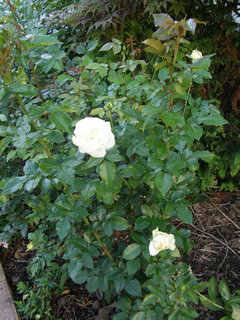
Below is Barcelona: I put a bag of old yellow-spit pea (high potassium) in the planting hole. No harm was done, it blooms lots. Pic. below taken in Sept.
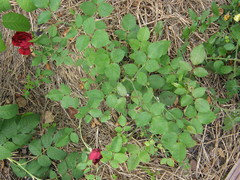
- 11 years ago
Hello Strawberry Hill
this is sooooo exciting........I can't thank you enough for this info.I have been in my garden all day planting trees and thinking about what you suggested with the lentils....
I have quite a lot that I can use for this purpose and I've seen the great amount of potassium in contains.
Now ...should I perhaps first let it go mouldy before adding it at the bottom of the hole, close to the rose's roots? or mixed with all the soil as is/uncooked? perhaps first softened in water?
I really don't ever want to use chemical sprays ever again....
I found this link to the Rock Dust I've been using just for interest's sake.
http://turbo-grow.co.za/composition-and-application/
will this be almost like using pea gravel? I can't find lava rocks or pea gravel anywhere around here....the closest I can get to lava rocks are the kind people use in their barbecues...and I don't know if that is man made or natural and no one can tell me....
I also found this distressing info on bone meal, which everyone around here uses quite liberally..
'But use of Bone meals as a shrub fertilizer has been questioned by findings that it reduces the formation of micorrhyzal friendly fungi. However, some soils and shrubs are not amenable to this anyway, especially following modern soil cultivation. '
http://www.the-organic-gardener.com/shrub-fertilizer.html
and some interesting info on Mychorrizal fungi:'There are different kinds of mycorrhizal fungi, though the most common among forest tree species (firs, pine trees, chestnuts, Holm oaks, oaks, hazels, etc.) are the ectomycorrhizal fungi. They develop in the plant’s short roots by creating a mantle of mycelia that sheathes the root tips where trophic interaction takes place and penetrates into the cortical cells to establish a network of fungal tissue. Many ectomycorrhizal fungi produce plant hormones that promote the branching of mycorrhizal roots, thus increasing the root surface and the contact area between the fungus and the root. Nutrient exchange between the plant and the fungus takes place in this extensive contact area.
A single plant can host mycorrhizal fungi of different species and one fungus can be associated with different plants at the same time. This multiple association forms an underground network that uses mycelia to connect fungi, trees and bushes in the forest so they can share water and nutrients.
This structure gives the fungus an enormous surface area with which to absorb nutrients from the soil.
In a mycorrhiza, some of these hyphae form a sheath around a root and penetrate the root tissues. These hyphae draw sugars out of the phloem of the plant for their own nutrition. However, these fungi are not parasitic and the plant cells assist the fungus and enhance nutrient transfer, because the plant benefits too!
The large absorptive capacity of the fungal hyphae makes them very good at drawing minerals out of the soil and they give some of these nutrients, especially phosphorus, to the plant in exchange for the sugars. Many soils are low in phosphorus, and plants can not grow well in such soils without mycorrhizal fungi to help them.
The toadstools that you often see growing near to trees are often the sporing bodies of mycorrhizal fungi. Some plants associate with very specific mycorrhizal fungi and grow poorly in soil lacking the right fungus.
http://lameva.barcelona.cat/barcelonacultura/en/role-mycorrhizal-fungi-forest-healthhttp://cronodon.com/NatureTech/Woodland.html
and I have to end of by just saying once again...I've never seen more beautiful and healthy roses than yours. ever. - 11 years ago
Hi Jim thanks for the info I really appreciate, and it's great to know phosphate (via the bone meal I've been using) doesn't kill mycorrhizal fungi. I've been very worried about that.
I grow my roses in raised beds and no water-logging or over watering happening :-)
plus I don't use pesticides or chemical fertilizers. I have sprayed my roses before with fungicides to treat Black Spot but I want to avoid doing that ever again, that is why I've asked Strawberry Hill's advice seeing that her roses are clean without using that.
But I am no scientist therefore I really appreciate any input I can get.
I am thinking now of soaking lentils in lots of water, and to use the water after a day or so to pour on my struggling Evelyn. then to add compost to the softened lentils, and to keep it in total darkness to go mouldy and then to add that to the new holes....(I'll have to wait for Strawberry Hill's word of approval, I think she's busy testing the lentils' PH)
that'll add natural potassium, don't you think? with equal amounts of gypsum.
I love Strawberry Hill's advice and reading about her experiments, she definitely is doing something magical (without hurting nature) , if you look at her roses....
:-) - 11 years agolast modified: 11 years ago
Hi jessjennings: I appreciate your kind words very much. You help me too ... without your questions, I would not bother to experiment, so you help me to learn. THANK YOU. I click on the link for the rock dust you gave:
http://turbo-grow.co.za/composition-and-application/
From the above link, your rock dust has 48.58 silicon dioxide, 16.32 aluminum oxide, 9.30 iron oxide, 0.18 manganese, 6.36 magnesium, 12.11 calcium, and 2.32 sodium oxide, 0.58 potassium oxide, 0.15 phosphorus, and 0.02 chromium oxide.
12.11 calcium and 6.36 magnesium is good, right ratio of twice more calcium than magnesium. I don't like the extremely low potassium of 0.58. And 16.32 aluminum oxide is WAY TOO HIGH, high aluminum is released in acidic soil and will damage root. Here's an excerpt from below link: " Since aluminum (Al) toxicity often negatively affects the growth and production of crops in acidic soil ... The results demonstrated that Al inhibited the growth of soybean root systems and severely damaged root cells."
http://www.sciencedirect.com/science/article/pii/S0261219410003467
Previous years I posted another science abstract on how plants' root growth is enhanced by soluble calcium, but damaged by aluminum. So there's more than one studies proving that aluminum toxicity hurts plants in acidic soil, where aluminum is readily released.
- 11 years agolast modified: 11 years ago
I soaked lentils overnight in distilled water, crushed that, and tested in red-cabbage juice, total of 15 samples: overnight soaked lentils & dry crushed lentils & dry crushed black-eyed pea & baking soda (pH above 9) & my clay soil & clay soil by BS rose (pH 8) & clay soil by clean rose & dolomitic lime & pea gravel & chopped sweet potato & Miracle-Gro organic potting soil & Jiffy seed-starter potting soil & local bagged top soil & Brewer's Yeast & red-cabbage boiled in rain-water (pH 5.6)
The result? Lentils soaked overnight is more acidic than dry lentils, around pH 5. The most acidic below pH 5: sweet potato and cracked corn. Brewer's yeast was light pink & tastes sour.
Miracle-Gro potting soil has a very light pinkish tinge, reported pH on-line is 6.5. Jiffy seed-starter potting soil is clear on top, it's a buffer, so the pH is neutral. Pea gravel and lime are both gaudy-blue (pH over 9), while baking soda is even more alkaline greenish-blue. My 2 clay soil sample is between pH 8 and 7.5. Local bagged top soil is VERY ALKALINE, coming second to baking soda.
The winner? Crushed black-eyed pea .. it was slightly alkaline at first (bluish purple). Upon soaking for 1 hour, it's still more blue, or more alkaline than red-cabbage in rain-water. The amount of potassium WAS NOT LISTED on lentil bag, so it's not impressive. But the amount of potassium was listed on black-eyed pea bag as 390, on black-bean bag as 520, and on red-bean bag as 500.
Some data from the below link: "Serving size: 1/2 cup cooked beans (or 1/4 cup dry bean) for potassium in mg
Large Lima 478 mg/
Pink 430 mg/Pinto 400 mg/serving
Baby Lima 365 mg/serving
Light Red Kidney 357 mg/serving
Dark Red Kidney 357 mg/serving
Red 348 mg/serving
Great Northern 346 mg/serving
Blackeyes 345 mg/serving
Cranberry 343 mg/serving
Navy 335 mg/serving
Black 306 mg/serving
Garbanzo (Chickpea) 239 mg/serving"http://www.recipelink.com/msgbrd/board_5/2001/APR/1529.html
From StrawChicago: It was very easy crushing black-eye pea, it crumbles with a few hammer hit, compared to major ordeal crushing red-lava-rock. Lentils was a pain to crush, since it scatters all over, rather than crumble. The data is correct, since I make lentil soup often, and I NEVER put tomato in that, otherwise we'll get heartburn from its acidity. But I put tomato in red-kidney bean for chili. I eat black-eye pea before bed-time, never get heartburn nor acidic tummy either.
- 11 years agolast modified: 11 years ago
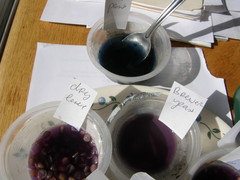
The top one with a spoon is my native clay. Vinegar is fuchsia pink (pH 2to 3), and dry lentil has this deep pink (pH 5 to 4), compared to lighter pink of brewer's yeast (pH 3). Neutral pH is 7, and rain-water pH is 5.6 .. I use red-cabbage boiled in rain-water, so the samples would be less acidic if someone use distilled water (pH 6.8), or tap-water (pH above 8).
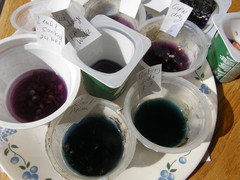
Above sample ... lowest to the right is baking soda (bluish green, pH over 9). center lowest is my fixed clay soil (dark blue, pH 7.5). Left lowest is lentil soaked overnight, pinkish and acidic. See the reddish-violet of corn, very acidic.
- 11 years agolast modified: 11 years ago
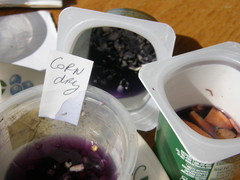
Left is dry-cracked-corn, pinkish violet. Right is sweet potato, even more acidic. top tilted container showing crushed black-eyed pea, bluish purple (near neutral), and after 2 hours it's still more blue than the control (red-cabbage in rain-water).
- 11 years agolast modified: 11 years ago
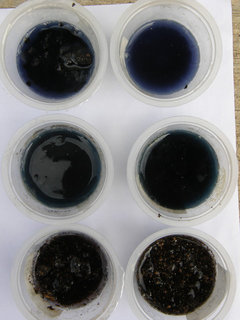
Top left is pea gravel, top right is lime. Both are very blue, pH over 9.Middle are my clay soil, and local bagged soil, both are alkaline, pH near 8.
Bottom are MG-potting soil and Jiffy-seed-starter potting soil .. clear on top, both are buffers. Came back after 2 hours soaking, the pea-gravel changed color to the same as my clay soil, less blue than lime. Since pea-gravel composes of a variety of minerals, it takes time for all of them to be dissolved.
- 11 years agolast modified: 11 years ago
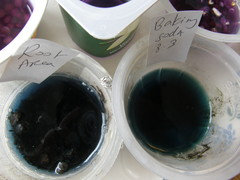
The above shows how alkaline my clay soil (pH near 8) ... compared to baking soda (pH over 9 when soaked for more than 2 hours).
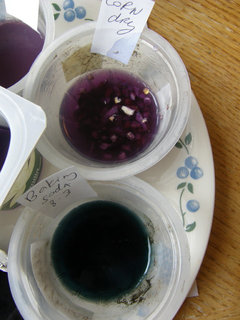
The above shows how pink cracked corn is compared to baking soda.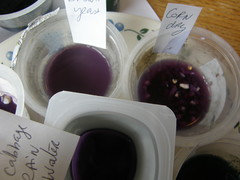
The above shows how pink brewer yeast (pH 3) compared to the control: cabbage in rain water (pH 5.6). - 11 years ago
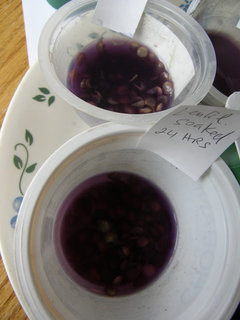
Lentil soaked for more than 24 hours is very acidic, just like cracked corn. - 11 years agolast modified: 11 years ago
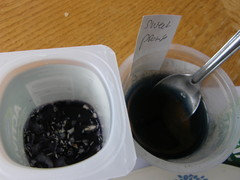
Crushed black-eyed pea is a winner (neutral), compare to the color to my native clay (pH near 8). For the planting hole, I would use NEAR-NEUTRAL pH organic matter, so it doesn't hurt roots. The slower-released, the better, I would choose crushed beans highest in potassium in the list, and black-eyed pea is a good choice since it's the SOFTEST among beans to crush. Crushing beans like black-eyed pea PREVENT it from sprouting in the planting hole. And even if a few plants sprout, the sprouts will provide more vitamins to the planting hole. It's easier to kill baby-plants when they sprout BEFORE planting the rose.
Anything neutral pH, or SLOW RELEASED is good, such as leaves, straw, hay, and crushed beans. Heirloom roses recommend mixing 1/2 wood-chips into clay soil.. Wood-chips have zero nutrients, but it holds moisture, and loosen up clay, plus serve as buffer to neutralize extreme pH.
For the concentrated high pH over 11 like wood-ash, that's best on top of mulch, or only a small amount mixed thoroughly with soil. If wood-ash touches the root, it burns roots. I already burnt plenty of roses with concentrated nutrients like bone meal, horse manure, and chicken manure in the planting hole. Horse manure and wood-ash used as thin-layer-MULCH on top on organic matter like leaves is safe, since the leaves neutralize what's above.
CONCLUSION: For the planting hole, I would put NEUTRAL & SLOW-RELEASED organic matter like leaves, grass, hay, straw, or wood-chips .. they are great to retain moisture and to buffer extremes in pH (too acidic or too alkaline). Dry beans like black-eyed pea is neutral pH at first, but releases acid very slowly as it decompose. The slower the decomposition, the safer for the planting hole. Sweet potato is very acidic in my red-cabbage testing, since it breaks down faster than crushed dry beans.
- 11 years agolast modified: 11 years ago
Not sure what the confusing is all about but in a nutshell if too much phosphate fertilizer is applied to soils there is no reason for mycorrhizal fungi to form on the roots...High levels of phosphate fertilizer applied to native garden soil is bad news period!
I removed that posting and am going back to my relaxing thread...lol
- 11 years agolast modified: 11 years ago
I'm wary of lawn-fertilizer companies, since many states pass laws to ban phosphorus fertilizer in lawn. Here's the news Feb 25, 2011: "Virginia is poised to pass a law banning the sale of fertilizer containing phosphorus, a major pollutant in the Chesapeake Bay and its rivers.
Lawns, parks, golf courses and other grass-covered areas cover 3.8 million acres of the Bay watershed. Most established lawns do not need phosphorus, but the majority of commonly used lawn fertilizers include phosphorus in their nutrient mix.
Once it goes into effect in 2013, the law will reduce an estimated 230,000 pounds of phosphorus pollution from reaching the Bay and Virginia rivers each year. This is 22 percent of Virginia's 2017 phosphorus reduction goal."
Also white phosphorus is a toxic chemical that cause severe burns in skin. Here's an excerpt from CDC (Center for disease control): " DESCRIPTION: White phosphorus is a toxic substance produced from phosphate-containing rocks. White phosphorus is used industrially to manufacture chemicals used in fertilizers, food additives, and cleaning compounds. It has been used in the past as a pesticide and in fireworks. It is used by the military in various types of ammunition as an incendiary agent (because it spontaneously catches fire in air) and as a smoke agent (because it produces clouds of irritating white smoke). .. CHEMICAL DANGERS:
- Phosphorus spontaneously ignites on contact with air, producing toxic fumes (phosphorus oxides)."
When I checked reviews on More-bloom formula with added phosphorus, folks complained about plants being burnt. There's an amazon review where a guy wrote how he killed his tomato by Jobe's NPK 2-7-4 (with bone meal for phosphorus). He said it worked fine when he mixed that thoroughly in the planting hole, but when he put that on top of his tomato .. it died. Phosphorus, even as bone meal, is caustic. My kid's plant experiment: she mixed Espoma Garden Tone (with bone meal, NPK 3-4-4) in the pot, that zapped out all the mung-bean seeds, only 1 sprouted (at the lower edge) where the Garden-Tone wasn't mixed in, see below pic:
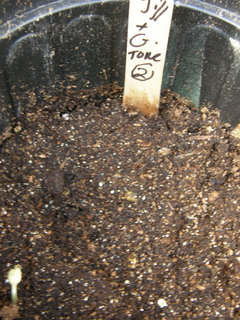
Below is the same potting soil: Jiff-seed-starter, without Plant-Tone, the mung beans plants are doing well:
- 11 years agolast modified: 11 years ago
Use of excessive phosphorus....I'm a real stickler about this subject....I do not add any phosphorus fertilizer because a soil test 2 years ago said our phosphorus levels were already to high in our soil... They suggested I do not add any phosphorus fertilizers...All other nutrients were already in our soil also... PH was good at 6.5... I'm still waiting for my new soil test results to come back...I'm hoping our phosphorus levels have decreased so Mychorrizal fungi will start forming if it hasn't already...
http://www.rose.org/phosphorus-fallacies-too-much-of-a-good-thing/
http://www.smilinggardener.com/garden-planning/beneficial-fungi
All of this information becomes critical for the gardener when one learns about the negative effects of too much phosphorus in the soil. Phosphorus carries a chemical charge that competes with other micronutrients for plant uptake. Excess amounts result in leaf chlorosis because iron, manganese, and zinc are not available to the plant. Leaf tissue turns yellow while veins stay green. Adding more of these deficient nutrients is useless because they already exist in good amounts in the soil. Foliar sprays of micronutrients such as iron can help because they are directly applied to the weakening plant tissue rather than absorbed by the roots.
In addition, phosphorus inhibits the growth of mycorrhizae in the soil around the rose plant. Rose roots form a symbiotic relationship with these beneficial fungi, providing carbohydrates in exchange for phosphorus which the fungi can find beyond the plant’s roots. When the rose has more than enough phosphorus it doesn’t need the mycorrhizae and withdraws its support. Mycorrhizal growth plays a key part in healthy soil.
Paul Zimmerman has some good info on this subject I just have to find it again...
- 11 years agolast modified: 11 years ago
Thank you, Jim, I appreciate the info. you post, in particular the phosphorus thread you posted last year. Australia has a vast region of alkaline clay ... even then granular phosphorus was useless, but SOLUBLE phosphorus increased crop yields. For my alkaline clay, bringing the pH down to free up phosphorus, plus soluble cow-manure .. resulting in Thai basil tons of blooms, and very little leaves !! That's for crops ... but for roses, tissue-analysis shows that roses require 10 times more potassium than phosphorus, and 12 to 15 times more nitrogen than phosphorus.
U. of Hawaii had a research where phosphorus uptake increases when the soil is made more loamy via organic matter:
http://www.ctahr.hawaii.edu/mauisoil/c_nutrients02.aspx
The solubility of phosphate minerals is very dependent upon soil pH.
- The soil pH for optimum phosphorus availability is 6.5
- At high or neutral pH, phosphate reacts with calcium to form minerals, such as apatite.
- Under acidic conditions, phosphorus may react with aluminum and iron to form minerals, such as strengite and varescite. "
For acid soil, Australian government site stated the below: "Incorporate lime in your soil to raise your soil pH to 5.0 (CaCl2) and reduce the availability of aluminium in the soil. In this way, applied phosphorus will not be readily tied up in aluminium compounds and will be more available to plants."
http://www.dpi.nsw.gov.au/agriculture/resources/soils/improvement/phosphorous
- 11 years ago
I check the nutrient-analysis of pink bean (highest in potassium) among the beans. It's quite impressive: very high in all B vitamins, 27% calcium, 79% iron, 96% magnesium, 87% phosphorus, 88% potassium and 144% manganese. Also 36% zinc, 85% copper, 39% selenium. The last 3 elements are anti-fungal agents (help protect plants against fungal diseases). Beans also have both Omega-3 and Omega-6 fatty acids
http://nutritiondata.self.com/facts/legumes-and-legume-products/4309/2
Pinto bean is next highest in potassium, that's sold really cheap at Mexican stores .. I'm going to test that in the planting hole in advance. My zone 5a winter will kill any bean-plant sprouted. Problem with excess in phosphorus? It has to do with other elements lacking. If there isn't enough calcium to bind with phosphorus, phosphorus release will be max. I like organics like beans as fertilizer, since it's a BALANCE in nutrients, versus chemical fertilizer having only phosphorus, and zero calcium to keep that in check.
Like my pH 7.7 clay is tested exceedingly high in magnesium. I corrected that by using gypsum, which provides calcium, plus bring down the pH. I also give it sulfate of potash, to solve the problem of potassium being less available with high pH. Potassium is necessary to induce blooming, but it's calcium & other trace elements are needed for high-quality blooms & more petals.
For acidic soil: As the pH drops, less potassium and calcium are available. Phosphorus is also less with extremes in pH (be it high or low), but roses require so little of phosphorus, that doesn't matter. The rose park here uses a high-phosphorus fertilizer, but that only work on their landscape roses (less petals, more branching). That DID NOT work whatsoever on Austin roses, and it burnt Tamora, plus their Austin roses are very stingy, only a few blooms.
Plants differ in nutrient-requirement. Tomato and roses require more calcium than other crops. Annual flowers like geraniums, marigolds, impatient require more phosphorus than other crops. I once put geraniums in pot, watered with my high pH tap water (near 9), and it has purplish spots on leaves & reduced branching & less flowers, typical of phosphorus deficiency.
- 11 years ago
Hello Strawberry Hill
I can't thank you enough for all the trouble you have gone into to have the beans tested and I will definitely get hold of black eyed beans at the local health shop...and crush them... :)
(I have never seen Pinto beans around here)
you are a great photographer as well, and your tests are extremely impressive...
I am shocked at the huge amount of aluminium the Rock Dust that I used contains...
maybe I should replant my Evelyn rose into a new hole - although I am not sure if she's ready for another transplant shock... what would you advise?
she has two branches with very healthy-looking leaves, and two others not looking healthy but the healthy branches aren't deteriorating....maybe I should just wait?
Can I perhaps treat her with a very weak solution of Comfrey tea just for now? or should I add some crushed black beans carefully close to her roots? Or perhaps just add some more Comfrey leaves as mulch on top?
I found this site, trying to locate something which contains organic potassium:
'The nitrogen-phosphorus-potassium (NPK) ratio of dried comfrey leaves is 1.8-0.5-5.3; comfrey also contains calcium.'http://www.harvesttotable.com/2009/05/how_to_make_comfrey_manure_tea/
but I couldn't find the ingredients of diluted comfrey tea....should I add lime to neutralize the aluminium in the Rock Dust I added to her hole? I am sure I'll be able to get hold of that at the local nursery...and then again, how much per hole, and how much for the struggling Evelyn...
and I will certainly add crushed black eyed beans into the holes of all the others that will be planted next week...have already added gypsum to the holes in preparation. Now just for the beans.
the good news is, as I dug in the gypsum I was very happy to see many earthworms.
But, I am going to have to read through your tests again to make sure I understand it all...
Will leaves/grass (fresh?) etc will be even better than the beans? (in the new holes) - will it be beneficial to mychorrizal fungi as well?
I won't be using any bone meal again....
you also recommend wood chips but they have only pine available at any nurseries here...should I add wood from my own garden, something not acid? I have a lot of acacia...
and now, at the expense of really sounding dumb...should I water if I feel the soil is dry, I am so scared to over-water Evelyn at this stage...
also - many thanks to Jim's input:)
all advice is highly appreciated, and as soon as there is improvement I promise to post a photo, hopefully with a bloom :) - 11 years agolast modified: 11 years ago
Hi JessJennings: Your Evelyn sounds good with 2 healthy branches and 2 improving branches. I would say "No" to moving Evelyn ... when I move roses, sometimes they drop all leaves, and takes 2 months to be healthy again. What you did was right: putting wood-ash, pH over 11 on top and watered that in. That would raise the pH of the hole, and when the pH is raised, aluminum can't be released.
Question: Is your Evelyn grafted on Dr-Huey rootstock? Or is it multiflora rootstock? Dr. Huey rootstock is a straight-stick down, multiflora-rootstock is more cluster & spreading. Dr. Huey rootstock is very aggressive and secrets plenty of acid, and it likes alkaline stuff like lime (pH 9), wood-ash (pH 11). If I have to raise the pH of a hole, I would put buffers on top (leaves, woodchips) ... then dilute wood-ash with water, and pour that through the buffers. The buffers will dilute the extreme alkalinity and salt of wood-ash. Wood-ash is a complete package with calcium, magnesium, potassium, boron, and trace elements, but it needs buffers & water to dilute its extremely high pH and salt.
My Mom used wood-ash in her acidic clay: she pile up leaves (pH 5 to 6), then put wood-ash on top, and let rain water (pH 5.6) neutralize the wood-ash downward. She told me NEVER let roots be in direct contact with wood-ash, it will burn roots. I touched wood-ash from a fireplace, and it was caustic to my skin .. I had to wash off immediately. Plants' roots are as sensitive as human skin. Think of what's good for human skin: grass is neutral, wood-chips is neutral (except for very acidic pine bark), straw and hay are mild to human skin. Crushed black-eye peas are mild to the skin, and it's used to lower blood-pressure in humans ... its high in potassium de-salt the planting hole. Those are good for the planting hole to hold moisture and to grow mycorrhyzal fungi.
Leaves for the planting hole? it depends some leaves like black walnut are toxic to roots .. Fresh leaves are best WAY AT THE BOTTOM of the planting hole, so when roots reach down, that would give time for leaves to decompose. That's what I did to my roses ... the leaves were too big to mix in, so I put that at the bottom, along with banana peels. I already tested banana peels in red-cabbage juice, it's neutral in pH. But the sweet-banana-core? That's sweet, and sugar, once fermented, becomes sour. I already mulched a rose with the entire bananas, and it released too much acid, the rose HATED that. A nursery recommends pouring a can of soda (high in sugar) into the soil to make the soil more acidic.
Gypsum is mildly caustic to my skin with its 17% sulfur, and lime is less caustic. Earthworms also prefer slightly alkaline. It's recommended 1 cup of gypsum and 1 cup of lime per planting hole for root-growth. Gypsum is for IMMEDIATE release of calcium, and lime is for slower-release (needs acid to break down). If you do 2 cups (1 gypsum and 1 lime) ... you would need equal or twice more potassium (for Austin roses), so you would need 2 cups of crushed black-eye-peas, and more high-potassium comfrey later. Nitrogen mobility is a 10, that moves down easily and can be supplied later from the top.
Melissa in Italy is an experienced rose grower with 400 roses, she used half-rotted straw in the planting hole. She has alkaline clay soil. I used half-rotted alfalfa hay, NPK 2-1-2, and the result is awesome, lots of mycorrhyzal molds growing, and the soil is fluffy & retains moisture. Once organics are fully-decomposed, it's slightly-alkaline.
Since your soil is acidic, I would choose VERY-SLOW to decompose, or fully decomposed. The decomposition gives off acid. I once received tiny roses grew in fresh pine-barks, and they almost died on me, thanks to the acids released by the NOT-decomposed pine-barks (pH 4). Potting soil is composed of chunky stuff (compost), then fine-particle like peat moss, perlite (to fluff up), and lime to balance out the acid of peat moss (pH 4). Professional potting soil also add gypsum for root-growth, and vermiculite (to hold moisture).
So for your planting hole, some chunky stuff is good (leaves, grass, hay, straw, crushed-beans), then fine-particle clay, and you still need lime to neutralize the acid given off by decomposing organics, plus gypsum for instant calcium for root-growth. If your soil is VERY acidic, I would use more lime, and less gypsum. My soil is VERY alkaline near pH 8, so I use 4 cups of gypsum (pH 6.8) per planting hole, and NO lime (pH 9). I use even more gypsum for roses that like it acidic.
If your clay is very dense and heavy, wood-chips, hay, straw will fluff that up to create more space. Roots grow best when there's oxygen, the logic of putting chunky matter like leaves, crushed beans, straw, hay, woodchips is to CREATE GAPS or AIR-SPACE in the planting hole, and to supply oxygen to roots. If your soil is loamy & fluffy like potting soil, it still need the calcium and potassium & a bit of phosphorus for root growth. Rose-tissue analysis showed twice more potassium than calcium, and one-tenth of phosphorus. Crushed-black-eyed-pea has ALL the nutrients needed, including B-vitamins.
- 11 years ago
Hi Strawberry Hill
this info is great and very clear...thank you from my heart :)
I won't move Evelyn, and the soil underneath the pile of leaves is still moist.
good news is the cracked corn that I added around her...well......some of them sprouted (I pulled them out gently) - that's a good sign though isn't it? regarding too much salt in the soil? :)
I will keep adding comfrey and other leaves on top and only water when dry. plus wood ash on top of that (a little bit), along with crushed black eyed beans and acasia wood chips, exactly as you advised, and prepare the new holes accordingly as well.
Also, I mailed the nursery where I bought Evelyn to ask if she has been root grafted, will have info soon, hopefully.
I have another question regarding the Pat Austin I want to plant now...she will need some shade from our hot sun. Can I plant a Buddlejah Salgina about 4 feet away from her? (to shade her from the harsh setting sun in the west). I am in two minds about that though, maybe I should prepare a hole for her somewhere else? Except that where I dug the hole for her is where I can see her all the time, with other roses at the back - Gertrude Jeckyll and Tradescant - and way behind all of them is an existing big Sally Holmes who I am hoping will soon add a lot of shade on top seeing that they'll all be climbing with Sally already almost on top. In our hot weather roses don't die in winter, some don't even stop growing and blooming.
http://witkoppenwildflower.co.za/buddleja-saligna/
The roots are not aggressive.Young plants grow quickly, up to 1.5 metres per year.
I'm just adding these as wellin case the top one won't open
- 11 years agolast modified: 11 years ago
Hi Jessjennings: Corn sprouted around Evelyn? That's great, it means your soil isn't salty, and the diluted wood-ash didn't harm your soil. I checked for the pH of acacia, but could not find it. Few facts about acacia: it's a hard-wood type, used to make sturdy flooring. It's high in tannins, and tannin is a fungicide. Acacia wood-chips would be great as mulch, since it's slower to decay. However, wood-chips have zero nutrients and rob the soil of nitrogen when break down. So I would use acacia wood-chips ON TOP of fertilizer.
Multiflora-type rootstock is a spreading, cluster-root, and it can take acid better than Dr. Huey. I have 3 Comte de Chambord roses: two are own-roots, and one is grafted on multiflora. I put tons of acidic cracked corn (pH 4), and gypsum in the multiflora' hole, and no problems whatsoever. The 2 own-roots are wimpy in hot-sun, while the grafted can withstand hot sun better.
Since your roses are grafted on Multiflora, which prefer acidic, I would limit the lime (pH 9) to 1 cup in the planting hole just to neutralize decaying matter, and water with diluted-wood-ash only for the ones that like it alkaline: Evelyn.
Multiflora is a spreading root .. best to spread out additives on top, so it won't gunk up at the crown and burn. Putting a tree, Buddlejah Salgina, 4 feet from Pat Austin? Pat Austin is a water-hog, and roses don't like tree roots stealing water from them. I had 2 Pat Austins: One in full-sun, and the other in partial shade. We get hot summer up to 90 F, or 32 C. Pat's blooms fry badly in full-sun .. I gave that away. I didn't mind the blooms being fried, but I didn't like watering that constantly. Pat and Evelyn both like it alkaline as own-roots.
When you plant a tree next to that, the tree will steal water from Pat. As grafted Pat can take full-sun, but she needs CONSTANT dampness. Another solution is to plant something pretty & tall in a pot, and put that next to Pat to block the sun. My Pat bloomed in 2 hours of sun in late fall, and Austin roses with soft-petals do better in partial shade.
- 11 years ago
Hi Strawberry Hill, I love the idea with the pot, and something tall in it, thanks so much for this great idea :)
While I wait for that to grow tall I will create a shade-net canopy for Pat and give her lots of mulch to keep the moisture in.
I will also be getting lime and more gypsum to add to all my roses.
How does one know which ones prefer adcid and which prefer alkaline?Great to know the roses will be strong, grafted on multiflora :)))
- 11 years agolast modified: 11 years ago
Great question, Jessjennings. The ones with shiny & glossy foliage tend to prefer more alkaline. Evelyn's leaves are shiny and glossy. Glossy foliage require more magnesium, and magnesium is alkaline. My rock-hard clay, pH near 8, is tested high in magnesium. Meilland French Romantica roses, bred from a hot & alkaline region, prefer alkaline. Examples: Bolero, Tchaikovsky (both have very glossy foliage).
The ones with dark-green & larger leaves also prefer alkaline. Pat Austin's leaves are very dark green. Stephen Big purple leaves are large and dark green, that one prefer alkaline. Dark-green and large leaves can withstand hot sun better, and it also requires more calcium for heat-tolerance.
The ones with lighter-green foliage, and smaller leaves typical of multiflora-genes prefer acidic. Polyanthas like Marie Pavie with smaller & duller & lighter green leaves prefer acidic.
Most Austin roses prefer acidic, being bred in a rainy climate with a large region of acidic soil. But a few Austin roses prefer alkaline, and these are popular in alkaline California: Tamora, Evelyn, Radio Times, Pat Austin, Prospero, Mary Magdalene, Bishop's Castle, Young Lycidas, Tess of d'ubervilles, and Munstead Wood.
See below pic. for LARGE, DARK-GREEN leaves of Stephen Big Purple, which blooms well with my alkaline-tap-water pH over 8.6. Intrigue is another rose with large & dark-green leaves that bloomed with tap-water at pH 9.
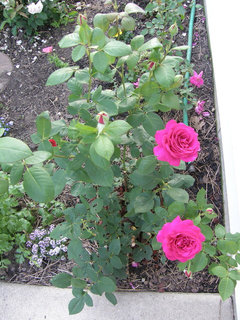
- 11 years ago
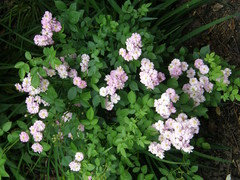
The above is Blue Mist, a polyantha with multiflora-genes. Note how small the leaves are, and how light-green it is. I have to give that rose tons of acid (via gypsum with 17% sulfur), plus rain-water (pH 5.6). That rose refused to bloom with my alkaline-tap-water, leaves turned yellowish with tap water.
- 11 years ago
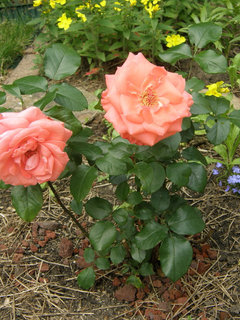
Above Sweet Promise, a French Meilland Romantica rose, also prefer alkaline. Note the LARGE, DARK-GREEN, plus glossy foliage. That's different from William Shakespeare 2000, which has lighter-green, and dull-foliage, that one prefer acidic, see below, pic. taken early this October:
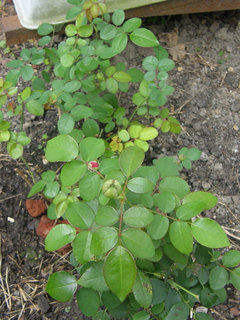
- 11 years agolast modified: 11 years ago
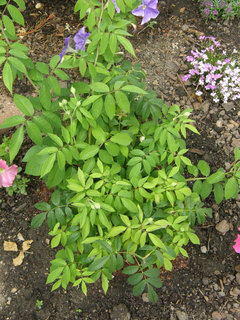
Above is Annie L. McDowell in early spring. That one prefers acid, I had to put tons of gypsum (17% sulfur) plus pine-bark (pH 4) in the planting hole. Note the leaves are smaller & lighter green.
- 11 years ago
your roses are breath taking! beautiful! and the amazing varieties you have...
Thank you so very much for sharing this with me.
I will inspect the leaves carefully from now on...and hopefully soon I'll have blooms and will post photo's of mine....:) tons of blessings to you
- 11 years agolast modified: 11 years ago
Thank you, Jess, for your questions which help me to learn. Go easy on lime (calcium carbonate), or dolomitic lime (calcium & magnesium), or gypsum (calcium sulfate). Too much calcium brings down potassium, and you'll get thin & weak stems, plus faded colors. Note: potassium is required at DOUBLE the amount of calcium in rose-tissue-analysis. Plus acidic soil doesn't need sulfur (sulfate) ... rain supplies sulfur, plus decayed & souring organics also supply sulfur.
Evelyn was getting less petals, so I put too much gypsum on her ... she broke out blackspots from the sulfate, so I put dolomitic lime ... her color became faded, almost white. I had to give sulfate of potash to undo the damage. Roses Unlimited recommended only 1 cup of lime and 1 cup of gypsum in the planting hole, plus 2 cups alfalfa meal, plus 1 cup organic fertilizer high in potassium.
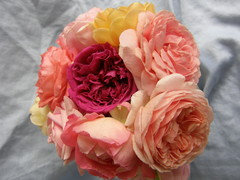
For mulching: Horse manure is best, since the pH is around 8, plus it has everything: calcium, potassium, phosphorus, magnesium, and trace elements for deep colors in blooms. I never have any problems with weak and thin stems with horse manure ... but a few of my roses get thinner & weaker stems since I overdosed on gypsum, and forgot about potassium. Below colors are achieved through horse manure, with 2 Evelyn on the right (2 years ago). Evelyn's color now with pea gravel is inferior to Evelyn on horse manure.
For info. about how phosphorus & trace-elements change color of blooms, see below link:
http://forums.gardenweb.com/discussions/3426074/roses-and-stuff-15-cont-of-oct-madness-2015?n=9
- 11 years ago
many many thanks Strawberry Hill :) again I have to say - I dream about having roses as beautiful and healthy as yours.....sigh.....those colors are so rich....
I have the most excellent news. The local nursery really outdid themselves and found me a 5kg bag of Sulfate of Potash - the powder ....
whoo-hoo!!!!!!!!!!!!!!!!!!!
Now I have the gypsum in the holes (1 cup), so I add 2 cups of the Sulfate of Potash?
I already have horse manure around each (of the older) roses, and have some left that I've kept to sprinkle around the newly planted roses this coming week....
and how much of the Sulfate of Potash can I sprinkle around all my older roses?
How will I sleep tonight I am so excited! - 11 years agolast modified: 11 years ago
Hi jessjennings: Sulfate of potash NPK is 0-0-50, salt index of 34 and 21% sulfur, fast release potassium. Compare that to gypsum with 17% sulfur, salt index of 8, and fast release calcium. You don't want to put concentrated, salty, fast-released powder in the planting hole ... that would burn roots. Yours is in powder form, is meant to dissolve in water, and water from above through the mulch. Or sprinkle less than 1 tablespoon on-top of mulch before a heavy rain, or use your hose (alkaline tap water) to water that acidic sulfate of potash from above.
I already have my child test that in her science experiment: mixing a bit of gypsum powder, and sulfate of potash powder in the ideal-rooting medium, that killed all her mung-bean plants. Sulfate of potash is extremely high in potassium and expensive, so you'll get your money worth if it's diluted, and aim-straight at the root-zone, rather than being lost in the planting hole.
Even if you got the GRANULAR form of sulfate of potash and mix 1 cup thoroughly in the planting, that will leached out during heavy rain, and you'll lose all potassium. Potassium mobility is a 3, it moves down slowly, compared to nitrogen mobility of 10, moves down fast from above. It's best to give plants a tiny bit of potassium once a week, too much at once will either burn roots, or leach out.
Same with nitrogen, best given when water-in by mulching with organic matter to nourish beneficial bacteria that fix nitrogen into the soil, also to feed earthworms, which in turn give nitrogen-rich earthworm castings.
Phosphorus mobility is a 1, it hardly move, and stays put where applied. Lots of people put bone-meal in the planting hole, but Roses Unlimited nursery did not recommend that approach. I already tested bone-meal in the planting hole, and killed a tomato plant, plus a $30 rose. That stuff burns when in direct-contact with roots. If your soil is acidic with too much aluminum, then phosphorus via bone meal can be used to bind up with aluminum, making it less available.
Since rose requires very little of phosphorus, only one-tenth of potassium ... the horse manure will supply plenty of phosphorus, even when applied from above. Horse manure in the planting hole is a NO-NO, too salty. I already tried that (failed), and it's worse with chicken manure (too hot & too salty in the planting hole).
- 11 years ago
me again Strawberry Hill :-)
do you think I could add some of the Sulfate of Potash around the 3 sugar gums (Liquidambar styraciflua) I've planted?...
apparently they also get attacked by fungus and scales when unhappy so I just want them to have the best... all the other trees are indigenous so they'll be fine.... (19 all in all :) - 11 years ago
thank you so much for the speedy reply....I was going to do it all wrong....
- 11 years agolast modified: 11 years ago
Hi Jessjennings: Per your question: "do you think I could add some of the Sulfate of Potash around the 3 sugar gums (Liquidambar styraciflua) I've planted?... apparently they also get attacked by fungus and scales."
Yes, sulfate of potash and calcium in a 2:1 ratio helps to thicken plant tissue, and help with fungal diseases. When soil is acidic, plant tissue is thinner thanks to less calcium and potassium. Raise the pH to neutral will help to protect plants from fungal and pests invasion. I once lowered my pH 8.6 tap water with vinegar, and saw roses' leaves became thinner and wilted in hot sun. Another time I put too much acidic sulfur and a rose came down with RRD (mite-infestation). Another time I put too much gypsum (17% sulfur) and a bunch of roses broke out in fungal blackspots.
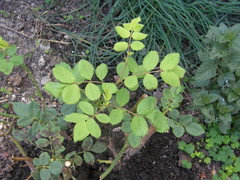
Below is Golden Celebration, which I dug up to fix poor-drainage, but I put too much acidic corn, and gypsum, plus high-phosphorus cow-manure (that was dumb, but I just want to get rid of that stuff). It blackspots BADLY, thanks to the high-phosphorus & acid. So I sprinkled sulfate of potash (1 tablespoon), and water that in ... I also put alkaline top-soil (pH 8) on top. Here's the new growth: 100% clean, compared the old leaves with blackspots.
University of Kentucky already did the experiments on the best fertilizer for marigolds in pots. The best result was with chemical NPK 20-10-20, 1/2 teaspoon per gallon of water, 3 times of week (or every other day). Second best result was with Omega NPK 6-6-6 (blood meal, bone meal, sulfate of potash) at 1 teaspoon per gallon, 3 times a week (or every other day).
I don't want to use chemical fertilizer (too salty for clay, and too high in phosphorus), so I sprinkle blood meal NPK 12-0-0 (8 teaspoon), 2 teaspoon of sulfate of potash NPK 0-0-50, and 2 teaspoon of gypsum. 4 x 12 = 48, that's close to 50. So I use 4 times more blood meal to achieve equal nitrogen to potassium. That's once a month on top of a tiny rose in pot.
Instead of bone meal, I used blackstrap molasses diluted in water (1 tea per 2 gallons), and water every other day. "Wholesome Organics" molasses has 15% calcium, 20% potassium, and 20% iron, plus other trace elements. NPK of molasses is 3-1-5, high in potassium & iron, plus good % of phosphorus, nitrogen, and calcium. Plantation brand and Wholesome Organics are molasses without salt added. This morning I saw a thick basal break in Prairie Harvest rose, which I received as a tiny rooting, shorter than my thumb 2 months ago. Now it's over 1 foot tall, and gave me 2 blooms, and 6 buds which I pinched off for root-growth. See below Prairie Harvest basal break which shows how potassium and calcium in a 2:1 ratio produce thick stem, pic. taken today Oct 9:
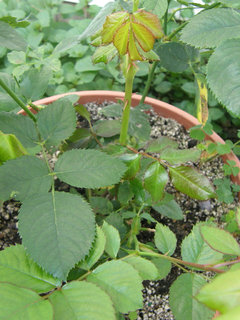
Here's Prairie Harvest on Sept. 30, it's much taller now:
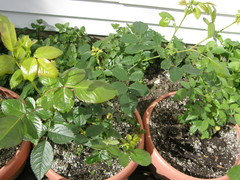
- 11 years ago
where do you get your blood meal Strawberry Hill?
I've never seen it around here.....only bone meal and that's a big no.... - 11 years ago
this is so awesome... It makes me feel alive when I read your posts!!!!!!!!!!!!!!!!!!!!!!!!!!
so that is gypsum (calcium) 1, Sulfate of Potash 2? with one teaspoon of molasses in 1 gallon water.
have I got this right....? - 11 years agolast modified: 11 years ago
I came back to my previous post and corrected to 1 teas. molasses in 2 gallon of water. I used 1 teas molasses per 1 gallon of water and that caused iron-stain on the leaves of Gina's rose (brownish edge on leaves).
The molasses was very thick, so I dilute 1/4 cup of thick molasses with 1 cup of water in a BIG bottle (shake that well). If you use a thinner molasses then adjust the ratio. Then add 1/4 cup sulfate of potash and 1/8 cup gypsum last. It will foam all over, so A BIG BOTTLE IS NEEDED TO PREVENT OVERLFOW. Then I add 1 more cup water to make it 2 cups total.
Then I transfer to a smaller bottle, so it's easier to pour one teaspoon per two gallons of water, or I just pour a tiny bit on to the water when the hose is running. Or sprinkle just a few teaspoons on top of mulch, then rain will water that in. Sulfate of potash is high in potassium at NPK 0-0-50 with 11% magnesium, 23% sulfur, and 20% potassium. Compare that to gypsum at 17% sulfur and 22% calcium. Data taken from EarthCo. soil-booklet. The solution is acidic, best used with alkaline tap-water, or on top of alkaline mulch (horse manure) before a rain.
Folks in California use horse manure (very alkaline pH of 8) to prevent fungal diseases in trees and plants. Baking soda at pH over 9 is used to treat blackspots. At pH 8 and above, fungal growth is lessened.
- 11 years agolast modified: 11 years ago
With regard to where to get blood meal? Both bone meal and blood meal here are from pigs, rather than cow (to avoid mad-cow disease). The rosarian Karl Bapst got his blood meal from slaughterhouse. Pigs are not treated with antibiotics as much as chicken or cow, so pig-blood would be best.
I grew a 3 feet tall Double-Delight in the pot before by just putting clover plants in the pot, to fix nitrogen. If you have plenty of land, soil from a clover patch is rich in nitrogen, that soil can be used to top roses. Also cracked corn has way more nitrogen than horse manure, except that it's acidic at pH 4. If your horse manure has lime added to deodorize, that would raise the pH to 8 .. and horse manure and cracked corn can be used together to achieve slightly alkaline topping.
Pea gravel is a smaller version of river-pebble (has a variety of colors). That's WAY BETTER than lime, since it has a variety of minerals, rather than just calcium alone. Gypsum bleached out Evelyn blooms to almost white. The color of Evelyn achieved by pea-gravel is almost as good as horse manure, but a bit of blue-hue (from aluminum). Horse manure is higher in phosphorus, so I got more pinkish Evelyn. Below are Evelyn blooms, mulched with red-lava-rock and pea-gravel, pic. taken yesterday at 80 degree heat:
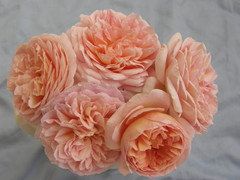
About your 3 sugar-gums attacked by fungus and scales. Raising soil pH to neutral and applying sulfate of potash will help. Folks throw wood-ash (pH over 11) around rose bush to treat rust (orange-spots-fungus) on leaves. Here's an agricultural report in 2005 that showed lime (pH 9) plus sulfate of potash (acidic) BEAT fungicides in soy-bean crop, with the most yield at 51.5 bushel per acre:
http://magissues.farmprogress.com/PRA/PF04Apr06/pra11.pdf
Treatment Description Yield (bu./acre) Pell lime + potash 300 pounds pell lime, 100 pounds potash 51.5 bushel /acre.
Fungicide Headline sprayed early reproductive stage 49.6
Fungicide + insecticide Headline + Warrior 47.9
Potash spread on top 47.2
Pell lime spread on top 47
Ag lime 1 ton per acre 47
Insecticide Warrior 46.5
Sure K Agro-Culture foliar liquid potash 46.5
Enhance + insecticide Enhance is a commercial additive 46
High population 250,000 seeds per acre 45.5
Nitrogen late 30 pounds per acre urea early reproductive 45.3
Enhance commercial additive alone 45.1
Nitrogen early 30 pounds per acre urea before planting 44.1
*** From Straw: Some info. on woodash from Purdue University. If I have acidic soil, I would use wood ash (pH 11) instead of lime (pH 9), since it has more anti-fungal trace elements like zinc, copper, boron, and selenium.
https://hort.purdue.edu/ext/woodash.html
"Wood ash contains less than 10 percent potash, 1 percent phosphate and trace amounts of micro-nutrients such as iron, manganese, boron, copper and zinc. Trace amounts of heavy metals such as lead, cadmium, nickel and chromium also may be present. Wood ash does not contain nitrogen.
The largest component of wood ash (about 25 percent) is calcium carbonate, a common liming material that increases soil alkalinity. Wood ash has a very fine particle size, so it reacts rapidly and completely in the soil .... Acidic soils (pH less than 5.5) will likely be improved by wood ash addition. Soils that are slightly acidic (pH 6.0 to 6.5) should not be harmed by the application of 20 pounds per 100 square feet annually, if the ash is worked into the soil about 6 inches or so."
- 11 years ago
I am so grateful for all this amazing info Strawberry Hill....
Have you ever considered writing a book about this? I really think it would be the best idea ever... - 11 years ago
ps...I am in love with Evelyn... and the blooms from your Evelyn is indescribable.............
- 11 years agolast modified: 11 years ago
Thank you, jessjennings, for your support & encouragement. People don't read book nowadays, they just google .. so they'll find the info. I'm so glad you ask questions, since it helps me to organize data in this thread, and if anyone else ask the same questions, I can refer them to this thread. I would love to see pics. of your South Africa village, and of your roses .. same with Jim and Sam.
You are welcomed in our small group in Jim's Roses & Stuff ... Msdorkgirl (from Hawaii) used to chit-chat in there, but she's busy with school, and Carol (from Canada) drops by sometimes. We chat daily about gardening & health & family & losing weight, also post pics. of our locality. It has been a pleasure to learn with you, and you are really nice, which make up for the negative people in other rose forums. I would rather have a few nice rose-friends, than be in a group of nit-picking strangers, who don't share about themselves, but criticize instead. Thank you for being you, a wonderful person.
 11 years ago
Wow.... there is so much to learn from this thread. Great effort by all specially Straw. Reading it again and again because it's not easy for me to comprehend the chemistry part related to various treatments. But will get through it hopefully. And I am happy I have landed at the right place with regards to organic rose growing.
Best regards
- 11 years ago
Thank you, Khalid, I'm impressed with tons of buds on your McCartney roses (posted here) & other healthy French and Austin roses you posted previously in English rose forum. Most of all, I really appreciate the time you defended me when someone else nit-picked me in English Rose forum. Still cherish that and respect you a lot for doing so.
 10 years ago
I hope this information stays here around on the top because I like to reference it next season for my garden.







hcarnevaleOriginal Author