Software
Houzz Logo Print
sorie6

what do you do

11 years ago
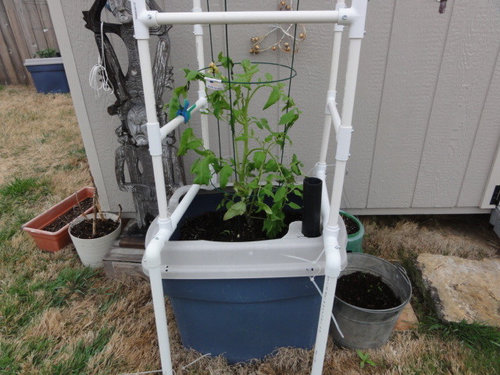
For BER?? We have only 1 plant with it. All our tomatoes are in containers.

this one is sitting in front of the shed and the shed has no gutter so the poor

plant got runoff from all the rain. So probably to much water but can we fix it??

thanks.

It is 5 times this big now. Just wanted you to see what it's in.

We used these containers that DH put together and have never had a problem with any thing before.

Oh the tomato is a Parks Whopper.

Comments (6)

  • 11 years ago

    Calcium deficiency.

    I keep BER spray on hand for a quick fix, but egg shells or some type of calcium source worked into the soil are better for the long term.

    Just make sure and observe the cautions on the label if you choose to use the spray.


  • 11 years ago

    Irregular or over watered container tomatoes are particularly susceptible to BER.

    Organic source options:

    Eggshells (breaks down slowly)
    Yogurt mixed with water
    Molasses Mixed with water
    Crushed Antacids mixed in water
    Epsom Salts*

    Magnesium is theorized to play an important role in the uptake of calcium.

    Effectiveness depends on conditions. I've had good luck with epsom salts, aspirin, molasses and home made powdered eggshells on my in-ground tomatoes. New fruit did not show BER. At the time, I was not watering consistently which was a huge factor in the development of BER. I cannot say if it was the supplements that helped, but I know they didn't hurt.


  • 11 years ago

    BER is not uncommon in first tomatoes. It is usually worse on paste types, but can occur on others. Once the plant starts getting all of the nutrients it needs from the soil (which it would normal get along with it's water intake) the fruit will be fine. We have just had too much water.

  • 11 years ago

    I agree with Carol's comments but want to add that when you are growing in containers, BER can be harder to control than when it is occurring on plants growing in the ground.

    I suspect the issue was caused by nothing but the excess rainfall. When you get excess moisture, the issue is a shortage of calcium within the plant itself, normally, not within the soil-less mix, because soil-less mixes that are sold for use in containers have a certain amount of lime added to them when manufactured. Assuming you are using a fresh-soil-less mix purchased this year, it should contain adequate calcium levels. When the roots are clogged with the excess water, they cannot take up calcium from the soil-less mix but then, once the excess moisture dries up and the roots can perform normal nutrient uptake again, everything is fine and you do not see additional fruit with BER. BER occurs when the plant runs short of calcium because the plant pulls the calcium back in from the fruit in order to supply the mother plant with the calcium it needs. It is that temporary lack of calcium in the fruit that causes the BER.

    If you are re-using last year's soil-less mix in your containers, you might have an ongoing problem with BER because it is possible all the calcium in the older soil-less mix has been depleted. To counter that, you could carefully add a little lime to the mix, but it would have been easier to do that before plants were put in the containers. When I mix up my own soil-less mix for containers (mine are about the size of a whiskey half-barrel for comparison's sake), I add a handful of lime each spring before I plant anything in the container.

    With plants in containers, it is even more important to keep the soil evenly moist throughout the growing season or BER becomes a perpetual problem throughout the whole growing season. Also, be sure to keep mulch on top of the soil layer to prevent the soil from drying out too quickly.

    I think your plant likely will be fine as long as torrential rainfall and runoff doesn't hit that plant again. However, if BER becomes an ongoing issue for that one plant, keep in mind it is an environmental issue, not a plant illness, and work to resolve whatever else might be "off" in the plant's environment. Other than the issue of keeping the plant evenly moist and never too dry or too wet, BER can be caused by excess soluble salts in the growing medium which could be caused by over-fertilization. As excess of phosphorous in soil or soil-less mixes also can interfere with calcium uptake. BER also can be caused by root disturbance (not common in container-grown plants since you generally aren't cultivating the soil after the plant is in the container) and even by strong winds that dry out the growing medium even though you are watering regularly to keep it evenly moist.

    The final reason I can think of that BER would occur would be with soil or a soil-less growing medium whose pH is very low or very high compared to what tomato plants prefer. I would think that pH wouldn't be the issue if you're using a good-quality, name-brand soil-less growing medium, but I have seen people create this problem themselves when using a home-made soil-less growing medium that has a pH that is too low because they failed to add lime or some other source of readily-available calcium. Tomato plants grown in a medium with a pH lower than 6.2 or higher than 6.8 often have an ongoing BER problem.

    I had some fruit on tomato plants grown in the ground develop BER during May, when we had 25.5" of rain that surely did clog up all the plant roots. It wasn't on many plants and it hasn't happened since we dried out some in early June. I didn't bother adding anything to my soil because I was 99% certain the problem was the excess moisture. I expect you won't see BER again either if the rainfall will just cooperate a bit.

  • 11 years ago

    Thanks all for your comments. I hope we can take care of the problem. No rain forecast till FRI. LOL!!!