Software
Houzz Logo Print
kim_wa

Curling, droopy leaves

11 years ago
last modified: 11 years ago
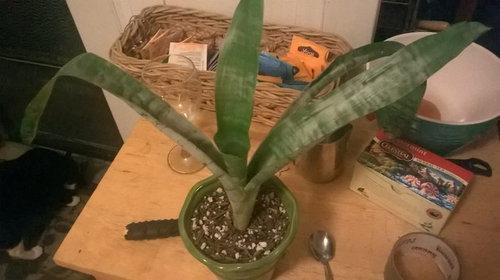

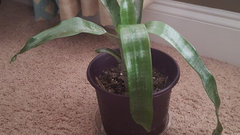
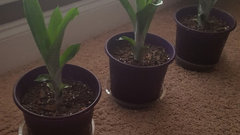
My friend gave me this bromeliad, and in another forum I was told its an Achmea. She had it growing in bright sun, so maybe that is why two of the leaves are a little sad? I have it in indirect light now. Will the leaves recover, should I cut them off, or just ignore it?

I would like to give it some fertilizer, I have a kelp based stuff I mix at 1/4 strength for hoyas, or I could do some fish emulsion. Any pointers there would be helpful too.

Comments (17)

  • 11 years ago

    Although it should be watered in the cup, some moisture in the soil is good. How dry is the soil? A bit of ferts would be fine.

    tj


  • 11 years ago
    last modified: 11 years ago

    Thanks, I had the soil really dry. It is a mix of about 50/50 perlite and potting mix, not the greatest draining pot but I put a couple inches of gravel in the bottom to help that. Gave it a little water in the soil and a spray with that kelp based stuff. I misted the leaves with it lightly too. This is probably Achmea fasciata hey? My first time with a brom, planning to add some cryptanthus and a guzmania to the party later on. And a tillandsia for every nook and cranny. I am going to get as bad with broms as i am with hoyas if I am not careful!

  • 11 years ago

    Hi everyone.

    Kim - I agree with tsugajunkie's comments above as your plant does look very dry. If left in a very dry mix like this it's possible the plant will become dehydrated. In their natural habitat these get water on their roots and also capture it in the central vase. Because they grow naturally on trees, the roots dry out quickly and that's why the potting mix needs to be well drained albeit still able to hold a little moisture.

    You say, "not the greatest draining pot"; by this do you meant that it has inadequate drainage holes? If so I would suggest you change the pot, as good drainage is vital to successfully grow bromeliads. If the drainage is inadequate the mix in the bottom of the pot will eventually turn to mud and the plant will die from water-logged roots.

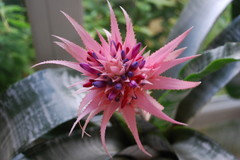
    I agree that your plant does look like Ae. fasciata, but there are also some Billbergias with similar markings on the leaves, however you will know for sure when it eventually flowers. The leaves that you describe as "a little sad" can be trimmed off as the dead portions will never green up again and they just detract from the overall appearance of the plant. When trimming leaves, don't just cut them straight across, try and copy the curved natural shape of the leaf tip and you'll be surprised how much better it will look.

    All the best, Nev.

  • 11 years ago

    Thank you Nev. I picked up some cactus/succulent soil mix today, would that do? I also have a mix of small orchid bark, perlite, and miracle grow rooting soil on hand. Would a terra cotta pot be sufficient? It is about all I have right now with drainage holes, might be able to dig up a plastic one the same size but those are slated for some Hoya cuttings I am rooting. And yes, no drain hole on that pot. How deeply can I plant this? It keeps falling over. I will trim the leaves back and start watering the soil more... Should I treat it like most of my house and just wait until the soil is dry on top and water? If you know hoyas, on a scale from Hoya Bella (doesn't like to completely dry out) to um, say a jade plant or sanseveria, how should I water the soil? And should I add this to my weekly misting rotation too?

  • 11 years ago

    A terra cotta pot would be fine. Most commercial cactus mixes are still pretty heavy, but if you mix it 50-50 with perlite it should be fine. Your plant looks to be planted at about the right height so if it is having a hard time standing up, the roots may have rotted from lack of drainage. Repot at the same height and support the plant with rocks or chopsticks or something similar. Once its repotted, I'd soak the whole pot in water just below the soil line (ease the water up slowly!) and let it soak for about 15 minutes. Take it out of the water, let it drain and fill the cup/central vase with water and put it in very strong indirect light for now, working it slowly up to stronger light. Fill the cup whenever it dries out or is nearly dry and let some water spill into the soil. Soak the whole pot only once every month or two. If it is an Ae. fasciata it will have what I consider one of the finest flowers of any plant I grow. I don't grow as many broms as I'd like, but I'm on my 5th or 6th generation of the Ae. fasciata I bought several years ago.

    tj

  • 11 years ago

    Hi everyone.

    Kim - Just to add a little more to what's already been said; Aechmea fasciata has been around for a long time and is one of the first bromeliads to be introduced into cultivation in 1826.

    It is still one of the biggest selling bromeliads worldwide, with thousands being sold annually, especially in the colder European countries where it is used in the home instead of cut flowers. It carries the common name of "Urn Plant", "Vase Plant" or "Silver Vase Plant" because of its ability to hold water in its centre.

    It is equally at home growing in a pot, on rocks or mounted in a tree and quickly makes up into a large attractive specimen. It does need good light to bring out the nice silvery colour of its foliage though.

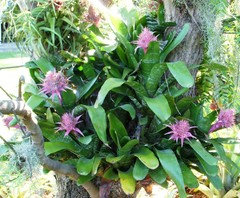
    The picture below shows a plant which started from a pup a few years ago mounted in the fork of a Peppercorn Tree in my back yard here in Australia. Although growing well, it doesn't have that nice silvery foliage due to the tree blocking much of the light.


    All the best, Nev.


  • 11 years ago
    last modified: 11 years ago

    I think it was tipping because the soil was way to dry. I repotted it as suggested, in terra cotta with 50/50 cactus soil and perlite, and trimmed off the droopiest leaf. The bent one is still there, but I will live with it for now. Thank you both for the information, with this being my first bromeliad I really appreciate it! I almost bought a clearance bromeliad (not sure which, foliage like a short guzmania, the flower bracts were sort of spade shaped), one already had three small pups forming, but think I should get the hang of this one before I buy more.

  • 11 years ago

    And Nev, you are making me want to move to Australia. If it wasn't for the 6 month quarantine period on dogs I just might. ;)

  • 11 years ago

    Hi everyone.

    Kim - Yes our quarantine laws do seem to be frustratingly strict, but when we stop to think what could happen to our wonderful often unique flora and fauna if some serious problem got into the country, it's easy to accept.

    All the best, Nev.

  • 11 years ago

    Oh, I fully agree!

  • 10 years ago

    Does anyone still monitor this site? I have questions about my bromeliad pups. HELP

  • 10 years ago

    Wonderful! I have 4 pups from my Bromeliad


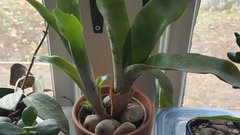
    (aechmea fasciata) this pup was from the first set in June. Are the leaves supposed to drop like this? I have water in the cup and water the soil when it is dry but know not to water too much. Is it just growing like this?

  • 10 years ago
    last modified: 10 years ago

    Yours looks healthy to me, but I honestly still feel like I have no idea what to do with mine. I have had developing leaves rot on the tips in the cup a few times, so I do not water the cup frequently. I actually do not give mine that much water, it does get misted frequently. I have mine here in a West window where it is protected, and periodically have some leaf droop. I can never really tell if mine is happy or not, but it did go off and clone itself. I didn't realize they would pup if they hadn't bloomed.

    edit- Just re-read everyones advice. Spotted a few things I have been missing, like the once a mo th soak and such. Think that explains a few things. I had forgottwn a lot of this very good advice, and overlooked my achmea in favor of my other plants. Still, doesn't seem to be doing all that bad!

  • 10 years ago

    Hi everyone, let me say
    firstly, I have no experience with growing bromeliad plants inside the house,
    so I can’t support the following suggestions with experience and for that
    reason they are just my own ideas of possible solutions.

    Shezzypie – It seems you are
    doing things right otherwise your plants wouldn’t be looking as good as they do.

    I’m not familiar with your
    growing conditions, but it seems to me by your pictures, you and Kim are probably both growing your plants inside; is this correct? If so, this could be the reason the leaves are a bit
    droopy. No matter how well you imitate the natural conditions, in my opinion, they
    aren’t as good as the benefit you get from natural external sunlight.

    An old
    nurseryman once told me, “there’s no such thing as an indoor plant”; he said
    there are plants that can be brought indoors, but to grow properly, they still
    need time outside in the natural elements to harden them up. Let me also hasten
    to add that he was talking about conditions in Australia on the east coast
    where I live.

    No matter where the plant is
    grown, usually long leaves (which will droop because of their length and weight) are a result
    of them reaching out looking for better, stronger light, but this doesn’t
    necessarily mean full sun as this could burn them in some climates. On the
    other hand, because Aechmea fasciata has been tissue cultured so many times,
    this may also just be a natural feature of this particular clone and will
    continue no matter where you grow it.

    Kim – The problem with your
    plant maybe a combination of water and cold; even though your plant is inside,
    often the temperature close to a window is much colder than the rest of the
    room as the cold can penetrate the glass, especially so in very cold weather.
    Just put a thermometer near your plant and see what the temperature is compared
    to other areas of the house, especially at night and the early hours of the
    morning. Do you have a curtain you pull across at night to help keep the cold
    out?

    Although the natural cycle is
    for brom’s to pup after flowering, they can pup before flowering as well. They
    will also pup if they are stressed in any way as this triggers the survival
    mechanism within the plant and because it thinks it’s going to die, it goes into reproduction
    mode to preserve the species.

    As I said previously, I’m not
    experienced in the area of indoor growing; so you are probably better off getting advice from
    people who are more experienced at growing plants inside, especially in your
    own area.

    All the best, Nev.

  • 10 years ago

    Thank you Nev and Kim. I live in Georgia and just brought my pups indoors as the temperature is dropping in the mid 40s at night. I have them sitting next to the window for now so they will get adequate sunlight which is what I did with the mother and moved her outside for Spring. Here are pics of my other 3 pups, I am excited to see these grow and produce their own pups. Thank you all for your feedback

  • 10 years ago

    Aaand that is pretty much what I was thinking too, it pupped because it tbought I was killing it. I do have a curtain, and soon will be sealing my windows for the winter months. That should help, but this started pupping in warm weather, so just not sure. My other plants are so much better at "telling" me what they need.

Sponsored