Software
Houzz Logo Print
h_nurmikko

Squash Vine Borers

11 years ago

This is my first year growing zucchini and therefore battling squash vine borers. They've managed to kill two of my zucchini plants. I've ripped them both out, but still have one that they damaged. The plant is still vibrant and green despite the damage to the main stem. Is it still salvageable or should I rip it out too? Also, I saw one flying around in the garden today and was wondering when they stop laying eggs for the year. I thought I read somewhere that they breed during a limited window and that some people plant out squash after this period to avoid them. Does anyone know the window in Oklahoma?

Is it too late to plant more zucchini and hope for a fall harvest?


Thanks in advance,

Heather

Comments (6)

  • 11 years ago

    Heather, if you're like the rest of us, it's futile unless you've got row covers. They are endless for me in Payne Co. I haven't planted because I'm moving, but I'm chipping and leveling the garden grade to get a mower over it. I continually find SVB larvae while digging.

    You can splice the stem, kill the larvae and it'll survive. I did that last year. Still, I had both bugs so bad they attacked my bottle gourd vines and Moschata Pumpkin. They, literally, destroyed all the leaves on the pumpkin vine but my variety is so tough it just grew new leaves on the same vines

    When it boils down to it, everyone ends up planting Moschata varieties or growing (tightly) under covers and hand pollinating.

    Wish I had better news.

    bon


  • 11 years ago

    Darn. I think I have my new most hated garden pest! I did try splicing the stem open and digging out the larva, but my winter squash still died. I guess I'll wait and see if the zucchini will survive the damage or need to be pulled.

  • 11 years ago

    Heather, We routinely have two generations of SVBS here in OK at a minimum and last year a forum member (Kfrinkle) who lives in Bryan County had them nonstop in very large numbers until late autumn, so we're thinking it was 3 or 4 generations there. I'm 2 counties west of kfrinkle and only had 2 generations, but 2 generations can cover a large portion of our growing season. My C. moschata type squash did produce until frost last year.

    I mostly grow C. moschata type squash, which are mostly winter squash varieties. The C. moschata types have dense, solid vine stems (other types of squash have hollow vines) that make it very difficult for SVB larva to tunnel through the vines and that is why they are so resistant to SVB-damage. There are a couple of varieties of summer squash that are C. moschata, although they are different from our usual idea of summer squash, which tend to be zucchini, yellow straightneck or crookneck squash, or pattypan squash, and are nicknamed avocado squash because they're roughly the size and shape of avocado fruit. The avocado squash I grow are Korean squash and their names are Early Bulam and Teot Bat Put. I got the seeds from Kitazawa Seeds, which has another C. moschata type summer squash that is shaped like zucchini and is called Meot Jaeng I Ae. It is on my list of new things to try next year.

    Y'all may see SVBs emerge slightly later since you're further north than those of us down here in southern OK. We normally see the first generation in June and the second generation in latest July or early August. Squash bugs down here can emerge in May and sometimes in latest April if the weather heats up fast and they're usually an earlier problem while SVBs are a later problem.

    Once the squash bugs and squash vine borers have found your garden, they'll be a problem almost every year. Once or twice a decade, my garden will make it through the whole year with no squash bugs or SVBs. The last time that happened was 2011.

    It has been a hard year for squash due to all the rainfall. A lot of my plants that set fruit still had trouble maturing it because the fruit kept getting infected with a fungal disease called choanephora fruit rot, aka wet rot. It is a common disease in wet years and not much of a problem in dry years. This year, our first six months of the year have given us around 48" of rain, so I totally understand why wet rot has been an issue.

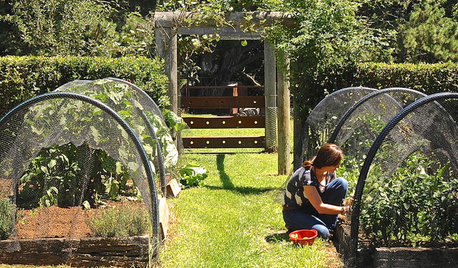
    If you don't have summerweight row cover, you can grow squash under any kind of mesh or netting with small holes that will exclude the pests and keep them off your plants. Some people use tulle placed over hoops to keep the netting suspended above the plants. You cannot let the tulle rest directly on top of the plants or the SVB moths will sit on top of the tulle and lay eggs directly through the holes of the tulle onto leaves that are touching the tulle.

    It is super easy to grow all kinds of winter and summer squash here. The seeds sprout quickly once the soil is warm and the plants grow and produce pretty quickly. Keeping the plants alive once all the pests show up is the real challenge. I was able to garden for 4 or 5 years before the SVBs finally found our place, and I was so disappointed when they showed up.


    Dawn

  • 11 years ago

    Yep, this year is looking to be almost as nasty as last year in terms of SVBs. They have been going here for a solid month. Thanks to Dawn's insight, I planted Early Bulam this year for my summer squash, and they have been awesome! The SVBs have managed to almost take one out, but the others are producing, and at a clip that I have 6 of the squash sitting in my fridge right now.
    Growing C.Moschata is really the only way to go. The Seminole winter squash was awesome for us last year, they store awesomely, and we were eating them until May of this year. I got a couple more c. moschata varieties this year and just planted them a couple of days ago. They should start producing in late September for me, but that is ok. I ended up with 4 volunteer Seminoles that are about 125 ft long in length when added all up right now.


  • 11 years ago

    I will never ever ever try yellow squash or pumpkin or anything this little jerks like to eat. At least i wont plant them with the intent of getting anything to eat. Only as a trap crop to keep the jerks off my cukes and melons. As cheap as squash is to buy and only needing a few pumpkins a year for decoration its just not worth giving up the space.


    What if we all could band together and not plant what they need to eat for say a couple years. You think we could exterminate them from the planet? LOL

    Mike

  • 11 years ago

    kfrikle, Oh, I am so glad that Early Bulam is working out well for you! I am about to plant it (tomorrow I hope) for fall, I had yellow straightneck for spring, planted extra-early to beat the first generation of SVBs and that worked out well. I was concerned that with your heavy infestation of SVBs last year, you'd have another horrible year this year.

    Now you see why I rave on and on every year about Seminole. I used to say "it won't die and you can't kill it", but I have had one plant die here or there, usually at the rate of about 1 per year, but I plant a lot of them so I don't even miss that one. So, technically, it will die....but not easily, and most C. moschatas are the same way. The more C. moschata types I grow, the more I like them. The fact that they store a long, long time is just the ice cream on the cake as far as I'm concerned. I don't mind doing a lot of canning, dehydrating and freezing (and some fermenting) of the harvest to store home-grown food for us to enjoy over a longer period of time, but the fact that with C. moschata, it stores itself, means that is just one less food harvest that I have to process for storage.

    In a rainy year Seminole will take over the whole garden, but I don't care. By the time the vines are rambling far and wide, everything else is fading away in the summer heat.

    Late production of Seminole fruit has never been a problem. I have picked them very green before the first hard freeze, and lined them up on tables in the garage, and they colored up over time and tasted perfectly fine when we finally got around to eating them months later. I've even missed some of them under the dense vines, had them endure multiple freezing nights (I found some in December a couple of years ago--might have been in 2011--that I missed earlier) over a long period of time and they were fine too. Their rind is so dense that I think they can endure almost anything.

    Mike, For the first few years that we lived here, I could (and did) grow every kind of pumpkin and squash imaginable. I believe the SVBs didn't find us until we'd been here 7 or 8 years. I suspect no one who lived within a mile or so of us was growing pumpkins or squash, and there must not have been many native ones around, although we had the buffalo gourds growing wild on our property. I grew up to 30 varieties per year because I knew that once the SVBs found us, I'd have to switch over to C. moschata, and there's not nearly as many of them as there are C. pepo and C. maxima types. It was fun while it lasted, but I knew it wouldn't last forever. Sometimes I can grow any of the Cushaws (green, orange, white, etc.) and they survive the SVBs too. I don't know why, but I'm glad it happens.

    Every now and then I grow some normal pumpkins---I like growing Knucklehead, for example, and One Too Many, but it is hard to beat the SVBs.

    In my dream garden, I'd have a medium-sized hoophouse (at least 15' wide by 30' long) covered with Proteknet's thrip netting, which I think would keep out the SVBs, and with the plants grown in raised beds lined with quarter-inch hardware cloth to keep the voles from eating the plants. It's never likely to happen, but that's the beauty of a dream garden---it isn't real.

    I don't care what we do....I don't think we'll ever eradicate them. There's too many wild squash type plants in various parts of the country that they could eat. It's a lovely dream, though.

    There's a reason the huge commercial fields where they grow pumpkins and winter squash (most of the canned pumpkin sold in this country is actually a C. moschata variety of winter squash) are not in the southern part of the country.

    I imagine there's systemic pesticides commercial growers can use, even in the south, to thwart the SVBs, but even if those types of pesticides were (and, for all I know, they may be) available to home gardeners, I still wouldn't use them.

    Dawn