Software
Houzz Logo Print
jdunwell

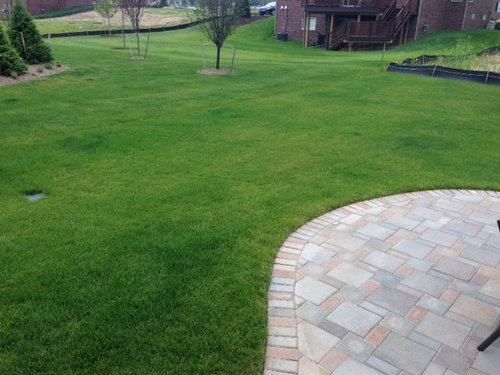
Light green grass

11 years ago
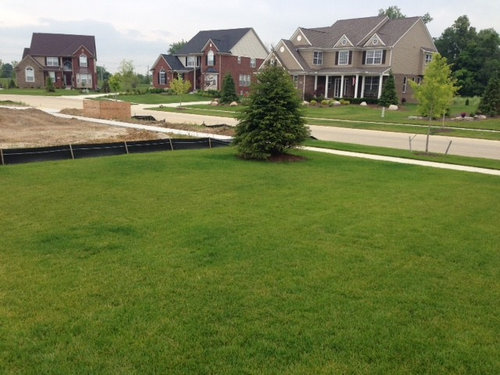
Hello All,
Just needing a little help determining how to green up my lawn (organically) to that nice, deep green we all love. I have a hunch, but want some outside opinions first.

Here's some back info...

-New lawn, sod laid last August; KBG blend of Rhythm, Julia, Midnight, and Moonshine
-Used Milorganite last year as the only fertilizer (2 applications)
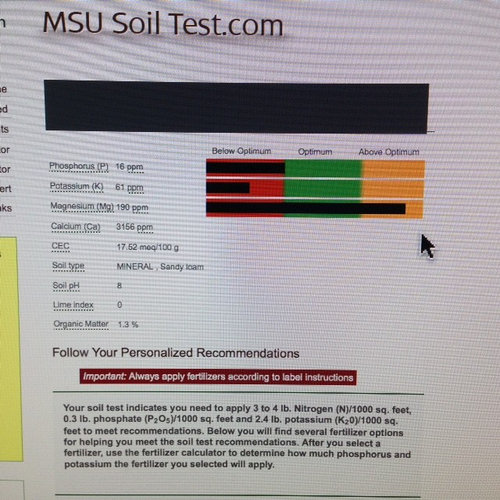
-Soil test seems decent (see pic), but very high in calcium and magnesium
-Soil test was done in areas of bare soil (no grass on top)
-Used Milorganite this spring, then last application (2 wks ago) was Nature Safe 10-2-8
-Applied Sulfate of Potash late May to correct Potassium deficiency
-Before I had researched this stuff, when the lawn was laid I accidentally over-soaked it and (I think) washed out a lot of nutrients.
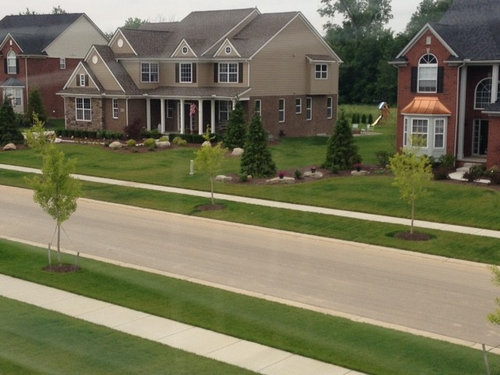
-Most of the neighbors' lawns look similar (light green with splotchy, dark, lush areas); none of them are doing organic
-I try to water deeply and infrequently, but it has rained quite a bit here this spring
-All the lawns were DEEP dark green when installed, so I hope there's still potential here

I really appreciate the help, and I've been loving reading all the posts on here!
Thanks everybody!
-JD


Comments (12)

  • 11 years ago
    last modified: 11 years ago

    One other point: KBG is a hungry turf. 3#/k of N annually at the minimum and 5# or slightly more with deep weekly watering for a lush green lawn.

    Depending on where you are and your climate, you should, at a minimum, be fertilizing late May, late August, early October and then a winterizer. The winterizer, if you are in an area that has a winter with temps consistently below freezing needs to be synthetic (straight urea--organic just wont work once temps fall and all research shows that the winterizer is the most important application of any.)

    jdunwell thanked User
  • 11 years ago

    Where in the world are you?

    At 1.3 percent the soil organic matter is way low and the soil pH (8.0) is high, turf grasses prefer a soil pH in the 6.2 to 6.8 range.

    The most bestest time to get the soil organic matter and soil pH near what turf gasses like is before the sod is laid. Trying to correct them now will take much longer.

    That deep green color of turf grasses many people like is artificial and arrived at by applying too much Nitrogen.

    Watering is important but keep in mind that with sandy loam soil and soil organic matter level so low the water will drain out of the soil very quickly and until the SOM is brought into the proper range (6 to 8 percent) the turf may need more than that 1 inch of water per week, depending on several factors including temperatures and wind.

    kimmq is kimmsr

    jdunwell thanked kimmq
  • 11 years ago

    Ok. I was thinking that it could be an iron issue. Also, what is the fastest (or best) way to get organic matter down?...compost? We have a local place that has great finished compost, but the thought of having to top dress by hand with wheelbarrows over my whole yard (>10,000 sq ft) is daunting.


    Will that Nature Safe 10-2-8 provide any significant OM?

    Would Greensand help with the iron issue?


  • 11 years ago

    Forgot to mention...I'm in Michigan, Border of Zone 5b-6a


  • 11 years ago

    Fast and easy? That does not compute. :) It really takes time. You need to build a good soil web and you don't want to overwhelm your lawn with more OM than it can process. Mulching and fertilizing with organic material is the easiest.


    jdunwell thanked User
  • 11 years ago

    While many think all chlorotic plants are the result of an iron deficiency that is not always true. The soil may well have adequate amounts of Iron but that soil pH of 8.0 could make that Iron not available and spraying a chelated Iron something probably will do little until the soil pH issue is addressed. Greensand will not do much for anything until the level of soil organic matter is brought up and an active Soil Food Web works on converting what is in the soil into the plant foods.

    With an established lawn the only way to build up soil organic matter levels is top dressing, either compost or other forms of vegetative waste. Unless you want to smother the existing grass that means several thin applications over some time, generally not more than 1/2 inch of material at any one time, if that.

    kimmq is kimmsr

    jdunwell thanked kimmq
  • 11 years ago

    First, google compost lawn spreader. then fugger out how to hook it to a lawn mower. Or a teenager.


    jdunwell thanked waynedanielson
  • 11 years ago

    I've been trying to come up with a way to answer you without torqing people off. Here goes nothing.


    New lawn, installed as sod. New construction, as evidenced by the pictures. Soil test results presented.


    Let's get back to the pictures. Two things stand out. One is the splotchiness of the yard and the other is the generally anemic color of the deciduous trees planted near the street.


    If you have the inclination, do another soil test, taking this sample from directly under one of the dark green spots. I'd bet the results are slightly different.


    I'm willing to support your notion of iron being low. technically, pH being high, which changes polyvalent minerals, of which iron is only one, into a form unavailable to plants. See the trees planted near the street? As far as I'm concerned, as far as the plants are concerned, you don't have enough iron. Or maybe it's manganese, or magnesium, or one of a few others, but those are the main three.


    your initial concern about having over watered and washed out some of the nutrients...not valid. Not in this context. Among other evidence...every yard in the neighborhood has the same appearance.


    Simple answers...iron and other micros are probably present, but not available to the plants, and when in doubt, turf likes N. How you choose to adjust is up to you, but I'd be checking in with your local garden center.

    jdunwell thanked waynedanielson
  • 11 years ago

    Soils in Michigan range from several types of clay to several types of sand so what was the soil type before the sod was laid Was something called "topsoil" put down before the sod?

    kimmq is kimmsr

  • 11 years ago

    No additional topsoil was put down--it was simply what was there before the development took place (open field, farmland). As the soil test says, it was "Mineral, Sandy Loam."


  • 11 years ago

    "Sandy loam" soils do not hold much of anything in the way of either moisture or nutrients until the soil organic matter is around 5 percent, which is why many "landscapers" will lay down 2 to 4 inches of something called "topsoil" before laying down the sod. Since that was not done here there is nothing in the soil (SOM is 1.3 percent) to hold either any moisture or nutrients. Until that SOM is brought up to around 5 percent, preferably 6 to 8 percent, you will see these types of problems.

    kimmq is kimmsr

    jdunwell thanked kimmq
Sponsored
Urban Upkeep LLC
Average rating: 5 out of 5 stars6 Reviews
Columbus High Quality Painting Expert