Software
Houzz Logo Print
missmandylee

Harmless spider or not?

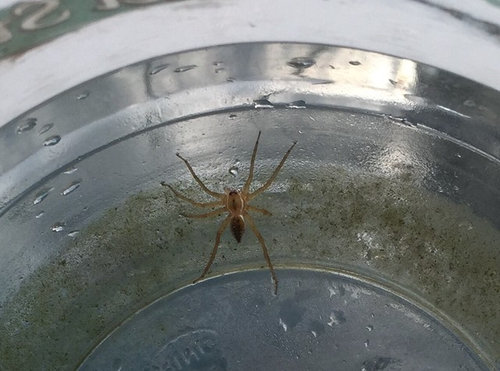
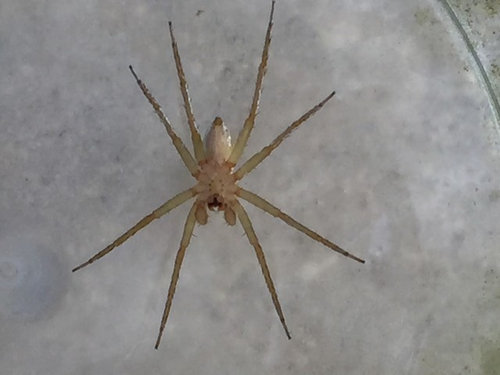
This leggy spider was crawling around the patio. A placed it into a container and taken some pictures. Can anyone identify this garden type spider?


Topside

Underneath


Comments (12)

  • 11 years ago

    Your location and the size of spider would be helpful.

  • 11 years ago

    I'm sorry that I have I omitted that information. The legs are approximately 1" long and have tiny darker spots on them. The abdomin is a darker color as well with a pointy bottom. i hope this helps.

  • 11 years ago

    Since we don't know what part of the world you're from, I hate to speculate. You might look up yellow sac spider just to see how it compares.


  • 11 years ago

    I live in central Florida zone 9. I'll check out what the yellow sac spider looks like. Thank you!

  • 11 years ago

    That looks like a brown recluse, called a "fiddle back" spider because it looks like a violin on top. The body of the violin shape is on the thorax and the neck of the violin is on the head. I can't enlarge the photo to look closely. If I get close enough to see it, I am too close. :)

  • 11 years ago

    Jonathan3, there is no "fiddle" on the carapace of this spider, just a thin, dark line. Loxosceles reclusa does NOT have any markings or patterns on its abdomen at all, as this spider clearly does, nor does it have that pointed shape to the abdomen. Loxosceles also has a very different eye configuration from Dolomedes, with only six eyes arranged in three pairs in what vaguely resembles a skull. This spider has the typical Dolomedes eye configuration of eight eyes arranged in a row. I'm not sure what you mean by "if I get close enough to see it, I'm too close", though. Is that a reference to fear of looking a photo, or belief that the actual spider would attack if you got close enough to see it clearly? Brown Recluse are called "Recluse" for a reason: they are shy, retiring, secretive and non-confrontational animals. They do NOT attack anyone. Bites only occur when someone presses the spider against their skin, as when someone puts their foot into a shoe in which a spider has taken refuse or accidentally grabs one that has made its home in a stack of old books, while attempting to pick up the stack of books. The spiders do not seek out people to bite at all.

    missmandylee Chirafisi thanked Sharon McKenzie
  • 11 years ago

    Jonathan needs to adjust his Mr. Magoo glasses, lol.

  • 11 years ago

    That wasn't very kind rhizo... :) Several people I know have had terrible spider bites, and yes, a few of them woke up with the awful bites that needed to be treated. Thanks for the information Sharon McKenzie.

  • 11 years ago
    last modified: 11 years ago

    Jonathan3, I believe you need to learn a bit more about these so-called "spider bites", especially the "I woke up with a horrible spider bite" kind. The overwhelming majority of skin lesions "diagnosed" as "spider bites" AREN'T. There was never a spider even involved at all. "Spider bite" has unfortunately become medical jargon for "I have no clue what's really wrong with you or how to treat it so I'm going to blame a spider". Doctors are not arachnologists, for the most part, and are no better able to identify a spider than your average fourth grader. The bad thing is, that many of these so-called "spider bites" are in fact serious infections caused by MRSA(Methicillin-resistant Staphylococcus aureus) which is contagious, "bulls-eye" lesions caused by Lyme Disease, severe fungal infections and even Melanoma skin cancer, which is going unrecognized because doctors are too willing to put the blame on a spider, especially Loxosceles reclusa, even in areas which have never had any populations of that species. The ONLY way to definitively diagnose a spider bite is to actually see the spider in the act of biting you AND to have it properly identified by someone qualified to do so! Most doctors, as I've already pointed out, AREN'T qualified to ID spiders, anymore so than any other segment of the populace. In the US, the only spider which has even been documented and proven as being able to cause severe skin lesions(which are still very rare) is the Brown Recluse and even THEIR venom takes several days to really take effect, so it is not possible to go to bed with healthy skin and wake up the next morning with an "awful bite" from such a spider. That sudden onset of a skin lesion is highly indicative and typical of a MRSA infection, however, or a bite from something other than a spider. One medical doctor who is also an arachnologist is Dr. Richard Vetter, who has written numerous scientific articles on the very widespread and dangerous practice of doctors labeling so many skin lesions as "spider bites", thus not treating the actual cause until irreparable damage is done. I strongly recommend that you give them a read, so I linked to a couple of them: Medical Myth: Spider Bites and Causes of Necrotic Wounds Other Than Brown Recluse Spider Bites

  • 11 years ago

    The people I know were treated right away for the necrosis.

  • 11 years ago

    "Necrosis" takes awhile to set in. It's NOT instantaneous following a bite from any spider. By the time that the tissue starts to actually die, many hours and probably several days have passed. Most Brown Recluse bites never become necrotic; that is a rare percentage that do. Unless the people you know actually caught the spider in the act of biting them and then had it positively ID'd by someone who knows spiders(which excludes 99.9% of medical doctors), there is absolutely NO WAY to prove that any necrotic lesion was due to a spider bite! MRSA is a leading cause of skin and tissue necrosis and unlike spider venom, it can really happen very quickly. That bacteria is already on your skin, and it's just waiting for conditions to be optimum to take off-a small break in the skin(doesn't even have to be near where the lesion breaks out since the bacteria can travel via the bloodstream), a weakened or stressed immune system, and you've got yourself a life-threatening situation before you know it. I've been through this before, and it had nothing to do with a spider. The infection, MRSA-related necrotizing faciaiitis, nearly cost me a limb, and resulted from the bacteria having gotten into my bloodstream through a puncture wound sustained in a fall in a wooded area, resulting in a stick impaling my leg below the knee. That injury took place months before the infection, so it would have been easy to simply say, "oh, I think I might have been bitten by a spider", and the doctor would not have questioned it had she not known about the previous injury.

Sponsored
AIS Renovations
Average rating: 4.5 out of 5 stars15 Reviews
Custom Craftsmanship & Construction Solutions in Franklin County, Ohio
More Discussions