Software
Houzz Logo Print
madtownwriter

Tree Planting: So Many Hardpan Questions

11 years ago
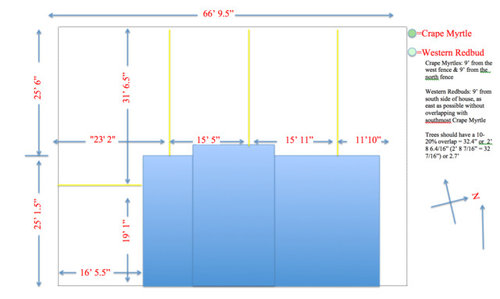
Hello, All,

So I'm nearly three years into owning my first house, and I'm finally trying to plan what to do with my back yard in terms of tree planting. Currently, there's nothing back there, just dirt and whatever weeds have sprouted since last I weeded, about three weeks ago. Here's a pretty accurate idea, made in MS Word, of the dimensions of my yard. The back of the house roughly faces west, and the yellow lines are drawn out from the center of 5' windows, which I hope to shade with trees as best I can.

I think that I've got how to plant the trees pretty well sorted out. There are a ton of guides, and, with minor differences, they seem to all share basically the same steps taken in the same order. I've also got the trees picked out; after having combed through many different online guides and sites that have to do with water-smart tree planting, I've settled on crape myrtles for the west side and western redbuds for the south. I've also already talked with USA North 811, and I'm cleared to start digging.

And that's the extent of my confidence. What I can't figure out is what, if anything, I should do about hardpan. None of the tree planting guides that I looked at mentioned even being concerned about hardpan. However, some of the guys that I pal around with, either teachers (like me) or school administrators who have planted trees, all mention having to break through the hardpan in order for the trees to thrive. Nearly all of them have made mention of using an auger. I wonder if they're just passing down outdated//discredited ideas to me as they were passed down to them.

I went through GardenWeb's tree forum pretty thoroughly (for hours and hours), and there's not much mention of hardpan in relation to trees at all. I do find some conflicting info online. Sunset magazine says "when planting new shrubs or trees, punch a hole through the bottom of the planting hole." This University of California pdf says that one should work the soil "three to six feet" in preparation for tree planting. But then there's this University of Arizona Cooperative Extension page that says that "the root ball should be set on undisturbed soil." I've read many versions of the idea that the soil under a root ball should be firm/"undisturbed" so that the tree doesn't drop down into the sol as the earth under it resettles. Does that settle it for not worrying about hardpan that isn't going to be dug out when I dig the planting holes at 2-3 times the width of the root ball and so that the top of the root ball isn't buried?

I'm trying to get all of this planned/scheduled out before the school year starts so that I can get as much done/sorted out now.

Any and all help will be greatly appreciated.

Thanks,


Madtownwriter

Comments (19)

  • 11 years ago

    Hello madtownwriter,

    First off, you might be able to do some prep work now but the next good planting season is October. Things can live if you plant mid summer but the odds are less favorable.

    Second, where are you? I am guessing someplace warm in California?

    Crepe myrtle dies back to the ground for me when temps get around 5f during the winter. They come back with a vengance and I own two.

    Your hardpan I am not familiar with. Here folks complain about the clay. Your instructions tondig the hole wide seem spot on.

    Whatever I plant needs supplemental watering the 1st year. Here we have to build levees to control our general surplus of water. Plus idiots insist on welfare levees for developers and those rezoning natural farmland but that is another story sorry. What is your water situation? I don't want ya paying $,$$$ a month to water willows and redwoods.

  • 11 years ago

    Toronado,

    Thanks for the kind response. I am only looking to put the plan together right now and not get to work until the fall, when, as you say, planting is more favorable. I'm in Firebaugh, CA, where it's quite hot and dry in the summer. We're also under some pretty stringent water restrictions; even if we weren't, though, I'd be planting drought tolerant trees, as they fit in the best with my views about conservation. The hardpan in my yard seems to be not too far from the surface, as a shovel doesn't go very far, and my 30-inch long 1.75" planting auger seems to be hitting something about 5.5" down below the surface.

    Thanks again,

    Madtownwriter


  • 11 years ago

    even if we weren't, though, I'd be planting drought tolerant trees

    ==>>> no recent transplant is drought tolerant.. until it is considered fully established ...

    i suggest you go with very small BARE ROOT trees ... so that a young one.. can take care of most of the problems you note ... we have all seen trees growing in cement cracks.. and the side of mountains ... no one planted those .. they made do ...

    doing this avoids the whole rootball issue ....

    its when we go for instant gratification .. and plant big.. that WE screw up the variables ...

    i highly recommend you call your COUNTY extension office.. as the local peeps might best know your alternatives ...

    i did that once.. and asked for a referral to the state forester.. who rides a circuit.. and it took some weeks or months.. but eventually he came by to discuss whatever i needed to know ...

    i dont think any of us favor using an auger to plant ... but its a great tool for finding out whats down there ...

    what is the native soil above the hard pan?

    ken


  • 11 years ago

    The question seems to be whether or not the hardpan is a solid sheet, or if it has cracks. If it is cracked, then water can drain through those cracks, and the tree roots can find them and grow through. If it's solid, then the trees will struggle until somehow, somewhere, cracks develop. So years ago, I read that tree planting in caliche (a specific type of hardpan) tended to involve dynamite. This wasn't necessarily to blow up a hole, but to crack the caliche enough that the tree roots weren't confined to a bowl atop the caliche.

    Just because you are hitting something with a shovel doesn't mean it is a solid layer. In my yard, outside of the prepared garden beds you can't even use a shovel because of the rocks. So probing for a solid layer of anything isn't going to work. However, if the locals talk about a hardpan layer, they are probably right.

  • 11 years ago

    This hardpan is something I am not familiar with. In some locations here there is rock under a bit of soil. I am imagining similar?

  • 11 years ago

    Hardpan usually refers to a layer of nearly water impervious soil beneath the topsoil. Farmland that has been repeatedly plowed to the same depth, particularly with an old fashioned moldboard plow, develops this layer over time. It was/is a major problem in much of the Great Plains and is certainly possible to find it in California when one-time farms are developed into housing areas. Other hardpans can result from naturally occuring mineral and soil deposits. There are a number of long-term strategies for breaking up hardpan, many involving planting and sometimes plowing under grasses with deeply penetrating roots. The USDA has or at least used to have several publications dealing with the subject. Ken Adrian's advice about consulting your County Extension Service is excellent. There's no better source for information that applies to a specific location.

  • 11 years ago
    last modified: 11 years ago

    Ken,

    Thanks for the help. Understood about trees only becoming drought tolerant after they've been established; taking the long view that the water I use to establish them will be used toward the long-term environmental benefit because those trees will require less water in the years to come.

    MadtownWriter

  • 11 years ago

    mad_gallica,

    Thanks for the advice. I was out there yesterday and today with a spading fork, working on making some test holes. It was pretty brutal, but I got down about fifteen inches, encountering hardpan from the surface and all the way down to the bottom of the holes, which were about three feet wide. There were a few spots where the digging was easier, and some of the the holes were less resistant to penetration by the spading fork. The dirt mostly came up in big flat chunks, but a lot of them broke up semi-easily when I shoveled them out. Some chunks I threw into the air about ten feet, and they landed almost intact. I did find some fine, dead roots running through some of the hardpan chunks pretty far down in some of the holes, which leads me to suspect that 1) my new house is on old farmland 2) tree roots might be able to get through there.

    Here's hoping,

    MadtownWriter

  • 11 years ago

    totonado3800,

    Hardpan is just really dense soil. It can be naturally occurring (through different interactions between stuff in the soil), or man-made (from farming and other stuff). It prevents root growth and the movement of water through the soil.

    MadtownWriter

  • 11 years ago

    akamainegrower,

    In my case, my soil used to be farmland, so that's part of the problem. I also used the U.S. Dept of Ag Web Soil Survey page to see what type of soil is naturally occurring on my property. 100% of my soil is Wekoda clay. Here are the specs:

    Map Unit Composition

    • Wekoda, clay, partially drained, and similar soils: 85 percent
    • Minor components: 15 percent

    Typical profile

    • Ap - 0 to 7 inches: clay
    • A - 7 to 12 inches: clay
    • Bss - 12 to 22 inches: clay
    • Bkyg - 22 to 35 inches: clay
    • Bky - 35 to 47 inches: clay
    • Bk - 47 to 60 inches: clay

    Properties and qualities

    • Depth to restrictive feature: More than 80 inches
    • Natural drainage class: Poorly drained
    • Runoff class: High
    • Capacity of the most limiting layer to transmit water (Ksat): Low to moderately low (0.00 to 0.06 in/hr)
    • Depth to water table: About 18 to 30 inches

    MadtownWriter

  • 11 years ago

    Another benefit to planting small, get a tree in a gallon sized pot and a 15 inch hole is maybe too deep!

  • 11 years ago

    I've only read your first post so far, madtownwriter, so my opinion will only cover that.

    Not everyone will have to contend with a hard pan. (Are you meaning a hard pan due to machinery having driven over it? When a rotary hoe is brought in, as many are fond of doing, it crumbles the top layer and leaves a hard pan beneath that layer. This is not good at all.)

    So, where there is no hard pan, I agree with the link that says not to disturb the soil in the bottom of the hole.

    Info is often contradictory because so much depends on what is going on in the mind of the writer/talker, their imaginations running riot.

    Would you be keen on getting someone in to rip the area? This is a long, single thing that makes its way from the soil, rather deep, leaving a rather choppy mess I suppose behind it, but breaking a hard pan. Maybe it would be something that you'd rather not do as any neatness would be ruined. And you would have to fork over the entire area perhaps, afterwards, before planting. I've never had it done. I think the trees would love it though, when they find themselves in a garden which was ripped, then dug by hand, and lovingly planted.


    (Oh and you would have to know where things were underground. You don't want pipes and wires and other frightening stuff making an appearance.)


  • 11 years ago

    A lot of vineyards are ripped prior to planting. The main benefit is more moisture is available to the plants if there is a shallow hardpan.
    Wish I had my place ripped after I bulldozed the final contours.
    Mike


  • 11 years ago

    tete_a_tete,

    Thanks for the response. After I called the 811 number and all interested parties (the utilities and the city, essentially) either email or call, it turns out that there's not anything in my back yard (there's a bunch of stuff in my front yard), so I could theoretically do anything back there. But I just want holes for five trees (maybe six), and it's be quite difficult to get anything sizable into my back yard. In the toughest test hole that I made using the spading fork, it took a little less than an hour to make a hole of 3' diameter and 15" depth, so I think that that's what I'll do for the actual planting holes come fall. I enjoy hard work, so maybe it'll be fun?

    Hope so,

    MadtownWriter

  • 11 years ago

    miketann,

    I grew up around vineyards/agriculture, so I've seen the process of ripping agricultural fields. And I lived in Seattle for grad school, though I left in '98. Go, Huskies!

    MadtownWriter

  • 11 years ago

    I had the feeling that you enjoy hard work, MadtownWriter. I could almost see you rubbing your hands with glee when I wrote that you would have to fork over your entire garden.

    I think it's a grand idea to dig very wide holes by hand. And as Ken said, with all those dots of his, bare-rooted trees are great things which unfortunately these days seem to be forgotten or ignored. So many people want trees that are 10' tall in pots. POTS! I can't stand it. I say to anyone who will listen, "No tree should ever be put into a pot."

    Winter time of course is the time to grab bare-rooted trees though. You still have to make sure that the roots don't dry out. The main ten advantages of bare-rooted trees is that: the roots are in a natural-ish position; there is no foreign soil with which to contend, they are cheaper, and much much much much much much much better.

  • 4 years ago

    When you have hardpan..however it is created you better get through it. Dig a hole and fill with water. If it hasn't drained over night..get out the digging bar! You have to create drain holes. Where I used to live we had a big auger attached to the tractor and would punch holes thru..otherwise it is a long tedious job getting thru. I'm encountering the same problem here..but auger or tractor are no longer here.

    I'm going to try a big drill and then have heard pouring a pt. bottle of hydrogen peroxide in the hole works? Doing to try that first. Otherwise using a digging bar will be a long haul. But it can be done. I get my husband to do it! LOL

    I've planted a couple hundred trees and you have to have good drainage however you get it no matter what size tree you plant.

  • 4 years ago

    Dynamite!!! There ya go!! LOL Quick and easy!!