

Mealybugs on Phal - Repot asap or after blooms fall?
I bought a phalaenopsis in bloom about 2.5 months ago to keep in my office at work. It's about 3 years old with two main spikes that each branch twice.
About a five weeks later, and after being away a week, I noticed it had mealybugs. Right away I spot treated the areas I could see with alcohol and a cotton swab. The next day I sprayed it with a Bayer neem oil to make sure I got in all the crevices, then swabbed out between the leaves and wiped off any dried residue later. I sanitized the clips. I followed up and did it again a week later when I saw a couple more, which I expected from their life cycle. Then over the next couple days I poked and prodded and looked from what I thought was every angle. I did some more research, because I am new to orchids. I thought maybe I was in the clear for a while. If not, I knew I would have to take more drastic measures.
Then this morning I came in after the weekend off and found 3 blooms had drooped and a couple visible crawlers. I had lost one here and there, but I had also gotten two to bloom. Time to get serious. I unbent a paperclip to use to individually removed adults and wipe them on a paper towel. While going about it this way I found that they were hiding up under the anther of 6 of the remaining blooms. No wonder the spray hadn't been completely effective! (Surprisingly I haven't found any information related to this in my web searches) I twisted up a tissue dipped in the neem and was able to get inside and follow up with my paperclip tool to remove them. I kept going back every half hour or so to check under there and between the sepals/petals to make sure I got all the crawlers.
So after all that my question is: I know I'm going to have to replace the potting material. Can I wait until the rest of the blooms fade or am I putting the plant at risk to further damage? It's only July here on the east coast of the US, so should I also prune now or can I wait to see if it will produce more blooms? I can see potential for buds at the end of the current spikes and a possible new branch from a dormant bud on the base of a spike.
Comments (11)

heather1023
Original Author11 years agoThanks for the advice Bill. As you probably could have guessed I'm a bit new to orchid care, but I like to do my research. I've always been intrigued by orchids and of course the advice indicated that the best place to start is with a phal and from a grower if possible. My goal would be a Cherry Black Lady's Slipper (lady slippers in general fascinate me), but first I want to be able to keep the "easy" one alive and get it to rebloom.
The Phalaenopsis I have is a 'Taida Sunflower Boy "Taida Apollo"'. I bought it from a grower that comes to my local farmers market. One of the photos is from about a week after I got it, and all the blooms are open.

The other is from a week ago.
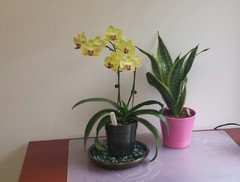
I can show the current condition and more of the branching when I'm back in the office.
The grower is local and goes to area shows according to her website. She was able to tell me quite a bit about all of her plants. I told her about where I was planning on putting it, the conditions, West window, etc, and she agreed that a phal would be good. I was drawn to the bright green flowers with dark pink centers. She said the specimens she had there were 3 years old. I was very nervous about taking a more mature plant. It's like accepting someone's toddler! She pointed out that it would have a more established root system and better chance of survival. All was going well, and now I somehow gave her kid lice.
As I mentioned in my first post, things look OK right now. For now. Hopefully the early intervention helped. But if they show up again I'm perfectly happy to increase the fire power. I just hoped things stay clear a few more weeks for me to enjoy the flowers a little longer before I unpack, inspect, give, the roots a nice insecticide bath, and repack.
Related Professionals
Westminster Landscape Architects & Landscape Designers · Myrtle Beach Landscape Architects & Landscape Designers · Lafayette Landscape Architects & Landscape Designers · Webster Landscape Architects & Landscape Designers · Cornwall Landscape Architects & Landscape Designers · Portland Landscape Contractors · Mankato Landscape Contractors · Providence Landscape Contractors · Kennewick Landscape Contractors · Athens General Contractors · California General Contractors · Fayetteville General Contractors · Worcester General Contractors · San Bernardino General Contractors · Yuba City General Contractors 11 years ago
Its a beautiful Phal. As Bill said, you are in a pickle. You could spray the plant with a natural insecticide such as Bayers Natria Disease and Insect Control. But you would have to do the spraying outside. I wouldn't spray the flower buds but you could spray the spikes. The crawlers will get hit with it on the spikes. You might lose the buds so you could avoid apraying the buds.
Spray the leaves well till runoff. Keep it in a shady spot until it dries and then you can bring it inside.
I also use a Bayer product which is systemic. Its granular and works by going up the roots to the leaves and will kill mites and sucking insects. Problem is it takes months to see the results.
I am battling thrips and scale on many of my orchids and use the spray as a quick knock-down and sprinkle the granular to continue working over the next few months.
If you could bring the plant home to treat it you'd probably have a easier result because you could do it outside. I have used the granular, Bayer, 'Rose & Flower Care'. 2 in 1 Systemic. I believe both the spray and granular work for two months. I would recommend using the spray every two weeks to get the newly hatched.
You have to be strict about applying the spray or the problem will continue.I have had good luck with both products.
Good luck,
Jane
 11 years ago
Another thought just hit me......Strange things do occur around here occasionally!......Check around the office......Anyone else growing plants (of any kind) close to your orchid? If so, be nosey, and give those other plants a close going over for your little varmints. You may be killing off someone else's supply of bugs.
Bill
heather1023
Original Author11 years agoJane, my office is on the first floor and near an open area, so I have been able to take it outside to spray it with the Bayer Natria Neem Oil. If I see the wee white fuzzy beasties again soon I will bring it home to treat with something stronger. By then I'll probably be about done with the remaining buds and could treat the roots and repot too.
Bill, I had considered that! I keep a Snakes Tongue on the same filing cabinet. It's been there longer than my orchid, but I did repot it this spring. I didn't see anything crawling about, but I treated it with the Neem for good measure anyway. No other plants are nearby and I keep a separate container for watering mine.
Here are a few pics from this morning. No further bloom drooping since my targeted, and slightly satisfying, paperclip lancing efforts the other day.
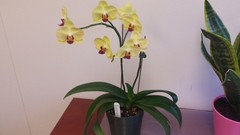
Branching
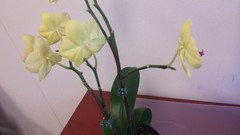
Node pushing up
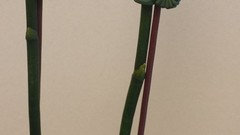
- 11 years ago
Heather, Here's the dilemma we get into. you say the flowers are "bright green with pink centers". The photo shows yellow flowers with dark "pink" lips. (centers) I am concerned about the amount of light the plant is getting, because I see photos of lush green leaves. My limited knowledge of photography tells me that if the blooms are indeed green, then on the web the color has been shifted to yellow, and that means that the real color of the leaves has been altered also. So, I wonder if I can really say that the plant needs a bit more light??
Your west window is ok. Recommended in order are south, east, west, and north.
The plant looks really ok....healthy, although M A Y B E a bit lacking in light.
If the bugs prove to have lost this war...not just the battle.....that will be great. You M A Y want to adjust your growing conditions a bit in the future.
If your friends come back, then I let me repeat that - I - would unpot the thing blooms and all, soak as much of the plant as possible in a contact insecticide and repot it. After it has had a chance to settle into the new home and heal the damaged roots, I would follow up with more contact insecticide plus begin a systemic routine for several rounds, then wait and see. That would be my approach if it were my plant.....I'm not recommending that, nor saying that is the only way to attack this problem. Like I said, I'm a "Kill em dead right now" kind of person, and don't have a great deal of faith in some of these other methods out there that require one to do a hunt and kill routine. I learned in a large commercial greenhouse environment, and sometimes radical treatment was necessary to save many $$$$$$$. We usually began with the radical treatment for that reason.
Good luck
Bill
heather1023
Original Author11 years agoYeah, sad cellphone camera and bad fluorescent lighting. I could play around with my bazillion Instagram filters to make it look a bit more like it does in real life. The leaves are more of a Pantone 363 than the glossy evergreen they appear. That new leaf in the middle is a bit brighter at its center still. Kind of like the 'Submit' button.
And no, not a graphic designer. Environmental scientist. Differentiating colors comes from reading Munsell soil books.
heather1023
Original Author11 years agoFollow up: I repotted the Taida Phal last night. Boy was I pissed when I got it out of the medium. It was 2 inches of soil and a ball of sphagnum. NOT what I was told. Very glad I practiced on a couple $1 clearance shelf phals about a week ago.
Yup, there were still some itty bitty crawlers inside the root crown when I got in there. Should have gone in fast and hard as Bill suggested. Lesson learned. Copious root rot down the middle from all the sphag and mealybug damage. The bottom most leaf had started to yellow several days ago (which seemed fairly normal for the cycle and expected) so I removed that easily, but then the next one up had mush around the base so I ended up removing it as well. Ended up removing in total about 1/4 or 1/3 of the roots. My kitchen table looked like some kind of plant horror movie between the garbage bag, sharp instruments, alcohol spray, and and excised plant parts.
I did not cut the spikes. Partly because I was afraid to traumatize the plant any further and partly because I still hadn't decided exactly where to yet.
I sort of formulated the potting medium based on things I read, knowing how much I would water, and what was available at Lowes. Tried it out on the little phals first, and they seem happy so far. About 1/2 of a fir bark/charcoal/perlite mix (Better-Grow Organic Orchid Mix), 1/4 Peat moss, 1/4 moistened sphagnum. Sterilized the pot, clips, stakes, and even the label before repotting. Then watered with some food and applied the Bonide systemic to prevent a repeat occurrence. I'm also keeping it quarantined for a couple months.
So how did I do?
- 11 years ago
Keep it in a shady location with good air circulation and do NOT water it for at least a week. let it get bone dry and stay that way several days before watering. You can mist the leaves lightly, but no root watering.
If you have not already read my other posts, the reason for this is to allow the roots to heal, callus over, and the plant to get really thirsty. Thirsty plants give roots instructions to go find water which encourages root growth. The drying may also give your battle of the bugs a boost.....few bugs like to live in dry places.
After the drying, put the plant back In its normal growing location and water as normal.
Bil
heather1023
Original Author11 years agoCrap, already watered it last night. Removed any sphag bits in the top few inches that would hold extra moisture and left it with the dry bark medium. I had left the base a bit exposed already because my gut told me I wanted to be able to keep an eye on it for a bit. Took away it's pebble tray.
But it just feels wrong! The EMT in me demands that I give my patient fluids! Lactated ringers, STAT!
Sigh, but I also know that it's better to learn from the experience of others than to learn the hard way myself.
- 11 years ago
I always soak bark for a day or two before repotting. New bark does not absorb water. I think, in your situation, I would soak the plant in the pot in a bucket of water for a few hours to hydrate the bark. I would not add peat moss to any orchid. Sphag is okay depending on your environment, but peat is a no, no.
Jane




Bill