

Clay soil
I just was on you tube.
I was watching Elaine Ingham on YouTube and she said the way to break up compacted areas of clay soil is with the fungal hyphae.
Comments (53)
 11 years agolast modified: 11 years ago
Sam, I googled Elaine Ingham, great lady!! An excerpt from Wikipedia: "
Ingham earned her PhD from the Colorado State University in 1981. Her doctorate is in Microbiology with an emphasis on soil. In 1986, Ingham moved to Oregon State University and joined the faculty in both Forest Science and Botany and Plant Pathology. She remained on faculty until 2001.
Ingham is also an Affiliate Professor of Sustainable Living at Maharishi University of Management in Fairfield, Iowa,[3] and was Program Chair of the Ecological Society of America from 1999 to 2000.[5][6]
She joined the Rodale Institute in 2011 as chief scientist and left in 2013.[4]
Ingham is the founder of Soil Foodweb Inc,[2] which works with soil testing laboratories to assess soil biology." Wikipedia.
User thanked strawchicago z5
User
Original Author11 years agoYes she can do a lot of good in the world if people would stop and listen.
Related Professionals
Rochester Landscape Architects & Landscape Designers · Omaha Landscape Architects & Landscape Designers · Colorado Springs Landscape Architects & Landscape Designers · Glenwood Springs Landscape Architects & Landscape Designers · Rapid City Landscape Architects & Landscape Designers · Charlotte Landscape Contractors · Amherst Landscape Contractors · Lima Landscape Contractors · Santa Fe Landscape Contractors · Elizabethtown Architects & Building Designers · Houma Architects & Building Designers · Vicksburg Architects & Building Designers · Lansing Architects & Building Designers · Hudson Architects & Building Designers · Liberal Architects & Building Designers- 11 years ago
Hi Sam: To benefit those who google on "how to fix clay soil": When people report leaves falling off, or leaves become yellowish and fall off, it's because of waterlogged & poor drainage clay. But when lowest leaves are yellowish & brownish but STAY on the bush, it's potassium deficiency. Symptoms of waterlogged clay: water don't sink in fast enough, but with continuous rain, it becomes waterlogged, then leaves turn yellowish, and fall off.
I moved 2 roses yesterday. When I first fixed the soil with organic matter (pine bark or alfalfa pellets), the holes were fluffy, and water soaked in fast. But after a year, organics broke down & glued up with clay, and when I watered, they didn't soak in, just flooded over. When I dug new holes, I learn to dig 1 foot deep, throw soils on 2 garbage-lids. Then dump 2-gallons of water in. If it doesn't drain in 5 minutes, I keep digging, and throwing out the sticky clay, until it drains fast enough.
The sticky clay at the bottom is what blocks the water from going down, resulting in yellowing of leaves or leaves falling off. I once bought a bunch of roses on sale from RU, I left them in plastic bags outside. It rained all-night & all-day, and when it stopped raining, those roses' leaves turned yellow, and fell off. Even the stems on Duchess de Rohan became yellow, I had to chop 1/2 off.
User
Original Author11 years agolast modified: 11 years agoThat sticky layer is possibly could be the owner before you, using artificial fertilizers for years. As seen in the Elaine Ingham video. The roots of your profit. There is soil compaction a few feet down. This is due to the loss of soil biology at the lower level. So it is important to reintroduce the bacteria and fungi.
There was one poster who said he was using artificial fertilizers for 35 years. Sure the plant roots can't go deep in his case so there will be constant problems for the plant to deal with stressors.
- 11 years agolast modified: 11 years ago
Our house was NEWLY BUILT on previous farmland (corn-field). My house is less than 12 years old, I'm the 1st owner. When they built the house, they scraped the topsoil OFF down to the bottom-sediment (dense & heavy clay) and rocks. That's to build the basement. Once it's done, they topped with 1 foot of heavy clay. Then they used a tractor to grade the slope AWAY from the house, to keep the basement dry. Grading the slope with a tractor created soil-compaction. I watched when they poured the top-soil, then graded with a tractor. That's the case with many NEWLY BUILT houses. When someone post a pic. of their sick roses, I always ask how old their house is. With older houses, less top soil is taken off.
Another cause of soil compaction is how high the pH of one's tap-water is. I notice that where I don't water, the soil is made fluffy with acidic rain (pH of rain is 5.6). But where I use my alkaline tap-water (pH over 8.6), the unstable calcium hydroxide in tap-water binds up and create solids with other nutrients, and harden the clay. The spots where I watered with tap, became hardened and compacted clay. That's why I installed 3 rain-barrels. Predfern, a rosarian in Chicago, with a Ph.D. in Physical Chemistry, e-mailed me researches on how calcium hydroxide added to tap water make concrete out of clay. Prolonged watering with tap-water like CA, create deficiencies in potassium (brown & yellowish lowest leaves), and phosphorus (roses don't bloom).
 11 years ago
Our house was built in the 1940's or 50's...lol... We put new siding on around 5 years ago... The people that lived here before us were all into Veg gardening. Almost the entire yard was a garden when we moved in here in 1995...
The location I have the most trouble with was not garden. A 25ft tree stood in that location with nothing planted under or around it... I took that tree down in the mid 2000's... That's our heaviest soft clay area... But its still very easy to dig in that location. But that area is just not as fertile as the rest of our property.
User
Original Author11 years agolast modified: 11 years agoIt is my opinion that when there is old tree roots it takes 10 years to get better. It's maybe better to do raised beds or build better soil some how.
- 11 years agolast modified: 11 years ago
Our house was built in the 1940's or 50's...lol... We put new siding on around 5 years ago... The people that lived here before us were all into Veg gardening. Almost the entire yard was a garden when we moved in here in 1995...
The location I have the most trouble with was not garden. A 25ft tree stood in that location with nothing planted under or around it... I took that tree down in the mid 2000's... That's our heaviest soft clay area... But its still very easy to dig in that location. But that area is just not as fertile as the rest of our property.
Heres what our house looked like under the old siding...: Looks like a shack...lol
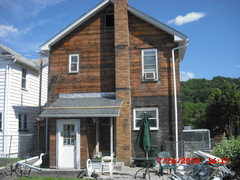
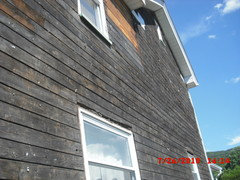
- 11 years ago
Love your house, Jim, it's so cozy !! I like your white door, very cheerful. A neighbor painted their door black before they moved. The next owner immediately painted it white, and I like that better. My heavy & compact & alkaline clay isn't bad .. very fertile. See pictures below of my backyard:
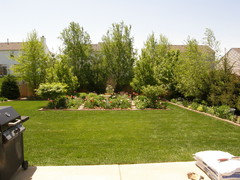
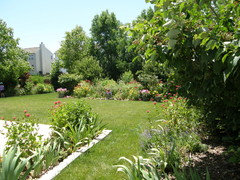
- 11 years agolast modified: 11 years ago
A few people asked me about raised bed for clay soil, I have 2 Suncast-resin-frame raised beds: one a foot tall, a second one 2 foot-tall ... both of these raised bed consumed $136 topsoil, and hard-breaking labor for me and hubby. He's a competitive marathon runner, yet his arms ached after hours shoveling dirt into raised bed.
I also have a 2 additional raised beds (bricked in) which consumed $150 worth of topsoil. My husband rented a sod-cutting machine to strip off the lawn. It was a super-heavy machine. That was before I knew about putting black-plastic mulch-film to solarize grass. My conclusion about raised bed: a real pain, it's easier just to dig deep, throw out icky soil, and put compost & organic fertilizers in the hole.
I re-post what I wrote to Jim regarding raised beds: " Raised beds are a real pain. I have 2 large raised beds, but I put that in an existing bed, bordered by black-plastic edging dug down to 4" to keep the grass out. But my 2 neighbors who made small wooden-raised beds, theirs are invaded by grass, since they don't have a frame below ground to keep the grass out. One neighbor trashed both of his wooden-raised-bed, since the grass grew inside, very messy.
I also have other bricked raised-beds. It took ungodly amount of dirt, like 30 bagged top soils per bed.Honestly raised-bed is NOT a good solution for cold-zone. I lost 10 roses in a raised bed, since they get dried out in the winter. The best solution is to rent a $20 auger (post-hole digger) and punch holes 3 feet deep into the ground in many places, so water can drain off. The roses which survived my zone 5a winter for many years, and which have zero blackspots, are the roses which I spent 1 hour digging, down to 3 feet below ground. When there's a rocky & sticky clay layer at the bottom, water can't drain off. Only when I dig past that sticky clay layer, fill in with pea pebble (for minerals and drainage) ... that's when roses are healthy, My most healthy rose is Christopher Marlow in a low land, I dug that up 4 times to fix the drainage, and filled the bottom with horse manure.
When one digs a hole, like 2 feet x 2 feet, if the water doesn't drain off completely in 10 minutes, roses won't be healthy. Raised bed DOES NOT solve black spots problem, it creates NEW PROBLEMS: harder to get rid of grass crawling under the raised bed, plus winter-killed by dryness and less insulated against the cold. My own-root Pink Peace black spotted badly in a raised bed, and died through the winter. I dug that spot DEEP, and removed the clay sediment that blocked the drainage. The best solution is to create drainage 3 feet below, rather than raised bed. " Below is a picture of my 1st Suncast-resin raised bed, a long one for roses, pre-filled with leaves for the bottom. After that we bought a second one, twice taller for tomatoes.
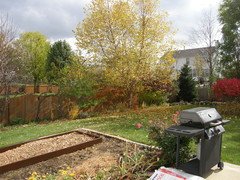
- 11 years agolast modified: 11 years ago
Love your pics Straw! My friend also gave a thumbs down to raised beds! I just never wanted to even try them... Yep they got the word pain written all over them...lol
I just took this pic today of how it looks now...Soon as I get the right roses here and everything appears stable I'll probably make a round rose bed in the middle of our lawn...
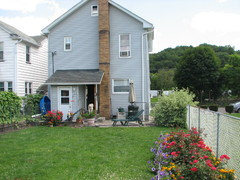
 11 years ago
Ahh, your house is very cute Jim, I do have yard envy of you and Straw.
We don't have issues with winter here (yet anyway, who knows about the weather) ... I like the idea of raised beds because less digging, having the root base at a better height to work on, how neat other people's raised beds look. Since I'm used to my roses in pots, I prefer working with them slightly raised. I dislike it when I volunteer at the rose garden and have to be so low to the ground to pull away mulch or prune or whatever other maintenance thing we are doing.
- 11 years ago
Jim's hedge of knockout is awesome ... I love how he mixed other colors in. Some pics. which I took today, July 23, in very hot & humid weather. The ones which got layers of horse manure on top are the healthiest. Stable uses lime to deodorize, and lime helps to buffer the acidity of rain. Works great here, funny how folks in other forums nit-picked on my using horse manure, making lime to be the bad guy. Dr. Earth Flower-girl fertilizer NPK 4-7-10 with kelp helped to deepen the color of Evelyn rose, it went from peachy to deeper pink:
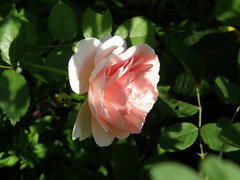
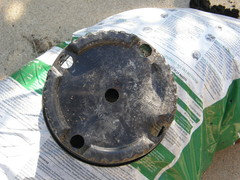
Holes in the pot of the Lavender Rose which I got for $6.59 at Meijers, that reminds to dig that many holes DEEP in my clay for good drainage.
Marie Pavie is 100% healthy in fun-sun, with the snapdragons that self-seed themselves year after year. I put high-potassium cocoa mulch and red-lava-rock. Pic, taken today July 23: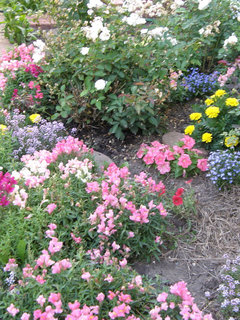
- 11 years ago
Radio Time is very clean in this humid, it's on its 4th year .. I spent 1 hour digging that hole for good drainage. Pic. taken today, July 23:
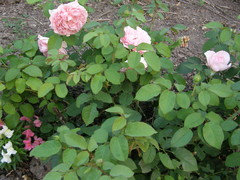
Pat Austin bloom is deepened with Dr. Good Earth-Flower-Girl with kelp, NPK 4-10-7:

Pat Austin bush & clean & glossy, pic. taken today July 23 ... hot & humid:
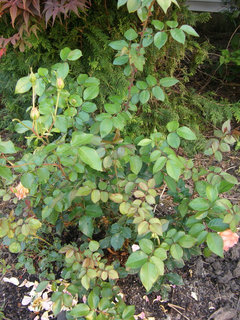
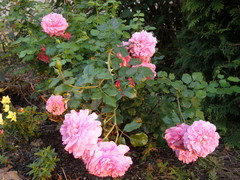
Christopher is all-over the ground, I should had given it more gypsum.
- 11 years ago
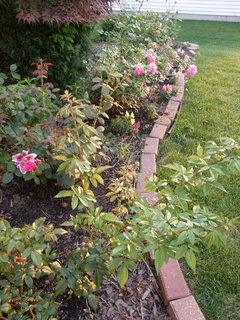
Front hedge of roses, pic. taken today July 23. The first one is Excellenz von Schubert, always clean with glossy foliage.
- 11 years agolast modified: 11 years ago
Isn't Marie Pavie one of those famous Texas Earthkind roses? I hope Azomite works Straw! Trees rob nutrients for sure...
Pat Austin does have a nice deep color!
All great pics Straw!
- 11 years agolast modified: 11 years ago
Yes, it's a Texas Earthkind, I never water that one, yet it's the healthiest in full-sun. Marie Pavie makes my garden smells wonderful, floating musk-scent, delicious !!
I moved 2 roses on July 22. When I first fixed the soil with organic matter (pine bark or alfalfa pellets), the holes were fluffy, and water soaked in fast. But after a year, organics broke down & glued up with clay, and when I watered, they didn't soak in, just flooded over. When I dug new holes, I learn to dig 1 foot deep, throw soils on 2 garbage-lids. Then dump 2-gallons of water in. If it doesn't drain in 5 minutes, I keep digging, and throwing out the sticky clay, until it drains fast enough.
The sticky clay at the bottom is what blocks the water from going down, resulting in yellowing of leaves or leaves falling off. I find that red-lava-rock or pea-gravel is best in the planting hole so their sharp edges can break up clay .. but NOT on top, since the sun heats that up. Organics is best on top, rather than in the planting hole. When I mulch with horse manure, alfalfa hay & organic fertilizer or compost ... I found tons of earthworm underneath. Horse manure & alfalfa hay have nutrients to nourish earthworms. Wood chips are less so, since they robs the soil of nitrogen .. tons of clover sprouting later, very messy. Plus I don't see much earthworms beneath woodchips.
- 11 years ago
How much pea gravel do you use Straw? Size of planting hole?
- 11 years agolast modified: 11 years ago
Jim: I'm testing Azomite to compare with pea-gravel in planting hole. My neighbor's roses with black-lava-rocks mulch look really bad in hot sun near 90 degree: no leaves, just blooms. But her other roses with pea-gravel AT THE BOTTOM OF planting hole are lush & lots of leaves. Meijers where I got my cheap lavender rose from: they have a bed with pea-gravel, and they sit those pots ON-TOP of pea gravels. The pot of rose I bought: roots were coming out of the holes in the bottom. That's much better than Menards, where they put pots on wooden-planks (clumsy), or sit against cement ground: water-logged and breaking out in black spots. I have zero luck in finding nutrients-value of pea-gravel, but I'm sure it has more nutrients than coarse sand. The bag of pea-gravel when wet, has this beige & grayish mud on ... that looks like gravel-dust used for re-mineralization.
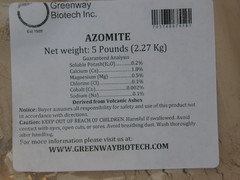
The Azomite dust I got is pinkish, really fine, dissolve great in water.
- 11 years ago
Wouldn't the pea gravel stay in the soil forever VS. Azomite which would disappear after awhile Straw?
- 11 years ago
I used to live in an area with dense black alkaline clay--called "gumbo" by the locals. It's initially challenging but with lots of organic amendment it makes a nutritious fluffy soil that you could grow anything in.
Our first year, we just dumped a little pile of gypsum on top of areas we wanted to stick a tomato or a shrub. It worked very well to soften that type of clay. Later, after 30+ years of dumping every leaf, every grass clipping & every tree trimming into the beds the dirt was wonderful.
Later, when a hurricane took down our fence, we found that our yard was a good 8"-12" higher than the neighboring field because of all the years of adding stuff.
Initially, in that type of clay, drainage was a problem.
It's similar here, where we're dealing with caliche--a dense calcium carbonate layer that's both below the ground & sometimes exposed on the surface. We
start digging (chopping, actually) a hole, putting any actual soil
aside. Then, it's a matter of pick axing out the caliche, a bit at a
time, soaking it in between to soften. We're finding it impossible to
actually dig through the caliche, so now we dig a wider hole (less
deep), repeatedly filling it with water. At first, the water will just
sit there, but at some point, when the hole is broad enough or whatever,
it will drain off properly. Then, we backfill with potting soil &
whatever little native soil we might have found on top.We berm up around the new planting & fill with mulch, etc., trying to add quality material yearly.
I like to expand the perimeter of the berms gradually to form beds
instead of just trees in holes. Then plant veggies, flowers, whatever.
After all, if you've got a tree planted in a nice hole full of good
soil, you're going to have to water it--why not use the edges for other
things like veggies or perennials? And I HATE mowing grass. We just
have clumps of native grass & weeds here--I'm working hard to
minimize how often I have to get in there & mow them. - 11 years agolast modified: 11 years ago
Thank you, Bluegirl, for sharing your experience with caliche clay in Texas. Great info !! I agree with you for clay soil: Dumping a 2-gallon bucket of water after creating a 2 feet wide x 1.5 feet deep is needed to see if there's a drainage problem. If the water doesn't drain immediately, then I keep digging, and throwing out the sub-soil below, until it drains all the water. Then I refill the bottom with pea-gravel.
When one waters from above, the lighter stuff (sand & organic matter) floats on top, and the heavy stuff (sticky clay) sinks to the bottom. I saw that when I mixed COARSE sand well with clay in a high-rain area. After a while, the sand floats on top, while clay sinks down. The logic of putting pea-gravel AT THE BOTTOM of the planting hole is to prevent heavy clay from sinking down and RE-CLOGGING the bottom again.
Jim: Good point. Pea-gravel below is for drainage. Azomite on top is to supply the trace elements. What's more effective? To supply minerals from above (Azomite), or to supply minerals from below (pea-gravel) ?? Time will tell. Forget to answer your question on how much pea-gravel to use. Whatever the amount of icky-sub-soil I dug out, I replace with the same amount of pea-gravel.
- 11 years ago
I got mixed up...lol... Azomite is for topdressing.... Gotch now!
User
Original Author11 years agoPerlite is also a great amendment to loosen and aerate clay. Perlite is great in any soil because of the great amount of water and air surface area for roots.
User
Original Author11 years agolast modified: 11 years agoI just wrote down azomite on my list.
What a great amendment to make all the nutrients to any plant to make it healthy.
Great tip that anybody should know straw Thanks
- 11 years ago
Since I know very little about planting in the ground, I have very little to add to this conversation except beautiful new pictures of your plants Straw! I do want to see what will affect color in my roses so I have molasses now, will water that in on Thursday to see what it will affect. Then the next flush, I'll probably have some Azomite to try.
- 11 years agolast modified: 11 years ago
Hi Msgirl: You enhance all threads with your graciousness and kind words, thanks. Azomite works faster than dolomitic lime, but less of drastic pH increase (pH of Azomite is 8, versus over 9 for d.lime). Azomite provides calcium with less causticity than gypsum (has 17% sulfur).
I'm happy with Azomite, roses are perky & more heat-tolerant, blooms have more petals thanks to calcium & magnesium & potassium and 60+ trace elements.
Kitty B. of dry Southern CA updated her website on rooting roses: best success for her is: 1/2 sterile potting soil & 1/2 perlite, full sun, with a misting box. That's what I did successfully last year, but in shade & without misting.
Hi Sam: Josh (TX) also mentioned about perlite for clay. Perlite worked great in potting soil for drainage, but does not work for super-sticky clay. Perlite was a disaster for my high-magnesium (dolomitic clay). I already tried lighten-up heavy clay with perlite, and it got more water-logged and killed my young tomato. Plus perlite compacts quickly, versus coarse sand and pea pebble takes much longer to collapse, compact, and decompose. Clay consist of very fine particles and it will glue up with small-particles like perlite. Only LARGE and ROUGH particle can break up heavy clay. People in heavy clay Texas use Expanded Shale for in-ground. Expanded Shale or Haydite
is a clay product that is heated in a rotary kiln until it becomes a ceramic
aggregate. Most Expanded Shale is sized to 3/8 inches and is grey in color. It
can absorb about 20% of its weight in water, yet because it is angular in shape
it also improves drainage and air circulation when used in horticultural
mixes.http://livingearth.net/expanded-shale#ixzz3hHVwJ8d9
Also see this review on Amazon for Azomite, his rooting-picture could not be posted here.
http://www.amazon.com/Root-Naturally-Azomite-Rock-Dust/dp/B00HCMASRE
By Lance
This review is from: Root Naturally Azomite Rock Dust - 10 Pounds"I'm getting more success rooting with 3/4 tbs of Azomite mix in pint of rainwater then with root tone alone. Slit bottom of stem, dust with cinnamon and wedge stem with a piece of paper towel on top of plastic soda bottle so that stem soaks only half way in solution. I'm using cinnamon as a cheaper substitute for root tone." Lance.
- 11 years agolast modified: 11 years ago
Straw I wonder if I could spread some Azomite under our roses next fall then cover with compost OR mix in with compost? Would that be a benefit doing that in the fall? I know applying my compost at that time seems to do wonders...
This video says you can? Video toward bottom of page...
http://www.alisorganics.com/products/azomite-mineral
The Azomite product you bought how much is used per rose bush?
User
Original Author11 years agolast modified: 11 years agoI am planning on 2" compost and azomite Aug 15 th and the 2 nd application of compost this year. Usually it is one compost in spring for me per year.
That's a good link with video. Thank-you Jim
- 11 years agolast modified: 11 years ago
Jim: I sprinkled 2 Tablespoons around the bush, and watered that it (at least 1 gallon of water). The effect is immediate, since it's a SOLUBLE. Azomite has calcium chloride, which helps plants to cope with heat & drought.
I would order from Amazon now while it's cheap at $8.92 per 5 lbs., free shipping. The price of fertilizer is cheapest in hot July. One July I got sulfate of potash only $11 for 5 lbs. from Kelp4less, then it jumped to DOUBLE the price in spring. Azomite has both calcium and chloride. Calcium chloride is documented by Texas Agricultural Extension as helping with LESS fertilizer, and with heat: "Calcium increases ammonium,
potassium and phosphorus absorption, stimulates
photosynthesis, and increases the size of sellable plant
parts. It also makes the use of nitrogen more efficient. "Azomite has calcium chloride, a form of salt. Less is best, Azomite can't take away the need for other calcium (dolomitic or gypsum), but it enhances the absorption of fertilizer & soil nutrients, thanks to its 60+ trace elements. Info. on various salt in soil: "Salts generally found in saline soils include NaCl (table salt), CaCl2 (calcium chloride), gypsum (CaSO4), magnesium sulfate, potassium chloride and sodium sulfate. The calcium and magnesium salts are at a high enough concentration to offset the negative soil effects of the sodium salts." http://www.spectrumanalytic.com/support/library/ff/salt_index_calculation.htm
**** potassium chloride is the worst with salt index of 116.2 (this is listed as muriate of potash in commercial fertilizers). Magnesium sulfate (Epsom salt) has salt index of 44, gypsum has salt index of 8, and dolomitic lime has lowest salt index of 0.8 (with 21% calcium and 11% magnesium). Can't find the salt-index of calcium-chloride, but the document said that calcium will offset the salt-content of chloride. Info. on calcium chloride from Wikipedia: "By depressing the freezing point of water, calcium chloride is used to prevent ice formation and to deice. This is particularly useful on road surfaces. Calcium chloride dissolution is exothermic, and the compound is relatively harmless to plants and soil."
As a firming agent, calcium chloride is used in canned vegetables, in firming soybean curds into tofu ... ] It is commonly used as an electrolyte in sports drinks and other beverages, including bottled water."
Here's a government document on how calcium chloride helps with drought:
http://www.ncbi.nlm.nih.gov/pubmed/23844172
Abstract - Few attempts have been made to study the alleviating effects of signal molecules on zoysiagrass (Zoysiajaponica) under drought stress. Calcium chloride has been shown to ameliorate the adverse effects of drought stress on many plants .. As a whole, the drought tolerance of zoysiagrass was improved to some extent by the application of a moderate calcium concentration. "
- 11 years ago
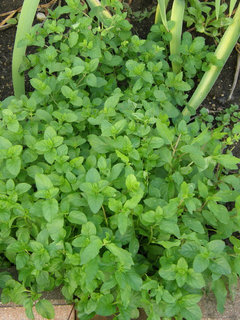
The effect of Azomite is immediate. My kid eats mint like a bunny. I pick mint once a day to feed her & to make tea. This mint is grown on a steep hill, pic. taken at 90 degree. I gave it Azomite, since I read Amazon reviews on how it improves the taste of onions, etc. The result is immediate, very vigorous, good heat-tolerant.
- 11 years ago
Hi Jim: Azomite is best applied to enhance other fertilizer (compost), and applied when you want growth FAST. I received a rooting from a friend, zero leaves, it stayed bare until I applied Azomite, and it sprout leaves immediately. That's why I apply Azomite to my mint patch, since I chop it down daily ... I want fast growth for the next day's tea. After Azomite application, I notice the "ground-runners" or mint-sucker was spreading fast.
Here's an excerpt from below link on how SOLUBLE calcium helps with uptake of nitrogen for fast growth:
"One report showed that adding soluble calcium to rice paddy water resulted in up to 15 percent of the flag leaf’s energy production being transported to the filling seeds (as opposed to 5 percent without calcium). Rice weights increased 14 percent when extra calcium was applied at seed fill. "
- 11 years ago
The heavier and harder-to-dig the clay is, the more alkaline. I re-post the info. I got Sept. 2013 from GERDA23, a Russian in zone 6 who shared her secret of tons of blooms for alkaline clay, where phosphorus & potassium are less available, due to bind-up with abundant magnesium.
The Russian GERDA23 has the best garden in HMF. She has alkaline clay, awesome garden. See link:
http://www.helpmefind.com/gardening/l.php?l=99.4875364&tab=9
I asked her how she did it, she wrote in Russian, I had to run through 4 translators. GERDA23 wrote:
"Early spring nitrate. After 7 days, 1/2 bucket of cow manure under each bush. Then double-superphosphate, ashes for micronutrients, potassium-sodium humate (80% humic acid). Two times a year top dress with chicken manure. In the fall feed roses with grass and compost.
My Sharifa Asma-2 yrs, good seedlings, blooms profusely with soluble phosphate-potassium." GERDA23
- 11 years ago
Ok Straw... I really do not want anymore fast growth for my regular roses...Might be good for my sisters roses though?
- 11 years agolast modified: 11 years ago
Yes, Amozite really stimulate root and leaves. I posted GERDA garden because she made stingy Austin roses like Falstaff abundant with tons of blooms. I like her feeding schedule, except I'll use horse manure for spring, sulfate of potash or red-lava-rock for potassium. I wish I have wood ashes to test. Hubby told me he'll bring all the dead-tree-branches and burn them at the park's large public fireplace, about 5 min. drive. That will save us money, since yard-waste-disposal is approaching $4 per bundle of sticks. I have tons of dead-branches from my many trees.
For the humid acid I'll use Walmart's bagged Humus & manure. I also use chicken manure twice a year. In the fall I'll top with compost or humus, plus alfalfa hay to stimulate earthworms during the spring. GERDA garden is one of the best in HMF ... she really know how to grow Austin roses:
http://www.helpmefind.com/gardening/l.php?l=99.4875364&tab=9
User
Original Author11 years agolast modified: 11 years agoYes Jim, Those are good pictures. Thanks straw.
User
Original Author11 years agolast modified: 11 years agoI am listening to whyy you bet your garden podcast. Jim do you or straw listen to Mike McGrath ?
he is in philly. Every Sat I listen to him since 2007
Last week the questions of week was about 10 10 10 fertilizer and the week before the question of the week was about perlite. This week is it it's about wild violets
- 11 years ago
I don't think we get that radio station Sam... I've heard of him though...
Sounds like some good listening!
- 11 years agolast modified: 11 years ago
Thanks Sam, for the info.. I will google Mike McGrath as to what radio station in my area. I listen to Christian soft-rock mostly. Clay retains water well, and cocoa mulch acts similar to clay, since it sticks together when decompose & retains moisture. Cocoa mulch pH is 5.4 with NPK 2.5-1-3 compared to peat moss pH of 4 (zero nutrients). Both are good stuff to fix SANDY SOIL, but NOT clay soil. Columbus Rose park in Ohio used peat moss to fix their sandy soil.
Cocoa mulch has a strong chocolate scent which attracts dogs ... DANGEROUS to dogs, but if watered-in immediately the chocolate smell goes away. I always mix dolomitic lime (pH over 9) with cocoa mulch to neutralize its acidity at pH 5.4 (perfect for rust germination).
User
Original Author11 years agoI listen to it on whyy you bet your garden . com on my computer phone.
- 11 years ago
I found this site:
User
Original Author11 years ago7 years I listen to him. Yay I am so happy to share. He says the same things you teach me ,Jim.
I think he might be your long lost cousin. Ha kiddin
User
Original Author11 years agolast modified: 11 years agoHere is an interesting post in the soil forum . I don't know if there is any new ideas but it still helps to hear other posters.
- 11 years ago
Thank you, Sam, for that link, I read through that, and Toxcrusadr (zone 6a -MO) gives the best view. Toxcrusadr is a retired chemist with a solid gardening experience. This is what he wrote: " Trench compost kitchen scraps if you want. Layer compost on top of the soil as a mulch. Cover that with more organic matter - grass clippings, leaves, weeds, whatever you can find that looks OK. This mulching will provide a feast for soil microbes and worms, which will incorporate it into the soil over time."
That's exactly what I did to the hole of Golden Celebration, which I dug up recently. It's sprouting new leaves, after being dug up for 1 week. The best way to fix rock-hard clay is to make it loamy & more air-space with COARSE SAND & LARGE-organic matter like alfalfa hay & cracked corn. That is best done through LAYERING, if possible. LAYERING creates more air space to nourish worms & best root-growth. I made many holes like that, a few months later came back: tons of earthworms underneath. Earthworms thrive underneath when there's slow-released & decayed organics on top: be it cracked corn, cocoa mulch, alfalfa, grass clippings, or leaves.
- 11 years agolast modified: 11 years ago
When I trim anything the leaves, stems, get thrown into the rose beds. I do not use weeds or flowers though...Flowers seem to have insects in them. I toss them into a garbage bag...
 6 years ago
Great info in this old post...I'm enjoying the post @User linked to too.
This section was interesting to me about weeds/grasses near the plants for the first year or two:
"Beware the quick fix. To make a clay soil into a really good soil takes time, and if a bit of effort is put in (but not necessarily a whopping huge effort) then that's great.Your friends are all the vegetable scraps that you can find, and all the leaves from deciduous trees that fall your way; lawn clippings that neighbours don't want; manure from pet rabbits or wild, untamed guinea pigs who have broken from their cages and are terrorising the neighbourhood.
And when stuff grows (even weeds and grasses that you don't want), the worms will embrace their roots as you have found. So, weeds in the beginning stages are good."
I've been reading about how soil life does well with a variety of roots/nutrients to work with. Makes sense.
Also Straw, great info on layering. I've been wondering how to ammend dense clay form the top only (without tilling and digging up all the roses in it)....and trying to figure out if layering lots of organic matter with gravel or some kind of small/medium size gravel spread evenly in the layers, would eventually pull it down and break up the clay. Would probably take decades but I have noticed that the biggest rose I've grown this year, out of about 40, is the Westerland planted in a LOT of organic matter (woodchips, compost) and gravel/limestone leftover from pool construction. It's giant. I think it's happier because it's roots can breath better than my beds in less amended soil that I built just this Spring.
It's hard for me to tell exactly, but from the tests I've done on my indoor plants (all tropicals and succulents)....lots of grit, with nutritious organic matter or fertilizer = more airflow at the roots and bigger, but most important, healthier plants. Less chance of rot or disease. I can't imagine this not being the same for roses and other plants in the ground.













strawchicago z5