Software
Houzz Logo Print
dreamhouseforsomeday

Simple question...is "door joinery" the same as "carpentry"?

While researching on this site I keep seeing reference to finding a "door joinery" to design custom sliding doors & such. I've never heard of door joinery. Is that a regional thing? And if so, in the US what trade would specialize in multi-bifold doors (i.e. to open indoor living areas to a porch/outdoor living area). Thanks in advance for any insight on this subject!

Comments (13)

  • 11 years ago

    ISTM that door joinery is the process of manufacturing a door. You may be in search of a carpenter to design and build a set of doors, or one who can install a factory-made product, of which there are many.


    Multi Bi-Fold Doors

    dreamhouseforsomeday thanked randy427
  • PRO
    11 years ago

    @Al F.,

    I'm hurt... where do hardwood floorworkers fit in?

    And I'm not talking about the "unfinished" guys, who can rely on a 5 gallon bucket of filler to get them through! haha

  • 11 years ago

    Hmmm. I've been making furniture for 30+ years, but I'd be terribly slow doing framing. I'd still be working on the first wall when Larry Hahn had framed out a whole house. Different skills, not that one is necessarily better or worse than others.

    dreamhouseforsomeday thanked bobismyuncle
  • 11 years ago

    If you do a lot of one aspect of carpentry, like door joinery or cabinet making or ornate corbels , you'll have the tools, processes and techniques readily at hand. If not, it may take even an experienced carpenter a few practice pieces to come up to speed.

    dreamhouseforsomeday thanked randy427
  • PRO
    11 years ago

    @ Select; I'm sorry didn't mean to walk all over the floor (guys) :) I've always put the flooring installers into the category of finish carpentry. As far as the manufacturers (like yourself), whole other category, manufacturing/finishing/subfloors/etc. Need to know a lot about everything.

    @ bobismyuncle; Yep, all the categories have a whole bunch of different skills, I too couldn't frame a house in the time good framers do it. I have a problem of reading any increment bigger than 1/16 on a ruler, many times I'm looking at 32s. (worked with a plumber once, I think his tape only had 1/2" increments.) But I can and have done finish carpentry, built cabinets, as well as reproducing antiques. Maybe I phrased it wrong. It's all about skill sets. I have the skills to trim out a house, but does a finish carpenter have the skills to reproduce a block front chest? Some may. I didn't intend any disrespect to anyone. We all have our niche.

    The original OPs question was about "door joinery". A framer could build a cross buck door using 1x and a framing nailer, and it will work. But maybe not have the skills and tools required to build a six panel (executive raised panels) with pegged mortise and tenon joints.

    A shipwright is another category. I certainly couldn't build a wooden sailing ship without a lot of learning. Let me rephrase that, not even a canoe without a huge learning curve.

  • PRO
    11 years ago

    I was just "razzing ya" Al... haha

    But thanks, Buddy, I feel better.

  • PRO
    11 years ago

    I know, but just had to respond.

  • PRO
    11 years ago

    @Al... I figured that. By now, you realize I have no feelings to hurt! haha

    And your little quip about "walking all over the floor guys" didn't slip by! lol

    Have a great Saturday.

  • PRO
    11 years ago

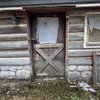
    A finish carpenter should be able to build "batten doors" which are basically t&g car siding held together on one side by battens and z-braces. Anything requiring mortice and tenon joinery is now the purview of a cabinetmaker. FWIW, very few people actually make doors and window sash the old way (they way I do ) with mortise and tenon joinery. Most doors are doweled.

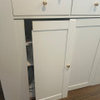
    My first job and my first effort at building doors. They are 3ft x 10ft


    dreamhouseforsomeday thanked Sombreuil
  • 11 years ago

    Like Al said, door joinery is how the door's parts are put together (joined). Terms used to describe the specific type of door joinery could be mortise-and-tenon, dowels, splines, biscuits, butt-and-glue joints, frame-and-stick/cope-and-rail, or others. (Note that at least one of these would never find its way into my house!) The type of joinery determines the strength of the joint. All types of joinery are part of the suite of skills referred to as carpentry, and specifically within finish carpentry and furniture/cabinet-making.

  • 11 years ago
    Salex--which would you never use in your own house? Thx!
  • 11 years ago

    I would never use butt-and-glue joints for doors, and likely wouldn't use mitered joints either (unless they had some other structural component such as a biscuit).

    Most carpenters that make doors have found a method that works for them, and you'll find lots of opinions on which ones are strongest. Most of the doors in my house (both passage doors and cabinetry doors)
    have cope-and-stick joints with glue. The photo at the top of this link (http://www.woodworkersjournal.com/eight-tips-routing-cabinet-doors/) shows an example of a cope-and-stick joint (it goes by many other names, fyi).
    Based on my own personal preference for both workflow and aesthetics, I build my joints these way using a
    Shaker-style profile with a flat panel in the door center. But if someone else was building my cabinets, I would welcome other types of joinery into my house (but still no butt-and-glue).

    Note that if you're considering contemporary-style, flat-front cabinet doors, most of these terms are less applicable. And drawer joinery or drawer assembly is also a different set of joints/terms.

Sponsored
Snider & Metcalf Interior Design, LTD
Average rating: 5 out of 5 stars25 Reviews
Leading Interior Designers in Columbus, Ohio & Ponte Vedra, Florida