

Wilting, New Alocasia
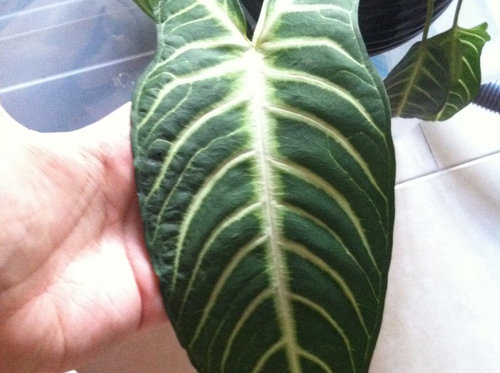
Hello there! I recently purchased an Alocasia Longiloba (advised by the staff, looks like but am unsure) a week ago.
It was extremely bushy when I got it, and several of the leaves were dull and had those white "target" fungal spots. The stems also had the beginnings of rust which I cleaned off gently with a paper towel. It didn't look too well, overall, but was the healthiest in the batch (others were droopy and sun-scorched).
After a few days of indoor acclimatising to my home on a windowsill with bright indirect light and lots of humidity, I thought to check it for any mushy roots before repotting. Sure enough, there were several black ones that fell apart and I pruned some other dodgy roots back. Kept the bulk of them but trimmed it for the pot anyway. There were about six, seven earthworms in there and two centipedes I relocated, since I intended for it to be solely a container plant.
There wasn't any peat in stock at a nearby nursery so I used regular potting soil with some fert, mixing in perlite. Staff told me to make sure I got all the roots under the dirt, but I didn't want to drown the rhizome either.
The weather is right humid here (think Malaysia/Singapore with all its rainforests) but with the heat recently we left a fan on at home at low strength for a spot of circulation which usually helps the other plants (hedera helix, fittonias, pothos, orchids, philodendrons) etc from becoming too soggy after entering (humidity can make soil drying tough to prevent root rot).
The poor Alocasia practically wilted overnight! All the leaves look sad and awful.
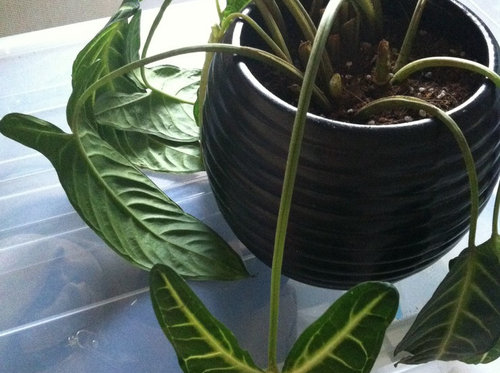
Should I repot it again to save it? I must have misstepped somewhere, it's my first time having an Alocasia. It's such a gorgeous plant, though, I would like to help coax it back to life even if not to its former (admittedly already sickly) glory.
Comments (19)
Kay Lee
Original Author11 years agolast modified: 11 years agoETA: I am in a Zone 14 area if that helps.
ETA 2: tropicbreezent has kindly identified this as a Caladium lindenii. 11 years ago
That isn't an Alocasia, it's Caladium lindenii (was formally known as Xanthosoma lindenii). With rotting roots and the plant wilting up top it would have to have been over watered and/or in a very poorly drained soil. They handle drying out better than being waterlogged. And no direct sun. If humidity is such a big problem you might be better off having it in a porous epiphytic mix.
Related Professionals
Cincinnati Landscape Architects & Landscape Designers · Frisco Landscape Architects & Landscape Designers · Moline Landscape Architects & Landscape Designers · Taunton Landscape Architects & Landscape Designers · Newport News Landscape Contractors · Buffalo Landscape Contractors · Wheeling Landscape Contractors · Salinas Landscape Contractors · Santa Maria Landscape Contractors · Ottawa Landscape Contractors · Belleville Kitchen Remodelers · Jackson Kitchen Remodelers · Corpus Christi Kitchen Remodelers · Huntington Kitchen Remodelers · Bridgeport Kitchen RemodelersKay Lee
Original Author11 years agoThank you so much for the correct ID! It was really suffering a fair bit when I took a look at the roots and soil – some thick, heavy peat. I'll try look for a better mix tomorrow with your recommendation. When I was just washing the old soil off, I patted them dry before placing them in the new pot with only a light sprinkling so it was damp, not soggy. Didn't do enough for it though. *shakes fist* Here's hoping. I really appreciate it. :)
 11 years ago
I would clean off as much water logged soil as possible and get some air to those roots. You can wrap them in moist paper towel while you work on your mix
Kay Lee
Original Author11 years agolast modified: 11 years ago@laticauda – I got rid of all the water logged soil and actually mixed in some sphagnum moss and orchid bark with the 3rd round of soil for this Caladium. The moist paper towel helped heaps as I was doing it! Thank you.
I forgot to mention that in the original soil, other than the earthworms, there were tiny white worms that another nursery staff identified as fungus gnat type worms – explains some of the eaten roots. The Caladium came to me in quite a state but with your advice and @tropicbreezent's, I've saved it a tad. Watered it thoroughly with the new soil yesterday (with improved drainage) and it has perked up overnight. Not quite back to its former 'standing' position but it's no longer completely on the ground, which I'm hoping is a good sign.
This plant is just so beautiful, and I hope to help it recover. :)
Kay Lee
Original Author11 years ago@laticauda I received that comment just as I was uploading one! (I was in the office earlier and couldn't do so.)
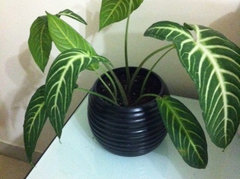
I'm letting the soil dry out a little tonight but am keeping the area a little humid with some of the other plants so that it'll have a recuperative resting period in the shade: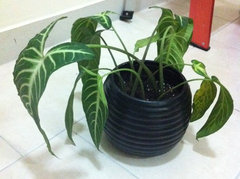
The weather has been brutal at an awful 100F over here, which may have traumatised it some (too-wet soil, in direct sun at the nursery, larvae/worms)... it's been a hell of a week.
- 11 years ago
I could be wrong, but I think the clear worms (fungus gnat larvae) eat the rotting/dead/decomposing matter in the soil. Kind of like how doctors use maggots to clean out surgical sites because they clean all the decaying/infected tissue away from the healthy tissue.
So really, they were just eating the already rotten-from-overwatering roots.
It looks good. I've never kept one of these but id say it's a safe guess to not water so much lol.
Kay Lee
Original Author11 years agoI'm certainly in no position to comment on that myself, but I'll keep my fingers crossed regardless :) it definitely needed new soil too!
Haha, yeah – when I was chatting with that staff and referred to the correct ID, he commented that other nurseries in Malaysia are actually phasing Caladiums out. They're not difficult to take care of once established, apparently, but it's hard to balance and give them the conditions they need here even though we're in the very climate that yields these plants because of how they're found in the wild as opposed to being grown as houseplants. It's resulted in a lot of negative feedback and people sometimes just don't try growing this anymore. A right shame, that is.- 10 years ago
I know I keep asking, but for some reason about once a month, this is brought up as a thread that I shoulD read.
Are you still having a good venture with this plant? Any new growth?
Kay Lee
Original Author10 years agoI'm sad to say the caladium succumbed to leaf spot. :( I pruned off the leaves that had the wet spots, but apparently it'd been too late! Still, I won't give up... I'll do better with another if I'm lucky enough to find the same one from a nursery again. Thank you for checking in, though!
- 10 years ago
I'm having trouble with a Alocasia plant which I've taken off a work colleague in the hope I can revive it, its only got four leaves and a long stalk which I've not seen on any websites and I'm wondering how I can revive it. Can't seem to post a picture, but I have one on this link http://www.helpfulgardener.com/forum/viewtopic.php?f=21&t=65567 can anyone help me correctly identify this one? Alocasia Reginula I think, but I'm unsure what it needs to become bushier and healthier, thanks so much!!
- 10 years ago
It's usually better to start a new thread for a different issue. However, your plant does look like Alocasia reginula. But that's an unusually long stem, it seems rather strange. Was it taken out from a clump of them? Competing for light in a crowded situation could explain it. Depending on your climate they can be very touchy. You need to grow it in a very fast draining epiphytic-type of medium. Air needs to be able to circulate around the roots and the medium stay damp enough to keep that air humid. They normally grow in rock faces in rainforest environments with the roots in moss and exposed to air. Too much water, or water that can't get away will cause them to rot. It will multiply if given these conditions but it can take time.
 8 years ago
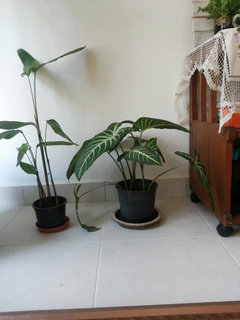
hi... are u sure its alocasia? i have mine exactly like that too and its caladium lindenii after doing a thorough search.. i have the same exact problems too after i bring my plant indoor ( a bout 4 days now) but i did not repot it yet. Im currently living in Malaysia. Do u have any solution for your problem? will be very helpful if u can share here. thanks
- 8 years ago
ok i just read the entire post and now figured u have the solution posted already... just too excited to post haha.. anyway sorry for your Lindenii..i hope i can save mine.


Kay LeeOriginal Author