Software
Houzz Logo Print
sandyslopes_z5ut

Monarch eggs or aphids?

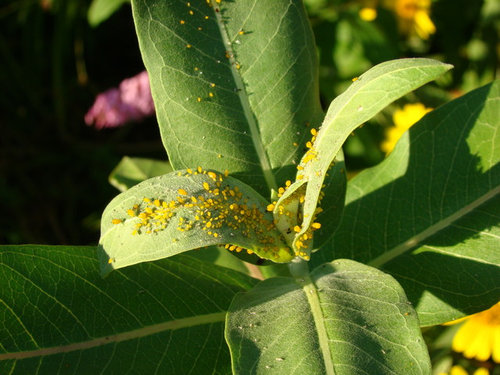
I've been letting the milkweed grow to help the Monarchs, but it's terribly invasive, and I've never seen any signs of it being used by Monarchs. I have a big stand of milkweed next to the veggie garden that I'm going to let alone, but I was going to pull it from the flower gardens when I saw this on several milkweeds. Is this a bad aphid infestation or future butterflies?


Comments (14)

  • 11 years ago

    Aphids!

    sandyslopes z5 n. UT thanked kaboehm (zone 9a, TX USA)
  • 11 years ago

    I pull off the leaves with the bugs (they don't move very fast) and squish them on the pavement. Very effective. Of course....check for Monarch eggs first!
    :-)

    sandyslopes z5 n. UT thanked kaboehm (zone 9a, TX USA)
  • 11 years ago

    You can pinch them off or gently hose if you don't see any caterpillars or eggs. As far as I know, they don't do any harm, just ugly. Sandy, monarch eggs are white and on the other side (back) of the leaves. They are very small, possibly a little smaller than the aphids. You can bend a stem over gently to see if there are any eggs there. Watch to see if your leaves are getting holes in them as that can be a sign of caterpillars, if you don't actually see them at work.

    sandyslopes z5 n. UT thanked socks
  • 11 years ago

    Oh darn! Well, for a day I got to imagine that I might have lots of Monarch eggs. It was a happy feeling to think I might be helping them in my own small way.


    For all the years I let this milkweed grow, I've never seen any evidence of it being used. Some bees and butterflies going to the flowers, but never a hole in a leaf from any caterpillars. I don't usually see aphids like this and wonder where all the ladybugs and other predators are.


    This is the common milkweed that grows around here, which I thought would be most desirable, but it does spread underground by rhizomes, which is not so great in my flower gardens. I'll check out the better behaved ones mentioned here to possibly grow next spring.


    Now I can continue working on this area of the garden if there's no Monarch eggs to disturb. I'll check underneath the leaves to be sure. On google it showed a neatly laid formation of eggs, but it also had a picture like my aphids with no explanation to accompany it. I'm very glad I could come here and find out for sure. Thanks for your help!

  • 11 years ago

    I was assuming that you had common milkweed, Asclepias syriaca. That was probably a wrong assumption on my part. In Utah, it sounds like Asclepias speciosa is the common one. I don't know anything about that kind, other than what I learned from your post, Sandy. I did find a nice link, though. There appear to be a lot of species to choose from in your state, and many things will do well in garden conditions even if they are not local to your exact area. Good luck!

    Utah milkweeds

    Liz

    sandyslopes z5 n. UT thanked Liz
  • 11 years ago

    I do check the leaves before I smoosh anything. I would rather kill them rather than relocate them with a hose. I think that they do affect new growth and I have a vast collections of amaryllis that could potentially be affected.

    sandyslopes z5 n. UT thanked kaboehm (zone 9a, TX USA)
  • 11 years ago
    last modified: 11 years ago

    Asclepias speciosa looks like the one I have. It gets from 3' - 4' tall and flops over a lot. I'd be kind of relieved to clean this one up. Thanks for that link. I had no idea there were so many kinds that will grow here, and some are really pretty, too!

    I'm used to nature cleaning up my aphids. So either they haven't been found yet or these milkweed aphids aren't that tasty. I'll let that big stand by the vegetable garden stay, but I'm pulling these out, anyhow. I'm a little squeamish about doing the smooshing myself. :-)

  • 6 years ago

    I noticed about 4 ants seeming to be tending to the aphids on my milkweed. Will the ants keep other pests at bay, such as milkweed bugs? Do they patrol the plant to keep things clear for their aphids?

  • 6 years ago

    The ants will bite you if they feel you are a threat to the aphids and definitely if you start killing their aphids. The time I had ants farming oleander aphids on my milkweed i don't recall seeing much else, but I don't generally get milkweed bugs.

  • 6 years ago

    Oh, and I know the comment is from five years ago, but I'd be surprised if the aphids affected amaryllis ... I've never seen them on daffodils or anything other than my milkweed, actually. I don't have any oleander or vinca, so on the milkweed is the first I ever saw of them. The key is to start squishing as soon as you see them before they form a colony and attract ants. If they're on oleander or you're squeamish, gloves are a good idea.

  • 6 years ago
    last modified: 6 years ago

    Here's a mystery folks - your insights would be welcome. I've been growing milkweed seedlings indoors and recently began "hardening" them by putting them outside on my deck. They are in flower pots that sit in a plastic box with about an inch of water in it. Incredibly, I found a few aphids on them. How did they get there, despite the "moats" surrounding the flower pots??

  • 6 years ago

    Honestly, I have no idea where aphids come from in most cases. We never had them before the milkweed was planted, and they appeared out of no where. However, I believe the answer to how they crossed the "moat" would be flight. Happy little aphid clones attack a host plant with no need for wings, but when it's time to find a new plant, the babies get to have wings and they fly across your moat to attack your tender morsel of a seedling and get the cloning going again.

  • 6 years ago

    You're right, Blueberry. I just learned that they can fly! I've never seen wings on them, and they just don't seem active enough or aerodynamic enough to fly, but they do!

Sponsored
NME Builders LLC
Average rating: 5 out of 5 stars2 Reviews
Remodeling Company in New Albany, Ohio