Software
Houzz Logo Print
thecollegekid

Herbaceous Borders

11 years ago

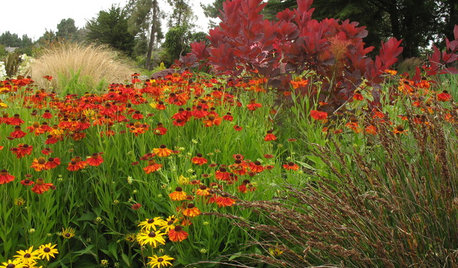
I am about to close on a house in Norman and am looking forward to finally having a large yard with a great amount of sun to play in. And like most gardeners who don't have a place to vent their gardening needs I find myself on youtube watching garden shows (usually BBC) and wondering what I will turn my backyard into. I have gotten into bees and chickens recently with a friend of mine and know I will definitely have a small coop and one or two beehives in my backyard but what I am wanting to do with the garden is ever changing. What I am leaning towards is something called a herbaceous border due to their beauty within the summer. I grew up in a slightly cooler climate, zone 5 and 6 and am still getting used to the hot summers here, although the excess rain this year has been amazing and most peoples lawns and gardens are still green to my amazement. That being said, I would love to have a blooming border along an 80' fence. I have attached the video of what I am looking to achieve (I also plan to have some sort of kitchen garden and even possibly a micro CSA which I will get into later) and I was looking for some inspiration from people who have lived here much longer than me in the form of pictures and names of plants I should include. I am looking for the majority to be perennials and I will fill in the holes with annual I plan to start in a greenhouse.

I am starting with a blank slate of a backyard with only grass which i will remove with a sod cutter. I will amend the soil with the free compost norman has to offer and mulch it with their mulch as well. I also have an irrigation system that I plan to tap into and water this bed sufficiently. Thank you in advance for all your advice and I look forward to hearing from everyone.


Herbaceous Border and Kitchen Gardens

Comments (8)

  • 11 years ago

    There are so many plants to grow. I have a little advice for what it's worth:

    Go slow, take that 80' bed and divide it into a couple of years. A large brand new bed can be overwhelming when it comes to planting, weeding, mulching and watering. Since you are not from here it will take a lot of trial and error to get your plants going. Even if they are within our zone you will have other determining factors such as soil, excessive heat, excessive moisture, no moisture and sunlight movement in your yard. A lot of plants will tell you full sun, but it will not survive our full sun. Again just take it slow and start small or you might become frustrated.

    Put your harscape in first and trees and shrubs next. These will also affect your planting season.

    Since your in Norman city limits check to see if chickens are allowed in your area.

  • 11 years ago

    I would use the compost but would hesitate on their mulch. Reason being it includes all the herbicides that are on the brush, trees, lawn clippings, etc. The mulch has not been composted yet and has not gotten hot enough to break the chemicals down. But YMMV.

    I think in Norman you can have up to 4 hens, but no roosters.

  • 11 years ago

    thank you everyone. You are correct scott with the 4 hens. Bees are allowed across the state as well. Thanks for the heads up on the herbicides. I hadn't thought about that yet.

    Stockergal-I plan to section it off. it is a bit overwhelming and I plan to get a lot of my hardscapes at the okc plant show next spring. I just want to start getting everyones opinions.

    Mulberryknob-thanks for all your suggestions. I had a bunch of those on my list and you have added quite a few as well.

    As far as hardy bulbs, i see cannas and gladiolas that have come back year after year here but i have personally had mixed results. Do people tend to just leave their canna leaves that die back as a mulch until spring time and would i have to mulch over glads in the same manner?

  • 11 years ago

    I have had cannas and glads come back for years. And yes, you should mulch them. Cannas can freeze out in a very cold year even with a mulch. And there is a disease issue with cannas. You can do a search of this site to learn more.

  • 11 years ago

    I sorry I sounded so negative earlier. Welcome to the site. You will enjoy the discussions here and will get lots of ideas. I just don't want you to jump off into a huge garden and get discouraged and quite on us. I hope you enjoy your new home and gardens.

  • 11 years ago

    Hey there, thecollegekid !

  • 11 years ago

    I didn't watch the video as I am always in a time crunch, but I'll just state the obvious that we have a vastly different climate and soil than they do and you probably should adjust your plans accordingly. I love to look at British herbaceous perennial borders, and might plant something similar if I lived in zone 5 or zone 6 in areas that have a milder summer than ours, but I don't, so I plant what will grow here in the soil and conditions I have.

    It is hard to suggest plants for a border without knowing what type of soil you have, whether it is alkaline, acidic or neutral and how well it drains. I have one area with very dense red clay that finally is in half-decent shape after 17 years of amending, but it still is clay and plants that demand well-drained soil still are hot happy in it in very wet spells like we had in May and June. I have a different area with very sandy-silty soil and can grow many of the plants that demand well-drained soil there, but also have to put up with the pests, like voles, that are prolific and like to eat the roots (including tree roots, shrub roots, perennial roots, bulbs, tubers and corms) of anything and almost everything that I plant there. I know people in parts of Norman who have gophers, so you have to consider what pests you might encounter (deer, rabbits, etc.) and have a plan to exclude them from your plants, as needed, long before you plant. It has taken me years to learn which plants perform best in which soils in all the various kinds of weather they must endure, and that included lots of trial and error plantings. For example, hydrangeas will grow in my highly-amended clay, but even after being amended very well over a long period of time, hydrangeas still cannot survive a dry summer in the sandy-silty soil because it drains too well in hot spells even when well-irrigated. So, I suggest you study and understand your soil very well before investing a lot of money in plants.

    Some plants will grow almost equally as well in sandy soil, sandy loam or clay loam, but it just depends on what your soil pH is and what your weather does.

    I agree wholeheartedly with Dorothy's recommendation to include trees and shrubs as a part of your border, particularly evergreens. They will add interest to your border when various perennials are not blooming.

    I grow a lot of the same flowers that Dorothy mentioned (not surprising, since she has clay as well, though I think mine probably is more alkaline and hers might be closer to neutral or acidic). I have tried to incorporate natives found on our own property (beautyberry, American persimmon, Mexican plum, thicket plum, Possumhaw holly, rough-leaf dogwood, etc.) because they grow well here and because they provide something (food, shelter) for the wild creatures who share this land with us. As much as possible, I always try to select plants that are multipurpose---it is not enough that they are attractive. They also need to provide something, even if it is just pollen or nectar for the pollinators.

    Plants that grow well for me in amended clay include canna lilies, daylilies, shasta daisies, hardy hibiscus, Texas hibiscus, echinicacea, rudbeckias (some, not all), red hot poker, autumn sage, yarrow, lantana (some are winter hardy, others are not), crape myrtle, maltese cross, Western ironweed, dianthus, French hollyhocks (perennial in well-drained soil and also self-sows abundantly), dahlias (in raised beds lined with hardware cloth to exclude voles who otherwise will devour their roots), catmint, and most salvia varieties. Gladiolas are a half-hardy perennial for me, usually living 3-5 years before a very wet, cold winter takes them out. I also mix in lots of spring-blooming bulbs, including daffodil, dutch iris, dutch hyacinth, and several different kinds of ornamental alliums.

    I grow lots of four o'clocks (a forest of them) in the very dry sandy soil beneath the big pecan tree in the front yard because their huge tubers do not get eaten by the voles that otherwise plague that area and because they are very drought-tolerant, but I wouldn't put them in a border because they would crowd out everything else and take over every square inch .That works for me where I have mine growing beneath the pecan tree, as they function as a tall ground cover there (albeit a deciduous one), but it wouldn't work in a situation where they would be expected to play nice and share space.

    Because I live in an area of largely native grassland mixed with hickory/oak/pecan forest areas along creeks and rivers, I mix in standard prairie plants, largely because they are tolerant of the wide range of weather conditions experienced here, and because they don't need a lot of irrigation. Some of my favorite prairie plants include Mexican hat, clasping leaf coneflower, Indian blanket (does better in the sandier areas than it does in clay), butterfly weed, Mexican petunia, liatris, Texas bluebonnets, winecups and blue star grass.

    I probably have more self-sowing annuals than most people because I like plants that are easy to grow, low-maintenance and which plant their own replacements. I also don't have as much trouble with rabbits, voles and deer eating the self-sowing annuals as I do with perennials. In my garden, the following are self-sowing annuals who replenish themselves each year. Some of them have perennialized too, but it just depends on their cold-hardiness: hollyhocks, 'Laura Bush' petunia, larkspur, poppies, nicotiana, moss rose, zinnias, marrigolds, daturas (several kinds), verbena bonariensis, scabiosa, bachelor's buttons, gomphrena, cosmos, celosias, amaranths and zinnias. I'm sure I forgot some of them, but those are the main ones that reliably self-sow.

    I didn't even mention vines, but there are many beautiful ones that complement a border, especially when grown on a fence, arbor, pergola or building that serves as a backdrop behind the perennial border. This includes American crossvine, coral honeysuckle, trumpet creeper, and clematis. Most annual vines are thugs that reseed too readily, so I wouldn't put them in a spot too close to a herbaceous border because they will outcompete, outgrow and outlast everything else you plant.

    I haven't planted a new rose bush in a decade, and when one gets sick, I take it out and replace it with something else. My sole survivor, after losing 3 very old climbing roses to the excess moisture this year, is Graham Thomas, which is my favorite rose, and it is getting old and not looking too good. Our hot summers can be hard on roses, and the rosette disease has made me decide I just won't plant any more of them.