Software
Houzz Logo Print
krysah

Alkaline soil (in DFW)

11 years ago
last modified: 11 years ago
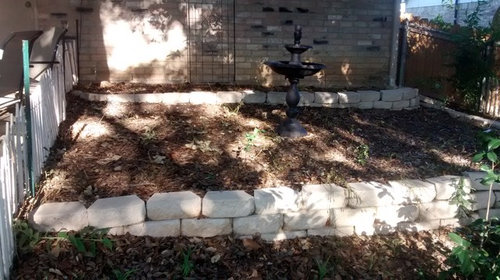
I have an area in my shade garden where nothing will grow. Even weeds do not thrive there. One or two small weeds perhaps, but it just stays dirt. I mulched it and planted vinca, but the vinca failed. I finally thought to buy pH test strips. It is pretty alkaline, somewhere between an 8 and a 9. The rest of my yard is pretty neutral, it appears the previous owners brought in bad fill dirt from somewhere when they laid the retaining wall bricks and made it a landscaped bed.

I'm trying to decide what to do with this area. It's right beside my patio, which is too small, so I have considered putting it all under cement and extending the patio, or building a wood deck over it or such. Pavers are prob out, because the dirt is loose sand and we would have to bring in a lot of gravel base. A green groundcover growing area with patio seating would be ideal, but prob won't happen with the pH like it is.

Any suggestions? We may end up moving in about two years, so I'm kind of shying away from the expense of a new patio. But then again, we might not move, so I don't want to do nothing. I'm planning to put down some sulphur and peat moss this weekend, but I don't know how long it will take to bring the pH down, or if it will even be successful. It is a long way to go.

Anytime have any experience in changing pH, or a suggestion for a cheap patio option? Plants that might grow in this soil, or other options I haven't considered? Thanks.

Comments (15)

  • 11 years ago

    I just used Google to find plants that tolerate high ph and found quite a few that surprised me.

    Clematis and heuchera were on the list.


    http://www.thegardenhelper.com/alkalineplants.html

  • 11 years ago

    Thanks! I will get a soil test for other issues, and I think I will add the sulphur and plant a clematis, and wait and see.

  • 11 years ago

    I would re-create the area around the fountain. Let's make it the focal point of the spot. If the fountain works, better than better, but even if he doesn't, I would place big pots of different sizes of harmonizing colors in the corners and 2 benches facing the fountain. Depending on the water and time availability, and your preferences, I would plant either a bunch of colorful impatiens and palms (require more time and water) or a bunch of agaves and cacti (require less time and water).

    If the fountain doesn't work, that means it can be moved. If so, you would have another possibility moving the fountain to one side and place a big swing set surrounded with different sizes of pots to enjoy the shade.

    If nothing grows by the lattice, I would remove it and would place a big metal ornament on the wall.

    Regarding the ground, I would dump a lot of mulch/ pine needles to make it look nicer, cleaner and more uniform. All these suggestions may cost some money to implement but I think they would be cheaper than extending the patio and would create a more artistic and cozier area.

    Omar

  • 11 years ago
    last modified: 11 years ago

    Sulfur does not always last that long. It does sound that the soil is lacking in nutrients..The other thing that one might think about doing is trying some green manure over the winter. Seeding some Austrian pea or crown vetch as a cover crop and then tuning it into the soil. I did this to some ground and was shocked at the improvement of the plants that I planted in it this summer. also some compost tea and micorrhizal fungal stuff to kick start the life in the soil.

  • 11 years ago
    last modified: 11 years ago

    One can put down some cardboard and then a couple of inches of Denatured granite and tamp it down and that will make a good informal walk area around the fountain , leaving the edges to improve the soil for plantings and/or place some pots. I have seen some interesting uses of landscape timbers and wolmanized designs placed into a matrix of decompose granite. It was a random minimalist pattern. Really interesting.

  • 11 years ago

    Thank you, everyone. First thing this morning, I filled a zip log bag with dirt for testing. I then put down sulphur and peat moss. I planted a few things i had in abundance that seem resilient in one corner as a test- snake herb, ruffled basil, creeping fig and a mountain pea. I plan to get a clematis as well. I ordered crown vetch seeds and will plant them this fall.


    if anything grows, great. If not, next spring, I may do the decomposed gravel thing, and get benches and pots to go around it. Or get a quote from someone with a cement truck.


    Thanks for all the help!

  • 11 years ago

    Peatmoss is not a good additive to change the PH. It breaks down very quickly and if it dries out in the Texas heat , it becomes "hydro-phobic". It will repeal moisture. . The breakdown has some not great chemicals also.. Compost is much better. Oak and pine compost are better.

  • 11 years ago

    I have to say that if you have a bed of highly alkaline soil, surrounded by more neutral soil, I wouldn't waste time with planting stuff that tolerates high alkalinity. I'd start digging, and getting rid of the soil in the bed. You don't say how big it is, or how many wheelbarrows worth of soil we're talking about. In some sense, replacing it with good soil is an investment in the house.

    But I agree that a responsible soil test from an ag extension is called for. One has to wonder if it isn't something else in that soil. No weeds even? The previous resident may have dumped something there, and you may have a toxic waste pit/superfund site on your hands. There are many unnatural and toxic ways to make soil alkaline. You might want to read "Fateful Harvest", which is an expose of an alkaline "fertilizer" being sold as a lime-like product, that was actually nasty industrial byproducts, rich in heavy metals. Yep, it made your soil more alkaline, and a whole lot more.

  • 11 years ago

    Peat moss and pine bark along with sulfur is what blueberry people use to lower pH on marginally suitable soils. It takes 6 months for sulfur to work to lower pH. PH is tough to lower in clay soils due to buffering agents that tend to keep pH steady. Peat moss has a pH of about 4.5. I would also fertilize with ammonium sulfate for nitrogen. I think the addition of organic matter should make the area suitable to grow most things. It will take a bale of peat moss (3 cubic feet) and several bags of pine bark. Still a lot cheaper than concrete.

  • 11 years ago

    Honestly, I probably should have just dug it up in the beginning- but hindsight is 20/20. The area isn't large, 270 sq ft by maybe 1 1/2 deep. The yard is fine, but this bed seems to be bad fill dirt from somewhere else. It does grow a few small weeds, none thrive. Acorns produce small baby trees (though I have been pulling those up, since it is right under a big live oak). I'll post the results once I get it tested, and go from there. I invested about $60 worth of peat moss and sulphur this morning, may regret that, we'll see.

  • 11 years ago

    Not suggesting it, but curious about what would happen if you dumped a bunch of vinegar in the bed.

  • 11 years ago
    last modified: 11 years ago

    I wondered that too. But I couldn't find any answers online, and I wasnt brave enough to try it.

  • 11 years ago

    Vinegar isn't a lasting solution to bed alkalinity. This is well understood. You'd poke the pH down a bit, and then it would shoot back up a week later. What makes a bed alkaline is largely minerals in the soil, and it would take a truckload of vinegar to dissolve them. FWIW, vinegar would also quickly leach out of the soil.

  • 11 years ago

    Now we know. Thanks, Dan!

Sponsored