Software
Houzz Logo Print
misssherryg

How A-DOOR-able!

11 years ago
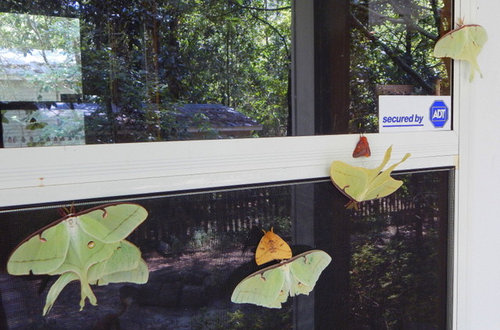
Does your door look like this?

Sherry

Comments (11)

  • 11 years ago

    No, but I wish it did!

    Liz

  • 11 years ago

    That's neat. Sometimes we see a lot of Lunas in the back yard

    Sitting around here and there in the morning like they all came

    Out at once. We have lots of sweet gum trees.

    What are the little orange moths? I have seen some that

    Looked like them before.

    DD

  • 11 years ago

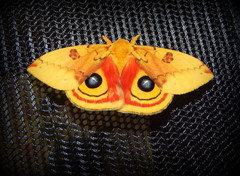
    The yellow moth on the left is a male io moth. If he had his wings open, you 'd be able to see his beautiful 'eyes'! I found some eggs that I think are io moth eggs (13 of them) which makes sense since I've been seeing so many of the adults lately.

    The darker colored moth on the right is one of the Anisota moths, probably a spiny oakworm moth. They're in the same big moth group (even though they're not big) as lunas, regals, etc., but I think they're a subgroup.

    Here's a picture I made recently of another male io moth. I blew on him lightly to get him to open his wings for a picture.

    Sherry

  • 11 years ago

    Wow, what beauties! I don't get to see these little guys here. Thank you so much for sharing.

    Mary

  • 11 years ago

    Oh wow......what incredible pics Sherry! Hey......does your door make you a Luna-tic? ;)

  • 11 years ago

    Sherry always takes such great photos, I'm green with envy. What beautiful babies too! :)

  • 11 years ago

    Beautiful, MissSherry! I don't get these moths here either! I did see a very nice twin-spotted sphinx this morning. Never have seen one of those before. I have 3 pink-spotted sphinx about ready to emerge.

    I sure wish I would get to see one of the silks, though....

    Susan

  • 11 years ago

    Sherry,
    I agree with your spiny oakworm ID. They are in the subfamily Ceratocampinae. That also includes the imperials, regals, rosy maple, and others.

  • 11 years ago

    Thanks, all! The poor luna moth without tails came back, and rested on my window screen today, and the mating female left a few eggs on the screen of the doggie door. I've got far too many luna cats in a cage, most about ?2nd instar, so I'm going to have to put at least half of them on sweetgum trees to finish raising themselves. I've still got many luna coccons from the last time I raised them, and if I raise the ones left on the doggie door screen, that will give me cocoons from three different groups.

    Yesterday we got 1.5" of rain - YAY!! It was horribly hot again today, and we'll be under another heat advisory tomorrow. But then there's a strong chance for rain coming again Tuesday with a 'cold front' - cold fronts in August are usually just slightly cooler, less humid bodies of air. I'm REALLY looking forward to fall!

    I found two red-spotted purple hatchlings, plus two eggs that I'll watch and bring in as soon as they hatch, so I'm back in the RSP business again. I'm raising about ?15 gulf frits, one spicebush swallowtail (the other egg hasn't hatched, even though it turned dark) and I've got four red admiral cats that have grown beyond the stage where parasitized RA cats turn into little bitty white cocoons. So I think they're out of the woods, will make red admiral butterflies - I'm very happy about that! And I saw a Mama RA laid some eggs on the false nettles in the garden yesterday around noon time, when I was outside in the heat! My goal is to find the eggs or hatchlings before they get parasitized. I've also got some eggs that I think are io moth eggs - 'looking forward to their hatching!

    I'm letting the cloudless sulphurs on partridge peas raise themselves, same for sleepy oranges on sickle pod. In fall, I think I'll pull up the partridge peas, sow the seeds along the roadside, and plant sickle pod in that raised bed. I can't keep partridge pea cuttings fresh in water to raise cats on it in my cages, sickle pod isn't the best, but better than partridge peas. Christmas cassia is the easiest to keep fresh, but the sulphurs won't use it with the other two host plants present.

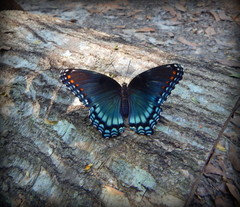
    Another big red-spotted purple female emerged the other day, and she landed on a log and posed for this picture -

    Sherry

  • 11 years ago

    Liz, I rarely ever find tiger swallowtail cats, even though they're pretty common. Like you, I think they use the tall tulip poplar trees in the bottom of the hollow, which are about ?80-100' tall. I once found a tiger cat on a leaf sprout about ?6' up the tree. I usually find tigers on wild black cherry, most of which are tall, and the cats couldn't be reached. But there are several that are growing at the base of big oaks and other big trees and never get too tall, just get wider. There's one in particular at the base of an oak that I find red-spotted purples on over and over - it's where I found the two yesterday, plus the eggs. Also, cherry trees come up all over the place, so there are always some small ones with leaves close enough to the ground that I can reach them. I have also found tiger cats on wafer ash/Ptelea trifoliata, which is a small tree or bush, and I once found a tiger cat on some lower leaves of a sweetbay magnolia/M. virginiana. There are undoubtedly many other tiger cats on the sweetbays too high up for me to get, just like there are undoubtedly many RSPs and tigers on the tall cherry trees.

    Same way with sassafras, some trees are tall and have leaves/branches too high to get cats from, but there are some young ones coming up where I find cats, plus some in my garden that I prune to stay short and bushy.

    Oddly, butterflies actually like to lay their eggs on saplings. You'll find a lot there if you plant them.

    Gotta go check the RSP eggs!

    Sherry