Software
Houzz Logo Print
zenimsaj

Soil Compacted with Roots - Aerate?

11 years ago
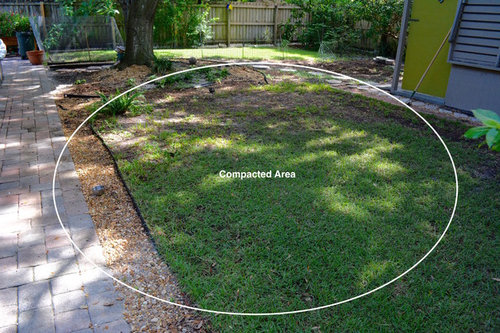
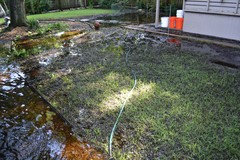
We live in West Central Florida and our yard has mostly sandy loam soil. It's nearly impossible to dig even an inch because of the amount of roots everywhere. Not sure if the roots are coming from our large oak tree or if they're remnant from the multiples times we've attempted to put sod in the backyard over the years. What I'm wondering is, would aerating even help if it's not necessarily the soil that's compacted but the dense amount of roots?

Comments (19)

  • 11 years ago

    Roots should be breaking down on their own, leaving air/water channels and organic matter behind, if they're dead.

    If they're not breaking down, either they're still alive or there's nothing there to break them down. Judging by the look of that grass, at least some of those roots are theirs and doing just fine. I don't know how far tree roots will extend, can't say anything about that. I wonder whether you've put down any pesticides or similar that might have killed off the bugs and microbes that would normally eat away the dead roots for you.

    Killing the live grass is easy enough. Mulch heavily right on top of it. It doesn't need to be any kind of special mulch, wet cardboard or even a pile of cut grass clippings will do it. Just cover it completely enough to block all sunlight access, and wait a while.

    Have you considered building up instead of digging down? There's a technique known as lasagna gardening that's pretty simple: start with a layer of cardboard (or multiple layers of newspaper) right on top of the sod to kill the grass, then build up alternating layers of "green" (nitrogen-rich) and "brown" (carbon-rich) organic material, and let it compost in place over time. You can plant straight into it after it breaks down a bit (or if you include finished compost in the layers), and when you've finished your growing season, you just throw on more layers of material to replace and continue improving what was used and amended the soil.

  • 11 years ago

    Tree roots can spread a significant distance - as much as 2-3 times the height of the tree - so I'd guess the compaction is due to the very dense mat of feeder roots generating from the large tree in the background. Aerating won't really help with that - it is what it is - and could very well cause serious damage to the tree if attempted.

    What is it you wish to attempt to do here? Improve the lawn? Lawns are very difficult to grow in that much shade and with the presence of large trees nearby. A more shade and drought tolerant groundcover might be a better fit. Or just mulch the area under the canopy of the tree that is now bare. And you want to be very careful changing the grade or constructing a lasagna bed that close to the tree. Increasing the soil grade over the root system of established trees will smother the roots and eventually kill them.

  • 11 years ago

    I too am wondering what the goal is. If the tree and the lawn are doing OK...well, why do you want to dig a hole?

    Oak roots should be quite different in appearance from grass roots, by the way. If the oak tree has a lot of shallow roots, it may be due to shallow watering of the lawn. Unless it's a type of oak that has shallow roots. The ones I am familiar with - northern red, white, pin, burr - are deep rooted.

  • 11 years ago

    While most oaks do not produce a lot of surface roots, they - like the vast majority of any other tree species - will have the major percentage of their root system within the top 12-18" of the soil and the feeder roots of any tree will be located just below the soil surface. And fine feeder roots can produce a very dense, mat-like structure that can be difficult to penetrate with normal garden tools.

  • 11 years ago

    Well, the problem is that area between the grass and the tree floods pretty badly. Water just sits on top and takes a couple days to soak through. So I guess what I'm wondering specifically is what can I do there to keep water from pooling? Aerating won't do anything, grading could damage the tree roots, grass won't grow because of the roots and mulch just gets swept away by water. I've tried ground cover (perennial peanut) and it didn't grow.

  • 11 years ago

    We got 10" of rain last weekend and this is what it looked like 24 hours after the rain stopped...

  • 11 years ago

    This is a drainage issue which goes beyond soil compaction or tree roots. Is this something that occurs throughout your whole neighborhood?

  • 11 years ago

    The streets flood in the neighborhood very easily, yes, but our neighbors yards (all with lawns) don't flood

  • 11 years ago

    Would raising the floor of the porch up help at all? It's ground level right now (7" lower than the house). If we raise the porch and remove those pavers, that's 7 more inches we could grade the soil away from the foundation.

  • 11 years ago

    Drainage issues such as you describe are best addressed not by the homeowner but by a landscape professional well-versed and skilled in addressing these matters. Grading may be advised, however the presence of the tree prohibits much. But diverting accumulated water way from both the house and garden and to a suitable drainage collection system requires some professional input.

    jz thanked gardengal48 (PNW Z8/9)
  • 11 years ago

    You probably won't need all of that 7" but it sounds like a good idea. It wouldn't disturb the roots of the tree to add soil on top, as long as it's only a few inches. I have to agree with Gardengal, if you're expanding this project to that extent, a pro might be worthwhile. Even if you just pay them for a detailed plan and move the dirt yourself.

  • 11 years ago

    A plug aerator with the plug holes filled with sand will tell you if the problem is thatch. I would also look to see what is daming the drainage. You don't want ponding around the house regardless of how good your drainage is. Becareful about adding soil over a tree's roots.

  • 11 years ago

    Yikes, 10" is a lot of water. What are the pavers on the left? Is that a driveway or a patio? Were the streets flooded when the pic was taken? Is that water backing up into your property or is this separate ponding?

  • 11 years ago

    Pavers on the left are part of the patio that surrounds the porch. The streets were flooded, water backed up about 3 feet onto the driveway.


  • 11 years ago
    last modified: 11 years ago

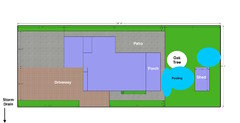
    Ok, so the ponding is in the back yard and separate from the street flooding. Looking at the plan you provided, what is below the lot. It almost looks like it is a corner lot because of the way that the driveway is shaped.good job on the plan btw, that helps a lot.


  • 11 years ago

    it's not a corner lot. There's a house next to us on both sides and behind us.

  • 11 years ago

    Do you have a drain line that takes downspout water from the back of the house out to the street or do you just discharge onto the pavers?

  • 11 years ago

    No drain line. Water just falls off roof and travels down pavers into the backyard.

Sponsored
Peabody Landscape Group
Average rating: 3.5 out of 5 stars8 Reviews
Columbus' Reliable Landscape Design & Contracting