Software
Houzz Logo Print
begonia2015

Light Meter: what is the correct dial setting to use for AV-s?

11 years ago
A few years into growing some AV-s (nothing large scale), I am still not 100% sure what is the IDEAL amount and type of light my plants should get.

I know all the theory (bright yet not full sun/direct) but in practice, it is not that simple. Because windows where the sun is not direct, they are not that bright to begin with, especially if you have some vegetation around, or the windows are not too tall, etc.

Also, if you supplement (which I do with some of my violets that I keep on a stand with fixtures) it is not clear to me how much the lights should go in addition to the light they get naturally during the day.

This stand I have is in the kitchen, against a south-eastern window - but with all the vegetation outside, it really doesn't get a whole lot of bright light, overall. At least this is what it seems to me because I am not sure HOW bright AV-s really like it.

So I have been supplementing with the light fixture that was going from 5pm until about 11 pm or so. I added about 6 hours to what they were getting during the day at that window.

Under these conditions, my Optimaras seem to get curly, hard leaves and sometimes turn a little stunted. The only one that does wonderfully here is my miniature Jitterbug. This might have to do with the fact that Optimaras are apparently bred for lower light conditions?...(nobody knows for sure).

So I remembered my light meter. The theory says AV-s want at least 500 candlelights and 1000 or so is best, if I am not wrong.

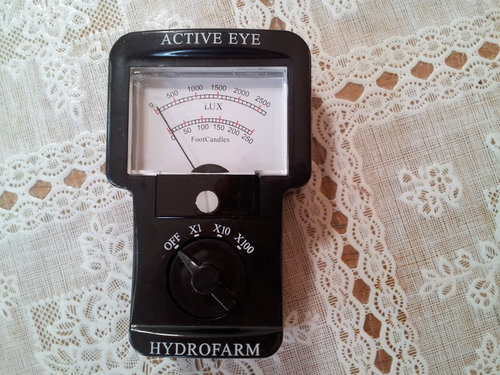
Trouble is I don't know which is the correct dial I should set the meter on when I measure the light the plants get (see pic below).

If I set it at x1, the meter indicates plenty of light - just right.

If I set it at x10, it is below 500.

(The x100 setting doesn't applt anyway, because I understood this is for outdoor plants in full, intense sun).

When I read the instructions for this meter, they say that the x1 dial should be used for fluorescent conditions, whereas the x10 is for when you use the sun.

Trouble is during the day, I do use the sun - but given the light must be indirect/diffuse/soft, I ma not sure whether I should measure at the x1 level or at the x10?

Because at x10, the meter barely moves above zero.

I want my violets to get plenty of light for maximum blooming, but not so much as to harden, to become stunted, with curled down leaves and to lower bloom production because of TOO MUCH light.

How much is too much and how little is too little...there seems to be a pretty fine sweet spot that is not so easy to catch. My plants do bloom here and there but not as profusely as I would like them to. Yes, I also fertilize them regularly, do all the other things as correctly as I can.

I am just trying to nail the IDEAL amount of light.
Any suggestions will be appreciated, especially re: the dial setting of the light meter. If I know which one must be used (x1 or x10), I will have a better idea of what is the ideal level of light for AV-s.

Comments (10)

  • 11 years ago

    good point Rosie, there are only so many windows so you do what you can, LOL!

  • 11 years ago

    AND it doesn't stop me from getting leaves or buying more! Like the 4 that followed me home yesterday!!!! I'm so bad, Rosie

  • 11 years ago

    LOL!

  • 11 years ago

    I have a light meter also but haven't used it in years. I let my plants tell me if they are receiving sufficient light. And I think the duration of light may be as important as the brightness. Some plants will do fine in low light as long as they are exposed to it for a longer time.

    Standards in general need lower light than miniatures which is probably why your Jitterbug is doing well on your stand while the Optimaras are a bit unhappy. This is one of the reasons I stopped growing a lot of Optimaras; my conditions are generally too bright for their happiness.

    Also keep in mind that violets are all individuals. The light conditions that make one plant happy may not work for the next one. Its a constant challenge to find just the right conditions for each plant!

  • 11 years ago

    Thank you, all. I just wish I knew what they mean when they say "at least 500 candlelight". Again with the the x1 setting, the meter shows great lighting (around 1000 - perfect). But if I set it on x10, it indicates insufficient light pretty much everywhere, including in a relatively bright (but not sunny!) window. The x1 setting is supposedly intended to be used for fluorescent conditions, and the x10 for sun. But since we don't grow AV-s in the sun and we use fluorescent lighting to approximate the bright but indirect natural light AV-s love, then why would I not use the same setting (x1 for flurorescent) to measure window lighting too?

    To approximate light needs based on plant behavior might work if you know for sure that those curly, harder leaves the Optimaras seem to develop, really have to do with too much light and not something else.

    The Jiiterbug miniature loves it under the fluorescent lights and has very smooth and flat leaves. It came back from the dead several times.

    At the risk of digressing, is it correct that miniatures are believed to be hardier and more profuse bloomers? At first, I didn't find the idea of growing miniatures too appealing - this is why I only have 1 of those. I am not crazy about plants that are too small - but given my only miniature is the one that has resisted longest (including through harsh treatment) and has also bloomed the best...maybe I really should consider getting more of those.

    The standards seem very sensitive to me. I lost countless to the simple mistake of letting them go a bit on the dry side and then watering them - and the fluctuations seem to upset them to the point of no return wilting (root rot?). Not that I was ever able to distinguish the "healthy tan" from the brown/rotten roots - but I suppose it was root rot every time.

    So if you can confirm that miniatures are considered hardier/bloomier, I would like to try more.

  • 11 years ago
    last modified: 11 years ago

    I don't know that one size or the other is actually harder to grow. I think it has more to do with what do mini's need? What do standards need?

    It is like painting with oils and painting with acrylics. They are both using paint, but you have to paint differently with each one.

    So you learn the requirements of each one and see if you are willing to adapt. I grow violets from micro minis all the way up to Supremes. (Supremes are larger than standards)

    Some things are the same but some are different. I just adapt because I want to grow the diverse sizes.

    As far as one being easier than the other, within each category you will have one easier than the other.

    If you are growing a semi mini now and are successful, well, try another one! But remember that one could be easier OR harder than the one you are currently growing!

    Kinda like kids,,,,two kids but one is easier to raise than the other one. Just take it one step at a time and don't look for trouble if non presents itself. Take a deep breath,,,,,,get that next violet,,,,,,,,and take it one day at a time! Good luck!!!! Oh and keep reading the posts (old and new) in this forum. AND ask lots of questions and show us pix!!! Lots of good advice here.

    By the way,,,,,,like you I can't tell the difference in the "healthy tan" from the brown/rotten roots. Sometimes I can not tell that my soil mix is too heavy! Until very bad happens. And I lose the violet or my precious leaves that I traded or paid postage for, Oh my then I cry!

    Just take it slow. Start with only one more at a time until you get the hang of that new size. And Good luck! Rosie

  • 11 years ago

    I use a light meter. I have many windows with foliage seasonally. Also the house is corner north, corner south oriented so the sun is much stronger in the winter than in the summer.

    The light meter is limited by many variables. I have one area where the light registers 250 at x1. But there is a mirror behind the plants. It is the best area for rooting leaves.

    I have a window sill where the light just registers at 10x. The plants there thrive and bloom year round due to trees in the summer and strong light in the winter.

    I have counter that receives the same light, 10x but it is brighter for a longer period. The window sill is narrow and the light is morning intense, afternoon dim. The counter is bright, bright bright from dawn till dusk due to a large window and a glass door. That counter I have to watch carefully because some plants seem to thrive but some burn. Leaves do not set there, turning brown and rotting fairly quickly.

    I have a living room coffee table where no plant should grow but due to the more direct sun from the large windows in the winter, plants grow and bloom there for a few months although they can get extremely lopsided and odd looking if not rotated faithfully. This area barely registers on the meter most of the day but somehow the light is enough for blooms.

    I bought the meter and found that what I had previously noted through the areas I had discovered through trial and error were what I thought. What I had seen was confirmed but not necessarily reflected by the meter. Somehow that coffee table received enough light in the winter but reads very low on the meter.

    I believe that a good meter would have to be a 24 hour light catcher with some type of averaging system. Taking a reading even several times a day doesn't tell you how much for how long. I have found trial and error to be a better method of finding the right light but it is frustrating to have to watch the plants carefully and move before any significant damage is done.

    I have the light meter. I use it but I also take into consideration variables, such as time of year, cloud cover, mirrors or bright surfaces and of course, heat and humidity.

    Light meters only measure one thing, the intensity of the light at one moment in time. My light meter is one part of a total equation and is useful only as a portion of the entire equation.


  • 10 years ago

    Hi Begonia2015, I can answer your question about how to use your light meter. Basically, you always start with the lowest x1 setting. If the signal is maxing out the reader, then you go up to the x10 setting, and you multiply what you see on the dial by 10. The reason why they say start at x10 for sun, and x1 for light, is just because usually the sun is much brighter, and full sun will always max out the x1 setting. But, I recommend that you always start at the x1 setting. If the reading is near the higher end maximum, then switch over to the next highest setting, x10, and so on. Multiply the result you see by the number after the "x".

    For those of you reading this who use digital meters (versus the analog type pictured above), the numbers should be automatically adjusted at the x10 setting already (i.e. no need to multiply by 10). But the principle is the same, start at the lowest setting, and then try the next highest if number reading at the high end, to see what number you get. No matter what kind of light meter you have (digital or analog), the numbers will be approximately the same at the x1 and x10 settings, when you factor in the correction factor.

  • 10 years ago

    Thank you so much, jwv24! I had figured out that the 10X is best used in full sun and it picks up where the meter maxes out on the X1 setting. What I wasn't sure of was which setting is usually used for AV-s. In other words, if I use the X1 setting, and the meter registeres somewhere between 500-1000, does this indicate an adequate amount of light? I assume so because the AV-s want bright light but not direct sun - so I am always using the x1 setting. If I am on the X10 setting and the indicator is barely above 0 (say at 100)...that means we have a 100x10=1000 candles which would be the same as the needle registering at 1000 on the x1 setting - so good.

    It is my understanding that in order for AV-s to bloom they need a minimum of 500 foot candles ...and ideally between 1000-2000.

    I am already starting to figure out by the behavior of my AV-s that they probably have been getting too much light where most have been sitting, which is on a stand placed against a south-eastern window where they also receive a few hours of supplemental artificial light, with the light placed about 7-9 inches above them. I wish I was able to lift the light further above the plants but the shelves are not adjustable, so I have reduced the hours instead. Trouble is they also receive some direct afternoon sun, though most of it is filtered by some trees.

    All in all, it is clear they are getting too much light because as soon as AV-s spend a few weeks there, the crowns start coming in kind of small and tight, stems shorten and leaves curl. I have moved some of them on the lowest shelf of the stand where they don't receive direct light as there is no window at that level...and I have also reduced the artificial light...so we will see if they straighten up. The meter easily registers over 2000 when on the x1 setting.

    I also have a smaller corner stand right between an eastern and north-eastern vindow (no supplemental light here) but based on what I have noticed, these too seem to be getting more light than they would like. For a few hours, the sun still kind of shines right on them from above, even if it is just morning sun. Being in the South, all summer sun is hot enough sun, I suppose.

    Things will change though with the colder season coming so my eastern ad south-eastern windows may be just right by the end of September.

    Thank you again!