Software
Houzz Logo Print
shedthechrysalis

I'm almost scared to ask, but what's wrong with my maple? Help please

11 years ago
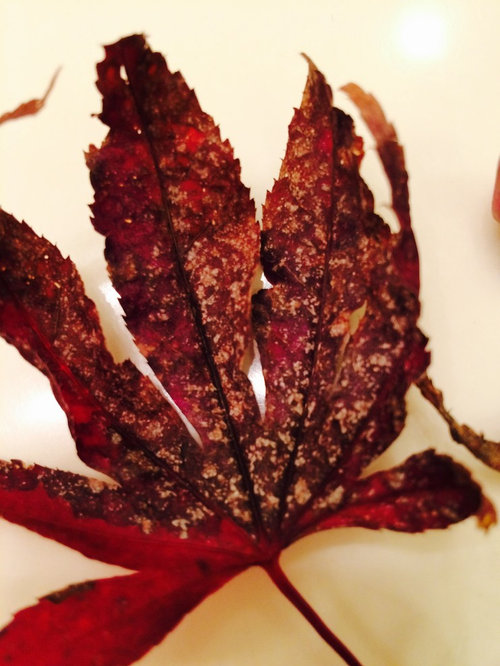


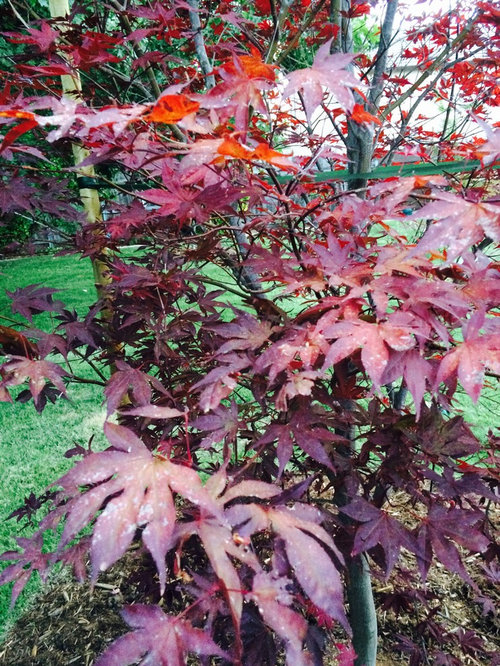
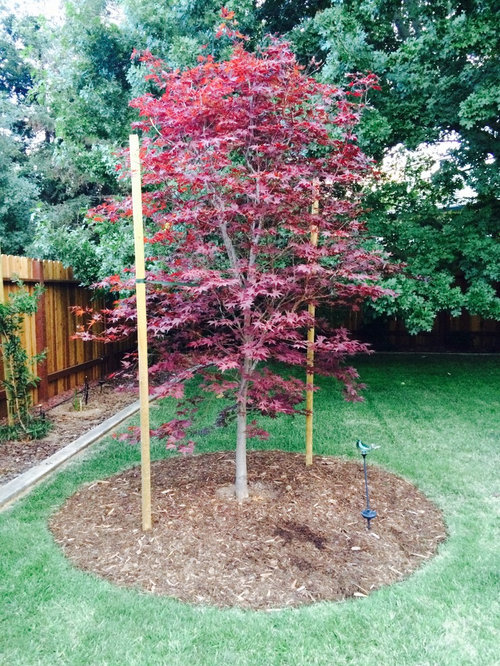
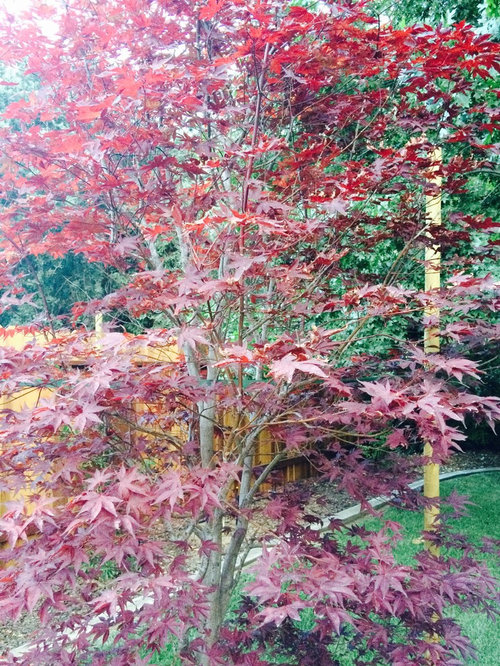
Hi fellow maple lovers! I went a little over board this year and planted 3 Japanese maples in the middle of our lawn. One is doing very well with no issues (knock on wood), one is a little crunchy because it gets more sun that the others, but this one I have no idea what's going on. I bought this lovely tree in May and we planted it the first week of June. Yes, I know it wasn't the ideal time to plant it but it came in a 36 inch box and the only location that could accommodate the tree was right beside the house where the sun beats on the wall all day long, where the leaves were staring to get a tad crispy already. Anyhow, we dug the hole and had to rent a pallet jack to get the tree to the hole. When we took the side off of the box, we saw that originally, the tree had been balled and burlapped. How many years ago, I have no idea. The roots had grown out of the burlap and were in fact starting to circle in the box. Luckily, my father in law, who runs a huge orchard, was helping us with the tree and was able to trim the circling roots. About 1/4 of the roots were removed, but it was still left with quite a significant amount of roots. The tree is planted an inch or so higher than the surrounding ground and the soil is not amended per advice I received here. Our native soil is nasty clay, but the top 2 feet or so is a fill dirt because this area used to be farm land about 20 years ago. The tree gets watered by the sprinklers. and gets supplemental water with the hose if the dirt feels dry, which isn't often. The soil always feels moist - not wet. The tree gets sun until about 2, and then our large oak shades it until about 5 when low dappled sunlight hits it.

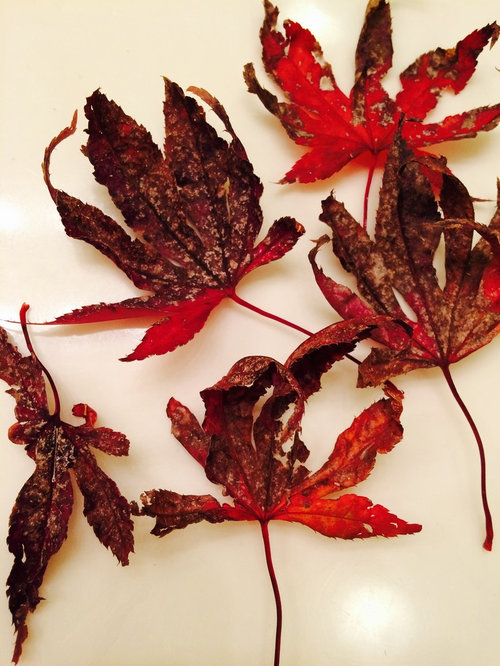
Up until the 2nd week of July, the tree looked great. Crunchy leaves started appearing on top, and then I noticed that some of the other leaves weren't crunchy at the tips, but almost looked like they were getting crunchy from the inside out, if that makes sense. There was a day that I rinsed off the tree with the shower setting on the hose because my neighbor got clumps of mud all over our fence and the tree from his rototilling. I thought maybe the leaves got wet and the sun hit it and burned them, but this problem is just getting worse.

Oh - I'm in zone 9 - California. This area has had a few days over 100, but mostly just mid to upper 90's this summer. The area I'm in does get a bit of wind from the Delta breeze.

If you've read this far, thank-you! I'd really hate to lose this tree. Does anybody have any advice? Thanks for your help!

Comments (9)

  • 11 years ago


  • 11 years ago
    last modified: 11 years ago


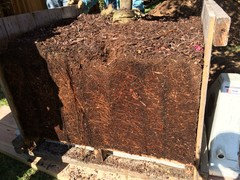
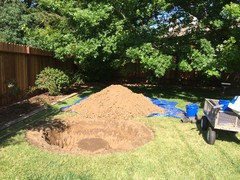
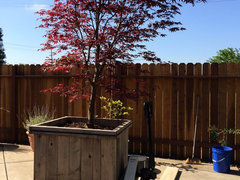
    This is the original planting hole, the tree in the box and a picture of what the roots looked like in the box. The roots that were cut were the smaller fine roots - not the larger, thick roots.

  • 11 years ago

    It appears to be some delayed transplant shock - not fatal but not necessarily a good thing, either.

    First, you already know this but I'm going to repeat........planting a JM in June in a hot summer climate that is undergoing an extended drought is just not a great idea. Period. The tree is put at an immediate disadvantage by doing so. A reaction by the tree to this stressful situation should not be unexpected.

    Second, I know it seems counterintuitive, but pruning off the roots is exactly what you should NOT have done. Those fine feeder roots are how the tree accesses soil moisture and nutrients - the larger roots are only for anchorage. So the tree is now working on a second disadvantage - trauma to the rootball (JM roots are very sensitive to disturbance) and a lack of feeder roots.

    What I'd suggest you should have done is remove as much of the soil on the top of the rootball as possible to expose the burlap, cut any ties (and gently remove) and then unwrap the burlap surrounding the trunk and remove as much from the top of the rootball as possible, leaving the sides - with fine roots growing through - intact. Cutting off these roots has given the tree a major setback. In fact, the nursery I am associated with now nullifies their guarantee policy if removal of the burlap disturbs the rootball excessively......it is that much of a disruption to the plant, especially during the middle of the growing season.

    Finally, I'd want to know about your watering routine. Using an automated sprinkler system to water a newly planted tree is usually not a great idea. In fact, I discourage it. Most systems come on for a few minutes once or twice a day - this is not enough water for a new tree, particularly one of that size. And you can't tell just by looking at the surface of the soil or even down a couple inches if the soil is adequately moist down to a sufficient depth - it may appear adequately moist on the surface but be dry as a bone further down. Watering by hand, with the hose on a low trickle, for an extended period of time as often as necessary is a much better approach. The water needs to penetrate down into the soil profile at least to the depth of the bottom of the rootball and only low and slow will accomplish this sort of irrigation. A drip system or soaker could accomplish the same thing, but not a sprinkler system.

    So you've planted at possibly the worst time of year, you've cut off a major portion of the tree's feeder roots that supply its moisture needs and your watering program is not very suitable. Not a huge surprise the tree is reacting poorly :-) All you can do at this point in time is correct your watering practices and hopefully adequate water and cooler fall temperatures will encourage some new root development. I believe this to be recoverable but it may not be obvious until next spring and how well the tree leafs out at that time.

    Did it come with a warranty?

    shedthechrysalis thanked gardengal48 (PNW Z8/9)
  • 11 years ago

    If it does have a warranty, I don't think you'll have to use it.

    Gardengal brings up some very valid points with a good explanation, but overall a passable installation. Much better than most I've seen on this forum.

    Here's a couple of small points I'd like to bring up.

    Laying the tarp down to put the soil on is something I've done only once. It sure slows down the backfill process and unless you go real slow and be real careful, you'll snag the tarp time and time again, rendering it useless when you are done. How'd you fare?

    I just put the soil on the lawn and shovel it back in the hole and then rake the rest off the lawn and into the hole. Much easier...... and faster too.

    A little extra thing I do after digging the planting hole is hit the sides of the hole with a pick and then leveraging it a bit to open up cracks in the sides of the hole. This alleviates the abrupt interface between the hole and the sides of the hole.

    Mike

    shedthechrysalis thanked Mike McGarvey
  • 11 years ago

    Hi Toronado! It looks like some years ago the tree was plucked out of the clay soil and balled and burlapped. Perhaps it never sold, so it was placed into the box where the roots grew out of the burlap and started to circle the inside of the box. What I found interesting was that with all of the time that went by, all of the water and elements this burlap was subject to, not much broke down. This is why we decided to remove as much as possible, keeping in mind the roots. The top portion that stuck out of the ground was removed as well of course. The burlap was tied with what looked like rubber coated electrical wires. It probably wasn't but have you ever installed a ceiling fan? This wire was the same gauge - it was meaty! Thanks for the compliment BTW. My hubby is a perfectionist - he literally levels the planting holes and trees when they go in the ground. It's cute, but a little annoying when I just want to get the roots covered and out of the air.

  • 11 years ago

    Gardengal - I knew most of what you said going into this whole project. We didn't really plan to get the tree. I have always been a fan of japanese maples but due to the warm climate I'm in, I didn't think I could ever have one. As we started driving around looking at front lawns for landscaping ideas, I noticed more and more large beautiful japanese maples and really wanted the opportunity to grow one in my yard. Well imagine my delight when I was shopping at one of our local nurseries and that little beauty was 1/2 off! I couldn't resist! I also pinched my sciatic nerve moving it and stayed home for a week unable to walk, but that's a different story :) Anyhow, the nursery delivered it but the only location we could put it on was on the side of our house with full unrelenting sun from sun up to sun down. The week that it was there in the 80's it was already showing signs of not being happy. So - we took our chances. The nursery does have a 1 year warranty but I'd prefer not to use it and am willing to do what it takes to baby this tree. We do primarily water with a sprinkler system. Approximately 3 times per week at 15 minute intervals. This tree gets hit with 2 separate phases, so 1/2 hour 3 times per week. My hubby checks it with a 3 foot metal rod that he pokes through the soil just out of the reach of the roots. We supplemental water by letting the water trickle from the hose slowly, but our soil seems to really drain and retain water, so we don't need to do that often. I don't want to drown the poor thing on top of everything else it's going through :(. I appreciate your help though. I've read quite a few of your other posts and you seem very knowledgeable. Would you recommend a better way to test the soil for moisture?

  • 11 years ago

    Hi Mike! My hubby likes to use the tarp because he doesn't want to damage what's left of our lawn. LOL. We've actually used the same tarp and same method for 3 other trees. We've also used it in the back of the truck when we hauled in 4 tons of dirt to backfill a concrete area we removed and to fill a raised garden bed. It's held up quite well and I'm definitely not as gentle with it as my hubby is. His patience level is a 10 compared to my 4! :)

    We roughed up the sides of the hole with a skinny digging shovel. A pick axe probably would've done a much better job, but we don't have one and used what we could find. Thanks for the tips - we have some hydrangea transplanting this fall so I just might have to get that axe :)

  • 11 years ago

    Putting soil on the grass for a day or two won't hurt the grass and it's easily cleaned up.

    Using a tarp slows the whole process down. I did it commercially and couldn't afford the extra time removing the soil off the tarp.

    That skinny shovel is probably a clean out shovel, used for cleaning out a narrow ditch a trencher makes. A very handy tool in that regard. I have one.

    Mike

Sponsored
NME Builders LLC
Average rating: 5 out of 5 stars2 Reviews
Remodeling Company in New Albany, Ohio