Software
Houzz Logo Print
javiwa

MDF - new and improved?

11 years ago

I'll preface by saying I've done as much reading (on GW and internet) as I could these past few months before ordering our kitchen cabinets. Seems to be a 50/50 whether plywood box construction is 'better than' MDF. Really difficult to discern, too, when folks say MDF, did they really have junky particle board in front of them? And vice versa. Based on cumulative reading and DW leak last year (which resulted in cheapy particle board cabinet 'feet' disintegrating), we asked for (and paid for) upgrade to 1/2" plywood construction boxes.

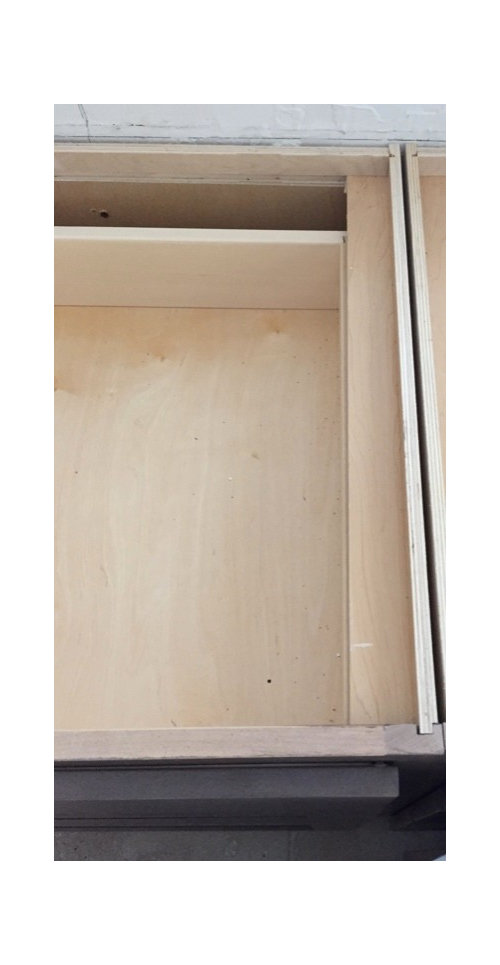
We received cabs where some (the ones w/o exposed sides) were indeed 1/2" plywood all the way around. (A big part of this is that I was very specific about upgrading to 'conventional' plywood boxes, and that's not what we received.) However, on some of the base cabs, back and unexposed side are plywood, but exposed end panel is, well, not sure what: some sort of MDF sandwich, for lack of a better term. This is left side of one of the base cabs - left side exposed (MDF sandwich):


Right and back, 1/2" plywood:


I'm now hearing that there is a "new and improved MDF" (HDF?) being used, even by high-end cabinet lines.

Am meeting with the cabinet company rep today, but would like to be separately educated: can anyone point to literature out there specifically about this new and improved MDF? Or is it marketing? And how would I know if what we have is the new and improved?

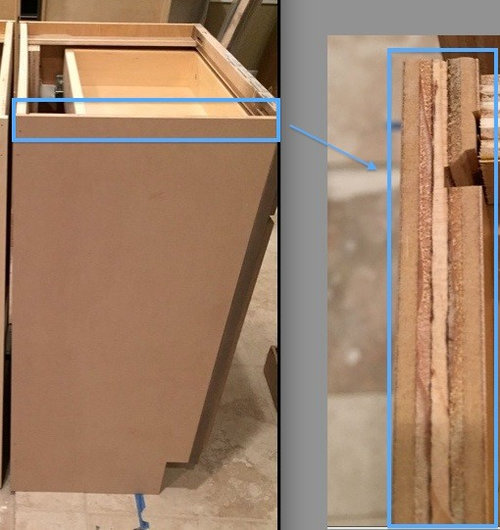
What also struck us as odd/inconsistent is that for these two lower cabinets (that needed to be modified in depth - 16" and 18"; they'll be parked back to back to comprise the end portion of our island), they used real plywood on the left cab and MDF (?) on the right cab:


And the composition of the panel on the right cab is completely different from the 3-ply MDF sandwich from the first cabinet shown -- here's the top view. Appears to be 'conventional' plywood sandwiched between outer MDF layers.


The cabinet boxes are otherwise well constructed, I believe, and the wash on the doors/drawers/faces are beautiful (i.e., exactly what we've been looking for!).

Any solid info on modern-day MDF would be appreciated. TIA!


Comments (6)

  • 11 years ago

    mdf is dimensionally stable (meaning it shouldn't expand, shrink or crack or do any of the things that wood does) and therefore is a great thing to use in certain applications. But here, where they used it kinda sorta in some places, your question is reasonable, they should be able to explain their rationale for different construction...

    javiwa thanked practigal
  • PRO
    11 years ago

    That's still plywood. It's actually specifically for the veneered finished end. The "mdf" layer will be flatter and have no voids for the finished veneeer layer to lay on. End result is a better finished end.


    As long as the two outside veneers are wood, it's plywood.

    javiwa thanked Taylor's Cabinets & Interiors
  • 11 years ago
    last modified: 11 years ago

    lazy_gardens: I appreciate your sending the link. If your comment "Why do people get all happy about composites..." is meant to be a generalization, then I apologize. But my query was specifically questioning the inconsistent use of materials (some including MDF, some not) in my cabinets, and trying to better educate myself on why MDF is just as good as or better than conventional plywood. I'm not griping about advanced technology at all, but am trying to find out exactly what that advanced technology is getting me. Regarding the MDF, it seems to be one veteran/pro's opinion over another. As a consumer watching this online ping-pong, and getting ready to spend a ton of money on a once-in-a-lifetime purchase, I need more to go on than, "Trust me, it's better." When our toe kicks and hardwood flooring were pulled apart after the leak, I saw that the old particle board bottoms (of the cabinet) were areas of dissolved, mushy sawdust. However, parts of the cabinet that were plywood, as well as our engineered solid-hardwood were fine (seemed structurally sound, in our opinion) -- intact and no warping. So, going into this purchase, and from our one-time experience, we were on the pro-conventional plywood, anti-anything-but-plywood side. Just trying to figure out the "anything but plywood" materials.

    practical: thanks. MDF - yes, that's what I keep hearing. But I also hear/read just as many woodworkers/carpenters recommend that MDF shouldn't ever be used (water absorption and disintegration is cited). Maybe this is wrong of me, but I'm assuming those who work with wood products would know from first hand experience...could be a bad assumption, but that's what I tried to sort out.

    Taylor's: Thanks -- our rep did a nice job of explaining to us why they used the MDF on the end panels (i.e., a much flatter surface on which to adhere the 1/32" maple veneer"). When the general public sees/reads/hears/uses the term plywood, we mean 'conventional' plywood -- our rep conceded this point. So, when a customer orders "all plywood box" construction, we're expecting conventional plywood to be used. It doesn't go over well to have non-conventional appear in the kitchen and then be told (after the fact), "technically, that's still plywood...plies of wood." I think that discussion needed to be had during the ordering process.

    What made matters very difficult for us is that our dealer/KD also thought we were getting conventional plywood, and plywood was spec'ed on the invoice. Our meeting went very well with the rep, and we're rallying, taking a leap of faith that the MDF composition will be perfectly fine, and moving forward.

  • 11 years ago

    MDO, which is ply with an outer coating of MDF, is what most cabinet makers have transitioned to for painted flat sides of cabinets. You don't get the swelling shriveled up snakeskin look that can afflict painted ply with a thin inadequately water based glued surface layer combined with a water base coating.

    javiwa thanked User
  • 11 years ago

    Thanks, Sophie. We went with stained/washed (they're beautiful, BTW!) instead of painted. Given we specifically ordered (and were invoiced for) plywood, I assumed the cabinet end panels would be stain-grade maple plywood. I'd read maple doesn't accept stains uniformly, but we (KD and I) were very pleasantly surprised that the stained maple door sample was very nice. Why would they not simply have continued the theme and used conventional plywood, stain-grade maple end panels, and similarly stained and washed the end panels to match the faces and drawers/doors?