

help with my design!
Re-posting here b/c no one in the 'landscape design' forum commented.... seems this forum gets more action.
Hello, I've received lots of good plant-choice-advice from
several other forums... thought I might ask you guys if this design
would work well in my space:
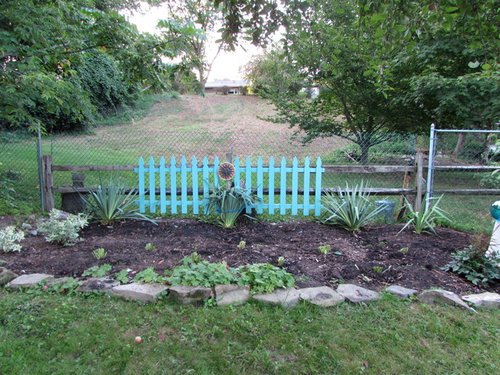
the yuccas, those are going elsewhere. The astilbe to the right and
the diervilla to the left will be relocated within this bed.
Here is the proposed new plan drawn to scale:
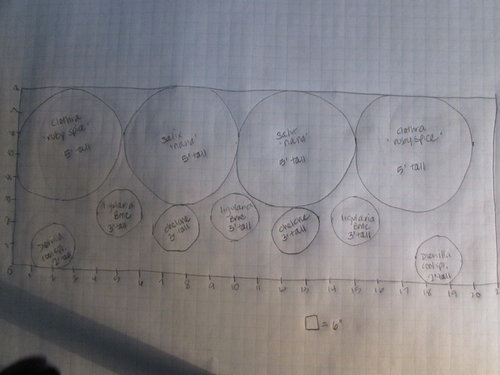
L to R back: clethra ruby spice, salix nana, salix nana, clethra ruby spice
L to R front: cool splash diervilla, ligularia britt marie crawford,
chelone obliqua, ligularia bmc, chelone obliqua, ligularia bmc, cool
splash diervilla
I can prune back the willow if it outgrows the 5' width I've allotted.
To me, it looks OK on paper but it's hard to visualize a scene here.
Any changes I should make? Anything I should know about these
varieties that may make a difference in the scene as a whole? I haven't
grown most of what is shown here ever before.
I will probably dot some astilbe in the front, and I have some
geranium growing too along that front border that I'm hoping will fill
in some void space.
thanks!!
Comments (58)
 11 years ago
One thing nobody has talked about is those Yucca. Removing them can be a nasty chore depending on how long they have been there. The roots are huge and it can be difficult to get them all out, just speaking from experience. Right now I would put my energy toward removing everything you want to eliminate now and let the rest wait till you start your class.
sherry
 11 years ago
Maybe the landscape design class I'm starting in the fall
==>>> oh god.. more planning.. lol ... you knock yourself out.. i am just kidding you ...
first.. ID what stays.. and what goes ... the existing backbones ..
second.. determine any new backbones... and get them in early next spring ...
in the mean time.. define the beds ... and work on building those.. and covering with proper mulch ... once the bed is there.. inserting and deleting things is easy ...===========
you also said: and I was planning to have it all done by the end of this season but that didn't end up happening.
==>>> that is what i meant by an evolution ... a garden is never done.. but if you dont start.. doing something.. anything.. odds are.. nothing will ever get done ... so i said.. just do it.. do something ...
get a can of landscape paint ... its made to shoot down ... and try some bed designs .. and if you dont like it.. the grass grows.. you mow it off ... and try again ...
do try to avoid straight lines with beds ... nothing in nature is angular ...
also work on buffing up that lawn ... it will detract from any great garden you develop ... assign such to hubby or some such .. delegate ... lol ... this is a 3 year project for most homeowners ... or hire a lawn company to do it faster ... a good fall fert ... will set you up for next spring ...
if you have bad clay;... i suggest a new post with that title.. to ask clay peeps... how they dealt with it from the beginning .... there is no reason you need to do everything in one post.. many peeps... once they post an answer.. dont come back ... so you force them back.. with different titles and posts ...
kenRelated Professionals
Birmingham Landscape Architects & Landscape Designers · Macon Landscape Architects & Landscape Designers · Denver Landscape Architects & Landscape Designers · Miami Landscape Contractors · Augusta Landscape Contractors · Gaithersburg Landscape Contractors · Lafayette Landscape Contractors · Worcester Landscape Contractors · Hackettstown Landscape Contractors · Logan Landscape Contractors · Honolulu Landscape Contractors · Florence Home Builders · New Haven Home Builders · Leominster Home Builders · Mission Viejo Home BuildersLauren W. (z5b - CNY)
Original Author11 years agoThose yucca were part of another project, I ripped them out from another area and tried transplanting them in the 'blue fence' bed before someone said I need to let the root dry out and plant them in the spring. (I was going to plant them back there after winter but, well, you know gardeners change their minds constantly), which brings me to Ken's point(s):
I guess by "having it done", I meant to at least get rid of the wreckage that is there now and put in some good bones. I have NO PLANS to ever be completely done, trust me. My mind is always wandering... just this season, I have some plants I've moved no less than 4 times! Maybe for those reasons, I try to be more of a planner (this applies to my everyday life too so I don't think that's going away any time soon!). Regarding the lawn, I have 3/4 of an acre... oy... thinking of freshening it all up gives me heart palpitations. But yes, I'm aware of its weediness :o/
So,
1) I will get rid of the straight edge
2) I will try to see that fence line as a whole, and not comprised of several separate parts
3) I will try to amend the entire area before winter sets in
You guys are the best!!
 11 years ago
No, don't get rid of the straight edge. Seriously, NO!!!!
I will try to explain why, though it isn't something I find easy to put into words.
You say you like symmetrical design. So do I, and so does Woodyoak. However, it is often very difficult to pull off with most plants, which are living things and behave more like cats than dogs. So the 'cheater' way of doing it is to have symmetrical beds but plant them with similar, but not identical things. It is an extremely common style of planting in the many house museum gardens around here, and works surprisingly well. The bedlines provide all the benefits of garden bones. They provide winter interest and a framework for the perennial parts of the garden. They are an organizing force, and turn a disorganized collection of plants into a garden. Doing it the other way around - organizing the plants into a garden of disorganized shapes is extremely difficult. To the point where it takes a very talented professional to pull it off. Such people are usually justifiable famous.The 19th century thought was that the house should be the center of straight lines and 90 angles. The further away from the house, the more natural things became. However, on a normal lot, there isn't anything far enough from the house to justify total anarchy. It is still taking its cues from the house.
- 11 years ago
I have to disagree with mad_gallica about the straight edges. Unless you have a very small courtyard garden or an expansive formal garden (a la Versailles), straight edged beds just appear boxy and unnatural. I realize that there are times when straight lines cannot be avoided (for example along a cement walkway or driveway), but even then, I think, plants should be chosen for their ability to encroach slightly, and to overhang enough to "soften" the edges.
I agree that bedlines do provide a garden with bones, but the bones are there whether the bedlines are unnaturally straight or curved and natural. Many successful symetrical gardens have curved bedlines that accentuate the symmetry without making the garden appear boxy.
P.S. I am probably in a very small minority here, but I love the piece of fence, particularly if this is right at the back of your property and this bed is in the centre. The colour is very arresting, and while it is distracting standing alone, I think if you moved it forward in the bed just far enough to plant some large white balled hydrangea behind it (or anything else that would put some white flowering height behind it) and framed it with some pink peonies (you will have to amend the soil, of course) then that little piece of fence would become, not a distraction, but a focal point for several seasons. Daffodil bulbs in front would add yet another season. Add a bird bath or a small statue that complements the look, and I thing the fence could stay.
 11 years ago
I am definitely with mad_gallica on the issue of straight lines being acceptable - and an advantage in many cases. The 'straight lines are unnatural' argument bugs me.... There are lots of straight lines in nature - consider rocks and soil layers in horizontal strata; consider the tall vertical lines of white pines, and other trees (and spike/spire flowers) that make vertical statements; consider the square stems of members of the mint family; etc. Horizontal lines and geometric forms are everywhere in nature if you pay attention. The straight lines and geometry of classic Renaissance gardens are commonly thought of in terms of a statement of power and control over nature. But the usually overlooked or forgotten aspect is that they were also the result of a seeking for the 'pure forms' in nature, making the garden a statement about divine cosmic order - the microcosm (garden in this case) reflecting the macrocosm. Philosophies aside, straight lines and geometry can have a very striking impact and project a sense of peace and order. 'Softening' the lines with abundant, relaxed plantings that blur the edges while not obscuring the underlying structure is effective and dramatic. It is the approach that made the gardens Gertrude Jekyll created in combination with the architect Edwin Lutyens so famous, and it remains a good way to structure a planting. The under-lying structure in such gardens continues to provide drama and interest even when herbaceous plantings have disappeared in the winter.
One important thing IMO when using straight lines is that corners are always rounded. Think about how grass is always worn away when two sidewalks meet in a T... Unless you're on parade(!), everyone follows a gentle, short curve when changing directions. (for example, the rectangular lawn in our backyard has rounded corners that are easy to walk - and mow on the lawn side.)
The 'curved bed edges' that have become common are often unattractive to me because they are too frequently wiggly lines, not smooth curves that flow well. I find short wiggles very 'busy', giving your eyes no place to rest. Curves that work IMO are ones that follow the natural contours of the land and follow the path that your feet would naturally take you when walking through the space. If you look at where you naturally walk getting from point A to Point B, that is usually a fairly straight line unless you have to curve to find the easiest route through uneven terrain or avoid obstacles. It is rarely, if ever, a wiggly line with lots of short curves strung together.So, don't rule out straight lines if they make sense in the terrain of your space and how you use it. Your course may help you with playing around with different approaches to see which appeals to you most. Experimenting with ideas on paper is easier, cheaper, and faster than doing the same experiment in the dirt! :-)
- 11 years ago
As you are discovering garden design is a lot to do with personal taste.
Woodyoak has said almost exactly what I would say. I am either with the straight line brigade in a plot your size or, if you are going to go with curves, make them bold and few. The worst thing is lots of meaningless wiggles just for the sake of it. And however wide you make a bed, it will almost certainly be better wider. Even if you believe there are no straight lines in nature, a garden isn't nature, it's an adjunct to a house and it's entirely artificial. Also heed Woody's injunction against 'business' This applies not only to structure but to planting. Lots of different shapes, jangling colours and blobby planting of single specimens never look restful. And note also what Woody said about straight lines for your framework but not within the plantings unless you are going very formal. Your original sketch has everything lined up. Imo it would look far better staggered or in waves. Leave the lines for the edging.
BTW the leaf shape on all your choices except the Ligularia is very similar and all the plants have a similar shape, if not size. How about something spiky, something vertical, something with bigger leaves? Lauren W. (z5b - CNY)
Original Author11 years agothanks floral_uk about the leaf shape comment, will take that into consideration when I do my new plan.
I appreciate your comments about the curved edges. I am thinking that maybe the more experienced gardeners here can appreciate the straight edge because you are able to create movement within the plantings themselves. I don't know if I'm skilled enough yet to do that, but again, maybe that is something my class will teach me. If I do go the curved bed route, I will make sure they are few and more sweeping. I have seen beds that have too many and just look ridiculous/unnecessary, so thanks for reminding me of that.
- 11 years ago
I just have to ask, what is the deal with those evergreen shrubs in the yard shown behind yours that are clipped like arrow-heads? Do they just shear them up to a certain height and then quit or what? Something rounded like a grouping of Ninebark shrubs would be good back there leaving just the tops of the neighbors shrubs showing above them from your view. There are several cultivars with nice leaf coloring for contrast and interest. You could add other plants among them, maybe something like three largish tall evergreen vertical elements for contrast & then add lower growing plants in front, extending the area as time goes by. These would be large plants that you will want to space out correctly and let fill in. Always watch your spacing, its a common mistake people make & it can be very regrettable. Ornamental grasses planted in groupings of threes -- switchgrass such as Cheyenne Sky or a weeping type like pennisetum (fountain) grass with that as a backdrop would be nice for adding texture, color and fall/winter interest.
What is the shrub that has red leaves in your yard? The sprawling one next to it, the one closet to the viewer in the picture and the mass of something back in the corner?
You need to ID what you have and determine if its something that can be shaped up and left or if it should be removed. They look like they have been neglected but if they are desirable shrubs they could be shaped up and used as an element to start to working around by adding other shrubs & perennials chosen to contrast or compliment them. Often just having something to build around makes things come together easier. Later as you start seeing plants that appeal to you, you can start adding what you like. Areas often begin to come together through trial and error. "Something red would look good with that......." or "Something tall and vertical would set that area off......." or "It needs more color......." "OHHH I really like that shrub, I think it would go great with the color of the _______ in the corner........."
Thats usually how it works.
It appears you are currently approaching this as if its a difficult geometry problem you will be tested on for a score. That is not a fun way to go. It should be fun. Plants can be relocated if something doesn't quite work at first and oftentimes an obvious solution will jump right out at you. I often change my mind after seeing the results. Thats part of the fun.
Its OK to start out with straight lines establishing your background plants for structure. Once you get into it and start discovering other plants you would love to grow, planted areas have a way of extending in width as time goes by; that would be a good time to start extending areas and curving the borders to create more planting space. Curves do look more natural in a typical yard and are better; a straight line border along a building or chain link fence will usually look amateur, uninteresting and stingy. Often (but not always) planting in groups of three or five's or seven's is good advice. Repeats make for continuity and rhythm.
A lot of different single specimens thrown together in one space is not usually good in the end so self control is needed because we sometimes want every plant that catches our eye and just plunk it in the ground with all the others that caught our eye previously resulting in a mis-matched mess of specimens. Its a bad habit, actually more of a vice for habitually shopping rather than a love of gardening-- needing to always be buying something new like people do with any shopping addiction.
If you really get into this, you will soon find you don't have enough planting area and will want to keep extending. You could work on it one area at a time as it looks like you are attempting to do in your drawing, then as time goes by you can add new areas so its not so daunting with the digging, clearing and soil prep, not to mention the financial aspect. I usually try to concentrate on one area (such as a corner for example) at a time when planting, cleaning or whatever because otherwise, its overwhelming.
Lauren W. (z5b - CNY)
Original Author11 years agotexas - I assume you're talking about the arbor vitae - those are on my property, at the entry to my backyard. They were there when we bought the house. The space on either side of that gate is kind of thin, so you can see they sheared them back in the middle b/c at points they were getting too fat. I don't know how hard arbor are to take out - they're pretty darn tall.
From L to R along the fence line in the 2nd photo is lilac, overgrown rose of sharon that has since been trimmed back a lot, and barberry. Right next to the barberry is a branchy spirea (you can't see it in the picture). I'm going to cut that way back and save it for next year. Those are the only things I'm saving. Oh, and a small groundcover patch of euonymus. You are right about the neglect, the previous owners were NOT gardeners and left the yard in shambles in my opinion, a serious shame because the people before them worked very hard on the landscape. I've been rehab-ing what I think is worth keeping.
I guess one of the reasons I've been so analytical about this space is because it's so large and I don't want to spend money on plants that don't quite work when I could've bought the right ones to begin with.
The grouping hypothesis is something I strictly adhere to, I definitely find it more visually appealing.
- 11 years ago
I just want to say something further about the curved / straight line debate. I agree entirely that they should be long, flowing curves and not tight little squiggles, because such tight squiggles are unnatural, too. i can agree that there are many places in nature where one finds amazing symmetry and straight lines (strata in rock for example), but you will have to search long and hard to find plants, trees etc. that plunk themselves in neat little lines. I am sorry, but I have yet to see a normal yard with perfectly straight beds that looks anything but contrived. Some people like the contrived look. I do not.
On a large scale, straight square, angular or rectangular beds with carefully planted symmetry can look impressive and formal, but it does not usually work in an ordinary size lot.
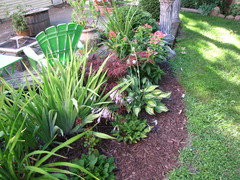
Imagine what this bed would look like if the bedline went straight across the front. I think it would be stiff and boxy looking.Similarly, the two photos below show the same bed. In the second photo, the front side of the bed is cut straight (due to road allowance requirements), whereas in the first photo, the house side of the bed is cut in sweeping curves. Which one appears more natural and pleasing to the eye?
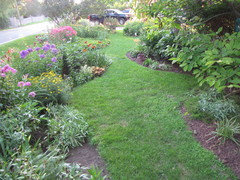
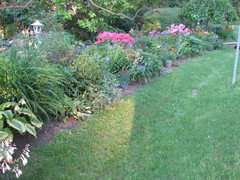
I don't think there in any contest. I have noticed that even in beds that are planted with one type of plant, curved plantings in curved beds still create movement of the eye where as straight lines in straight bed look static. I am not saying that they cannot be made to look beautiful from a colour and plant material perspective, but I firmly believe that any planting, unless you are going for the very formal, large scale mirror look, will be enhanced by beds that do not have acute angles and long stretches of straight lines.I do agree with those commentators who said that there will be differences of opinion based on taste. I do not see, however, that anyone can argue very convincingly that the straight line beds and plantings are not artificial, less "fluid" and more static than those that are sweeping curves, or where the linear expanses are broken up by rocks that jut out into the pathways, and plants that overflow the beds, undoing the straight planting that someone has tried to impose on them.
I have probably just started a war, but I would love to see what others think, and to see pictures of "straight line" beds (other than very formal plantings) that those who advocate straight line beds and plantings believe would not be enhanced by curving the beds, and the position of the plants in the bed.
- 11 years agolast modified: 11 years ago
I certainly like and use straight lines in beds - curves too when that is appropriate for the place and intent. But don't confuse straight line beds with straight line plantings - the one does not require/imply the other! Much natural growth consists of a clear, strong structure that involves straight lines and/or geometric forms. Think of a fern frond for example. The rachis - main axis - is approximately a straight line (with perhaps a gentle curve to one side and/or arching back to some degree). The leaflets' axis are also more-or-less straight lines going off at an angle from the primary axis. The pinnules angle off the leaflets and tend to be lobed around their own central axis - essentially a fractal sort of pattern; fascinating when you look at the detail. The uncurling fronds tend to be spirals - another mathematical/geometrical form. Consider the perfect Fibonacci spiral in the flowerhead of a sunflower, and other natural things. Those are the sorts of things that the illustrate what 'pure forms' in nature was about. The way I interpret it all as relevant to gardens is that nature has an underlying structure overlaid with a looser (more chaotic/random-appearing) final layer. That final layer can be showy and distracting, obscuring the underlying structure that is the foundation for the whole package that we find pleasing. When we look at gardens like Sissinghurst with it's strong structure that employs lots of straight lines in combination with abundant, colorful, relaxed plantings and find them pleasing, I think subconsciously we recognize the link to a pattern seen in nature (strong, often linear or geometric, underlying structure with lots of variety and show on the surface) and that contributes to why we find such gardens/plantings pleasing.
(Yeah, I know - I'm weird - I actually think about such things....!)
Here are two views of the front beds showing that there are curves, but not wiggles :-) In the view from March 2013 you can see the underlying pattern of the bed, but by the end of May, the plantings grab your attention first but the structure, particularly the 'river' of grass in the 'negative space' between the beds contributes strongly to the scene (2013 was the last year that both wisteria 'trees' bloomed in spring - nasty winters since hit the flower show hard!):
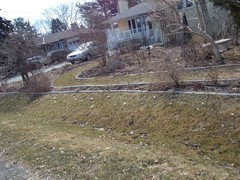
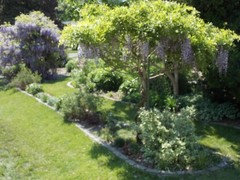
 11 years agolast modified: 11 years ago
(Edited to say that Woody and I were posting at the same time and I think may have made some of the same points.)
I think that there will be many varied opinions of what looks best, probably about as many different views as there are gardeners. I am afraid that I am probably not going to say what you expected - I like the last photo better. Perhaps it's a relic of the photo itself, but it seems to have a long gentle curve, but even a straight edge directs attention to the plants rather than the bed structure. In contrast, the wiggly edges of the previous photos look difficult to mow around and to me look contrived, without a reason or need for the curves. My bed edges aren't dead straight, but are more likely to have a long single sweep of a curve, or swing out to accommodate a plant that has grown wider than its neighbor, but not multiple curves of in-and-out edges.
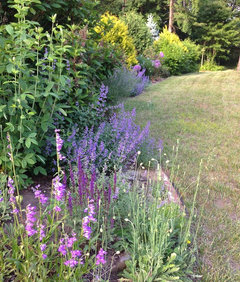
One term in this discussion that seems to me to be talking at cross purposes is the idea of straight lines. Edges can be straight without the plants being in straight lines (just look at some of WoodyOak's garden photos) or this photo from Marie's garden which has a dead straight edge that is virtually unnoticed against the riot of shade-loving perennials behind it.
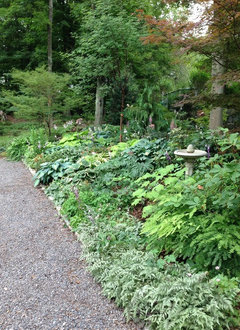
Also, plants can be in lines even when the bed isn't straight. A straight line doesn't necessarily mean a single line of plants; multiple lines of plants can add long season interest and a good depth to the bed. To my mind straight lines of plants, especially hedging plants can look quietly elegant (just look at some of Deborah Silver's Hydrangea hedges here or this link, or just rummage around on her blog to see where she fills a square of boxwood with a riot of tulips or annuals) - it just depends on the setting and the gardener's goals. While the examples linked above from Dirt Simple aren't something I would want in my rural garden, I can appreciate the beauty of them and enjoy the contrast between the billows of the hydrangeas and the straight lines of the edges.
- 11 years ago
I am not confusing straight line planting and straight line bed edging. They are obviously different, but whether the bed is straight or the plant material is planted in straight lines (or both), I still thing the general effect is stilted. In the link provided by NH Babs, the pictures where the Hydrangeas are spilling over the brick fence and where they are planted in the wide curving bed are much more pleasing to the eye than those where they are "contained" by the hedges. While the contrast between the hedge and the hydrangeas is indeed beautiful, imagine how much more flowing and pleasing would be the picture if the hedge was curved. 2000 acres of lavender growing in plowed rows is spectacular, but the only thing that separates it from a field of corn or potatoes is the showiness of the flower heads. The other pictures, in my view, make my point. In the picture which shows the long sweeping bed which widens at the end and then is rounded would look stiff were the sides straight, equi-distant from each other with squared ends. The bed alongside the gravel rockway in the other picture feels confined, and, I would suggest, that only when the plants in the bed, spill over more fully into the walkway, will it look unconstrained and fluid.
Several posts have "reminded" me of the many straight or near straight lines that occur in nature. I am not sure how talking about the intricate geometric patterns of a flower, or the fibonacci sequence found repeatedly throughout our natural world, is relevant to this discussion. However plants might emerge from their seeds, or unfurl their fronds or order their seedheads, they do not set themselves into perfect rows, and do not surround themselves with perfectly linear boundaries. To confine the garden to square beds is, to me, akin to confining a river to a cement canal. We have all seen this in our urban landscapes - a small river or creek running through a suburban area, is suddenly confined by a cement causeway so that it glows in a perfectly straight line from A to B. Aesthetically, the beauty of the creek is diminished, if not lost entirely. While it might be improved by strategically placed gardens full of colourful flowers, it will never have the beauty of the original creek. Consider as well how many people install small waterways and other aquatic garden features in a straight line. None that I am aware of, because that is not the way a body of water naturally flows. No one is going to create a completely natural looking waterway, but when an effort is made to do so, the result is often breathtaking. So, too, with flower beds and placement of plant material in the garden landscape.
Lauren W. (z5b - CNY)
Original Author11 years agoI have to admit I like the 2nd photo of keswick's also... the curves of the 1st are too exaggerated in my opinion.
For me, the most appealing is the edge that is somewhere in the middle, following natural contours.
- 11 years ago
The debate whether gardens should reflect nature in literal detail or through abstracting 'pure forms' has been going on for centuries and is unlikely to be resolved here :-) Both points of view have their merits. Individual tastes, though, tend to lean in one direction or the other. Given that things like symmetry and geometry are common in nature (look in the mirror for a good example of bilateral symmetry! Also consider the spiral form of DNA in the cells of all living things....) it's surprising that symmetry in a garden is seen as unnatural rather than as a reflection/artistic use of a pattern that comes from nature.
I'm not very good at 'painting' with Photoshop, but here is my rather messy attempt to show how I'd modify the garden in keswick's second picture to simplify the lines and make the space flow better by letting the grass become the route to draw you in and move you smoothly through the abundant plantings:
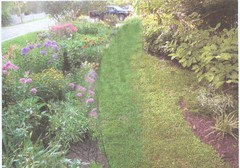
- 11 years ago
Something I decided years ago was that there was definitely a regional component to this discussion. While the eastern jungle has been beaten back, it is still very much a work in progress. Any land abandoned for a few years reverts. There were 4 ft saplings in the middle of the IHOP parking lot before Starbucks came in and rebuilt the place. It is a lot harder to build up nostaglia for 'nature' when it is very much still out there. When a short walk takes you to the real thing, why should somebody build a copy?
A picture of the neighbor's garden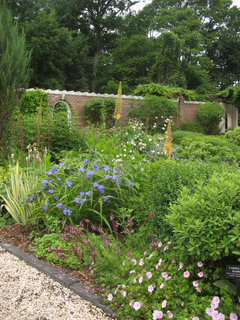
A picture of the neighbor's view from the other side of the garden

- 11 years agolast modified: 11 years ago
Woodyoak, that is a continuously flowing curved line you've made. A straight line or long square 'box' would not look nearly as pleasing.
Symmetry is always artificial and contrived but that doesn't mean its bad. Take the case with a symmetrical entrance for example -- symmetry is very effective, desirable and usually is the best solution. Its working with the structure in a good way. Knot gardens are another example. I've seen one large landscape where a grove of miniature trees were planted in an artificial grid pattern creating a feeling of distance and depth. Quite straight and intentionally artificial. Vegetable gardens are usually laid out in straight lines and can be worked in to look quite pleasing. There is nothing wrong with straight lines. Its all a matter of how you tie all the elements in together in the entire space.
Comparing to other things in nature is not applicable. That other thing (whatever you come up with) is what it is. A garden or landscape is what it is. They are two different things. Its a weak argument and rather irrelevant. You can use same argument to support just about anything -- gardening or other topics.
What is objectionable is: the common tendency so many people have of creating rigid, unimaginative straight line planting areas smack up against a fence or house following the line of the existing elements like a slave. It is irritatingly typical of many homeowners. There is no other or nice way to put it. If you seen one, you've seen a hundred. Just drive around any town or city.
Another common mistake is alternating two different plants in a straight line or alternating shrubs, perennials etc in a bed. That doesn't really work and the results look artificial and trite. You can rightly say this occurs in nature, such as in a striped leaf but its not a good comparison for an argument and it doesn't make the alternated plants look any better. This is a problem of imagination, an 'obvious' but clumsy attempt at creating order.
The sad fact is, stingy straight line beds along structures, fences or boundary lines with the expected border to separate them from a lawn simply looks corny and amateur. It does not add to either the house or the landscape. It merely looks as if something is required there so someone planted a plant there. Its as if the homeowner says "OK, that job is done, now what should I tackle next". I imagine its an attempt at creating order or its considered to be expected but it usually looks like a lack of knowing what to do with a space, an inability to visualize. Maybe the job simply seemed too daunting to try to dig out a wider more appealing space so an easy fix is chosen. The homeowner can relax and feel they have done the thing up right, it matches everyone else's. Forget layering plants, thats not even in the thought process.
I suppose some people cannot think outside the box when laying out beds so they tend to follow any line already there that is created by a fence or structure, others simply lack interest in gardening so they don't really care or see it in the first place.
The problem in this particular case is this. Lets say the little area in this big square yard was planted as shown in the drawing above posted by the OP. What do you do next? Do you create yet another symmetrical area done similarly next to that one only this time using different plants alternated? Then another? and another? Its a problem with flow & seems to show an inability to think of the entire space and how to tie it all together. Its as if the entire area seems too big so its easier to bite it off in small pieces of little self contained compositions. I would compare it to having a large canvas but instead of creating a painting, the artist covers it in several thumbnail sketches, each having its own subject, color scheme etc. That is the problem with the way this big square backyard is being approached as I see it.
Lauren W. (z5b - CNY)
Original Author11 years agoyou are right texas, I am still learning... so incorporating things as a whole is difficult for me. And the space would've looked 'staccato' the way I was going to do it - separate areas trying to unite but failing.
But what you are saying about people creating beds along existing elements or hardscape I think is only natural, right? I have retaining walls and fence lines and porch borders all planted around, is that wrong? I try to do the best I can, and I thoroughly enjoy gardening. I know my gardens don't touch some of those posted on here, but I'm learning. Maybe those artificial and trite landscapes you've seen are others still learning too...
- 11 years ago
The Landscape Design forum used to refer to this as 'perimeteritis'. It is something a geometrical layout is very good at overcoming. Most things just plopped in the middle of the yard look like something plopped in the middle of the yard. However, if you put something in the middle of the yard, and connect it to the corners, it starts to make sense as a pattern.
- 11 years ago
Lauren, when you ask for help or opinions you will get them. If its confirmation and strokes you are after then you need to phrase your post differently. I've taught art classes and the thing I most hate are those students who are overly sensitive and who think each attempt should be an instant masterpiece without practice or experience. They say they want to learn but get their feathers ruffled at the slightest critique and always have personal reasons for all their choices as they argue away or pout. I am my own harsh judge with both my garden and art. I am always making changes, trying to observe and fix my own stupid mistakes and I appreciate constructive criticism as long as its not intentionally revengeful or malicious.
If I just want a hand-hold, a back pat or to have someone boost my fallen ego there are people I know I can ask, their flattery is soothing and cheap but its not helpful.
and....You don't need to defend all those other poor people "still learning too" as if I have cruelly mentioned them out of spite or insensitivity. Are we children or what?
Lauren W. (z5b - CNY)
Original Author11 years agowhoa, it was just a simple comment, no need to be rude.
I just tend to disagree with what you said about planting around hardscape or existing elements. Can two people agree to disagree?
- 11 years ago
Rude?
I've never said its wrong to create beds around or along existing structures or boundaries. Where do you get that?
My comments were intended to address the subtopic of straight lines vs curved that came out of this discussion, an interesting topic by the way which I now think might be better picked up in a new thread.
My comments referred to people in general (the ones you felt compelled to defend as still learning). You and your specific yard were not the main 'topic' concerning the more general subject of straight lines and stingy borders. Most serious gardeners would know what I am talking about, it's a common enough mistake.
My specific comment about your particular landscape is in the last paragraph.
Lauren W. (z5b - CNY)
Original Author11 years agomiscommunication I guess...
you mean like this?
I don't have that, so maybe I'm safe so far? ;)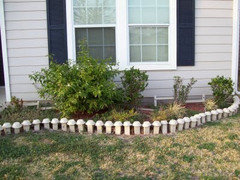
- 11 years ago
Going back to keswick's photos, I have to say the wiggly grass area is not to my taste either. It is fussy and looks amateurish to me because there is no practical or topographical reason for those curves. They seem to be there just for the sake of it. And the bed around the deck looks skimped. I'd take woody's simple curves every time. But the one I really love is the neighbour's garden.
Taste really is very individual and is also a product of what one is used to.
- 11 years ago
Floral, I would be the first to admit that I am an amateur gardener and not a professional. Even as an amateur, however, I know that if everything one does in a garden is practical or topographical, one runs the risk of creating a space that is utlititarian, bland and lifeless. In any event, I would argue that there is a topographical reason for those curves, i.e. the area is completely flat, and one long curve (which was how I did fashion the garden when it was originally planted and which was infinitely better than what a straight line, rectangular bed would look like), simply did not have the same "movement" as the undulating curves that are there now.
And, at the risk of sounding defensive, the amateurness that you refer to is part of a front garden that on three separate occasions has been awarded "Best Front Yard Garden" in our area where there are some remarkable gardens, with the judges being landscape professionals and Master gardeners (I am neither). Interestingly, one of the judges, in his comments, said that the only suggestion he would make to improve the design of my front yard would be to somehow break what he referred to as the "monotony" of the straight edged side of the front bed that faced the road.
Taste is very individual, and it appears that it may be regional and cultural, too.
- 11 years ago
I enjoy the planning and drawing out a design. I also think through what height the bushes/flowers get. I am faced with the same dilemma. My neighbor rarely cuts his grass, the sun comes from his side of the yard. If I put up a privacy fence, I will block out some of what my garden thrives on. I desire a focal point of interest since it is one of the first things you see when you pull in the driveway. Previously there were black raspberries and a huge collection of tall (Man sized) weeds. They are gone, the raspberry bushes have been pulled out. I was thinking tall grasses only reaching 6 foot since it is about six feet away from my garden and I don't want the grass to shade the garden at all....but it would provide a natural backdrop to put up something that could be iconic from season to season. Your area looks so much like my area....it's crazy.
Lauren W. (z5b - CNY)
Original Author11 years agoyes, we all have highly varying taste. There's technically no right or wrong (just personal preference), although I do often find myself trying to find what's 'right' even still....
Here's a link to a blog I follow, one of my favorites:
http://awaytogarden.com/putting-a-fine-edge-on-things/
This is my kind of edge, still gracefully following contours, and straight in spots too.
hitch - would love to see photos!
- 11 years agolast modified: 11 years ago
I have the same situation as hitchman. The neighbor dictates many things I can and cannot do because of shade, the view, height of trees, unkempt property line etc. Its frustrating to put it mildly. There are angles of my garden showing the impossible to hide backdrop that I don't even want to show here because it looks like a mess.
I've never believed that saying "There's technically no right or wrong (just personal preference)". It sounds like an excuse and besides that, its meaningless & empty. It leaves no opening for intelligent discussion or a way to assess anything. That type of excuse is used to describe so many different subjects anymore that its become ridiculous; it seems intended to make everyone feel good about themselves whether they have accomplished anything or not.
Of course there are rules--- right ways or wrong ways, attractive or unattractive, balanced or unbalanced, order or overwhelming chaos, rhythm or visually jarring effects, etc.
There is also ignorance, sloth, trashy etc.
It is more correct to say that people can do what they want within the law but it doesn't make it right. Others just have to put up with it but hey, lets makes sure everyone feels warm and fuzzy.
- 11 years agolast modified: 11 years ago
Mad gallica, I was also thinking about "regional". We are not a nation of gardeners. Given our brief history, perhaps we've been too busy building other things. Perhaps there could never be a shared (national) aesthetic of gardening created by a nation of immigrants living in a dozen different gardening climates with significant differences in leisure time and disposable income, among many other variables.
I get bothered by an undercurrent- and sometimes explicit- snobbery that emerges in these discussions. (I'm ready to be roundly chastised making this personal observation. I stand by it. ) I've never seen a picture of zinnias in a rubber tire planter on gardenweb. Nevertheless, I'd bet the same impulse to bring beauty into one's life in a tire planter is the same impulse behind trying to create the pleasing curve to a borde, a variety of flower forms and effective color harmonies.
I interpreted Laurel's very mild (and undefensive) comment about the new/inexperienced/average gardener's instinct to work off existing lines as acknowledging that new gardener has to start somewhere. "Somewhere" may not be particularly inspiring, beautiful or reflective of advanced principles of design. .... according to whose standards? What were our own beginning gardens like? Now there's a topic for discussion (or perhaps confession.)
Lauren, you invited comments and suggestions and got them in spades! I think you've been really gracious and open. Be sure to take pictures, at least for yourself, so you can document how you're learning and growing as a gardener. I'd really love it if you shared them here.
- 11 years ago
Is the fence line the boundary of your property and you are going to plant tall plants to hide the view behind the fence? Is the area behind the fence going to be developed for another home? I like how the open area behind the fence gives an extended view. Does the brown grassy area always look like that? It would be a lovely view if the ground was a lush green.
The three different types of fences were jarring to me when I first saw them. I would choose one fence and use the others in other areas as needed. The more often I see the blue picket fence the more I like it and would find a way to use it as a focal point somewhere in you gardens.
Lauren W. (z5b - CNY)
Original Author11 years agolast modified: 11 years agothanks Marie for your comments, will be sure to take inventory and mark my progress! :) I'm excited to see things evolve as the years go on.
mnwsgal - the old wood fence was existing - here's another picture of it to get a better idea (don't mind the apple trees, they need serious help).
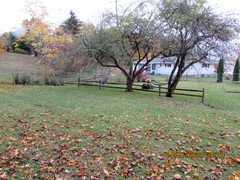
The blue fence I put there a while ago to act as a focal point before I knew what I was going to do, but I will be moving it somewhere else, somewhere it can act as an accent and not distract (although it may be difficult considering it's bright blue, but I like the eccentricity of it so it stays!) :)
and yes, I was planning on planting some taller things in that area, only so everything along that fence line can mesh. There will be no building along that hill, and yes it always looks like that, it's nothing to look at honestly. That said, I don't have a problem with covering any views, privacy, etc, I just wanted a cohesive plan so that's why I was thinking mainly taller items.
- 11 years agolast modified: 11 years ago
Marie - interesting topic suggestion re what ones beginning garden looked like etc.. I do often think about how different this garden is from the one at our first house, what influences are the same for both, and what things changed as I became a more experienced gardener. Thirty years ago when we bought our first house, it came with a fairly large perennial garden in the front and a space in the back for a veggie garden. The property was the same size as this one but was cursed with two large Norway maples in the backyard which rather limited the options there. Since we lived at Mom's parents (east coast small farm gradually going back to bash! Grandpa was 80 when I was born....) for a fair but of my youth, gardening was something I had done practically from the time I could walk ;-). Grandpa had my sister and I weeding the vegetable garden by we were 2-3 years old, and Mom had us working in the small perennial garden that dated back to her paternal grandmother's time. Plus my undergraduate degree is in agriculture, so I figured gardening was a piece-of-cake activity:-).
DH was responsible for veggies in his parent's garden, so he took on the veggie garden at our first house while I did the perennials.
At that point what fascinated me was seeing how much I could grow - i.e. how many different types and varieties of plants. There wasn't very much organization to it for the most part - a collection of plants more than a coherent garden. There were a couple of areas that had shaped up pleasingly (a white-themed area on a bank under the front window and swaths of hostas around the large concrete patio in the backyard) that gave me the sense that I needed to take a different approach to planting.
Bed lines, however, were simple, sweeping curves in the front, and rectangles in the back (veggie garden and patio garden) as those shapes seemed to best fit the spaces and reminded me of the sweeping lines of pasture edges, and the roughly rectangular hayfields and veggie garden I grew up with. When the time came to move on from our first house, I had a much better sense of what I liked and didn't like, and resolved to make the garden here in a much more organized fashion.
Having recently become disabled and unable to work, I also had the time to indulge in lots of reading about all things related to gardens, including lots of garden history stuff that led me down some odd pathways at times!
while I've tried to be more organized here and had a fairly good mental picture of what I wanted to create here, it has still been very much a trial-and-error process - doing one thing tends to lead to "well, now that over there looks wrong, so I now need to do [whatever]....". But that's a good part of the fun of it all!
I suspect that, at times, my comments might fall into your "snobbery" category because I am interested in things that would generally be considered fairly esoteric (Fibonacci spirals and such! ). But that's just part of the rather quirky person I am. I thoroughly enjoy gardening in all its aspects and believe a pleasure shared is a pleasure doubled. If my attempts to share my garden thoughts and pictures annoys or offends people, I do apologize - but I can't guarantee I will change very much :-)
i would love to read the stories of other people's journies to becoming the gardener they are now.
- 11 years ago
I think we should take this discussion to a separate thread. Really, I do. Just to keep the comments from being interpreted as pertaining to the OP and her property, which is the subject of this thread and make it more objective.
Two conversations have developed here.
I don't consider you a snob WO. I think of you as a very experienced gardener. Thats all. Probably some of the stuff you 'tout' will sound snobby to a novice but that would be the case in any field of endeavor.
A lively or heated discussion is usually more interesting than a bland polite one where its all compliments and back patting, but that just me and my personality. I prefer spice over bland tapioca and I prefer it when people are not afraid to be honest and say what they really think. Call me rude.
Since we are into name calling, what is a snob? "A person who believes there is a correlation between social status and human worth" also: "A person who believes that some people are inherently inferior to him or her for any of the variety of reasons, including real or supposed intellect, wealth, education ancestry, power, physical strength, class, taste, beauty, nationality fame, extreme success of a family member or friend etc"
Well OK. Maybe you are a chocolate snob based on being married to a bona-fid-ed chocolate expert and having such a well established garden (which you have busted your a** on creating and obviously done a lot of hard work on) maybe just a tad at times like we all are if we are honest about it. Admittedly, I am a snob based on my belief in the fact that there definitely are actual rules governing nature, physics, art, design, gardening, the universe etc. whether we want to say so or not, our opinion doesn't change the truth or the way things really are.
Of course, I actually think all you's easterners are all regional snobs of a certain order but we Okies down here think we are pretty cool too in spite of what you's guys up there think.
- 11 years ago
.....and then some people might possibly be considered snobs based on how many years they have been on GW (as they love to remind us) and think their way of posting is superior. They serve as self appointed overseers to corral and correct 'unruly' members to set them on the straight and narrow path.
- 11 years ago
Definitely time for a new thread - I just started one.... (Tex - DH is not a chocolate snob - but definitely is a coffee snob! :-)
- 11 years agolast modified: 11 years ago
Woodyoak, your being a snob never crossed my mind, You always speak from your own experience and very graciously at that.
- 11 years ago
Woody's a snob, Woody's a snob, Woody's a snob.
Woops sorry, lost control again, its just kinda hard to take some things seriously. So, what kind of coffee is the kind eastern coffee snobs drink? I'm a coffee addict, as in 4-step-program level of stage 9 addiction. Actually I'm a peasant, I drink Maxwell House but don't let him snub me if we ever meet. My garden is sort of peasant-ish too. Its a financial thing.
- 11 years ago
LOL Tex! DH got into roasting his own coffee a couple of years ago. He buys various types of green coffee beans and then can roast them to however dark he wants. There are a few sources now around here for getting the green beans, including a couple that come from the owner's family's farms in various places in the world. He makes terrible faces when he forces himself to drink instant coffee! (e.g. when he's overslept and he doesn't have time to grind and steep the fresh roasted coffee because the dog and I are waiting impatiently for morning walkies!) The roaster tends to set off the fire alarm a lot :-) I don't even drink coffee at all, so he thinks I'm a terrible Philistine! I do miss the abundant supply of chocolate that we had before he retired....:-)
- 11 years ago
Hi Lauren, How long is the entire fence area where you plan to plant? I see you have an 8' deep garden in your first drawing. Depending on how long the garden will be, you might want to bump that depth up if there's room to help make it look a little more balanced in the depth to length ratio.
Regarding straight lines or curves.....if you like straight lines, then do it. Maybe that symmetry in the design will make you feel good about it and you can have more flowing, diverse plantings to offset it. Whenever I've visited gardens with straight-lineborders I've always admired the "control" of it. I have a cottage garden in front and it is all straight lines with casual plantings. In my backyard I have multiple beds, and when I planned that area I did long flowing curves with some floating beds. Those planting are also rather casual. If I had to do it over again, honestly, I'd go for straight lines and then add multiple arbors down the line to add interest. Much like the main pathway at Monet's garden (although not as wide!)
I guess my plantings are so casual and flowing I sometimes feel the need for a bit more order, and straight-lines would help with that. However, the edges of course would be softened by plants.
My friend's backyard had a chain-link fence and she had a 75 x 18 area that she wanted to plant. We did a design with a straight line and actually did a mirror-image of plantings on either side with a bench smack dab in the middle. Might not have been my cup of tea for my yard, but she really liked symmetry, so that's what we went for. On a larger scale we were able to pull it off. The garden was beautiful. We softened the edges with tall grasses, shrubs, etc......
I'm not making a case for straight lines here, just the fact that they can work and look beautiful in certain circumstances, even when not a veggie garden, parterre, etc.
Your design course should give you lots of ideas and will be very interesting. As you scour pictures of gardens, think about what really catches your eye and makes your heart skip a beat. Sometimes it might not be what you thought. I always thought I wanted a dark cherry kitchen until I was moving and building a new house, ripped out all kinds of kitchen pictures from magazines, and lo and behold, they were WHITE! What? Never in a million years did I expect to have a white kitchen, but without my even realizing it, the pictures helped spell out for me something I didn't even realize about myself.
With wet, clay soil you might want to take this fall to amend the soil quite a bit. Amend more in spring and then start planting.....and keep amending the soil......are you seeing a pattern here? Ha ha!
Good luck. It looks like a great project! Gardeners always love to have new spaces to plant! Have fun with your design course. Would like to hear a little about what you learn. Keep us updated as you move along!
Lauren W. (z5b - CNY)
Original Author11 years agoI'm guessing the entire space I want to plant is over 70' long (at least). It's a pretty large area. I am often inspired by the photos on here, so I'm always looking around :)
Funny you mention that about your kitchen, I feel the same way (a kitchen reno is on the horizon for us pretty soon). I always liked dark cabinets but when I started looking at white more recently I loved how bright and clean it looked.
This weekend we're going to till up the whole fence line and add some compost, then I'm going to lay some cardboard over it and leave it til spring. I'm sure once we uncover it next April/May I won't be able to contain myself with all the plants and ideas!! :)
- 11 years ago
straight lines in tiny spaces work really, really well. My tiny 36square metre home garden is all geometrically laid out since the artless naturalness of curved lines is just not going to fly in a 1960s townhouse (3 storey) with a miniature walled courtyard. It is all about the vernacular.
- 11 years ago
Helpful to be reminded of this word. One doesn't see it in American garden writing very often.
This may be one reason the neighborhood gets upset when someone has a front yard 'wild' garden or vegetable garden.
Good to see you writing. It's been months, hasn't it?
- 11 years agolast modified: 11 years ago
Lauren - Based on my experience, you will want to plan the whole planting area in a general way, though it can be planted over time. This will help avoid having a bunch of little disjointed pockets that don't relate to each other well. I've done it both ways, and the overall design ages much better. Your landscape design class should help with this.
Try to figure out your goals:
- creating separation between areas?
- providing visual interest, whether framing a view or a close focus?
- lots of flowers in the garden or for cutting or veggies or . . . ?
- you said no need for privacy, but do you specifically want to be able to see longer views - are there nice things in the distance that you can "borrow" - trees with nice fall foliage, or the sweep of the hill? Are there views to block such as the neighbor's house/swingset/trash cans or a power pole?
- wildlife interest?
- seasonal interest? Is it in an area where you will see it from the house in winter? If so, evergreen plants (both perennials and shrubs/trees) should be included along with plants with interesting bark or nice bare silhouettes.
- are there things you want in your yard that aren't there such as a shady seating area or an outdoor kitchen that need to be considered as you plan?
- do you have pets such as dogs that like to patrol the perimeter fence?
- do you have kids that will want to use the yard?
A good book on home landscaping will probably have more of these questions to answer as will your design class. Once you have thought through and answered some of these questions, you will be more ready to start planning garden spaces. In general, hardscape needs to be done first, followed by any soil work, and the plants will be the last thing added. So if you are planning to change the fences, for instance, that is much easier to do now rather than after soil and planting, and adding organic matter to entire beds is much easier now than after planting, and much healthier for the plants than adding to the planting holes.
For now you might want to look at other folks' yards, look at photos of other yards and gardens on the web or in books from the library and start a folder (virtual or real) of ideas that appeal to you and that fit your site. The website and magazine for Fine Gardening is a good place to start as is Tracy DiSabato-Aust's book, The Well-Designed Mixed Garden. Visit nurseries in your area to see what they have available and snap photos of plants you like. If there are garden centers with planted gardens, take notes/photos of what appeals, and there may be botanical gardens or arboretums in your area as well. Seeing plants in person is more helpful that just seeing photos. Anything without ID can be posted on the Name that Plant Forum here on GW to get an ID. Pay attention to foliage as well as flowers since for most perennials and shrubs, there is a longer season of foliage than of flowers. Think about size, shape, color and texture of foliage, and try for variety.
You can start a compost pile this fall or even start lasagna layers in areas you are sure you want to plant and research local sources of compost and mulch. I get all of my organic amendments and mulch free, from the horse farm down the road, the local line trimming crews, and area woodworkers and saw mills. Some towns make compost that residents can pick up free or inexpensively. Some of my plants come from cuttings or divisions from friends or from local plant swaps, so you can look into inexpensive plant sources as well as local nurseries.
If you can afford the space, T2D's advice of perhaps making the bed deeper is one I would second. 8' is about my minimum, and most of the beds are about twice that depth. It allows me to have long season interest with several layers of plants. Mulch will be your friend in helping keep the gardens low maintenance and an edge of some kind to keep grass out, whether a cut-in edge or a buried strip of some kind. I don't see issues with having a garden around the perimeter of your yard if it fits your yard use - just remember that you can shape the edge to please your eye. I'll be interested in seeing what you come up with for a final design as you take your class.
Lauren W. (z5b - CNY)
Original Author11 years agoBabs, I actually did buy 'the well designed mixed garden' and am almost done reading it. You had suggested it to me when I posted another thing a while back. I love it - she gives me a lot of good ideas.
I am not going to change any fences around (besides the blue one which is 2 screws) or change any hardscape, so the next step really is amending the soil. Maybe I will work on just extending the 8ft for now and if I want to add to it later, I can. I don't want to get too overwhelmed filling that long of a space at 16' wide.
thanks for the advice :)
- 11 years ago
Lauren, in the 70', were you planning on any trees? Or just shrubs and perennials. There are some really nice smaller ornamental trees available. If you think you'll start with 8' but then do plan to expand to 16' in the future, you might want to start with a backbone of small trees/shrubs first, along with some vines on the fence. There are some great shrubs that take up almost eight feet! Then as you pull out another 8' it would be natural to add smaller shrubs mixed in with perennials and annuals. That would give you a layered effect and no one would know you worked the border in two separate phases.
- 11 years ago
Despite having a lot to say, and usually quite opinionatedly, I rarely chip in with design issues because a) it is so utterly personal and subjective and b) because I hardly ever do it...and quite honestly, Lauren, unless you are astonishingly wealthy, you won't be doing 70feet of it either. As a little rule of thumb, I use a 5-7 perennials to each square metre and, unless you are raising all these from seed, it is going to cost an arm and a leg to fill those 70feet by however wide you go (say an estimate of 300-400 plants)...so why not just muck about with what you like, what does well for you, what colours you really resonate with - you have tons of space - and worry about getting a design down a bit at a time.
I suspect that if I did have to fill an entire area from scratch with selected plants (instead of the usual randomly aquired stuff), I would be paralysed with indecision...
- 11 years agolast modified: 11 years ago
Campanula - I tend to work midway between a very specific design and just mucking about with colors I like. I find that if I do designs with what I can find available as small or sale or pass-along plants, I can keep things within a reasonable budget, though there will be no instant gratification (definitely not astonishingly wealthy!). I can most years find small Hydrangea paniculatas on sale for well under $10, and since one of those, Pinky Winky, has filled a space 12 feet across, it doesn't take huge numbers of plants to fill the space (plus more Hydrangeas are easy to start from cuttings). Similarly I've bought various rhododendrons and other shrubs (spicebush/Lindera, various dogwoods, etc) quite inexpensively. For me it means being willing to plan loosely rather than with specific plants (e.g. 8'-12' gold evergreen, mid-sized rhododendron, summer blooming clematis, white groundcover, etc. rather than particular varieties) as well as use cutting-grown and seed-grown plants. I just have to research the published ultimate plant size, add a foot or two, and then be very careful not plant any closer than that even when the plant is a 6" stick with 4 leaves. I do a fair amount of plant swapping and shopping at October sales as well. Things always look fairly sparse and mulch-y for a few years, but then as things fill in, everything looks much better. I used to have a source where I could get a flat of 32 liner shrubs for something like $40, so I shared with friends ordering, and so now have some plants (certain hardy rhodies and Fothergilla for instance) that I have in quantity scattered around the property. The availability of inexpensive plants may be different here in the cold parts of the US than in the UK since around here most nurseries want to get rid of as much inventory as possible in the fall before it gets cold, since overwintering potted plants can be a challenge here.
Here's the bed I posted above on Monday about 8 months after planting (click on photo to see the whole thing), still quite sparse, but by year 3 it really started to fill in and look much better. I have added some but not many plants, since a lot were put in at liner (rooted cutting) size and so had much growing to do - they are for the most part invisible in this photo. All the larger plants were bought at fall sales at 30% to 75% off or seed grown and so I really didn't spend a lot on this bed.
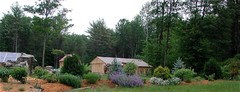
Lauren W. (z5b - CNY)
Original Author11 years agolast modified: 11 years agoT2D - I wasn't thinking of trees, but I suppose it's a possibility.
We had a lot of willows at our previous home and I fell in love with them, so I wanted to do a few of those - they grow so fast, they cater to my impatience well. Any other large filler plants I should consider? I know I have my choice of many considering most of this space is full sun.









Thyme2dig NH Zone 5