Software
Houzz Logo Print
miscel

Getting rid of thrips on indoor mint

11 years ago

My indoor mint plants are now infested with what I'm pretty certain are thrips. I would appreciate some advice on the best course of action. I was thinking of spraying homemade insecticidal spray (drop of Dawn, water, drop of olive oil) every other day for a week or so on the leaves and the top of the soil. If that fails to work then a spinosad spray. And if that fails then neem oil. Does this sound okay? Or should the homemade insecticidal soap work. Or should I just go for a spinosad spray?

Also, I've read conflicting information regarding sticky traps. In some places blue sticky traps are recommended for adult thrips and in other places yellow sticky traps are. Which is it? Blue or yellow? Or do both work well?

I would really love to salvage my mint. Thanks.

Comments (14)

  • 11 years ago

    I've never had thrips damage my mint. So, let's make certain of the identity of the critters at hand. Please post picture(s) of the critters (if possible) and damage.

  • 11 years ago
    last modified: 11 years ago

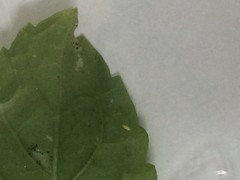
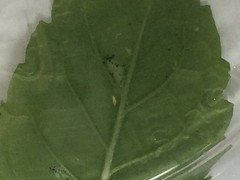
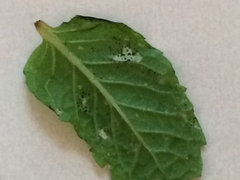
    Sorry, Jean. I forgot about the photos. That would be helpful! Thanks for the reminder. Attached are the photos. The first two are of the pest which ranges in color from a translucent white to a tan/light brown. The pest is very small, but visible to the eye. The last is a photo of the damage on the leaves.


  • 11 years ago

    Unfortunately, it's definitely thrips. I just had it confirmed.

    Do you think it's better to go ahead and buy Safer Insecticidal Soap or go for the Monterey Garden Insect spray with spinosad? Or will my homemade insecticidal spray be as effective? I would love to get rid of the thrips in one round if possible and avoid having to try multiple products. Any thoughts on the best course of action?

  • 11 years ago

    kimmq - I'm rather surprised that Dawn and olive oil are useless in insecticidal spray. I got the recipe from a reliable source a few months back and I've subsequently have come across similar versions of the recipe elsewhere. Thank you for clearing that up.

    As for the soap, would Dove work? I only have Dove bar soap besides liquid hand soap and dish washing liquid. Dove contains sodium tallowate. If not, is it best to use Dr. Bronner's Pure Castile bar soap which appears quite a bit as a recommended soap for insecticidal spray? Also, can Dr. Bronner's liquid soap work or is the bar version the best way to go?

    Thanks.

  • 11 years ago
    last modified: 11 years ago

    It turns out that Safer is having a pretty good Labor Day sale that ends Friday for those who like Safer Brand products. I still plan on making my own insecticidal soap, but I'm thinking of placing an order as back-up. Which Safer brand would be recommended: Safer Brand Insect Killing Soap or the Safer Brand 3-in-1 Garden Spray?

    http://www.saferbrand.com/store/outdoor-insect/5110#

    http://www.saferbrand.com/store/outdoor-insect/5452

  • 11 years ago

    the 3-in-1 is overkill. Use the other one, please.

    miscel thanked jean001a
  • 11 years ago

    Thanks, jean001a. I was actually leaning towards the 3-in-1, because I figured I could use it next year on my tomato or other outdoor plants if I had any pest or fungal issues. I'll order the insecticidal soap spray which is more in-line with the few issues I've had so far.

    As for the Dr. Bronner (or any other soap), does anyone know if it's better or easier to use the bar soap or liquid version? Or does it not really matter?

  • 11 years ago

    Umm, want to say that even though the insect in your images may be thrips, the damage is not typical of thrips. Even so, I suspect that direct hits of insecticidal soap to the undersides of the leaves will deal with the culprit(s). Repeat as needed.

    miscel thanked jean001a
  • 10 years ago

    I do not know what Dove "soap" is made of so I cannot know if it is a soap or a detergent. Soaps are made of animal or vegetable fats reacted with a caustic, typically lye. The labels of most of the commercial insecticidal soaps I have looked at do not list oil as an ingredient.

    Dr. Bronner's products are, to the best of my knowledge, real soaps. Another is Fels Naptha, although some state it contains Stoddards Solvent, a petroleum derivative, which
    I do not find on the list of ingredients. http://www.purex.com/products/laundry-enhancers/purex-fels-naptha-laundry-bar/

    The primary reason to not use Olive Oil is cost. There are other, less expensive vegetable oils that could be used.

    kimmq is kimmsr

    miscel thanked kimmq
  • 10 years ago

    A insecticidal 'soap' solution with Dawn works well on most soft-bodied insects - even scale. The take-away from a day long greenhouse management seminar at the regional botanical garden - they have an acre under glass - was their simple, go-to spray solution: a drop or two of Dawn and a capful of 95% isopropanol in a quart sprayer. (Of course, their volumes are much larger....) I've used it on both scale and aphids and it does an excellent job at virtually no cost - or damage to the plants. Also, no residual if one plans to consume the plant - like mint.

    miscel thanked apg4
  • 10 years ago
    last modified: 10 years ago

    Thanks, apg4! Great to know that the person who gave me the recipe was right. I've been spraying my homemade Dawn insecticidal soap solution on my mint these last few days. I figured it wouldn't hurt in the interim until I could buy Dr. Bronner's and Safer Insect Killing Soap Spray.

    kimmq, Dove is a soap not a detergent, though these days there seems to be such a variety of soaps. Today I went ahead and purchased a bar of unscented Dr. Bronner's soap as back-up. Hopefully, the Dawn solution or the Dr. Bronner's solution will do the job and kill the thrips once and for all.

    Thanks again to everyone who wrote. I appreciate the helpful advice and information.

  • 10 years ago

    As I tried to point out real soaps are made by reacting animal or vegetable fats with a caustic, usually lye, and it is the fatty acids in real soap that kill the insects. Not even the manufacturer of Dawn Dishwashing Liquid calls it soap.. That product made of synthetic, petroleum based, material may kill insects, but many also report it kills the plants they spray.

    http://www.realhandmadesoap.com/folders/FAQ/what_is_saponification.htm

    kimmq is kimmsr

  • 10 years ago

    So why does a major botanical garden use it on virtually everything in a very large greenhouse? The stuff just plain works, and one or two drops per quart isn't going to do any damage. The Dawn is there as a surfactant: it allows the solution to cover everything, especially the target pest. In their mixture, I believe that the 'active' ingredient is the isopropanol (simple rubbing alcohol) which probably works as a desicant. It's simple - and cheap. Dawn, a detergent and not a true soap, is also used to clean up wildlife after oil spills.

Sponsored
AIS Renovations
Average rating: 4.5 out of 5 stars15 Reviews
Custom Craftsmanship & Construction Solutions in Franklin County, Ohio
More Discussions