

2016 Spring Fling
Because I'm OCD and plan too far ahead, and because I've never been to a Spring Fling before and my imagination is going wild, I am wondering what you all are planning to bring to the Fling next year? I will have Red Yucca and plenty of trees for sure. Probably mostly oaks and some chestnuts. Also sycamore. Seed balls have popped up on my Silverwood Sycamore for the first time this year. The Chinese Elm trees the builder planted at my house seed profusely so I will probably have plenty of those. But you never know I'm always on the lookout. Let me know if there is something specific needed. I have lots of Virginia Creeper and some Wild Grapes that sprouted this Spring from the birds. I assume I will have more next spring as well. Still looking for some Rusty Blackhaw Viburnum so I am hopeful someone will bring some. I need some more medium sized natives for a border/hedge I'm working on. Food/medicinal/native a plus. Will be on the lookout for Red Mulberry, Red Buckeye, Apple Serviceberry, and Sand Plums (Chickasaw Plums). I will also be watching for luvabasil for that Comfrey hookup.
Comments (15)
 10 years ago
My greed just kicked in. LOL
Permaculture for you?
I'm needing to establish canopy trees as well as understory trees. Appreciate you putting this out there.
Welcome, Wayne. Look forward to meetin' ya.
It might not be popular, but I'm going to bring Molokhia/Egytpian Spinach since Amy couldn't get hers going to well this year. Also maybe bringing sustainable plantings like:
Shining Sumac
Giant Red AmaranthRelated Professionals
Enfield Landscape Architects & Landscape Designers · Grand Junction Landscape Architects & Landscape Designers · Sugar Land Landscape Contractors · Tyler Landscape Contractors · Champaign Landscape Contractors · Middletown Landscape Contractors · Huntsville Accessory Dwelling Units · Tuscaloosa Accessory Dwelling Units · Rocky Mount Accessory Dwelling Units · Bloomington Accessory Dwelling Units · Hudson Accessory Dwelling Units · Bakersfield Accessory Dwelling Units · Lewiston Accessory Dwelling Units · Everett Accessory Dwelling Units · Vancouver Accessory Dwelling Units- PRO
Oklahoma Native Nursery
Original Author10 years agoDone. I will have a couple different varieties. They will be in Rootmaker cells which I want to keep so not sure how I will package them yet. But I can also just bring seed if you want. I am in SW OKC suburbs and have the biggest lot in the neighborhood but it is still just a city lot. Maybe 1/4 acre? I have family with land and friends with seed. That helps. I also enjoy going to parks and public spaces with my kids and collecting acorns/seed/cuttings. I have about 20 or 30 seedlings in pots at any given time in my back yard. I also started recognizing the difference between weeds and seedling sprouts and began to let seedlings come up to see what they are. My passion is native Oklahoma trees and I am in the process of starting my own nursery. But for now it is just a hobby. Definitely not a common hobby for 34 year old men, LOL but I love it.
- 10 years ago
That's a pretty good sized lot, depending upon how big your structures are. Even so, it can be stuffed with all sorts of goodies. I hear where you're coming from. It's a good hobby. Nothing wrong with planning/dreaming/doing all the time.
I'm only definite about having 1, 2 or 3 Oklahoma redbuds with yellow forsythia beneath. I have the forsythia (thank you, Lisa). I need to read more this winter about the different native Oklahoma trees and what make work best in the spot that I'm populating.
it's an open area exposed to extreme heat and drying winds. I think a strategy is necessary for inter-planting with native shrubs to help protect the sapling canopy trees. I haven't figured this much out, much less how to plant them properly. That's what winter season is for, I guess.
bon  10 years ago
Hey my Egyptian spinach is flowering now, maybe a foot tall. Trying to decide wheter to harvest it or just let it seed. ;)
 10 years ago
Wayne, I have a couple of large shrubs I haven't identified. I'm pretty sure the first is a type of viburnum, but probably not the specific one you're looking for:
The second one I have no idea what it is: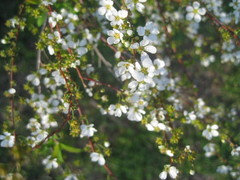 And a third, which a friend told me she thought looks like a flowering almond: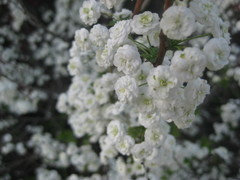
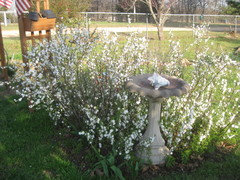
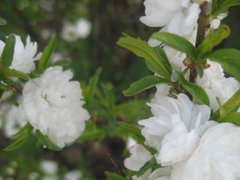
I would love to have one of your red yuccas, and I am also looking for a Chickasaw Plum/Sand Plum (my GW name is in honor of my grandma's delicious wild sand plum jelly!)
I attended my first spring fling this year and had a wonderful time (dh enjoyed it, also.) Everyone was so nice to us and it was a lot of fun (Paula was the best hostess ever!) Hope you get to come and I look forward to meeting you!
 10 years ago
We have rusty blackhaw viburnums scattered in our 10+ acres of woodland, but the woodland is full of venomous snakes and I don't venture into it except in winter when the snakes are hibernating so I don't get to enjoy the viburnums much, except for one very old one that I can see from a field behind the barn. I used to spend more time in the woodland in spring and fall but after one venomous snake encounter too many, I wised up and learned to stay out of the woods. There's just too many timber rattlers in the woods, and too many copperheads on the edge where the grassland meets the woodland. I need a suit of armor in order to venture into the woodland during the growing season.
We have wild grapes everywhere on our property, but they are for the wild animals, not us, as they produce a grape that is very sour and not good as a table grape. The danged old birds constantly plant wild grapes in my veggie garden and I constantly remove them. If you don't get rid of one the first year it sprouts, it is almost impossible to get rid of it and I don't need wild grape vines running amok in the area where I grow veggies, flowers and herbs. Down here near the Red River, wild grapes are a widespread, pernicious weed, burying everything underneath their rampant foliage. It will be interesting to look at them next year and see how they fared since most of the ones near the river endured three rounds of severe flooding this year and some of those areas were under water for two months and then had a lot of silt deposited atop he ground after the floodwaters finally receded.
Sandplum, I've tried to get sandplums to grow here ever since we moved here in 1999, but they don't like our clay, and our narrow band of sandy soil isn't large enough for them to take hold and grow. Finally, the last two years, a few sand plums have popped up along our fenceline, where I had piled up 200 square bales of rotting hay and mostly left it there to decompose and enrich the soil. They're in the area where the narrow band of sandy soil cuts through the otherwise dense, red clay, so it may not be that they'll do well there anyhow. I'm excited to think we might eventually have a clump of sand plums take hold and survive on our property. I'm not sure if there were some plum pits in the hay that eventually sprouted and grew or if the trees were planted by birds. They bloomed this year but didn't form any fruit, but they still are only a couple of feet tall so maybe weren't big enough yet to fruit. If that clump enlarges and resprouts in spring, I can dig up a couple of rooted sections to bring you. Right now, though, they aren't looking too good in the drought that has plagued us ever since the flooding ended.
We do have native persimmons that thrive in our clay and our sand, and new ones sprout every spring. I can bring some of them to the 2016 spring fling if anybody wants one. The fruit is very astringent until after it has been hit by a couple of freezes, and then it gets sweeter. However, coyotes (who must not have any taste buds!) eat the fruit in summer while it is still green, very sour and as hard as a rock, so we rarely get any persimmons for ourselves. I finally dug up one persimmon tree from the persimmon grove and planted it right beside the house so that maybe it will give us fruit the coyotes don't get. The coyotes don't venture too close to the house too often any more.
Dawn
- PRO
Oklahoma Native Nursery
Original Author10 years agoThanks for all the great responses guys. I am more excited now than ever. Dawn, the deer also love Persimmon and may be contributing to you not getting any. I think I am going to try a grafted variety for my orchard I am planning for the Spring so I will pass. But it sounds like a great addition to the Fling. I hear the fruit is very nice when finally ripe. I have never had one. I am looking forward to trying both the American and Asian as well as our own Oklahoma native Paw Paw fruits. I would ask you to bring some of that viburnum but I don't want you to battle deadly animals to do so, LOL. I would be scorned on this site forever. I know what you mean about the birds they have wild grapes growing all over here as well. I have three in pots that I am looking for a good home for. There is someone in Lawton that sells Sand Plums on CL and that is fairly close to the Red River. I wonder if they have a good miroclimate going?
Sandplum1 I will set aside some RY for you. I was told that they grow slow at first and I am growing from seed so I don't know how big they will be. But I have LOTS of seed. I will be planting some in my front yard between the sidewalk and the street. I can't tell what your shrubs are either from the pictures but they are beautiful. The Rusty Blackhaw Viburnum flowers in large clumps I can tell that first pic is not a RVB but it is very pretty.
Chickencoup I think you have the right idea. I have found that plants that are advertised as "full sun" don't mean "full Oklahoma sun" so looking up recommended spacing, sun requirements, etc. doesn't do much good to us here in the Sooner State. I have most of my seedling trees on the N side of the house next to my *cough* Japanese Maple and they are all doing great. Before that they were mostly on the East side in the small side yard between my house and the neighbor's house and only got a few hours of full sun a day. I tried to move some into full sun and they burned up. I eased them into it, I didn't just throw them into full sun but they seem to be happiest on that N side where they get great morning sun and more afternoon sun than before but not too much. I have also read that many species need mother trees or nurse trees to give them afternoon shade in their youth and then once they are established can handle full sun and wind. An Osage Orange or Hackberry hedge would be fast growing and protect from wind (they are also native). I don't know how much space we are talking about here though as these trees will grow large if not pruned. Red Mulberry is one of my favorite trees and is also native and very fast growing. The birds love it. Would make a great addition to your windbreak. Plant away from cars, houses, and sidewalks though. The best tree for a native windbreak though if you have the space is Loblolly Pine IMHO.
On a side note, does anyone need any toads?! I have them everywhere. I can bring some to Spring Fling. :D
- PRO
Oklahoma Native Nursery
Original Author10 years agoI just though of another "want" on my list. I would love some native milkweed to plant for the monarchs. Seed for this is fairly easily available so I could order some; but, I would much rather just trade for an established plant at the Fling. Thanks again everyone.
- 10 years ago
I'm hoping to avoid invasive tree species. I'm battling Mulberry and poplar, now. I really like the Osage orange for practical reasons and I could put one out in the open where it will be perpetually mowed on all sides, but then it will get massive in the middle of the yard. Eventually, its roots would extend to the fence line adding to the forces with which I am at war.
The more I look into it, the more I revert to pecan. I've had in mind to plant sumac nearby. Scattering of redbud and forsythia in the interim with fruit trees and fruiting shrubs in understory fashion. - 10 years ago
I like my redbuds when they are in bloom, but the rest of the year they are ugly. It doesn't help that they are under electrical lines and have been pruned for that reason, but they always seem to have dead limbs sticking out somewhere. Then I have little ones that crop up everywhere. I don't think I would ever plant one.
- 10 years ago
Wayne, While deer can eat persimmons and usually do, the coyotes get hungrier earlier and eat them off the lower limbs long before the deer do. I know this because every day while walking my dogs since 1999, I have observed both deer scat and coyote scat and know that the coyote scat is full of persimmon seeds months before I see any at all in deer scat. That is what I have observed in my specific area.
On the other hand, deer will visit my fruit trees often while they are in bloom and while they have small fruit, and show a definite preference for plum over peach, but I've never seen plum pits in coyote scat (though I suspect they eat wild plums) and I've never found coyote tracks in the soft sandy soil beneath my plum trees. That might happen solely because wild plums grow with abandon along fence lines and in pastures here, so the coyotes can eat all the wild plums they want without having to venture up close to our house to snatch plums off our cultivated varieties.
The deer are not afraid of me because I feed them in winter and in drought, so they boldly walk up into the yard and snatch young plums (or even the blooms) off the trees while I'm working in the yard. They also visit the compost pile regularly to scavenge for appealing kitchen scraps and, in winter, when I am not feeding the compost pile enough to please the deer, they will stand by the pile and scream or call for me. Sometimes my husband will come indoors and say "the deer are calling you" and I go out, and they aren't even calling---they just stand by the compost pile and stare at the back door nonstop, as if willing me to walk out the door with a bucket of compost pile scraps for them to pick through. It is sort of comical, but sort of sad that they get so desperate for food. The coyotes wouldn't dare do that because we do nothing to encourage them.
Nowadays I only plant fruit trees within an area with an 8' tall fence because otherwise I have to fight the deer for every plum, and sometimes for the other fruit as well. The squirrels largely ignore plums until they are ripe, but go after the peaches while they're still green. I learn a lot about wildlife by observing them here since we have so much wildlife. Birds seem to prefer peaches or cherries. Most of the wildlife leave the figs alone, and I think that's because figs are not common here so the wildlife don't realize what they are.
I can watch for young rusty blackhaw viburnums to sprout in spring, but rarely see them because only one viburnum is on the edge of the woods near the house where I can see it from a spot outside the woods. All the others are buried deep in the woods, where I fear very large, old trees are slowly shading them out.
Our climate has veered towards being both hotter and drier since we moved here in the 1990s, and I am seeing subtle changes in what grows well here as well as in what sprouts and what doesn't. Partly, I think, it is because our water table has changed. The spring that once fed our pond dried up, another spring that fed our swamp dried up, and the two springs that feed our creek barely run at all any more. Consequently, the swamp slowly died off and the plants that grew in it died as well. Now, just ordinary old woodland trees have taken over the once swampy spot, and trees grow where we once had a huge pond full of fish. I hardly ever see new viburnums or Mexican plum trees sprout and grow, and even the wild blackberries don't grow as abundantly as they once did. But then, on the other hand, I see more prickly pear cacti, even deep within the woods, than ever before. For years and years I spent a significant part of every winter clearing undergrowth in the woodland and removing invasive species of plants, but as we became more and more involved with our local VFD, I gave up time in the woodland because I was spending it at grassfires and wildfires instead. So, with less time spent in the woods, it is hard to know what's growing well. That situation became even dicier in the drought of 2008, when I had two encounters with a cougar. Ironically, in both cases the cougar came out of the woods directly adjacently to my garden, and wandered along beside the garden fence. So I actually had the encounters with the cougar in the yard/garden and not the woods, but because the cougar came out of the woodland, I stopped going into it alone and unarmed. We also have had feral pigs at the back of our property, roughly 1100' from the house, several times, which put a halt to me venturing back there (even in snake season) to pick wild plums. A couple of times the feral pigs have made it to within 200 or 250' of our house, so I have to be really careful any time I go outdoors.
When we moved here, I hoped that when the wildlife adjusted to us being here on this property, they'd kind of move further away from the house. I was wrong about that. If anything, every year they become more abundant near the house. I blame some of that on too many years of recurring drought. When the greenest area and the spot with the most potential food sources is the acre or two around the house and outbuildings, then that is where the wildlife go.
Now, I hate the highly invasive mulberry trees and don't want them anywhere near me. The birds plant them (and wild grapes) endlessly all along our fencelines, the garden fence (where I don't need anything invasive), ponds, etc. and they grow fast and spread and take over. We spend a couple of days every year in late summer taking out mulberries, hackberries, wild grapes and other wildlife-sown plants that easily invade and spread and get out of control. The wildlife can sow seeds of whatever they want in the woodland, but in the areas where I am trying to grow stuff for us, I want them to stay away and not fill my gardens with stuff I don't want. Every year the squirrels plant about 10,000 pecans and acorns in my fenced veggie garden space, and every spring I yank out all those young seedlings. Mulberries, wild grapes, native pecans and oaks have their place, but it isn't in my garden.
I don't plant much of anything in our landscape that cannot tolerate being eaten by wildlife, and I don't plant anything that needs a lot of water because most summers, rainfall is low to almost non-existent. Even the native plants that thrive in these conditions are less common than they were before 2011. In some cases, plants that were abundant before 2011 never really have recovered from that horrific drought, and in order cases, they have sprouted and grown and died in drought every year since then so that every attempt at a comeback largely fails. This means our natural landscape is changing and evolving to tolerate increasingly more common drought periods, and our native grasses and forbs continue to change and evolve as that occurs. We spend most of every year on the U. S. Drought Monitor classified as being "abnormally dry". Well, to me, if we are spending, let's say, 30 weeks a year being "abnormally dry", then to me it isn't abnormal any more----it is the new normal. The weather and drought agencies won't recognize it as the new normal for us, though, until we have seen it seriously affect our 30-year-averages from which they derive the norms.
Native milkweeds ebb and flow a lot around here where they have to survive only on rainfall. Some years they are plentiful, and some years they are sparse. This year they are very, very sparse. The one I see most often is green milkweed, but this year we only have had maybe a half-dozen of them grow and bloom. Most years we have dozens, or even hundreds. This trend doesn't bother me as much as you'd think because I still see plenty of them nearby on property that has sandy soil. We mostly have clay with only a couple of bands of sandy soil running through it, so we've never had milkweed that is as abundant as those sandier areas have. I've never seen the milkweed vine here, so suspect it doesn't like our recurring droughts, or our highly alkaline soil and highly alkaline water. Every now and then I'll see a showy milkweed and we had swamp milkweed back when we had a swamp. Now? Nope.
Bon, The birds plant sumac for us, so maybe they'll plant some for you.
Carol, I agree with you on the redbuds. I'd never plant one on purpose because they look pretty crappy for most of the growing season. They seem prone to every kind of foliar leaf spot a person could dream up. I do love them when they're in bloom, and we have several dozen of them scattered around our woodland so I enjoy seeing them. When they're out of bloom? I don't even notice them until they start looking especially ugly.
Dawn









soonergrandmom