

We closed on the house, today. No it's not ..
.. off topic. Actually, the elderly woman was in good spirits like I remember her being years ago (She has Alzheimer). Honestly, everyone seemed happy that we were getting it and they seemed happy to finalize the affairs.
But I got to mention the soil.. the beautiful brown dirt on these lots and how I suspected there was much gardening activity long ago because just outside the fence is typical red clay, but inside it's beautiful. I've mentioned this before. it's striking. Really. I got to hear her talk of how things were back then. They've had the lot for eons and I cannot imagine how long. All of them gardened, of course.
She spoke of how, when canning, all the neighbors suited up at each other's house. Now, I live here and see all these old homes and am imagining my neighbors that live in those houses, today, coming by and helping me can food. When done, I envision myself going to their house and canning. Impossible! I don't even know these people's names. But, honestly, I do secretly desire that my plot can help others and contribute to the community through perilous times. I'm open to it. So, that inner human connection is still there.
She went on ... one by one every neighbor's house was filled with women and men until everyone's canning was done. She's in her 70s. Cushing is a late bloomer. I've met people from here that didn't have plumbing until their teens. So, I can imagine this happening a few decades ago.
She mentioned that they didn't can just a few.. or even tens.. but hundreds and, sometimes, totaling into the thousands of canned goods. "It's how we ate through the year." she said raising her eyebrows with the gravity of her memory and making the assumption that if you didn't can you didn't eat. I could almost see the fear of a switch in her face. As she spoke, I could see disgust in her face, too .. whatever that was .. the same disgust my mother expressed for it all (even tho my mother loves growies).
I realize those days were hard and I'd want to put them behind me, too. I think it's striking that my kids' generation and as an elder (lol, right?) we are required to start all this up again. Of course, we all know why.
But things have changed rapidly in my generation. Very rapidly. I really wanted to press her more, but I can tell she didn't want to think about it for whatever reason.
Comments (31)
 10 years ago
I'm glad that is behind you and everything works out.
I know as a kid I ate lots of home canned goods. I know it was all we had at times.
My mother told me about making a hickory but pie because they couldn't afford pecans. So she picked up wild hickory nuts and made a pie out of them.
I know my grandma would sit on the back step and crack black walnuts with a hammer.
You just have to admire the older generation as to what they did without.
 10 years ago
I rather enjoy canning for the things I can do in a boiling water batch, but I really don't get excited about the pressure cooker anymore and find I would rather freeze those things than pressure can. I did about 200 jars this year. As for black walnuts, they grow in my front yard and I let the squirrels eat them. I like the taste so I just get my fill with Braum's Black Walnut ice cream and maybe once a year buy a bag at Sam's. That sounds wasteful, but they are just too much trouble to shell.
Related Professionals
Oxford Landscape Architects & Landscape Designers · Cherry Hill Landscape Architects & Landscape Designers · Lawrenceburg Landscape Architects & Landscape Designers · Lafayette Landscape Architects & Landscape Designers · Phoenix Landscape Architects & Landscape Designers · Evansville Landscape Contractors · Victoria Landscape Contractors · Newburyport Landscape Contractors · Kalamazoo Landscape Contractors · Palm Bay Accessory Dwelling Units · Elizabethtown Accessory Dwelling Units · Houston Accessory Dwelling Units · Nashua Accessory Dwelling Units · Newark Accessory Dwelling Units · Medford Accessory Dwelling Units- 10 years ago
Bon, Congrats to you, Bill and the kids! I am so glad you were able to close on this deal and put this whole mess behind you.
I imagine her memories of canning are mixed memories. Everyone had to work so hard back in the day, and if you couldn't can enough to carry you through to the next harvest season, your family would literally starve. My dad's mother (who died decades before I was born) and his two sisters could and did can anything and everything. In the drought years that preceded and accompanied the Dust Bowl years and the Great Depression years, if you didn't raise your own food, scavenge for wild food, and preserve as much of everything as possible, then you didn't eat. There was a constant struggle for survival. I think that look of distaste you saw was related to how hard the struggle for survival could be.
I can 600-800 jars of food per year, and freeze, dry and root cellar an equivalent amount of food, and it still seems like a small amount compared to what we purchase at the store over the course of a year. Still, it makes me happy that we never have to buy corn, green beans, snap peas, onions, potatoes, tomatoes, etc.
Do I want to can thousands of jars of food a year? No, I am too lazy for that, but over the years, I lean more and more towards raising more and more of our own food. Largely it is because at least that way I know we are eating organic food that was not raised with systemic pesticides (which remain in the food you eat), that isn't GMO, that isn't raised from Round-up Ready crops, and that isn't contaminated with salmonella or E. coli or anything else. I also like raising food that travels only from our garden to our house. It makes more sense to me than buying food that travels an average of 1500 miles to reach a local grocery store.
Times change and people change. My mom was 10 years younger than my dad, born in 1929 versus his birth year of 1919. She didn't understand the hard times of the 1930s and 1940s the same way he did because she was so much younger in those years. To this day, she absolutely abhors the work involved in raising your own food and in preserving it. To her, being able to eat store-bought food was a sign that you had managed to get off the farm and become prosperous. Believe me, once she grew up and left the farm, she had no desire to go back to it, or to engage in any activity that reminded her of life on the farm in her childhood.
For her, gardening/canning just meant that you were poor and struggling because for her family, in her childhood, that is what it represented. I remember how my maternal grandmother would recite a list of what she had put up recently, generally by canning though also by freezing. As she'd list what she'd preserved recently, I'd see that look of distaste on my mom's face. She just never understood/appreciated that growing and preserving your own food was a good thing. To her, the need to do that represented poverty and nothing else, and nothing my dad and I ever did with the garden and our canning ever changed her mind about that.
I remember my mom telling me in the 1960s and 1970s that her parents still had a big garden and canned their own food because they were poor. I don't believe they were poor, and I didn't at the time, but I do believe they always remained frugal until the day they died. That was typical of folks who lived through the Great Depression. I think her perception that they were poor was because they probably were poor when she was a child (it was, after all, the Dust Bowl years and the Great Depression years, even if she was too young to understand what that meant).
I suppose my mom probably still secretly thinks that I have a big garden and do so much canning/food preservation because we couldn't afford to eat otherwise. That thought makes me laugh! I think it is more expensive, in some ways, to raise and preserve your own food, especially if you factor in the cost of canning jars and lids and such, but I doubt I could convince her of that.
I also think we eat better because I can, even if it costs us a lot in terms of preserving the harvest. When I have three full deep freezes there is, of course, an electrical cost associated with that. Yet, I'd rather spend the money to grow and preserve our own. And, as the year goes on and we eat the preserved food, I consolidate food items from multiple deep freezes down to, eventually, only 1 deep freeze. When the freezers don't have anything in them, I unplug them, so we aren't actually keeping three deep freezes plugged in and running year-round.
Because we have those freezers, I don't have to pressure-can foods that cannot be canned using either pickling, fermenting or a boiling water bath. I just freeze them instead. While I have a pressure canner and still occasionally use it, the fact remains that it is very time-consuming. The recommended pressure-canning times needed nowadays to can in a safe manner also make me crazy. I'd rather blanch and freeze something than have it in a pressure canner for 60-90 minutes.
One drawback to growing so much of our own is that I absolutely abhor buying something that I can raise myself, even if I didn't grow any of that item in a given year. I often will skip buying something that I didn't raise, just telling myself that we can have that item next year when I grow it. I don't know that doing such a thing makes sense, but it is just how I am. I probably will not buy plum jelly ever, because I can make it. Or, if I want plum jelly in a year when we have no plums and have eaten up all the plum jelly canned previously, I'll buy plums and make jelly instead of buying plum jelly. It all gets back to wanting to know what is in the food we eat.I enjoy baking and I enjoy cooking from scratch, and I enjoy building meals around whatever the day's harvest happens to be. Still, I cannot imagine what life would be like if we had to make do with only the food we could raise, preserve and prepare. I think it would get old really fast if we "had to" bake all our own bread, make all our own cheese, butter and yogurt, make our own sweeteners by raising/milling/boiling down our own sorghum syrup, ferment our own fermented foods and process,butcher,smoke/preserve our own meat. While I might voluntarily do any or even many of those things occasionally, I wouldn't want to have to do it all the time or to face starvation or a very poor diet if I didn't do those things. We have an easy life nowadays and I think most of us have no clue how hard it would be to live only on what we could raise ourselves.
 10 years ago
Bon, glad you're free of that situation, and so glad you get to keep the garden.
chickencoupe
Original Author10 years agoThanks everyone and thanks for sharing. Dawn, that makes sense - that gardening and harvesting work is related to poverty. I think that fits the disgust perfectly and makes much sense, too, as the people I speak of - including my mother- suffered through the depression. It's interesting to start over. To see, yet again, an empty plot and to wonder what is best, what will I do and what am I willing to do? Where will I challenge myself?
It is quite clear I need to do what I love. And I'm at the point of letting go and trusting the process. At least I've learn to start simple, keep it small and try to work things out one micro climate at a time, one plot at a time and work with most things that I am more passionate about. ya'll told me that, but I couldn't hear it in my newbie dreams. So, this chance at starting over is awesome.
This post has raised an interesting perspective - that gardening is related to poverty. I'm practical-minded and a spot of overgrowth doesn't bother me. Yet, I know it would bother others driving by or visiting because that elder woman is from here and there are a lot of people here who feel the same way.
I don't live by what others think, but accept the reality of the local climate emotionally, psychologically and financially. As I consider the ultimate design for this so-called forest garden I wonder if I should go the lengths to help it looking rich in growth and design, like well-planned landscapes with contrasting colors and rich borders (but most mine would have veggies) with self-sustaining irrigation.
I've already committed to keeping the road-side section of the lot from overgrowth and in suitable aesthetics. But I've wondered if I should apply this principle to all of it? This would, of course, require more time and energy on my part and also would require financial investment in specific landscaping necessities. Perhaps a little creativity will help keep those costs down, but I think people here tire of the trashy repurposed look. I don't want to be so selfish as to put people off, but to try to contribute to the community as well as to the plant diversity and local ecology.
I think I just described permaculture principles applying to my city. lol I'm finally getting it.
bon- 10 years ago
Bon, It is a topic that fascinates me because for many years I couldn't understand why my mom was so disconnected from gardening and canning when everyone else on both sides of the family loved it. I guess I had to grow up and be able to look at the past family history more objectively to understand her perception of gardening and canning being something only poor people did. To be fair, there are lots of people nowadays who feel the same way, though I think there is less and less of that every year. In the last decade, there's been such a beautiful renewed interest in raising one's own food, homesteading, baking bread, fermenting and canning food, etc. and it does my heart good to see it. I fear for the survival of any nation which lets go of and forgets its agricultural heritage and lets much of its food supply be imported from elsewhere. We need to never let go of our agricultural roots. You never know when disaster, whether it is just unemployment or underemployment at the family level, or some sort of crisis at a regional or national level, might undermine our food supply. I'd like to think that if that happened, I'd be able to grow/preserve enough food to keep my family fed.
There always have been people who equate growing one's own food with struggling and being just barely above the poverty level, but I think there's lots of folks who are beginning to understand that growing one's own food is more sustainable and helps families sidestep the constant issue of salmonella and E-coli contaminated foods that plague the grocery stores nowadays. Honestly, look at cucumbers. Grow your own, enjoy them fresh, make pickles, whatever......or buy them at the store and hope you aren't among the hundreds sicked, or three deceased, persons in the cucumber-salmonella scare of 2015. Which one seems like the smarter idea? Granted, we'll never be able to convince the public at large that we choose to garden by choice and from a love of gardening and not from some effort to sidestep poverty, but that's okay with me. Different strokes for different folks.
The people who regularly get canned goods from us are quick to tell us how much an organic jar of plum jelly costs at Whole Foods or Central Market, so I know they get it, and they appreciate what is given to them. They confess to having tried to buy plum jelly that tastes the same and freely admit nothing is quite as good as homemade. (I do think, however, that Central Market in Texas carries some lines of locally-produced and canned foods that are as good as the ones we home canners make.) The same is doubly true of Annie's Salsa. So many of our friends love, love, love Annie's Salsa and are unhappy they cannot find a grocery store variety they love as much. None of them think of our canned goodies as a poverty-survival thing. They definitely think of them as a luxury item that is something you cannot even buy in stores. In that sense, we win over new converts literally one bite at a time. Several of Tim's coworkers have become gardeners because they wanted to find the same joy in growing and canning their own food that we have found. Maybe it isn't a huge number overall, but each time we convince someone (merely by example) to start growing and canning their own food, I count that as a huge victory.
I think that you should grow your garden exactly as you choose. Make it plain and simple. Make it fancy and pretty. Do whatever pleases you. It is your garden, your rules. People will like it or they won't. Who cares what they think? If I had listened to all the old farmers and old ranchers who told me I couldn't grow organically here....that I was wasting my time with raised beds....that you never should dump wood chips or old, rotten hay in your garden......(sigh)....I wouldn't even have a garden. The very things they warned me would be the death of me and my garden are what ultimately made the garden so productive, pretty and successful. They gave me hell for about the first three years, and then watching how the garden grew and produced just shut them up. Only Fred supported me 110% from day one and encouraged me, and he didn't have to. He could have been as discouraging as the others, who one of my friends referred to as "the Old Goats and Old Farts", but he wasn't like that. He encouraged me every step of the way and I appreciate him for that so much. I didn't mind the Old Goats and Old Farts too much, and always tried to show respect for their ways of doing things and for their experiences farming here, but I was not shy about reminding them "My garden, my rules" and also "You're a farmer, I'm a gardener, and there's a difference". Some of them never got that. That's okay. They were perfectly happy when I unloaded extra produce on them.
Sometimes all you can do is follow your own arrow, live your dream and be kind and gracious about the process all along the way. Only one Old Goat was a perpetual PITA by insisting on telling me every single time he saw me that I'd never have a good garden as long as I insisted on growing "them weeds" (my herbs and flowers) in there in the garden. Even though he annoyed me to no end, I put up with him because I knew where he was coming from.....in his day, it was a huge mark of achievement to be able to be self-sufficient and grow enough food to feed your family. In fact, it was imperative to do so. I just think he couldn't let go of the fact that I devoted some garden space to plants we weren't ever going to eat. A lot of those guys had the idea that flowers belonged in a flower bed and not in a veggie garden, and yet they complained their veggie gardens had no bees.............
I laugh about it now, but at the time, all that nagging from the Old Goat Brigade did get on my nerves. Except for the fact that they thought I was too stupid to grow a garden, they were good and decent people whose company I greatly enjoyed. What a crazy catch-22 it was!
There was another great man named Butch that I got to know over the years, though I didn't know him in our earliest years here when I was breaking the ground and building the garden. He was a hard worker in his garden and had the most perfect garden I'd ever seen. It was beautiful and productive and he raised enough food in it to feed he and his family and their kids and grandkids. There was never one weed in there. He hoed it all the time. Just thinking of how hard he worked plumb wore me out. He never once criticized how I did things even though my garden never was neat and perfectly tidy like his. We lost Butch last year and I miss him still. I think that I always will. Seeing his bare garden plot this year just broke my heart into a million pieces every time we drove past it. It still does. I don't know how his family can bear to look at it either because it was such a part of who he was.
Do what suits you in your garden. I think it is good to make it pretty if you can, but it is much more important to make it healthy and productive. People will think whatever they are going to think no matter what you do or how you do it. There's always going to be someone who tells you that it is ugly, it is unsuitable for a city neighborhood, or that you're doing things wrong. Ignore them. Follow your bliss. Remember, your garden, your rules! Even Old Goats and Old Farts can be won over when you give them a fresh tomato or watermelon now and then----even if they grow their own. It is hard for anyone to argue with success. I know you, I know how hard you work and I know your garden will be a success. Let the Old Goats and Old Farts think and say whatever pleases them. You and I? We can rise above that sort of thing, right?
Dawn
chickencoupe thanked Okiedawn OK Zone 7 chickencoupe
Original Author10 years agoLOL @ "Old Goat Brigade"
The story of Butch is sad. Very sad. Some people's passing leaves a black hole when they're gone. I'm sorry you are feeling that loss, but happy that you knew someone with whom you could experience the goodness in order to be fed the bitterness of their passing.
On facebook I'm always trying to be inspiring about how awesome people can be everywhere and stamp out a little mark against the barrage of negativity and criticism. That was stampeding righteous awesomeness you wrote, right there, especially that last paragraph.
bon- 10 years ago
Bon,
The stuff we planted recently is jumping up. I was plowing outside the wire today when I noticed long strips of green where we planted. The only thing I didn't see was the snow peas. So, collards, mustard, rutabaga and turnips are going great guns.
Congrats on your home.
I have a present for your son (the budding scientist). Please send me your new address.Johnny8@cox.net
chickencoupe thanked johnnycoleman chickencoupe
Original Author10 years agoGreat to hear! Looking forward to the kids harvesting. If you need weeding, let us know.
 10 years ago
Interesting how many of us are kids of parents who grew up in the Depression. My parents wanted us to grow up on a farm. They both worked sun up to sun down, both at their full time jobs and then on the farm (10 acres). But every year they would plant a garden big enough to feed a small country. Guess whose job it was to weed? and harvest? :) My poor mom. One year Dad planted 100 hills of hubbard squash. If you know squash, you know there is NO WAY any one family needs a hundred hills of anything. It was also the year the well failed. Mom hand watered each and every one of those hills. I must have already been gone, because I remember asking her (and not being there) why she didn't just let them die. She didn't say so, but she was born dirt poor, right on the eastern border of Oklahoma, in 1930. You didn't let anything just die. We canned everything. Well, except the hubbard squashes, those went in our "cold room" for winter storage. When mom died we had so many old jars of home canned green beans that were no longer any good, but dad, child of 1932, refused to let us throw them away. I think he actually got food poisoning from one of them. I think his new wife finally put down her foot and threw them out!
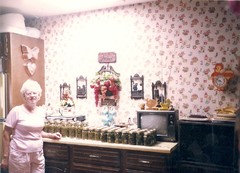
I will say, I'm probably the reactionary child. While I grow way more flowers than I need or can easily take care of, vegetables just die in my yard. I think they heard that I like living in the city and not in the country :)
I was also the child that danced when the hail came every.single.spring. and wiped out the peas and blackeyed peas :)
chickencoupe
Original Author10 years agoWhat a beautiful story and a heart-warming photo. I love your mom for helping mold you into such a beautiful person. The wallpaper, TV and micro. bring back many memories.
- 10 years ago
Thanks, Bonnie. I had great parents. My dad built most of that house...after working a full shift at the airport every day. That wallpaper...we looked at soooo many wall paper books. I think that was the replacement for the original. I'm pretty sure the first one was orange and yellow. I'll have to go back and look. I think I have an old pic in that very spot from when my brother was a toddler.
chickencoupe thanked Lisa_H OK - 10 years ago
Lisa, Thanks for sharing your memories. Your mom's kitchen photo took me back a few decades, and I loved walking back down memory lane. Like Bon, the TV, microwave and wallpaper all look familiar to me, as does the decor items on the wall. Nowadays, the TVs are bigger and the microwaves are smaller. : )
The story about the hubbards made me laugh. I love squash and grow a lot of it most years and I still cannot imagine 100 hills of hubbard squash plants. I wouldn't have hauled buckets of water to them either. There's only so far I'll go in order to grow a garden, and carrying buckets of water is not on my list of fun gardening activities. I think I'd feel differently if we had to have those squash or it would be a hungry winter, and maybe I'd haul water by hand, but I don't think so.
We are so spoiled nowadays compared to the lives our parents, grandparents and great-grandparents led.
I remember that my grandmother saved and reused aluminum foil as if it were made of gold, she saved bread bags and reused them for food storage instead of buying ziplock bags or baggies, and she saved bleach bottles, filled them with water and used them in the fridge and freezer. In the freezer, the bleach bottles of water froze and kept it full (thereby enabling it to cool more efficiently) and she removed them as she added food the deep freeze. In the fridge, they served as unbreakable pitchers of water the grandkids couldn't break. I may think I am thrifty, but I'm a real slacker compared to her. She even saved food scraps (mainly meat and bread) from their dinners, placing them in bread bags in the deep freeze, and sent them home with us to feed our dog. The dog always was happy to get her leftovers, and she knew that for each meal he ate from her carefully-saved leftovers, that was one less can of dog food my parents would have to buy. They truly believed in "waste not, want not", and lived that way all their lives
Dawn
- 10 years ago
Dawn,
There is another little discussed facet to local food. (Resilience) Just reading about growing food is not enough to really KNOW you can feed yourself in a worst case scenario.
Many other countries encourage family gardens and some countries even provide garden plots for free or very cheap. If their system collapses, their citizens can survive. (Resilience)
Johnny chickencoupe
Original Author10 years agoI recall Denmark being that way. On the outskirts of town was simple land lots. Most of them had a tiny cabin and cleared plots for gardens. Really cool, but makes me grateful for the room that we have.
And the Danish ... all of them .. had home grown flowers. I visited in May. Very beautiful.- 10 years ago
Bon,
That is common in Europe. Also, gleaning is still practiced there. When I lived in Germany, the farmers allowed gleaners to take what they wanted after the harvest. I remember farmers leaving one whole strip of food and the corners of the fields too.
I would guess about two percent of most fields.
We used to cook that food while on long war games. We took a large stew pot to the field with us just for that purpose every Fall. Some of those stews were fantastic. Cabbage, turnips, corn, potatoes, "C Ration" ham, the odd goose that chased our jeeps...
Johnny
chickencoupe thanked johnnycoleman - 10 years ago
Gee whiz, how in the world could you keep squash bugs from destroying 100 squash plants? Maybe squash bugs weren't really a problem back then.
- 10 years ago
Well, my dad was not exactly chem free. And it was the plains of Colorado. I don't remember if we had squash bugs or not :) (and it wasn't alllllllll that long ago :) )
- 10 years ago
Johnny, Yes, resiliency is important, and so is redundancy. I use succession planting to grow successive harvests of the same thing. I'd rather harvest green beans from May through July (or August) weather permitting, than to just get a big harvest all at once. I also use redundancy in food processing. For example, with tomatoes I freeze some, can a lot, and dry some. With onions, I root cellar them and also chop up and freeze a lot. Sometimes I can some of them. Oh, and because you never know when weather or pests will destroy a harvest, I always try to preserve at least 2 years' worth of food in any given year. That way, I'm covered if a crop fails.
I've gardened all my life and still doubt I could raise all my family's produce if it was our only source of food. That's a lot of garden and a lot of food preservation even for someone who likes doing both. I suppose my family would pitch in and help me if it ever comes to that.
We need for local communities to have a local food system in place, but except for market growers and CSAs, most do not. Lots of small communities don't even have a local Farmer's Market. I love the community garden movement and the community orchard movement, but they are bigger in some areas and not so big in others. I think we have an unworkable ag business model in the USA, especially in California. The majority of our produce cannot continue to come from a state that is rapidly running out of not just water, but groundwater in the aquifers as well. We need to be growing as much produce as possible in every single state.
Lisa, I was thinking the same thing---that either y'all were too far north for SVBs to be a big issue or your dad was spraying something that killed them. I am old enough (you might not be) that I remember my dad having an icky can of something stinky in the garage that he sprayed on his garden to kill pests. It had a skull and crossbones on it (which terrified us children), and it was DDT. Everyone used it back then. How times have changed (and it is a change for the better).
Dawn
- 10 years ago
Dawn,
Seems to me that California running out of water should be on the front page every day. Maybe it would wake up some folks.
I read a few articles about rock phosphate being used up faster than our population is growing. Makes me very concerned for our Grand kids. Sustainability!
- 10 years ago
Lisa, I gardened in Denver (Aurora actually) and never saw a squash bug. In fact, I don't remember anything being a real pest problem.
- 10 years ago
Johnny, What bothers me even more than the lack of water is that their ground is subsiding due to all the groundwater being pulled out of the ground. I don't believe the ground rises again when or if the aquifers ever get to recharge again adequately. I believe I read that somewhere. It would bother me if the ground I live on was sinking. I wonder what the folks in California think? Maybe at this point, in their 4th year of drought and with horrific wildfires and severe economic issues facing their agricultural industry, right now all they can focus on is survival and getting through the current crisis. At some point, though, they will have to deal with the issues of groundwater depletion and land subsidence. If they don't get great snowpack this year, then what happens to them next year? It is scary to think about. It doesn't really matter how much rain falls because rain isn't where the majority of their water comes from. It is snowpack. Did I not just learn that rainfall alone is not enough after making it into Severe Drought a mere two months after catastrophic flooding resulting from incredibly heavily May-June rainfall? All that rain that fell in huge amounts ran off more so than it soaked in so that we didn't have nearly enough deep moisture to get us through two months in which almost no rain fell. I'd hate to see Cali get only rain relief this winter when what they really need is snow.
I have changed so much about the way I garden here, all in an effort to garden in a more sustainable way. I used to bring in bags of purchased soil amendments, but I am mindful of the fact that it is better to create your own amendments so your own property is self-sustaining.], so now I try to do it myself without buying bags of amendments. It is a lot harder if you are relying only on what you find, make or grow on your own property, but at least I know I am not bringing in peat moss (not sustainable and is transported great distances) or herbicide residue-contaminated manure. Mulching and compost still are important to me, but I also have to grow compost crops in order to be able to make enough compost and I grow cover crops/green manure crops to add more organic matter. It is a challenge every year to put enough nutrition and organic matter back into the soil to make up for what my plants take out of it, but I'm up for the challenge. I haven't even brought in any old spoiled hay since 2010. I miss having the hay, but I no longer have to worry about whether one of my neighbors sprayed one of those persistent herbicides on their hay. Trying to be self-sustaining is a lot more work than just hauling stuff in.
Carol, Thanks for confirming my gut feeling that maybe SVBs don't make it that far north. Or, at least they didn't then. With warmer temperatures creeping steadily northward over the last decade or so, it may eventually get warm enough there for SVBs to become a problem. I hope not. I love Hubbard squashed but they are the #1 favorite of SVBs in my garden, so the only way I grow them nowadays is in their own little raised bed far away from the garden in order to use them as a trap crop to find and kill the SVBs when they first show up. That buys me a little more time for other winter squash varieties, or at least warns me to get floating row covers/netting firmly in place to thwart the SVBs.
Dawn
- 10 years ago
Dawn,
Another gotcha is salt water intrusion. As the fresh water is pumped from the California aquifers near the ocean, the salt water enters the aquifers. Just bad any way you slice it.
- 10 years ago
Lot's of interesting thoughts and information in this topic!
I fully understand a lot of our older generation not wanting to continue the way of life they had growing up. They worked their tails off just to survive. The thing that saddens me is the fact that we are losing those skills.
I've spent the last several years learning and developing as many of those skills as I can. It's not so much that I feel our country and the world for that matter are headed for major problems, it's just some of this stuff is just plain fun! There's just a certain amount of satisfaction that comes from producing something that I can say, 'yes, I made that'!
Seeing the look on someone's face when they taste some of the creations that come out of the learning process can be priceless! Of course, I cheat and don't share the stuff that flops.
One of my next projects is going to be a root cellar. Whether I figure out a way to convert my storm cellar or put in a separate one, this is going to happen. Storm cellars are great for dodging twisters, but not so great when it comes to maintaining consistent temperature and humidity for long term storage.
- 10 years ago
The first time I saw a little old lady take home some of the food I grew and gave to the food bank, I was hooked. My chest swelled up so big I thought it would pop.I expect to be at this for the rest of my life. I helped a farmer plant 10 acres of arrowleaf clover and Austrian Winter peas today.
Wish us luck. We need it.
Johnny
chickencoupe
Original Author10 years agookoutdoorsman,
Would love to see updates on that cellar. We're still pondering our options. The other house has a massive crawl space. We might convert that.
- 10 years ago
okoutdoorsman, Well, I don't share my flops either! After I master making new "artisan foods" to the point that there aren't flops, then I share the successes. It is amazing how easy it is to make things like yogurt and soft cheeses, but I haven't tried to make hard cheeses yet. I'd need to build a cheese cave to do that because my tornado shelter doesn't stay cold enough to properly age cheese. Building a root cellar has been on my wish list forever, but it isn't likely we'll ever get around to it until Tim retires. If we ever do build one, I'll make one part of it a cheese cage and try making hard cheeses.
I have stored some things, like potatoes, onions and winter squash in my tornado shelter in fall/winter, but it gets too hot to use it for that purpose most summers, so I just store potatoes and onions indoors in the coolest, darkest space I have. I'd rather have a root cellar.
The first time I made sauerkraut (long, long ago), I wouldn't share any of it with anyone either for fear I might do something wrong and accidentally poison someone. I laugh about that now, but when I was new to food fermentation I was very anxious about whether I was doing it properly.
Johnny, Your chest should have swelled up with pride! It is a wonderful thing you're doing to help feed people who might otherwise go without.
Several years ago I read an article online somewhere about the potential desertification of California. It is scary how much of what that article predicted (it sorta seemed like science fiction at the time) now seems like it could become a reality in at least some areas of the state. The intrusion of saltwater is almost too scary to contemplate. Two of my uncles met California girls while stationed in the U. S. Navy in/near San Diego in the 1940s, married them and stayed there. My aunts and uncles are long gone now, but I have many cousins out there. I always have been envious of the fact that they can grow oranges in trees in the ground in their yard with no winter protection and thought they lived in an agricultural paradise, based on my childhood memories of visiting them there in the 1960s. Well, it isn't an agricultural paradise any longer because it was not built on a sustainable model and I hate that for everyone there.
Dawn









Okiedawn OK Zone 7