Software
Houzz Logo Print
authereray

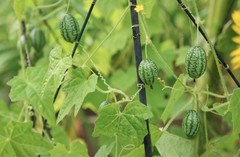
Creeping Cucumber - Melothria Pendula

10 years ago

Has anyone noticed a very small vine growing in their yard. The leaves look much like English Ivy but the vine is tiny. They are invasive growing many feet long and can climb any bush or they can climb up the side of a house. The vine has very delicate flowers and after they bloom they make a small watermelon looking berry about the size of an olive. They are lite green and striped like a watermelon. Cut open they smell like a cucumber and have similar taste only maybe a little sweet. I don't know how they got here but have covered up my flower bed and grown around the foundation of the house. They can be looked up on the web. They claim that they are good in salads and snaking. But after they get ripe they turn black, and are laxative to some people.

Comments (14)

  • 10 years ago

    I used to think bind weed was my biggest problem, then I discovered the honeyvine milkweed. And the other day my husband says "What is this?" I think it is this vine you are referring to. The fruits were black, the size of a cherry tomato. not sure I want it around!

  • 10 years ago

    You can see pictures of it on Green Dean's- Eattheweeds web site. I have no idea where it came from, birds maybe? Green Dean say's it's eatable chopped in salads or pickled like pickles. Squirrels apparently like it also. I am not particularly a fan, I'm sure there is a place for it some where, just not around my house foundation.

  • 10 years ago

    We have them everywhere. I have fought them and fought them for years and years, trying to keep them from taking over the entire west end of the garden. Their flavor isn't bad, but when I want cucumbers for pickling, I'll just use a regular pickling cucumber or, for fresh eating, a slicing cucumber. I've been really vigilant about weeding them out this year and don't have many at all, but sometimes new ones sprout and grow faster than I can yank them out. I never ever would let one stay on purpose. They are almost as aggressive as bind weed and they grow happily in almost full shade. I hate them.

  • 10 years ago

    Macmex,

    I found them the first time 4-5 years ago growing in the corner of the yard on an old dead cedar bush that had died. I had never saw anything like them before out of curiosity I tasted a couple, one was dark in color and the other was light green. The taste wasn't bad but nothing I felt compelled to keep eating. I was tempted to pickle some of them but have never done so.

  • 10 years ago

    Here's the thing, if we're ever lost in the woods, starving to death, at least we know we COULD eat these. Might go well with lambs quarters and purslane. I am facinated with foraging, though usually I really don't care for the taste of things they say you can eat.

  • 10 years ago

    Is this what you're talking about? I've heard it called Cucamelon.

  • 10 years ago
    • The cucamelon is Melothria scabra. It is the same family. This is a truely wild plant.
  • 10 years ago

    Which is truly wild (as invasive?)? The pendulum or the scabra?

  • 10 years ago

    Pendula. The little melon you show is being sold by seed sellers. I think it would be an anual in our climate. The M. pendula is a perennial. Which is probably why it becomes invasive.

  • 10 years ago

    Ahhh, they're so cute! ;)

  • 10 years ago

    This is the plant. The little seed pods taste like a cucumber.

  • 10 years ago

    Many annuals become invasive too, so be careful if you plant the one sold by seed sellers, and make sure you harvest all the fruit so no seed-containing fruits are left behind to self-sow a million new plants for the next year. I have many annual flowers I love that are more or less perennialized in my garden because they self-sow abundantly. They aren't actually perennial in the sense that they survive the cold from roots, but just that they have self-sown in some areas since 1999, so my neighbors who seem them every year think they are perennial. That's good in one sense because I always have plenty of them sprouting and growing so I can have flowevers everywhere if I want, and it is bad because they sprout so aggressively that it can be hard to keep them weeded out.

    The wild cucumbers I have here are not truly perennial---they don't come back in the same exact spot every year as if coming back from the roots, but since I don't harvest and use the fruit, new plants pop up from seed every year, including in the mulch and in permanent containers that sit in the garden year-round and in which I've never planted one of these things. They even pop up in pathways and in the gravel driveway. And in the middle of the chicken runs and flower beds up around the house. They often pop up in mid-summer, growing in mulch that I just put down in the current season on top of landscape fabric, so I suspect birds or field mice are "planting" them there for me. Or maybe wind blows the seed in or rain runoff carries it in. They definitely are more invasively at the sandy end of the front garden on its west end than in the rest of it where the soil is clay. It might be their seed rot in our clay in wet winters, but survive in the more well-drained sandy parts of the garden.


  • 10 years ago

    Wild cuke is easy to pull so once you see a strand just grab it til you find base and yank. No need to let it eat your garden/home. It is edible in a pinch.

0
Sponsored
Grow Landscapes
Average rating: 4.5 out of 5 stars8 Reviews
Planning Your Outdoor Space in Loundon County?