Software
Houzz Logo Print
sharon2079

Still another question on trying to propagate a cutting

10 years ago

I just watched a video link that someone supplied on this fourm. My question and clarification is where exactly the cut should be. From the video it looks like they are making an angle cutting above something they are calling a node. I thought the angle cutting was supposed to be below the node, because that is where the roots are likely to come from. What would the point be for cutting above the node?

Sorry for my ignorance. I really want to do this successfully. I guess I am just dense.

But I do appreciate your taking the time of helping me.


Comments (15)

  • 10 years ago

    It should be below the bud eye, the place where the leaves attach to the stem. I don't worry about the angle. I just cut it 1/4 to 1/2 inch below the bud eye. You want at least one bud eye to be under the soil as that is where the roots start and one budeye above the soil. I don't know if they mentioned it, but you should scar the bud eye by scraping where it is. I'm not sure what they are calling a node since I have not seen the video, maybe where the stem meets another stem?

  • 10 years ago

    The video used the term leaf node, I am thinking that is a bud eye. And that is where I thought the roots came from. However, I have not scarred the bud eye. I have scared from the leaf nod that is in the soil to the the bottom end of the came so I am scarring apprx 1/4 to 1/2 inch of the stem. I will try the leaf node now.

  • 10 years ago

    I think they are the same thing and that is where the new roots will come from.

  • 10 years ago

    Oh.......!!! Now that makes sense!!! I've never heard that before. This time I did my rooting - I did manage to cut below the leaves, and the eye is under the dirt. I didn't scar them though.

    Carol

  • 10 years ago

    There are different methods. Some people actually smash the end of the cutting! I experimented once using three different methods of scarring the end of the cutting. I don't think there was any noticeable different in rooting success. Not everyone scars the budeye before planting. how long have they been in the soil?

  • 10 years ago

    At least 2 weeks.

    Carol

  • 10 years ago

    There are many ways to "scar". The object is to expose the cambium layer. That's the white layer beneath the outer bark or green skin. I use small scissors to scrape the green skin off but you can also split the stem or just cut on a very long slant.

  • 10 years ago

    Yeah, that makes sense.

    Carol

  • 10 years ago

    Uh, no, the cambium layer isn't the white layer. That is the pith. Cambium is the juicy, brighter green layer between the bark (skin) and the pith (bone). Cambium is circulatory system and the only tissue capable of callusing and forming roots. If you break a prickle from a recent flowering stem, you often expose the juicy cambium beneath it. If you scrape through the cambium into the white pith, you expose thin strips of cambium between the outer skin (bark) and the pith. Where this makes the most difference is in budding, where you don't want any pith exposed, because you need cambium tissue both on the reverse of the bud as well as on the stock. Cambium only grows to (knits to) cambium. You can scrape (scarify, scar) through the cambium and into the pith for rooting. For quite a few years when I propagated at The Huntington Library as a volunteer, I would simply scrape the cutting toward its bottom with the blade of a single edge razor blade, as if I was scraping off paint. It exposed sufficient cambium for callus and roots to form along the edges of the wound.

  • 10 years ago

    Thank you roseseek. Do you by any chance have any good pictures showing the difference between Cambium and pith..... and do these show up different in hard cuttings and soft cutting. Hopefully I will get better at understanding this. Thanks again everybody,

  • 10 years ago

    Thanks for clarifying that, Kim! I knew you had to exposed that layer. Sorry about the mix up.

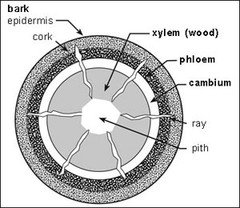
    I found this diagram on line


  • 10 years ago

    You're welcome. I have thephotos I posted on my blog in the Chip Budding post which may help you see the difference. If you remember the pith is nearly white, it may help when you see the juicier, brighter green cambium. You'll have to scroll down to see the photos. If you take some cane parts you don't care about and start dissecting them, you can quickly see the difference. Some roses have rather thin cambium. Others seem to have extremely thick cambium. That's one of the great benefits of Ralph Moore's Pink Clouds. Its cambium seems extremely thick, so it's very easy to graft on it successfully.

    With practice, you can easily remove the bark-skin and expose the layer you want. Quite often, particularly on green wood (either soft wood or green harder wood) cuttings, the skin is almost translucent, like a plastic or waxed paper. The green color you see is the juicy, green layer you want to expose. From experience, you don't need to differentiate between the extra layers represented in Seil's diagram above. Just think of it as three layers...skin, circulatory system and "bone". As long as you expose the circulatory system, you should have callus and eventually roots. If it turns tan and dries out, there was insufficient moisture. If it turns black and furry, there was too much moisture. It honestly can be that simple.

  • 10 years ago

    Thank you Seil for the picture. And Thank you Roseseek for the link on Budding. I may try the budding if I can get my Fortuiana to grow. I have had a couple of suckers and I have been tryuing to root them.... so far not successful... but hopefully if I can get it to grow then I can get my root stock.... at least that is the plan - then I can bud roses that I normally can't find on Fortuiana.

    Again, thank you for your input.

  • 10 years ago

    I have been doing softwood cuttings for over 30 years. An older Rosarian showed me how to prepare the cuttings. She just took a knife and cut from the budeye down

    She cut right through it. I usually get 90% of my cuttings rooted. I have a video on roses out and it includes doing a cutting UTube.com/Decatur Roses

Sponsored
Industry Leading Landscape Contractors in Franklin County, Ohio