Software
Houzz Logo Print

Comments (25)

  • 10 years ago

    Acorneti, you are truly the "Mad Scientist of Cucurbits" !!

    Love seeing all the interesting varieties you post, and very nice Facebook page.

  • 10 years ago

    Looks like a Moschata, what size is it?

  • 10 years ago
    last modified: 10 years ago
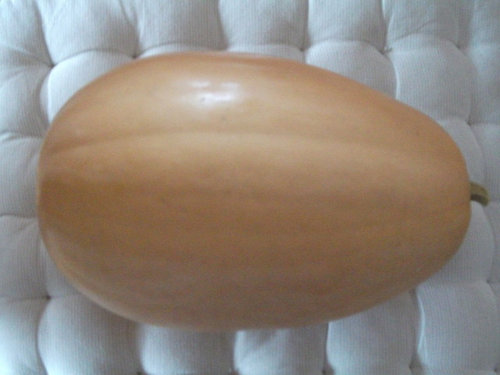
    Valery ´s Cucurbita moschata, yes for sure. But I am the opposite of a mad scientist, since I do strictly classical breeding without destruction or modification of genetic material.

    Length of F1 was around 32 cm through hybrid vigor and in F2 now for the finished true seed variety between 26 and 31 cm or 10" to 12", while diameter was 24 cm equatorial cut in F1 and now is between 18 and 20 cm or 7" to 8".

    Since the wall is as thick as it was in F1, we now have less air in seed cavity and a far better market fruit. For BRICS and Eurasian nations or the Shanghai world I give away seed for free, while for North America this variety costs you at least a five digit $ sum.

  • 10 years ago

    How does it do with Downey and powdery mildew ? And what is a 5 digit sum, I'm in the US

  • 10 years ago

    You can´t afford it. I will multiply seed in Russia. In a few years you may buy seed from there or from growers, who buy seed in Russia.

  • 10 years ago

    Ha! Sounds good, get to work growing it out because I sure do like the looks and sound of it. I liked you on Facebook and was looking through there. You really do have a lot of amazing varieties! My particular problem here in the south is downey mildew, it quickly kills any Moschata not from a hot humid area, beginning about mid season

    I know nothing about plant breeding, but I'm saving seed from an F5 cross of butternut and Seminole. In this, my first year growing it, it charged right through the mildews. Only problems were some enormous neck pumpkin fruit (18 pounds), and 50 foot long vines. There were many different shapes, some smaller Seminole shapes and some butternut types. Flavor was good on all of them I have tried to this point.

    The two in the front were Geramoun Martinique for Baker Creek, the rest were the butternut Seminole hybrids, you can see the range of size. Some were dark green as young fruit like pure Seminole, some had classic butternut coloration like the one on the right.

    I pulled many more than this over the course of the season. These were pulled before the first frost. The Geramoun was not nearly as productive and was from the Caribbean Islands, but it was a better size and not impacted by Downey Mildew.

    Glad to learn about your work and thanks for sharing it.

  • 10 years ago

    Since I was allergic against Gringos, I did not send seed to North America this year. But your posting is my world. I like to cooperate with growers like you.

    I have seeded moschata crossbred pumpkins in late June this year to bypass PM and harvested the best fruits from these plants on September 30.

    Albeit we had a very dry summer with only little PM-pressure, I had it on some of my moschatas, which were propagated indoor with seed in late April and set out early May.

    But one variety was PM-free and also very early seeded and set out prior to our last frost date. I don´t know, whether this can be named PM-resistance, but I am very happy about the outcome in fruit quality too of that C. moschata 'Estroval'.

    Would you like to become my only breeding partner in North America now?

    My PM-tolerant variety I named C. moschata 'Estroval', because the base of my breeding line was Don Maynard´s C. moschata 'La Estrella'. It would be fair to select this variety in the USA further on, since Don Maynard bred half a century ago 'La Estrell' at the University of Florida. It was the first academically developed pumpkin with the goal to produce fruit uniform in shape for a better machinable harvesting. Fruits all had a plain globe shape without ribbing then, but they matured differently colored. And they were made for your southern US climate. To fit more for our climate, I had to cross 'La Estrella' two times interspecifically, and now I grew first time in 2015 a F2 true seed variety with homogeneous oval shape with ribbing, equal maturing and size. Storability of 'Estroval' is far better as for 'La Estrella', but fruits don´t roll so well in front of the rake, when the tractor makes rows for the harvesting machine. This is not important for me, because I want to harvest fruits by hand for the best storability, while the farmers only provided the industry to make puree or grew for fresh market.

    These fruits here on my picture are not exactly uniform in size, but this is absolutely ok for same size of a pumpkin variety. Would you like to multiply and select 'Estroval'? And would you like to cross my C. moschata 'Valery' with the largest one of your butternut-seminoles? I give you seed for free - for sure! But you would communicate about the outcome with me and send me seed of your crosses, if I was interested?

    When I look at your picture, the only worth to breed fruit is your morst butternut-like one, yes.

  • 10 years ago

    Acornetti, I agree to your terms, and did you mean most shaped like a butternut in the pic? If so, I will cure it for a bit more and then do a taste test, all that other stuf does not matter if taste is not there. Me email is genesmith325@me.com, send me a mailing address and I'll send the seeds from that fruit to you to breed out as you wish. Sorry, I don't have the patience for hand pollinating, and such. I guess I would be more of what we call a landrace gardener, saving seeds from whatever Moschata Mother Nature pollinated for me in order to develop a variety suited to my climate, no till organic lasagna garden and diseases and pests. Speaking of pests, hope you don't have issues with the despicable caterpillar we call pickleworm. Here is a pic of one. The moth does not overwinter here, but in Florida. However it does migrate north and gets to our area a bit after mid season, some timing as the mildews. It will damage any cucurbits it finds,no matter the species or how hard the rind is.

    You can see the hole bored here, I put these under water, the worm came out and was immediately squashed. The squash heals around the hole and I cut it out when I eat it. If I miss one, the squash will rot as the worm grows.

    This is what the little suckers look like, this squash was pretty hard and it still bored in. I covered some with ladies nylon stockings and they cut right through. I did have some success with spraying the stocking with Neem and the coating with Bt powder. I am currently trying to find some sort of breathable bag to secure them.

    Had roasted squash last night from the biggest one, we have eaten at least 8-10 portions and have twice that left over. I cut the neck a month ago to get a portion, then rubbed the sap and sealed with plastic, it kept another month! Having squash frittata's frmm it tomorrow night.

    Moschatas are amazing, no early season diseases, long keeping without any prep, and very tasty. Let me know what you want me to do about breeding and swapping seeds, just understand I make no claims to be a plant breeder. The only thing I don't like about the butternut/Seminole is the variable size from 4-18 lbs. It's a lot easier for me to store and process a 3-4 lb squash.

  • 10 years ago

    I see. Estroval would be too large for you, but Valery is around 4 to 5 lbs and maybe without minera fertilizer your ideal 3 to 4. Since I never grew Seminole and still don´t like to grow it, I would prefer to try you proven cross. That is very interesting, when you stored the cut fruit a whole month! Sometimes I open a fruit with equatorial cut, remove seed and then close the the fruit exactly as it was before... only without seed and placental tissue, which could rot inside. I do so, when I want to eat or to process it a little later. But after a month these fruits are a little too squashy at the inner flesh. When I cut a Pennsylvania Dutch Crookneck, it can be stored for two weeks but never a month. And so I think, that your Seminole crossing really prolonges storability all around.

    Your seed would be worth a mint for me, since I am lazy about doing the cross from the start all by myself.

    Do you have seed from that nice larger and darker green Geramoun too?

  • 10 years ago

    I'll be glad to send the larger one now, once it dries, and the Geramoun when I cut it to eat, just send me the address, but be forewarned that the Geramoun may have crossed with the butternut Seminole cross and vice versa, since I offered no protection.

  • 10 years ago

    By the way, the butternut Seminole was very firm and required a lng cook time.

  • 10 years ago

    To fight your Diaphania nitidalis with Bacillus thuringiensis (Bt) spray on the plant, is the most proper way. Best you do this in the night, when moths are laying eggs. But Bt also kills clutch and larvae of useful insects, and so I do not use Bt. I have learned to live with all creatures and even fodder my voles. On my pictures you can always see weed. Some pumpkins I grow in a carpet of pimpinella and everywhere stands high thistle as fodder for Minerva´s owl. Bats and owls eat up so many moths, I can´t produce enough for them. Even our cat is happy, when moths are to catch between the pumpkin plants.

  • 10 years ago

    Squash fruits nicely show xenia habit, which means, that the fruit always shows a little or much more influence of the pollinating plant. And your Seminole-Butternut went back to butternut-shape and colour, what proves that it is selfed or sibbed and not influenced by the Geramoun. That nice Geramoun also is best pollinated by bees or wild insects and a true seed fruit, I think. No, I am sure, that the darker Geramoun is never influenced by the Seminole-cross, because of the dark colour. I have bred such wild-type C. moschata with dark colour, and when they were pollinated from a Crookneck or a Butternut, xenia habit always was a brighter green. Your second Geramoun front middle in this picture is younger and therefore bright green... so you can´t say. Anyway, there will be no viable seed in that fruit.

    I would be very happy to get seed from your darker Geramoun and from your best Butternut with much Seminole in its genetics. The latter is a semi-finished good for my breeding of great value. And Geramoun Martinique is a very welcome quality of a new variety for me. I did not grow it before, because no seller could guarantee the flat-round shape. I think, that you did good selection for me with this single fruit. So you are a good breeder yet, but without knowing it so far.

  • 10 years ago

    I now have watched that picture with two fruits on the washing machine again. The smaller fruit is very interesting. I think, that this one is pollinated by Geramoun pollen! Do you have seed of this fruit, or did it move onto the compost heap?

  • 10 years ago

    I cure mine in the laundry room, glad I went in there, one of the Geramouns had rotted, yuk. I checked the Baker Creek online catalog and they were not listed. Here is the one I cut and cooked, pretty bland, but also easy to cut. I think these have a long curing period. I checked the ones in the pic and they were easy to pierce with my fingernail. The Butternut/Seminole was very tough to cut.

    I guess the Geramouns are 3-4 lbs and 12-14 for the butternut cross. I think I have seeds left over from the Geramoun if you want them. I checked their catalog and it was not listed this year. Last years catalog showed a tan all over, but mottled and very pretty ripe one, guess I'll have to wait and see if mine cures to that color. Not nearly as productive as the cross either. I lost three to spoilage, ate one and these 5, not many from 3-5 seeds.

  • 10 years ago

    The smaller one on the washing machine is the Seminole classic shape and was dark green with no mottling.

  • 10 years ago

    The only other Moschata that survived the Downey mildew was tromboncino, so any of those three could have been the pollinator. Guess I'll have to wait for next year to be sure

  • 10 years ago

    ... was? Does it still exist? Or did you harvest seed? Is this little fruit from the cross, or did you also grow the pure Seminole seed?

  • 10 years ago

    Tromboncino is also called zucchetta, albeit it is no Cucurbita pepo like zucchini. As a Cucurbita moschata Tromboncino has a dominant allele combination for the long barrel or neck. So in every cross you can find a neck or butternut-like barrel between fruit stalk and seed cavity, when a normally not as strong half-long allele combination - like in butternut genetics - or the recessive half-long - like in Geramoun or in my Palav Kadoo - is single present. Since you have very very short necked Geramouns, in these fruits no influence from Tromboncino is expected.

  • 10 years ago

    Tromboncino normally is tolerant to PM powdery mildew, and you said downy mildew now for the zucchetty but PM first for your great problem every year. So I think, that your zhucchetta war tolerant to PM, as it should be normally.

  • 10 years ago

    ... but your zucchetta also is tolerant to borers and many other bugs. If you did not have pure Seminole seed, the smallest one might be a Geramoun cross with zucchetta pollen. Would this also be possible, or do you know for sure, that this tiny little fruit grew on a Butternut-Seminole?

  • 10 years ago

    Sorry for talking so much, but your fruits are really interesting for me, and with the third pollen donor now I watched this picture with the wheelbarrow again: there is a fruit with a crookneck in the middle. This is a smaller Butternut-Seminole with extremely distinct crookneck. Yes, this never can come from Seminole or Butternut alone, because both do not possess the real long crookneck allele combination. This only can be a Butternut-Seminole (BS) cross with father Tromboncino! I must have seed from this unique fruit! You are a master in plant breeding, because you have brought the bug and PM resistance from the zucchetta into this very interesting BS cross... probably... with strong probability! I must have seed from your masterpiece! Or is that seed rotten?

  • 10 years ago

    Yes, it was about 2lbs, and average for Seminole as I have read, never grown pure Seminole. It has a solid green baby fruit, while the Geramoun had a similar shape, coloration was very different.

    Pickle worms do bore, but into fruit only, squash vine borers get in the stems near the ground and feed inside the vine stem and make pepo's and maxima's almost impossible for me over a long season, although I do get a few weeks of crops before the SVB's get them, they a done almost always by mid season.

    i get both types mildew, the butternuts all resist PM, but not DM. Maxima's and Pepo's get hammered by PM quickly. Seminole, Geramouns and Rampicante are not bothered by any mildew. i think it is because they originated near the equator in Hot steamy climates.

  • 10 years ago

    Here is a link to the company that bred the butternut/Seminole, lots of shapes in the pics:

    https://www.seedwise.com/listing/268/seminole-x-waltham-f5#.Vmo40Ho8KrU

  • 10 years ago

    Thank you so much! There are fruits with very long barrel on the picture with so many differnt Butternut-Seminole, and so your fruit with the crookneck might fit into the spectrum of this cross... but these long fruits have a linear barrel and never a crookneck! I think, you really have a very valuable cross with B-S and the zucchetta!

Sponsored
AIS Renovations
Average rating: 4.5 out of 5 stars15 Reviews
Custom Craftsmanship & Construction Solutions in Franklin County, Ohio