Software
Houzz Logo Print
sunshine_1621

looking to add some "bones"...need ideas!

Hello!

I've been slowly but surely compiling a list of plants that I like and want to include in my landscape for next year. I've also been looking at a lot of pictures of landscapes to decide what looks good to me. I definitely want some variegated and purple foliage... anyone got any good ideas? Looking for larger sized plants. Maybe even small trees. Also, I'm thinking evergreens with fall interest?

So far I'm thinking dappled willow, ninebark, smokebush - these are just varieties I've thought of, not sure what's actually going in the space yet.

Any advice is greatly appreciated, thanks!

Comments (35)

  • 10 years ago

    how much space, what exposure, do you mind pruning, are you looking for "4 season interest" or do you particularly love one season and want to emphasize that in these plantings. Is this a border?

    The 3 you mention all get big.....perhaps as much as 3-4 feet wide and 4-5 feet tall or bigger with no pruning. Willow wants moisture, ninebark doesn't mind dry but not drought, smokebush seems, in my experience, indifferent.

    You may want a mixture of shapes (fountain, round, upright) .... choices are endless despite your initial leads: big, variegated, purple and fall interest


    If you could narrow it down a bit I think we can be more helpful.

  • 10 years ago

    sorry...

    It's around 8'-10' depth and 60' long... plenty of space. Yes it's a fence line border. Yes, needs 4 season interest. Most of the area is full sun, part is part shade, and another part is full shade. Thanks for mentioning the mixture of shapes, didn't think about that and I definitely need to switch it up by having a variety.

  • 10 years ago

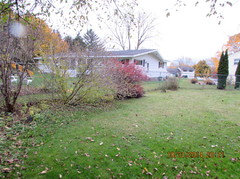
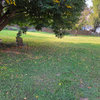
    pop us a pic ....


    ken

  • 10 years ago

    it goes beyond this, if the photo was extended to the bottom left there's about 20ft more, and it's mostly all shade there. This photo shows an area which is mainly full sun/part sun.

  • 10 years ago

    Be sure to include your neighbor's trees in your planning. The tall evergreens at the far end can appear as part of the scenery by planting a dense evergreen shrub that just covers the fence. You should try to capture the view of the tree behind the house, while obscuring the house.. you get the idea. I would make concealing the chain link a major objective. That means evergreens, vines, and dense layering of deciduous plants. Soften the corner so that it's natural and not an obvious lot line.

  • 10 years ago

    IME, 8' is a minimal width for what you want to do. If you can spare 12', it will give you more choices and at least 2 layers of plants. A single line of plants will create gaps and not be as interesting. As Kitasei suggested, layering and borrowing landscape will help, as will making the bed wider in some areas to accommodate larger plants or more layers. Plan on having certain plants repeat periodically along the entire border to create some cohesion.

    I'm adding thislink to an older thread where I added fairly extensive answers along with photos of one of my mixed shrub/perennial borders to a similar question. Besides plants, I talked about my planning and prep of the area. In addition to the plants suggested there, I grow elsewhere in my garden and like some of the Viburnum plicatum cultivars and Fothergilla (both of which have spring flowers and gorgeous fall foliage), both variegated Cornus/dogwood shrubs and Cornus kousa, some of the really hardy, disease resistant roses such as those in the Canadian explorer series, spirea 'Ogon', gold-leaved Caryopteris such as 'Sunshine Blue', a couple of the reddish-leaved ninebarks/Physocarpus, Kalmia/Mountain Laurel in some of the shadier spots, and a forsythia with a lovely fountain shape and reddish fall color as well as the cheerful spring flowers.

    My soil is acid fine-sandy loam, so you will want to research if my plant suggestions will work well for your soil.

  • 10 years ago

    I can spare 12', I just am not ready to right now. This is already a really big space to start with so I'm trying to not get in over my head. In time, I may expand it...

    I took a peek at the link, and your photos are truly inspirational. I will message you if I have any questions on cultivars. thanks!

  • 10 years ago

    If you haven't already, download some graph paper and start drawing things out to scale. That will quickly tell you how fast that area is going to disappear when you start planting. MOBOT is a reliable site to check size and whether or not something is tricky. (more so than UCONN because of soil pH issues)

  • 10 years ago

    Yes, that is the next step. I do have graph paper, we'll see how things fill up then I'm sure I'll have to re-evaluate ;)

  • 10 years ago
    last modified: 10 years ago

    I planted so that I wouldn't have to thin later, so things were somewhat sparse for a couple of years. However, now after 6 growing seasons, most of my shrubs have exceeded 6' in width, and several have exceeded 10' which is why I asked about adding width so you could have 2 rows. Mad_G's suggestion of graphing out the plants is a good one - I was amazed by how quickly my plants filled my bed which is closer to 20 feet deep. If you may want it deeper, it's better to plan for that now, even if you don't plant everything now.

    One possibility is rather than drawing plants directly on your graph paper, make circles of the right size and foliage color for individual shrubs and slide them around until you get a design you like (then tape or glue them down.) I did that for furniture to help plan a move for my mom and it was really helpful to not have to do lots of erasing.

  • 10 years ago

    Lauren, your post title says you want "bones", but then you immediately go on to list the peripheral aspects of some shrubs you want to use. That's not "bones", that's later-stage aesthetic considerations. "Bones", in my understanding, are the large-growing trees one is or will install on their property. These are the framework of the landscape, and all elements, including shrubs, follow. So, in terms of large-growing tree types, the factors to consider are : size at maturity (width, height), crown shape-conical, widespreading, oval, etc. and perhaps density of crown. All else follows these considerations. So, don't say, 'I've got to have a tree with purple foliage' or something like that. Say, 'I need an oval-crowned tree of moderate height in this spot' or some such idea. See where this is going? Don't start with the details, start with big-picture stuff-size, shape, etc.

    +oM

  • 10 years ago

    Shrubs are bones to my mind when one is talking a mixed shrub & perennial bed rather than the whole yard.

  • 10 years ago

    NH, within the confines of that scenario, I agree with you. But I just re-read, and nowhere does it state that's what OP is about here. In fact, I see her as already skipping right past the "bones" aspect of this potential planting, into such detailed factors as bark color, winter foliage, etc.....all important factors, but decidedly not "bones"

    +oM

  • 10 years ago

    sorry for the miscommunication. It seems that we are arguing semantics, I thought it was clear what I was asking. All I really wanted was some suggestions to add structure to the landscape. The 3 plant varieties mentioned initially were ones that I like because of foliage. I consider them to be "bones" because they will grow to be large and do not die back to the ground. Apparently what I consider "bones" is wrong, my apologies... but I think most people here knew what I meant.

    Can't "bones" have interest too? Nice foliage, winter interest? That's really what I was getting at.

  • 10 years ago

    No worries-I'm often accused of any over-emphasis on semantics, though I maintain that that's not the case-here or elsewhere. Landscape design, just as is true with any other discipline, has its own set of terminology and if one really wants to drill down into it, it will be helpful to that person to learn what these terms actually refer to. I do understand what you're after, and even in this case, I'd think in terms of size and shape before I'd consider such things as bark, fruit, flower, etc. That's just me, but many, perhaps most designers do operate this way. Think big-picture stuff first, then see if your favorite shrub can fit into this plan. In too many cases, it is obvious that the homeowners started out from the wrong end-'I like this, I like that', instead of starting from the basics. In any case, when things go too far down that road, one ends up with a collection of plants, not a harmonious landscape composition.

    +oM

  • 10 years ago

    I certainly understand what you're getting at, and I appreciate your advice! Will definitely take that into consideration... still open to more plant suggestions if you have any!

    thanks!

  • 10 years ago

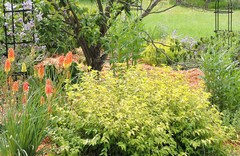
    babs - do you have a picture of your caryopteris, I love this one! What's the size? Missouri botanical is telling me about 2x3'?

  • 10 years ago

    kousa dogwood or maybe crepe myrtle

  • 10 years ago

    What general shapes do you want the shrubs to have? This gets back to the 'bones' question. You can assemble lists of large, roundish shrubs, narrow pointy shrubs, smaller filler shrubs, etc. and then try to select a pleasing assortment from the lists. But first you need to define what you want the shrubs to do for you. It seems to me that there is a lot of bouncing around in your requests, which just confuses readers. If we are discussing large shrubs, how in the world did caryopteris get into the mix? It's a nice subshrub, certainly suitable for putting in front of the composition, but as a bone? Then smokebush, which is usually pollarded here because it only naturally dies back an annoying part of the time. So it grows into a large presence in one year, but certainly doesn't start out that way. Dappled willow is also cut back by a fairly large percentage of people because the newer growth is considered more attractive.


    So what, fairly exactly, is the question? Are we talking about large, rounded shrubs in the general size of 8 or 10 ft around? That wouldn't be a bad place to start, but it is going to eat up that bed fairly quickly.

  • 10 years ago

    sorry, it is a bit confusing now isn't it.

    babs mentioned the caryopteris as one of the plants that does well in her garden, among some of the other larger ones she mentioned... so I got off track a bit.

    I do want an assortment of shapes. I guess the question now is, should I put evergreens/conifers in there for some structure or just do larger shrubs? That is I guess what I'm struggling with now. Babs had some gorgeous pictures of her landscape with a nice backdrop of evergreens but I know right now I don't have enough room for the layering she did. Kind of torn now...

  • 10 years ago

    Lauren, this is absolutely not to point fingers your way, but we do seem to be getting lots of questions about "what should I plant" and it's a little bit as if the entire field of landscape design never existed! There's books about this stuff, there's experts who understand how to assemble a pleasing and long-term composition of shrubs. Maybe those who point queries like yours to the design forum are actually being the most helpful. Again, this is not just you, but a rash of recent posts where it is expected that folks will-from their remote locations-design a landscape for someone in another region of the country. Maybe I'm just venting a bit, but really, there is such a thing as design. And all of your considerations at this point are design considerations, not horticulture per se.

    +oM

  • 10 years ago

    surely I don't expect everyone that reads this to respond... if you have any tips, I'm all ears, if not, that is perfectly fine. I have read books on design and am aware of the 'rules' but sometimes they can feel obscure. It's difficult when you're trying to get down to specificity for YOUR landscape to actually commit to something and start somewhere. That's where I enlist help of others. I don't wish for anyone here to design my landscape, just looking for where to start. I have received many good suggestions thus far so we'll leave it at that.

  • 10 years ago

    This is a pair of Coreopsis "Sunshine Blue" plants planted next to each other. Here it gets to 2 1/2 feet or so, so definitely not bones. (The other similarly colored plant in the background is Spirea 'Ogon' which gets somewhat taller.)

    I guess I was using info that Lauren included in questions on a couple of other forums.

  • 10 years ago
    last modified: 10 years ago

    Throw in a Bay Laurel for good measure--Laurus nobilis.

  • 10 years ago

    Bones in gardening is usually considered as evergreen trees. Then you design deciduous trees, then evergreen shrubs, deciduous shrubs, and then evergreen groundcovers. Last are perennial flowers and annuals. It's been said you have to build the cake before you decorate it. There's a definite order when you design a landscape and you're starting somewhere in the middle with deciduous shrubs and thinking of them as individuals instead of a part of a designed community.

    You mention evergreens for Fall interest. Evergreens are for all year interest, not just a small cog in the works. Evergreens work all year long. In your picture I see an almost complete absence of evergreens. It could sure use some. The whole area in the picture looks bare to me.

    I have a feeling you're not ready to give up much lawn to achieve this. Experienced gardeners gradually shrink the lawn as they gain experience and have to make a lot of changes in doing so. We're trying to give you the shortcuts so you start out right and save yourself a lot of work and come out with a nice landscape.

    Mike

  • 10 years ago

    Catkin, from my limited knowledge of US climates I'm not sure Laurus nobilis would survive outdoors in Lauren's region, at least not in good shape. Where it does thrive it can grow into quite a reasonable sized tree if not constantly pruned/clipped. It would be too big for the pictured area if left natural, so quite a high maintenance choice. But I certainly agree with Mike about putting in a couple of evergreens, not necessarily coniferous ones. Personally, I'd include deciduous trees with specifically interesting Winter shapes, e.g. fastigiate or weeping, under 'bones'. But that's not an important discrepancy.

  • 10 years ago

    Mike - I don't have issue with losing lawn, I have plenty of it to borrow from, but I am worried that this area will become too much maintenance (weeding specifically) with a bed that size. But maybe I just have been delaying the inevitable this whole time...

    Also, thanks for laying it out the way you have, the layers certainly make sense and maybe expanding the bed is something I need to do for the area to look right in the end. I'm going to experiment more with this on paper...

    Appreciate everyone's advice!

  • 10 years ago

    Evergreens are difficult to deal with. There are very few broadleaf evergreens that can handle the conditions. Boxwood is one of the few. Conifers are difficult because of their growth patterns. Any bed they are in has to be almost continually redesigned as their footprint grows. The very small conifers are out of scale. What are usable are evergreens that can be pruned to size, and lawn trees. Neither of which are currently fashionable.

  • 10 years ago

    so then, what would you suggest mad_gallica?

  • 10 years ago

    Deciduous shrubs with interesting winter shapes or berries.

  • 10 years ago

    There are some broadleafed evergreens that work if your soil is acidic. Have you had a soil test done? Onondaga County has quite a range of common pH, from around 6.0 to 7.9 and what you can grow will vary quite a bit depending on what your pH is.

  • 10 years ago
    last modified: 10 years ago

    yes actually, the pH is 6-7. The areas closest to where you enter to the backyard is the 6 reading. But I have added compost so not sure if that area will neutralize at all. The soil was pretty bad before we worked it.

    and I did see this one that I thought might be a good choice - picea glauca 'conica'? From what I read, some think it's too common and a little boring but it seems like it might work for my purposes.

  • 10 years ago

    Way back up the thread kitasei pointed out that the neighbours have a couple of columnar conifers which you could 'borrow' into your vistas. There are also some good columnar yews and hollies which would work if they suit your area.

  • 10 years ago

    Correct flora! I didn't realize they were so tender.