Software
Houzz Logo Print
gardenchuck

A lonely Madrone, need advice.

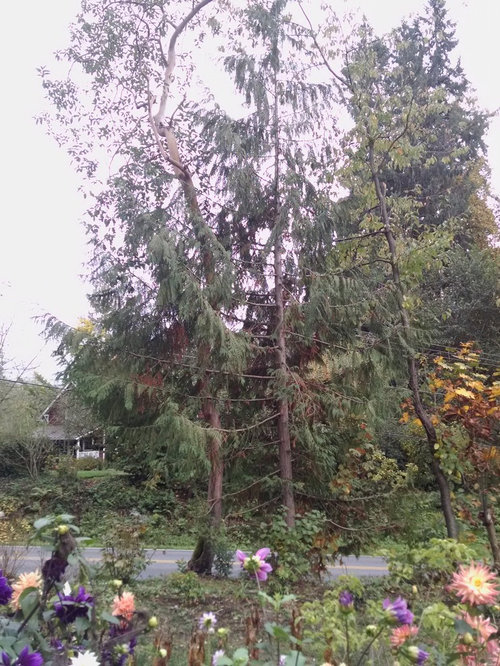
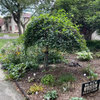
I have a single madrone tree in my front yard growing over the drainage ditch next to road. Next to it, 3 feet away!, is a small western red cedar. This madrone is the only one I have seen in my area. Do I cut the cedar? Can they co-exist? I am in the middle of a complete redo of the front yard. To the left of Madrone is a conifer bed with pines,blue spruces,yews,cedrus deodara,japanese cedars,etc. I have planted many evergreen shrubs,Pieris and Viburnums, along the road treeline. I will be cutting most of the small trees like the cherry next to cedar in picture and putting in Cornus Kousa dogwoods to shade the shrubs. The front yard faces southeast and gets morning and early afternoon sun.

Comments (22)

  • 11 years ago
    last modified: 11 years ago

    Will be interesting to see what the far more informed PNW posters think; but if I were operating in a total information vacuum on this I'd almost wonder if leaving the cedar there is a good idea - thinking that it will suck up a lot of the extra water that might upset the Madrone. In the real world of nature (versus a semi-modified suburban landscape), surely, these species must sometimes coexist this close together. Or similar Ericaceae/Coniferales...I'm quite sure, for example, that along the route of the California Zephyr I saw Arctostaphylos that close to the base of large Calocedrus.

  • 11 years ago

    Mostly right in line with David-in that I'm not the most well-versed when it comes to PNW gardening-but surely those two do indeed coexist, and at many locations, no? I will readily admit to having more than a little fondness for all native versions of Thuja, so there's that, hidden in my answer. But still.....they're native to many of the same locales, are they not?

    +oM

  • 11 years ago

    if for any reason.. you decide the cedar goes .. it gets cut flush to the ground.. and it will be dead... no grinding out the stump or some such ... dont even need stump killer ...


    you might also.. at this late date.. have an issue of changed wind patterns if you remove only one ...since they grew up together.. their tolerance to such.. might rely on each other ...


    whats the third tree on the right.. that LOOKS like it is is leaning into the two of them???


    for the rest.. i also will defer to the PNW peeps ....


    ken


  • 11 years ago

    I am so glad I posted this question. Some very good points I wouldn't have thought of! Both trees are on a 5 ft "cliff" above the street drainage ditch. Drainage is excellent due to a sloping yard away from it.

    I had no idea madrones don't like water, good info to know.

    Ken, the 3rd tree is a wild cherry, its coming down.

    How close to the madrone is safe with a compact tractor?

  • 11 years ago

    If you like that madrone you don't want to go under the dripline with a tractor. Like gal said, they are picky and if you have one, you are lucky. I also agree with gal that the two trees can coexist, but from a landscape standpoint the cedar will take up volume that IMHO is better filled with the madrone. Celebrate it and cut down the cedar. BTW, IMHO in addition to the Cornus, a vine maple might be a nice companion for that madrone as well.

    .02


  • 11 years ago

    I agree with Dan Staley, cut the cedar down and plant a vine maple or two for blocking the view from the road. I just hope the madrone doesn't die on you in a few years, and you will have no trees at all.

  • 11 years ago

    Lol! I have plenty of trees. It's usually the first thing people comment on when they visist. I would love to have vine and Japanese maples near the madrone, but it is full sun all day in that spot.

  • 11 years ago

    Vine maple grow in sun. I had one in more than half-day sun where I lived in Wallingford.

  • 11 years ago

    The arbutus looks gaunt as though on the way out - as so many are these days - and the cedar is genetically programmed to become a forest giant. Also it being a broad-leaved evergreen the madrone generates debris for months at a time, which many people don't like. Take all three out and start over with a new arrangement, maybe one including a wood fence.

  • 11 years ago

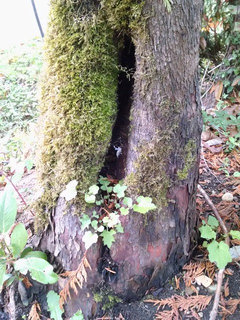
    I took a good look at the arbutus. It appears to have issues down low.

  • 11 years ago

    It's pretty hard to find a madrone that doesn't have some issues, even those growing under almost ideal conditions in the best locations. But even with all the myriad of problems they encounter, they have great staying power and will hang on for decades.

  • 11 years ago
    last modified: 11 years ago

    And looking like Hell the whole time. This example does not have a normal level of crown density visible in the first picture, with its leaves appearing so small it looks like an aspen.

  • 11 years ago

    Embothrium, you're taking the words right out of my mouth!

    In addition, the Madrone drops a good third of it's leaves in June! Who wants that? Plus, they're slow to decompose. It's just a messy tree all around.

    The Thuja plicata prefers a heavier, damper soil, the complete opposite of Madrone. The Western Red Cedar will eventually crowd out the Madrone. As Embothrium says, they are programmed to be a forest giant. Here's one in the lower part of my garden with a friend of mine, a real tree hugger.

    Mike

    http://i75.photobucket.com/albums/i283/Botann/2496008070036511179.jpg

  • 11 years ago

    Mike, lots of trees are messy! I'm not sure that is necessarily a valid indictment against madrones :-) Western red cedars can be equally as messy, especially after one of our fall windstorms, when fallen needles carpet the streets, lawns and roofs and clog the gutters of anything nearby. And to an amazing thickness!

    And while the WRC's do prefer a different environment from the madrones, one does see them growing naturally in close proximity all the time, often with madrone seedlings popping up within the dripline of the cedars (thank you, birds), so the tolerance of either for less than optimum growing conditions is definitely present, at least in the short term.

  • 11 years ago

    I like the lower trunk of madrone. The rest of it doesn't do much for me, lol! Obviously, here I'm easily the least well-versed person in terms of knowing about these plants. But I do like that mossy area. Looks like sediment is or has been building up around the madrone's base, as can happen on a sloped area. Blah blah blah....I feel like I'd almost have to be standing right there, looking the situation over, to offer a valid recommendation. Just generally though, both species are very cool plants. I'd start from that framework, wrong though it may be.

    +oM

  • 11 years ago

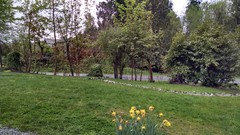
    My thought right now is to leave both trees and trim the lower branches of cedar to expose some more of the madrone trunk. See how I like that and what it does for them. Those are the only 2 trees worth anything in that area of yard. I have 8 maples and cherries to cut down,clear stumps and plant cornus kousas first. OR any other tree recommendations for the area in this picture,its right of madrone and cedar. 40 feet from house.

  • 11 years ago

    Gardengal, I know lotsa trees are messy, but large stiff leaves in June? The rest of the messes that Madrone produces can easily be swallowed by your average groundcover, but not those leaves.

    They do grow side by side, but eventually one will preside over the other depending on site conditions. Chuck, leave them as they are then, and make choices further down the line.

    Forty feet from the house should be enough space to not get many Madrone leaves in your gutters. They are nice trees when growing good and take to pruning surprisingly well. I know of one that has been kept at shrub size for many years. I wish I had thought of that when I had one.

    They make good firewwood. Real dense. A little hard to split where it's gnarly though.

    Mike


  • 11 years ago

    Yeah Chuck, that should be good. And while many of us do prefer not raising up our conifers, when done judiciously-and especially where there's another plant to look at in the void-a bit of branch removal will be fine. It may-well beat the alternative-total tree removal. Any room anywhere in there for a hemlock? One or the other of your two native types might compliment this setting. Also gened-up to be forest giants, but there, may be some low-growing cultivar that would be just the thing.

    +oM

  • 11 years ago
    last modified: 11 years ago

    Kousa is broad-growing and, like other flowering dogwoods cannot be lopped back to fit into a too narrow space without spoiling it. One that was planted apparently as a foundation shrub in a Seattle park was over 48' across about 10 years ago. This may be yet another situation where various kinds of shrubs are what need to be looked at instead of trees.

    The three existing trees in the one view look like they are jostling for space in a line for coveted concert or sports tickets. Either all need to be taken out or one needs to be chosen to remain, on its own without another tree being so close. Ruining the shape of the cedar by cutting part of it off, leaving the madrone and the cedar still standing there, elbowing each other is not the answer.

    As it is now only the cedar has any kind of presence, provides any screening, the other two being sparse sticks. It is not the one to be cutting on.

  • 11 years ago

    I agree, plus the Cedar will give the most privacy.............. and it's all year long. The branches will droop all the way to the ground and fill in. No sense in having much interfere with it.

    Mike

  • 11 years ago

    I think that I will let the cedar and madrone winter over and decide in spring when I plant new trees and shrubs. The info on how broad a cornus kousa can be is very helpfull Embothrium. Gardengal and Mike , and everyone else,thank you. BTW Mike, I have oogled your photos and you have done what I am envisioning. Very nice!......goshdarn landscaping itch!

Sponsored
AIS Renovations
Average rating: 4.5 out of 5 stars15 Reviews
Custom Craftsmanship & Construction Solutions in Franklin County, Ohio