Software
Houzz Logo Print
gixet07

Gnats

11 years ago

Hello Everybody,

I was wondering if anyone had any concoctions or tricks to fight off those pesky little gnats? I've tried mixing Ivory soap in water and using it to water them with it. I haven't tried it recently, but not sure how effective that is. I also read some mixture in a book about using garlic oil and dish soap and spraying it on the plants. Have been trying this of late, but hasn't been terribly effective it seems. I have a lot of plants in my room and these gnats are annoying.


Would appreciate any ideas or mixtures, homemade or purchased, that could help. Thanks

Comments (30)

  • 11 years ago

    I've used BT (Bacillus thuringiensis) before with good success. It's a cultured bacteria from the store that you add when watering. It kills the larvae. Can buy a bottle for fairly cheap with the other insecticides in the store.

    Personally, I prefer commercial products as they are designed for a specific purpose and rarely contain extra ingredients that could leave harmful residues/cause other issues. Of course, may growers swear by their home-brew methods. =)

    If you want to quickly gain control over the adult fliers, try carefully vacuuming them up (so you don't suck up your plant or soil). They move fairly slowly it works, as odd as it sounds.

  • 11 years ago

    I would very much consider using mixes that don't harbor them at all..I use to have them and now not a one in the nodders of plants I own unless one has been sitting in a mix that holds water for too long that I have been lazy to repot..

    They have a product my 'Bayer' that works wonders...Also too, I have use Soapy Water with Neem in it in the past and that use to work.)

  • 11 years ago

    I used to have this problem until I switched to faster draining soil mixes with less peat and organic materials that gnats love to feast on. Sure, you must water more often, but I can say that my bug problems have been reduced dramatically after the switch.

    My garden center recommended a powder product by Bonide that you sprinkle and mix into the soil before watering, but since I switched my soil I have not had to use it. The label says it protects from mealy bugs and aphids also. I can't vouch for its effectiveness, but they said they used it on their own plants.

  • 11 years ago

    Mike - I've had fungus gnats indoors in gritty mix even covered with 1/2" layer of white grit top dressing. Similarly, in pure perlite with grit as well. Not sure what crazy gnats we have here in Canada, but they are resilient!!

    Just adding a fan to try to lower humidity helps control them a little, but I have seen them live happily for two weeks with a fan blowing right beside them.

    Imidacloprid/Bayer requires a commercial pesticide licence to buy in Canada due to its implications on pollinators (I realize that OP is from NY). You won't find it in any stores.

    Honestly, fungus gnats are such a minor nuisance that I think systemics is far overkill. There are so many other highly effective solutions/pesticides with far less environmental impact for this little insect.

    Just my opinion!

  • 11 years ago

    Buy
    a package of "Mosquito dunks" at the garden center. Put one
    quarter of one in your watering can. This will kill the larvae in the
    soil and stop future generations. It is all natural and safe. Use
    sticky traps and manually kill the adults.

    Alex (NY_7b) thanked tommyr_gw Zone 6
  • 11 years ago

    Wow, never heard of gnats in gritty mix. Y'all must have mutant bugs up there. Conversely, the Deep South (FL, AL, GA, etc.) has "palmetto bugs" the size of trucks, so I don't know what's worse. : )

  • 11 years ago

    Never a gnat here in gritty mix and extremely rare in a well-made 5:1:1.

    Alex - please don't use any detergents (Ivory dish soap contains detergents + other phytotoxic chemicals) on your plants. Dishsoap/ detergent’s effect on plants varies with the mode of exposure.
    If the top of the plant is sprayed thoroughly with even mild detergent solutions
    such that all surfaces including leaves are covered, the detergent can easily
    dissolve the protective coating of cuticular wax on the leaves of the plant,
    causing abnormally high rates of water loss and possible necrosis of all or
    part of the leaves. Cuticular waxes prevent leaves from drying out, and help stop
    pathogens from attacking the leaf. Stronger solutions will even dissolve cell
    membranes, causing death of the cells.

    If a detergent solution is used as a soil drench or makes its way into
    the soil as a consequence of overspray or run-off, the effect on roots is
    immediate. Because one of the main function of roots is to absorb water and
    nutrients dissolved in water, they lack the waxy protective coating that leaves
    employ. Detergent solution in contact with root cells can
    quickly dissolve the lipid membrane surrounding cells, killing the cells
    and inhibiting water/ nutrient uptake. Hair cells growing as appendages of
    larger roots do the lion’s share of assimilating water and nutrients, and these
    very delicate cells would be the first casualty of any detergent in the root
    zone.


    You can almost always control gnats by allowing even extremely water-retentive soils to dry down to a level that's healthy for plants, so better regulation of watering habits is step 1. Make sure you're keeping the soil surface tidy, too. Fallen leaves and any other vegetation that breaks down quickly touches off a feeding frenzy followed by population booms, as long as there are gnats to breed.

    Al

    Alex (NY_7b) thanked tapla (mid-Michigan, USDA z5b-6a)
  • 11 years ago

    Jentsu - I'll happily take our mutant bugs up here than your truck-sized cockroaches! o_O

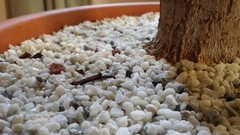
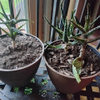
    I know everybody says that you don't get gnats with gritty, but it is possible! I admit that this pot was not sifted that well, but I never imagined they could stick around for weeks with a full 1/2" layer of grit as a top dressing:

    This happened for two large pots with trees in lower light in my living room, as well as two small pots in my loft under moderate light. All four with very minimal organics in their mix.

    For the most part, I think it's only really possible in lower light and cooler temperatures. Otherwise it's a non-issue.

    Al - Absolutely agree with your explanation on why detergents aren't a good idea. There is way too much misinformation floating around! It's an important point that what's safe/good/normal for humans may not be the same for plants.

  • 11 years ago

    I refrained from contending it wasn't possible to get gnats in gritty in large part because you've earned a lot of credibility via what/how you post (so I simply believe you), but also because I know that saying 'it's not possible' would obviously do my own credibility no good. I've never had them indoors, but that doesn't mean it follows that no one could .... or does. You're one of those who understands how you couch your remarks determines how they will be taken, and how you qualify your offerings often determines their value. I just wanted to take a sec to bring that to the attention of others who might not have noticed, otherwise.

    Misinformation - rampant on the container forum lately and apparently coming to a forum near you, soon. All intentional.

    The detergent thing comes up so often I have a file I can copy paste to the threads whenever the issue is raised. About a year ago I had dinner with a past pres of the MI Nurseryman's Assn. One of the things I so clearly remember him saying is, "Al, you know, we don't do ANYTHING [his emphasis} the way we did 30 years ago". Technology and information is evolving so fast that we'd all be better for opening our minds to the idea that the growing habits and myths we've embraced for the last 30 years could use some review. I can look at the last 30 years of my own experience and see that 30 years of doing the same things I did 30 years ago wouldn't have offered much in the way of an education or an increase in the rewards I get from the growing experience.

    As I scroll up the thread, I see several names of growers who regularly and actively seek information and knowledge. They're the ones on a fast track to a green thumb, and they'll arrive long before those with 30 years experience doing the same thing; this, because they can use their experience to validate what they already know, then move on to learn other things that further enhance the growing experience.

    Al

  • 11 years ago

    Thank you everybody for your advice. I use two types of soil, both of the Miracle-Gro brand, one for Cacti and the other being the Moisture Control variety. I was informed in another post of mine that I should probably move on to better soil. For the time being, however, this is what I have until I can re-pot again. I was advised not to repot during this time of year, so I'm holding off on replacing all my soil. That's going to be a huge project in and of itself! It's not terribly cold here in NY just yet though, so I wonder if it would still be as detrimental? When it does come time to repotting, is there a general consensus as to the soil type to use?

    Now, as for the rest of advice. Thank you, Al, I'll cease using any soap products to water my plants. I didn't realize it was so harmful! Maybe I'll look into those Mosquito Dunks. Would you guys recommend using Mosquito Dunks in addition to Mosquito Bits?

    I think these gnats are definitely due to this Home Depot soil, unfortunately. I don't really overwater my plants either, so I don't think it's necessarily due to poor watering habits. I recently bought 2 bags of perlite, but also due to the above and not being able to repot, I'm stuck just hanging onto it until next spring or whenever it'll be safe to repot. Gnats are a minor nuisance, but my main concern is solely the health of my plants, of course.

  • 11 years ago

    Mosquito dunks and bit are most likely the same things so just get one or the other. I use the dunks.

  • 11 years ago
    last modified: 11 years ago

    Alex, reading some of the posts, here and elsewhere, I want to share This Narrative.

    I once was in a discussion and remarked that a particular individual had "ten years experience". My mentor's retort was a short and crisp lesson in management. "No! He has had one year's experience - ten times!"

    And just to be even-handed, "Variety may be the spice of life; but routine is the bread and butter".

  • 11 years ago

    Thank you, everybody, for all your advice and input. I greatly appreciate your assistance.

  • 11 years ago

    Rina - I've never seen them here either in Canada, but Mosquito Bits and Dunks both are the same thing. They both use Bacillus thuringiensis (BT) to kill the larvae:

    https://www.americanpest.net/docs/msds/mosquito-bits-label.pdf

    You can buy the same stuff in liquid form at Home Depot, called Safer's BTK for $11. It's kind of goopy, presumably because of the nutrient medium necessary to keep the bacteria alive.

  • 11 years ago

    I admit that at times I use soap for aphids and similar pests for some of my plants. To be safer I use Seventh Gen plant based soap at 2tsp/gallon. To be avoid getting it into the soil I wrap the pot in a plastic bag, tilt it and then spray the leaves. In 5 minutes I spray it with clean water. I would do this for heavy infestation which happens once in a while during winter months and due to neglect on my part. Once in a while, I would see leaf damage on some plants especially on younger leaves as Al described. For regular maintenance, I just plain water sprays. I also use horticultural oil sprays sometimes. They contain some sort of soap for emulsifying the oil.

    Good info using BT for gnats. Never thought of it although I rarely have any gnat problems. I use those dunks in my small pond during the summer.

  • 11 years ago
    last modified: 11 years ago

    mayo

    I understand they are the same, and have used liquid too (was less than $11...), but like idea of just sprinkling it...using a shaker :)

    Rina

  • 11 years ago

    I went ahead and bought a pack of mosquito dunks and mosquito bits. I see how you're supposed to use the bits. Sprinkle it until it covers the soil per pot and then water. Now, my question is, how exactly am I supposed to use the dunks? Keep in mind my intended purpose for these are indoor pots. I see a lot of inhalation warnings on these. Is there actual dangers with using this? Would using this in a room not be the greatest idea?

    Anyway, back to my original question. Do I simply mix a little bit of the dunks powder in my watering can and water my plants with it? If so, about how much would I be using? I bought both because it seemed like they worked best in conjunction. Hopefully that was correct.

  • 11 years ago

    I break off a small piece and put it in my watering can. About an 1/8 to 1/4 of a dunk.

    Alex (NY_7b) thanked tommyr_gw Zone 6
  • 11 years ago

    Is there any actual danger using both of these for a lot of pots in one room? Will there be any inhalation danger once it has seeped into the soil


  • 11 years ago

    If you are just watering, I think mosquito bits alone are fine. Dunks are intended as 30-day time release when left sitting in water. So unless you are putting pieces of dunks in/on your pots I don't know if there is a real advantage.

    Avoid inhaling the dust, just as you would for perlite. Once you add it to water, any dust concerns shouldn't be a problem:

    http://www.summitchemical.com/wp-content/uploads/2010/05/117-6.pdf

    Alex (NY_7b) thanked ewwmayo
  • 11 years ago

    Maybe I should return these dunks if the bits alone are sufficient, huh? Is it true that I should also buy the sticky tape to capture adult gnats in the air as the bits will only target larvae? Or will this eventually do the trick as it kills off where they start. I read that gnats only have a 7-day life span as is.

  • 11 years ago
    last modified: 11 years ago

    Yes, the mosquito dunks only attack the larvae in the soil not the adults.

    Sticky traps work really well with fungus gnats. I'd use them just to get rid of the last remaining adults making sure none somehow survive or breed somewhere that wasn't treated with the dunks. And they're really annoying so it will help eliminate them faster which is always a welcome thing.

    Always good to attack them at all angles

  • 11 years ago

    We ran a research project for a year in our university greenhouse and had to deal with these. Drying out the flats wasn't an option, and we had a few hundred... Anyways, since we couldn't use anything chemical, we kept them under control with dishes of apple cider vinegar to trap the adults and chunks of raw potato, cut side down on the substrate. The wormy larvae go nuts for the potato, and it is gross but effective... Just toss the potato hunk every day. We also dusted with diatamaceous earth on occasion. Not a total fix, but kept them in check. For houseplants, drying out between waterings and whatnot is best, but just wanted to add a few more suggestions to your arsenal if its useful for you. Good luck!

    Alex (NY_7b) thanked Kim
  • 11 years ago

    Just an FYI, BT is all natural and extremely safe to use.

  • 11 years ago

    I was worried, because the label indicates warnings about having it come in contact with your skin, inhalation, etc. I know that things like perlite shouldn't be inhaled either, but the whole "do not allow it to touch your skin" sounded scary, I suppose. I was trying to be as cautious as possible when applying it to my plants yesterday for this reason. I have a lot of plants in my room, so was just worried about a confined space with all the bits in one room causing possible inhalation issues. Perhaps I'm over-worrying, though, huh?

  • 11 years ago
    last modified: 11 years ago

    I use the bits often ... a spoonful or two sprinkled in each pot. My orchids have bark, so they tend to work their way down into the mix. It does take about two weeks or so to get all the cycles of the gnats, but refreshing the bits a couple of times a year will keep all gnats at bay.


    Edited to address your concerns: I have about 30 pots of varying size in my office, and all contain at least one spoonful of bits. Though you can smell that weird sweetness in the container, it quickly fades once in the plant. I don't think it poses much risk. I wash my hands thoroughly after dispensing, and have suffered no (known) ill effects!

  • 11 years ago

    Fungus gnats are quite the rarity for me. My carnivorous plants pretty much wiped them out long ago. Pity, in a way, means that over the winter the plants must forego their "snacks".

  • 11 years ago

    I didn't have fungus gnats until a couple weeks ago when I brought my plants inside for the winter. That's never happened before. ???

  • 11 years ago
    last modified: 11 years ago

    Paul, get yourself a Hoya multiflora, gorgeous and like obscene amounts of water. And by that I mean daily waterings, almost guaranteed to boost your fungus gnat populations. I am either going to switch mine to a vase with semi hydro that some growers use, or get a cape sundew to park next to it. ;-)